

Refreshed and republished:

The most useful content marketing tips for lawyers start before writing: choose a real client question, check whether your website already answers it, and assign someone to verify the finished page. These seven decisions turn a topic idea into a useful article, a reviewable distribution plan and a measurement record.
Useful legal content answers one client question, supports its claims, explains a practical next step, and gives the law firm a way to check its value.
1. Choose one client decision, not a broad topic
“Estate planning” names a practice area. “What information should I have ready before asking this firm about an estate-planning consultation?” names a decision and a next step. Start with questions your intake team actually receives, using an approved summary with private details removed. Confirm that the question fits the firm’s services, jurisdiction and intended audience.
Write a one-sentence assignment: After reading this page, this reader should be able to do this specific thing. A prospective client may need to prepare for a first conversation; a business referral partner may need to understand the firm’s scope. They do not necessarily need the same article. Place that assignment within your broader law firm SEO strategy.
Use legal keyword research to learn the language people use and inspect the pages returned for it. Search volume alone does not establish relevance. A popular question outside the firm’s work should not become an article simply to fill a calendar. Keep a short “not for this audience” note so the idea does not keep returning.
2. Decide whether to create, refresh, extend or hold
Search your own site before commissioning another page. Compare the reader’s question and intended next step, not just the exact keyword. Several phrases can belong in one useful answer. Similar subject matter alone is not proof that two pages should be merged or redirected.
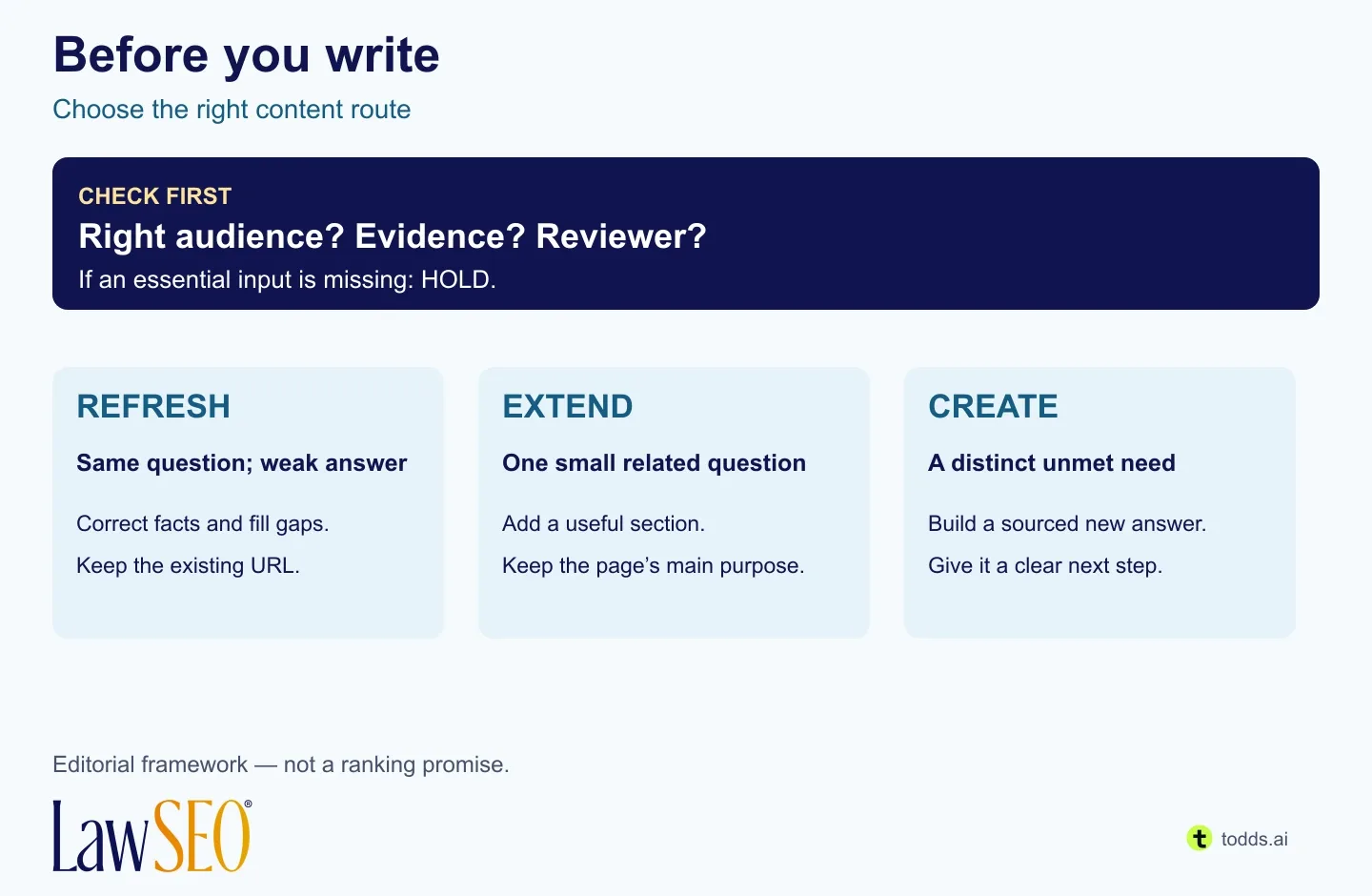
| What you find | Recommended route | Evidence to keep |
|---|---|---|
| Wrong audience, unsupported claim or no suitable reviewer | Hold the affected idea or claim. | The missing input and the person who can resolve it. |
| An existing page answers the same question but is inaccurate or incomplete | Refresh that page. | Current URL, dated baseline and specific corrections. |
| A useful page needs one closely related explanation | Extend it with a section. | Proposed section and why it belongs there. |
| A distinct reader need has no adequate page | Create a page. | Audience, sources, unique contribution and next step. |
A real refresh decision: the previous version of this LawSEO article opened with an unsupported percentage about law firms struggling to stand out. Its FAQ also ended one answer with an unfinished “Topics like.” The reader still needed practical content guidance, so the route was to refresh this URL, remove the unsupported statistic and complete the answer—not create a second tips page.
Our SEO tools comparison answers a different question: which tool helps with a particular task. For that page, we recommend a link to this content workflow rather than adding another full seven-tip guide inside the tool article. These examples demonstrate editorial routing; they do not establish a traffic effect.
3. Build the evidence brief before writing claims
For each important claim, record its source, applicable location or scope, checked date and reviewer. A legal statement needs the relevant current authority and a qualified review path. A firm-specific statement about fees, experience, awards or outcomes needs evidence supplied or confirmed by the firm. Remove a claim that cannot be supported; do not soften it with a vague “research shows.”
The ABA’s Model Rule 7.1 addresses misleading communications about legal services, including material omissions. It is a model, not a substitute for the rules adopted in the firm’s jurisdiction. Have the responsible attorney assess the actual wording and qualifications. Our ethical SEO checks can help organize that review.
Model Rule 1.6 addresses information relating to a representation and its permitted disclosure. Removing a client’s name does not by itself establish that a story may be published. Use an explicitly hypothetical example when no appropriate real example is authorized, and label it. Keep private case facts out of shared drafting tools unless their use has been specifically authorized through the firm’s process.
AI may help structure a draft, but a generated citation is not evidence that the cited material supports the sentence. Open the source, check the passage and verify that qualifications survived the rewrite. Do not add an attorney reviewer’s name until that person actually reviewed the version being released.

4. Make the answer easier to use, including the images
Give the reader something they can apply: a comparison, a preparation checklist, a decision map or a clearly scoped worked example. Explain the assumptions and exceptions beside it. A longer article is not automatically a more useful article; Google’s people-first content guidance specifically rejects the idea of a preferred word count.
Give each image a job. A branded cover identifies the article. A diagram should explain a choice or sequence that prose alone makes harder to follow. For a consultation-preparation article, an illustrated checklist could separate information to have available from material the firm has not requested. Label it as a general example and let the firm confirm its own process.
- Check the source and rights. Keep permission for photography, logos and data. Do not present a generated scene as an actual client, office or completed matter.
- Check what the pixels say. Proofread labels, amounts and arrows; ensure the diagram reflects the article’s conditions.
- Test the smallest view. Inspect the phone layout and blog-card crop. Keep essential text out of a crop-prone edge.
- Provide a text equivalent. Use descriptive alt text and explain a complex chart or decision tree in nearby HTML. Do not make readers decode a tiny image to get the answer.
Useful structure also helps people skim: a direct answer, descriptive headings and clear source links. Do not buy a special “AI schema” requirement on faith. Google’s guidance for AI Overviews and AI Mode says no additional requirements or special schema are needed for those features. Eligibility still does not guarantee appearance.
5. Link the answer to a clear next step
Choose the next step that fits the reader’s situation. A beginner may need a related explanation; someone checking the firm’s services may need a practice page or contact route. Link at the point where the next question arises, using descriptive words rather than a string of “click here” links.
Before release, test the destination on a phone: can a visitor read the page, use its navigation and find the intended contact option? Test a form through the firm’s approved procedure using non-sensitive test data. Check both success and failure states. A button that looks correct in an editor is not proof that an inquiry reaches the right person.
Choose SEO and measurement tools by the task your team needs to perform. An extra dashboard will not repair an unclear service description or an untested form. Record the original URL and publication history during a refresh; a meaningful revision can have a genuine update date without pretending the page is newly published.
6. Approve each channel version before distribution
One article can support a short professional discussion, a visual explanation or a business-profile update. Select the format and audience before writing the adaptation. Each version should preserve the source’s factual limitations and offer a useful reason to open the full article.
Use a simple review record: exact text, final image file, descriptive alt where supported, link, destination account and approval. If a material change is made after approval, return the changed version for review. Confirm the correct account and check for an existing post before submitting. An article approval is not automatically an approval of every caption, crop or destination.
Assign a realistic cadence based on who can research, review and maintain the work. Keep separate dates for the article and its distribution. After submission, keep the returned link or receipt and verify the destination. A pending post is a status to investigate, not an invitation to submit it again. The same evidence and claim checks apply to a short caption as to a long article.
7. Measure the next decision and maintain the page
Write down the question you want the report to answer before launch. Search Console reports search clicks and impressions. GA4 events describe configured interactions; important ones may be designated as key events. Neither automatically confirms a unique, qualified inquiry or retained matter.
Keep search visibility, tested website actions and separately verified intake outcomes in different columns. A repeated form event may describe the same inquiry; deduplicate received inquiries in intake before reporting an outcome. Compare like periods and filters, annotate content changes and record tracking gaps. If attribution is unknown, label it unknown. A small sample or several simultaneous changes cannot establish that one article caused a result.
Do not send names, email addresses or case narratives to Analytics. Check page addresses and event parameters against Google’s PII guidance, and have the responsible reviewer assess the actual tracking setup. For a practical starting point, use the evidence levels in our SEO tools guide.
Give each article an owner and a review trigger: a relevant authority changes, the firm changes its services, a link breaks or readers repeatedly ask a question the page does not answer. Also set a review date suited to the topic’s risk and change rate. Fix the substance when needed; merely changing the displayed date does not make content current.
Copy this one-page content brief
Fill this out for one proposed page or refresh. Use summaries without personal or case details. A blank source or reviewer field means the affected claim is not ready to release.
- Reader and decision
- Who is this for, and what should they be able to do after reading?
- Route and existing URL
- Create / refresh / extend / hold. What existing answer did you inspect?
- Evidence and review owner
- Sources, scope, checked dates, firm confirmations and responsible reviewer.
- Original contribution
- The example, checklist, comparison or decision aid readers can actually use.
- Image and text equivalent
- What the visual explains, its rights/provenance, alt text and phone/crop checks.
- Next step and distribution
- Destination link, tested action, exact channel versions and separate approvals.
- Measurement and maintenance
- Baseline, metric definition, known gaps, owner, review date and change trigger.
A short worked brief
Hypothetical firm, not a client result: a firm wants to explain how to prepare for an initial consultation. It finds a service page that describes its work but does not answer the preparation question. The editor proposes a distinct preparation guide, subject to checking the rest of the site. The firm confirms the process, the writer uses a generic checklist, and the reviewer checks the exact page and image.
The next step links to the firm’s verified contact route. The measurement plan separates tested form completions from inquiries actually received. A social caption is drafted and approved separately. If the firm already has a sufficient preparation section, the route changes to extend or refresh that section instead. If the process or reviewer cannot be confirmed, the draft stays on hold.
Questions about law firm content
How often should a law firm publish?
Choose a schedule the team can sustain through sourcing, review, production and maintenance. One useful, verified page can be a better editorial investment than several unfinished answers. There is no universal posting frequency that guarantees rankings.
Should every keyword get a separate article?
No. Group phrases when they express the same reader need. Create a separate page when it has a distinct purpose and enough useful material to stand on its own. Review existing pages before adding another URL.
Can we use AI for law firm content?
It can assist drafting and organization, but people still need to verify sources, legal qualifications, firm facts, image provenance and the finished output. Do not claim human expertise or review that did not occur.
