


TL;DR:
- Generative AI creates original content by sampling learned patterns rather than retrieving answers. Law firms must supervise, verify, and document all AI-produced legal marketing material to ensure compliance and accuracy. Building a review process before publishing helps firms benefit from AI’s efficiency while managing legal and ethical risks.
Generative AI content is defined as original material produced by AI models that learn statistical patterns from large training datasets and generate new text, images, or code on demand. Legal professionals now face a direct question about what is generative AI content and how it fits within their ethical obligations. The global generative AI market was valued at $22.21 billion in 2025 and is projected to reach $324.68 billion by 2033. That growth signals a technology that is reshaping how law firms attract and engage clients. ABA Formal Opinion 512 and Model Rule 7.1 already govern how attorneys must handle AI-produced work, making compliance knowledge non-negotiable from day one.
What is generative AI content and how does it work for legal marketing?
Generative AI models produce novel outputs by sampling learned statistical distributions rather than retrieving stored answers. This distinguishes them from search engines or classification systems that simply match queries to existing records. A transformer model, the architecture behind tools like GPT-4, reads billions of words, learns relationships between them, and then predicts the most contextually appropriate next word or phrase. The result is original text that did not exist before the model generated it.
For legal marketing, this means an AI model can draft a practice area page, a client FAQ, or a blog post explaining a recent court ruling. The model does not look up a pre-written answer. It constructs one from patterns learned during training. That distinction matters because the output can be fluent and authoritative in tone while still being factually wrong.
- Transformer architecture: Processes entire sequences of text simultaneously, capturing long-range context that earlier models missed.
- Probabilistic output: Every word the model produces is a weighted guess based on training data, not a verified fact.
- Multimodal capability: Modern generative AI models produce text, images, and structured data from a single prompt.
- Fine-tuning: A base model can be trained further on legal documents to improve accuracy for jurisdiction-specific content.
Pro Tip: Always specify the jurisdiction, practice area, and intended audience in your AI prompt. Precise inputs reduce the probability of generic or inaccurate legal claims in the output.
What are the benefits and risks of generative AI content in legal marketing?

Generative AI content creation delivers real efficiency gains for law firms. A practice area page that once required three hours of attorney drafting time can reach a first draft in minutes. That speed frees attorneys to focus on client work while keeping the content pipeline active. AI also supports SEO and client engagement by producing topic clusters, FAQ pages, and location-specific landing pages at a scale that manual writing cannot match.
The risks are equally concrete. Generative AI models can hallucinate fabricated statutes, non-existent case citations, and invented regulatory standards. A published page containing a false legal claim exposes the firm to bar complaints, malpractice risk, and reputational damage. Search engines compound the problem by applying Google’s E-E-A-T framework, which evaluates Experience, Expertise, Authoritativeness, and Trustworthiness, with particular scrutiny on legal content.
“Legal marketing content generated by generic AI without attorney review often fails search engines’ E-E-A-T requirements, damaging trust and rankings. The solution is not to avoid AI. The solution is to build attorney review into every publication step.”
The benefits and risks break down as follows:
Benefits:
- Faster content production across practice areas and geographic markets
- Consistent brand voice when prompts are templated and supervised
- Scalable SEO content that targets long-tail legal queries
Risks:
- Hallucinated legal references that mislead prospective clients
- Ethical violations under Model Rule 7.1 if content is false or misleading
- E-E-A-T failures that suppress search rankings for AI-only content
The AI-generated content spectrum ranges from fully AI-created drafts to human-created content with AI assistance. Law firms that treat AI as a drafting collaborator rather than a final author consistently produce more accurate and compliant material.
What compliance measures should legal professionals follow with generative AI?
ABA Formal Opinion 512 mandates that lawyers using generative AI must demonstrate technology competence, protect client confidentiality, and supervise all AI-produced work as their own. That supervisory duty is not optional. An attorney who publishes AI-generated marketing content without review bears full professional responsibility for every claim in that content.
Attorney Sergei Tokmakov has noted that AI platforms function as non-lawyer assistants requiring the same level of supervision an attorney would apply to a paralegal’s work product. That framing is practically useful. You would not publish a paralegal’s draft without reading it. The same standard applies to AI output.
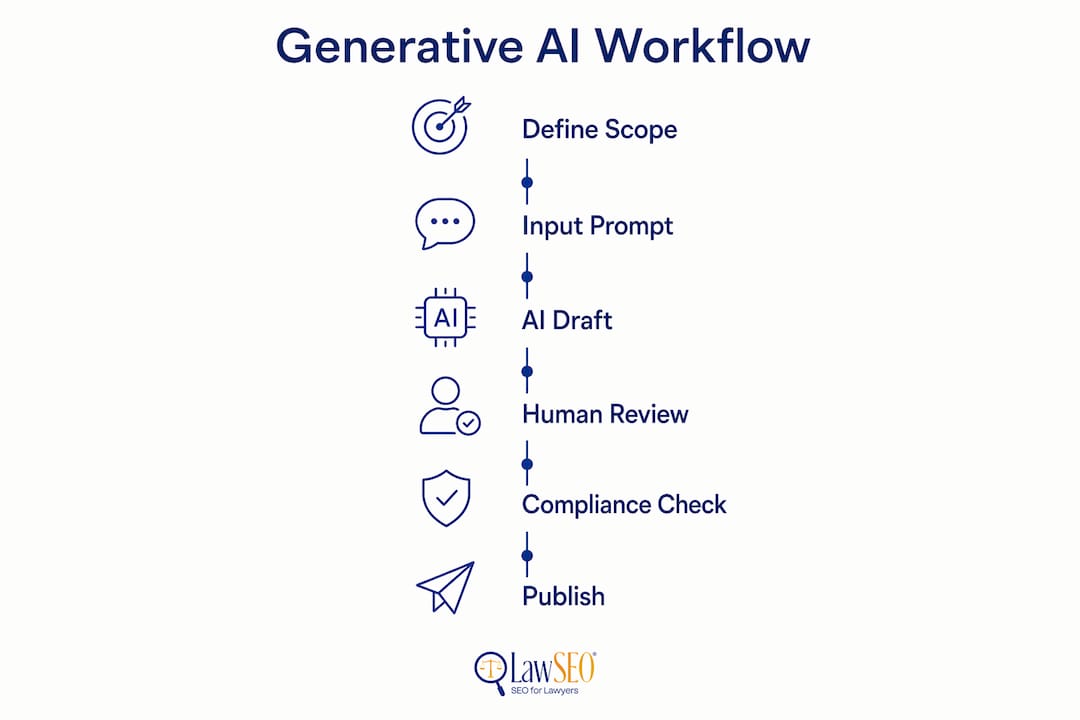
The following numbered steps form a defensible compliance workflow:
- Embed advertising rules as pre-publish gates. Law firms must embed ABA Model Rules 7.1 through 7.5 and applicable state advertising rules into the content approval process before any AI-generated page goes live.
- Require attorney review of every draft. A licensed attorney must read, verify, and approve all AI-generated content before publication. No exceptions for “low-risk” pages.
- Maintain an AI audit trail. Retain creative outputs, landing page HTML, and targeting metadata for at least two years to satisfy regulations such as California Business and Professions Code § 6159.1.
- Document the AI tools used. Record which model generated the content, the date, and the prompt. This documentation supports bar compliance reviews.
- Disclose AI involvement where required. Some state bars require disclosure when AI substantially contributes to client-facing communications. Check your jurisdiction’s current guidance before publishing.
Pro Tip: Export a monthly archive of all AI-generated content, including final text and any targeting parameters. Store it in a dedicated compliance folder with attorney sign-off timestamps. This single habit satisfies most state-level documentation mandates.
How can legal professionals apply generative AI content effectively?
The most effective application of AI in legal content creation treats the model as a first-draft collaborator, not a finished-product machine. An attorney or content specialist provides the strategic direction, the AI produces a structured draft, and a licensed attorney refines and verifies the output before publication. This workflow, sometimes called “AI-assisted human authorship,” produces content that meets both search engine quality standards and bar ethics requirements.
Practical applications for law firms include:
- Practice area pages: AI drafts the structure and general explanation; the attorney adds jurisdiction-specific statutes, case examples, and personal insight.
- Client FAQ content: AI generates common questions and plain-language answers; the attorney verifies accuracy and adds firm-specific context.
- Blog posts on recent rulings: AI summarizes a court decision from a provided source document; the attorney confirms the summary and adds strategic commentary.
- Local SEO landing pages: AI produces location-specific variations of core service pages; the attorney reviews for accuracy and the marketing team checks for compliance with local bar advertising rules.
One area that requires particular caution is AI solicitation and disclosure. Automated AI systems must not conduct live, person-to-person solicitation of prospective clients. That boundary is clear under most state bar rules, and crossing it creates serious ethical exposure.
The table below maps content types to their recommended AI involvement level and required human oversight:
| Content type | AI involvement | Required human oversight |
|---|---|---|
| Practice area pages | Draft generation | Attorney review and fact verification |
| Client FAQ pages | Question and answer drafting | Attorney accuracy check |
| Blog posts on case law | Summarization from source | Attorney confirmation and commentary |
| Local SEO landing pages | Location-specific variation | Attorney review plus bar advertising check |
| Social media posts | Caption and copy drafting | Marketing team and attorney sign-off |
For law firms building a compliant AI content strategy, the goal is not maximum automation. The goal is maximum quality with minimum compliance risk. AI accelerates the process. Attorneys protect the firm.
The compliance-first mindset is the only mindset that works
After nearly three decades working in legal SEO, I have watched law firms adopt every new marketing technology with the same pattern. They move fast, skip the compliance review, and then spend months cleaning up the damage. Generative AI is not different in that respect. The technology is genuinely powerful, and the efficiency gains are real. But the firms that benefit most are the ones that treat compliance as the foundation, not an afterthought.
The attorneys I work with who get the best results from AI content are not the ones using the most advanced tools. They are the ones who built a review process before they published a single AI-generated word. They understand that AI in legal workflows carries regulatory weight that does not apply to most other industries. A hallucinated fact in a recipe blog is embarrassing. A hallucinated statute in a legal FAQ can harm a real person who relied on it.
My recommendation is simple. Treat every AI output as a paralegal’s first draft. Read it, verify it, and sign your name to it only when you are confident it is accurate and compliant. The firms that build that habit now will have a durable advantage as AI becomes standard in legal marketing.
— TODD
How Lawseo helps law firms use generative AI content responsibly
Lawseo works exclusively with attorneys and law firms, which means every content strategy we build accounts for bar advertising rules, E-E-A-T requirements, and ABA supervisory obligations from the start. Our team produces AI-assisted content that goes through attorney-aligned review before publication, and we maintain documentation workflows that satisfy state-level audit requirements. If your firm wants to use AI to grow its online presence without creating compliance exposure, legal SEO for law firms is where that work begins. Todd R. Stager personally reviews strategy for every client campaign, bringing over 29 years of legal marketing experience to each engagement. Lawseo also offers exclusivity agreements, so your local competitors will not benefit from the same strategy we build for you.
Key takeaways
Generative AI content delivers real efficiency gains for law firms, but attorney supervision, pre-publish compliance gates, and documented audit trails are the conditions that make those gains sustainable.
| Point | Details |
|---|---|
| Define AI content correctly | Generative AI produces original outputs from statistical patterns, not retrieved answers. |
| Supervision is mandatory | ABA Formal Opinion 512 requires attorneys to treat all AI-produced content as their own work product. |
| Embed compliance before publishing | ABA Model Rules 7.1–7.5 must be built into pre-publish approval workflows, not checked after the fact. |
| Maintain a two-year audit trail | Retain AI outputs, prompts, and targeting metadata to meet state bar documentation standards. |
| Use AI as a collaborator | AI-assisted human authorship produces content that satisfies both E-E-A-T standards and ethics rules. |
FAQ
What is generative AI content in simple terms?
Generative AI content is original text, images, or other media produced by an AI model that learned patterns from large datasets. The model creates new material rather than retrieving pre-written answers.
How does generative AI work differently from a search engine?
A search engine retrieves existing documents that match a query. A generative AI model constructs a new response by sampling statistical patterns learned during training, producing output that did not previously exist.
Is AI-generated content allowed in legal marketing?
AI-generated content is allowed in legal marketing, but ABA Formal Opinion 512 requires attorney supervision, accuracy verification, and compliance with Model Rules 7.1 through 7.5 before any AI-produced material is published.
What is the biggest risk of using generative AI for law firm content?
The biggest risk is hallucination. Generative AI models can produce fabricated statutes, non-existent case citations, and false legal claims that expose the firm to bar complaints and harm prospective clients who rely on the content.
How long must law firms keep records of AI-generated content?
Law firms must retain AI-generated content records, including creative outputs and targeting metadata, for at least two years under regulations such as California Business and Professions Code § 6159.1.