


TL;DR:
- Legal directories are vital marketing tools that improve law firm visibility, credibility, and search engine rankings. Maintaining complete, regular profiles on platforms like Justia, Martindale-Hubbell, and Chambers yields better client inquiries and AI recognition than neglecting premium listings. Consistent profile management and strategic directory selection tailored to practice areas maximize long-term marketing success.
Legal directories are structured online platforms that list attorneys and law firms by practice area, location, and credentials, and they are one of the most direct ways to put your firm in front of clients who are actively searching for legal help. The importance of legal directories extends well beyond a simple name listing. Platforms like Justia, Martindale-Hubbell, Avvo, Legal 500, and Chambers serve as authoritative marketing channels that deliver backlinks, credibility signals, and client leads simultaneously. This guide breaks down how directories work, which tiers deliver real returns, and how disciplined profile management separates firms that win clients from those that simply appear in a list.
Why the importance of legal directories cannot be ignored
Legal directories function as key marketing channels for law firms, placing them where prospective clients already search and evaluate attorneys. That positioning matters because a client who finds your firm on Justia or Martindale-Hubbell is already in evaluation mode. They are not casually browsing. They are comparing credentials, reading reviews, and deciding who to call.

The SEO benefit is equally concrete. Backlinks from legal directories pass domain authority to your website, which improves your rankings in competitive practice areas. This is not a secondary benefit. For a personal injury firm competing in a major metro market, a cluster of authoritative directory backlinks can be the difference between page one and page three on Google.
Directories also influence AI-generated search results. When ChatGPT, Perplexity, or Google’s AI Overviews surface attorney recommendations, they draw from structured, authoritative sources. Legal directories are exactly that kind of source. Firms with complete, well-maintained profiles are more likely to appear in those AI-generated answers.
The value of legal directories compounds over time. Each profile you build and maintain adds a structured data point that search engines and AI systems use to verify your firm’s existence, expertise, and reputation.
Visibility, credibility, and the role of rich profiles
A bare-bones listing with only your firm name and phone number delivers minimal value. Rich profiles with detailed practice area descriptions, client reviews, photos, and interactive tools like Justia Chat convert browsers into inquiries.
- Practice area FAQs answer the questions clients type into search engines before they ever call an attorney.
- Client reviews provide social proof that your own website cannot replicate with the same credibility.
- Photos and bios humanize the firm and reduce the friction a prospective client feels before making first contact.
- Premium placement tiers on platforms like Justia put your profile above organic listings for targeted practice areas and geographies.
Justia offers a free, fully customizable profile that any attorney can claim, including Practice Area FAQs and Justia Chat. That free tier is a legitimate starting point. Premium placement is available for firms that want higher visibility within the directory itself.
Pro Tip: Claim and complete your free Justia profile before spending a dollar on premium placements anywhere. A complete free profile outperforms an incomplete paid one every time.
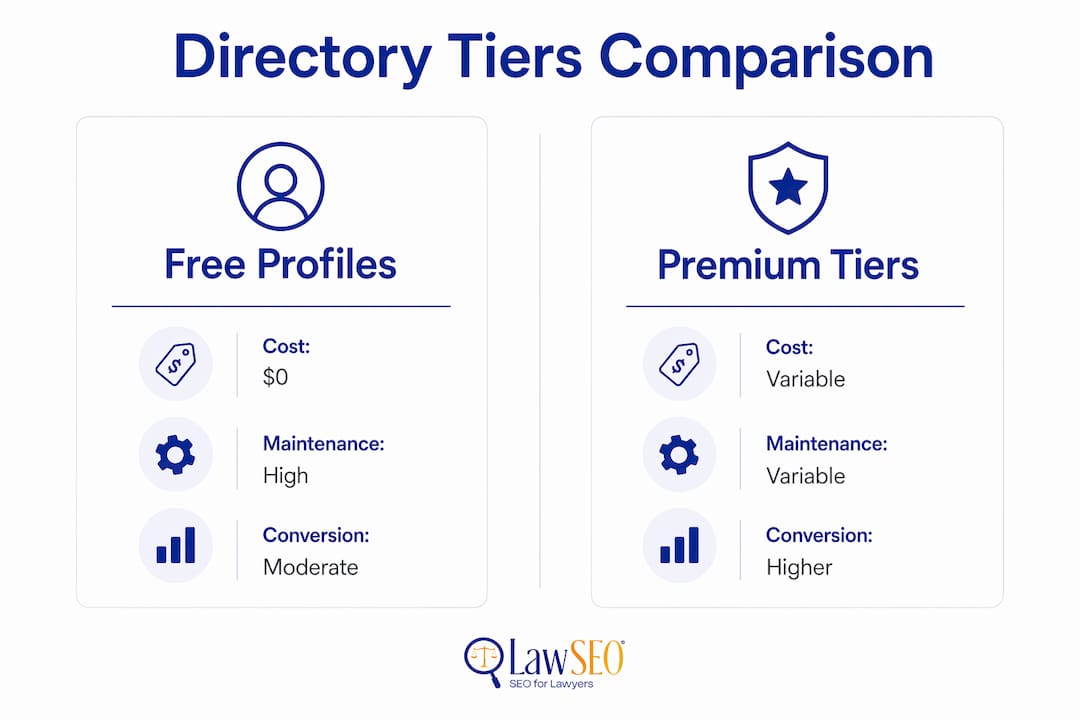
How do directory tiers compare in cost and conversion?
Not all directory tiers deliver equal returns. The relationship between what you pay and what you get depends heavily on how well you maintain the profile, not just which tier you select.
| Directory / Tier | Cost Type | Avg. Cost Per Inquiry | Conversion Rate | Key Feature |
|---|---|---|---|---|
| Justia (free) | Free | Low | Moderate | Customizable profile, FAQs, Chat |
| Martindale-Hubbell | Paid | Moderate to high | Higher with peer review | AV Preeminent rating, peer reviews |
| Avvo | Free + paid | Variable | Moderate | Client reviews, Q&A section |
| Legal 500 | Editorial | N/A (editorial) | High in corporate | Ranked by editorial research |
| Chambers | Editorial | N/A (editorial) | High in corporate | Ranked by client interviews |
Data on profile maintenance quality tells a sharper story. Well-maintained profiles show a clear cost-per-inquiry advantage. Free and basic profiles with complete, current information averaged $42 per inquiry with an 18.4% conversion rate. Premium profiles averaged $118 per inquiry with a 23.7% conversion rate. Poorly maintained premium profiles averaged $294 per inquiry with only a 14.2% conversion rate. That last number is the one that should concern you. Paying for premium placement and neglecting the profile is the worst possible outcome.
The takeaway is direct: directory ROI is more sensitive to maintenance quality than to subscription tier. A firm that invests in keeping a free Justia profile current will outperform a competitor paying for premium placement on a stale, incomplete profile.
Legal 500 and Chambers operate differently from the platforms above. They are editorial directories where rankings come from research and client interviews, not self-submitted profiles. These directories pull hardest in complex practice areas like corporate M&A, commercial litigation, banking, finance, and restructuring. In-house counsel and intermediaries use them heavily for selection decisions. If your firm serves corporate clients, a Chambers or Legal 500 ranking carries weight that no paid listing can replicate.
For consumer-facing practices like family law, personal injury, or criminal defense, platforms like Justia, Avvo, and Martindale-Hubbell deliver more direct client inquiries. Match the directory to your practice area and client type before committing budget.
Why consistent profile management drives legal directory benefits
Profile completeness at the moment of claiming is not enough. Directories reward firms that treat their listings as living marketing assets, not set-and-forget entries.
The recommended maintenance cycle follows four clear steps:
- Quarterly profile audits. Review every field: contact information, practice areas, office locations, and attorney bios. Outdated information erodes trust and wastes clicks.
- Review solicitation protocols. Ask satisfied clients to leave reviews on your directory profiles after each matter closes. Ethical and compliance frameworks govern how firms solicit and present reviews. Treat this as a regulated marketing activity, not a casual ask.
- FAQ and content updates. Add or refresh Practice Area FAQs seasonally. Search behavior shifts. The questions clients ask about estate planning in january differ from those they ask after a tax law change in march.
- Response protocols. Assign a staff member to monitor and respond to directory inquiries within one business day. Delayed responses lose leads to competitors who respond faster.
Directory ROI depends heavily on consistent maintenance discipline, including scheduled reviews, response protocols, and accountability structures. Firms that document these processes and assign ownership see measurably better results than those that treat directory management as an afterthought.
Pro Tip: Add UTM parameters to every directory profile link pointing back to your website. Combined with CRM source capture, this reveals how directories influence client decisions beyond last-click attribution, including their role in shortlist formation before a prospect ever fills out your contact form.
Measurement matters here. UTM tagging and CRM integration reveal that directories often influence client selection even when they are not the final conversion source. A prospective client may find your firm on Avvo, visit your website three times, then convert through a Google search. Without proper tracking, you would attribute that client entirely to organic search and undervalue the directory’s role.
How do legal directories fit into a law firm’s broader SEO strategy?
Legal directories are not a standalone tactic. They are one layer in a multi-channel marketing structure, and they reinforce every other layer you build.
The structured signals from directories improve rankings in both traditional Google search and AI-powered search environments. This dual function makes them more valuable in 2026 than they were five years ago. AI systems like Perplexity and Google’s AI Overviews need structured, authoritative data to generate confident recommendations. Directory profiles provide exactly that.
Here is how directories integrate with the rest of your off-page SEO strategy:
- Backlink authority. Each directory listing creates an authoritative inbound link. A cluster of these links from Justia, Martindale-Hubbell, and Avvo signals credibility to Google’s ranking algorithm.
- NAP consistency. Directories enforce consistent Name, Address, and Phone data across the web. Consistent NAP data is a foundational local SEO signal.
- Entity verification. Search engines use directory data to confirm that your firm is a real, established business. This entity verification supports your rankings across all search types.
- Client discovery. Many clients use directories as their first research step before visiting a firm’s website. Your directory profile is often the first impression you make.
- AI search inclusion. Firms with complete, well-maintained profiles on authoritative directories are more likely to appear in AI-generated attorney recommendations.
Balancing directory investment with local SEO, content marketing, and reputation management requires a clear budget allocation. Directories should not consume the majority of your marketing spend. They work best as a foundation that supports and amplifies your other channels. A firm that publishes strong content, earns local citations, and maintains complete directory profiles creates a compounding visibility effect that no single tactic can replicate alone. You can review a full law firm visibility checklist to see how directories fit within a complete 2026 marketing plan.
Key Takeaways
Legal directory ROI depends on profile maintenance quality more than subscription tier, making disciplined upkeep the single most important factor in directory performance.
| Point | Details |
|---|---|
| Maintenance beats tier | A well-maintained free profile outperforms a neglected premium listing on cost per inquiry and conversion rate. |
| Match directory to practice area | Use Justia, Avvo, and Martindale-Hubbell for consumer practices; use Chambers and Legal 500 for corporate and complex commercial work. |
| Track attribution properly | UTM tags and CRM source capture reveal directory influence beyond last-click data, including shortlist formation. |
| Directories feed AI search | Complete profiles on authoritative directories increase the likelihood of appearing in AI-generated attorney recommendations. |
| Treat listings as regulated marketing | Ethical compliance rules govern review solicitation and service descriptions; manage directories as a formal marketing channel. |
My honest take on where most law firms go wrong with directories
After nearly three decades working in legal SEO, I have watched firms make the same mistake repeatedly. They pay for premium placement on three or four directories, neglect the profiles for six months, and then conclude that directories do not work. The data says otherwise. The problem is not the directory. The problem is the discipline.
The firms that win with directories treat each profile the way they treat a client file. They assign ownership, set review dates, and document protocols. They also think carefully about which directories align with their actual practice areas and client types. A boutique securities litigation firm does not need a polished Avvo profile nearly as much as it needs a Chambers ranking. A family law practice in suburban Atlanta needs the opposite.
The other mistake I see is ignoring the compliance dimension. Directory listings are regulated marketing channels, not just SEO backlinks. How you solicit reviews, what you claim in your service descriptions, and how you present credentials all carry ethical obligations. Firms that treat directories casually expose themselves to bar complaints that no backlink is worth.
My recommendation is straightforward. Start with a complete, free Justia profile. Add Martindale-Hubbell if your practice area benefits from peer credentialing. Pursue Chambers or Legal 500 if you serve corporate clients. Then build a quarterly maintenance calendar and stick to it. The compounding effect of a well-maintained directory presence, combined with strong local SEO and content, is one of the most durable visibility advantages a law firm can build.
— TODD
How Lawseo helps law firms get more from their directory presence
Lawseo works exclusively with attorneys and law firms, which means every strategy we build accounts for the ethical constraints, competitive dynamics, and client acquisition patterns specific to legal practice. Our law firm SEO services include directory profile optimization as part of a broader off-page authority strategy, not as an isolated tactic. We handle profile audits, NAP consistency, backlink analysis, and UTM tracking setup so your firm knows exactly which directories are driving inquiries and which need attention. We also build AI search optimization into every campaign, so your profiles and content appear in the AI-generated answers that are becoming the new front door for client acquisition. If you want a clear picture of where your firm stands today, an SEO audit for attorneys is the right starting point.
FAQ
What is the primary benefit of legal directory listings?
Legal directories increase law firm visibility in both traditional search results and AI-generated recommendations while providing authoritative backlinks that improve website rankings. They also serve as client evaluation platforms where prospective clients compare credentials, reviews, and practice area expertise.
Are free directory profiles worth the effort?
Free profiles on platforms like Justia deliver strong returns when fully completed and regularly maintained. Data shows that well-maintained free profiles average $42 per inquiry with an 18.4% conversion rate, which outperforms neglected premium profiles on both cost and conversion.
How often should a law firm update its directory profiles?
Quarterly audits are the recommended standard. Each review should cover contact information, practice area descriptions, attorney bios, and FAQ content to keep profiles current and aligned with how prospective clients are searching.
Do legal directories influence AI search results?
Yes. AI platforms like Perplexity and Google’s AI Overviews draw from structured, authoritative sources when generating attorney recommendations. Complete profiles on established directories like Justia and Martindale-Hubbell increase the likelihood of appearing in those AI-generated answers.
Which directories matter most for corporate law practices?
Chambers and Legal 500 carry the most weight for corporate M&A, commercial litigation, banking, and restructuring practices. In-house counsel and intermediaries rely on these editorial directories for selection decisions in complex, high-value matters.