

Many attorneys believe simply listing their firm across dozens of legal directories guarantees top search rankings. That’s a myth. Firms with inconsistent or outdated directory data lose up to 30% of potential visibility despite high listing counts. Quality, accuracy, and AI compatibility matter more than quantity. This guide reveals how to optimize legal directories strategically in 2026, improving both traditional search rankings and AI-driven discovery to attract more clients.
Table of Contents
- Understanding Legal Directory Optimization
- Role of Legal Directories in Search Visibility
- AI Search Impact on Legal Directory Optimization
- Choosing Directories to Optimize
- Best Practices for Directory Optimization
- Common Misconceptions in Legal Directory Optimization
- Timing and Results Expectations
- Relationship with Local SEO and Google Business Profile
- Boost Your Law Firm’s Visibility with Expert SEO Services
- Frequently Asked Questions
Key Takeaways
| Point | Details |
|---|---|
| Quality Over Quantity | Accurate, consistent directory data outperforms numerous poorly maintained listings. |
| AI Search Integration | AI platforms cite directories in 16% of legal queries, requiring structured data optimization. |
| Ongoing Management | Directory optimization demands continuous updates, not one-time setup. |
| Local SEO Synergy | Directories complement Google Business Profiles to dominate local search results. |
| Measurable Timeline | Expect visibility gains within 6-12 months with sustained effort and monitoring. |
Understanding Legal Directory Optimization
Legal directory optimization enhances online visibility, credibility, and client acquisition by leveraging strategic listing management tailored to legal marketing’s unique challenges. It involves managing and enhancing law firm profiles in specialized directories like Avvo, FindLaw, Justia, and Lawyers.com. Unlike general SEO, directory optimization navigates strict ethical guidelines governing attorney advertising and addresses competitive differentiators specific to legal services.
Three pillars form the foundation of effective directory optimization:
- Data Accuracy & Consistency: Uniform NAP (name, address, phone) information across all platforms prevents search engine confusion and ranking penalties.
- Content & Profile Quality: Keyword-rich descriptions, practice area details, attorney credentials, and client reviews establish authority and relevance.
- Technological Integration: Structured data markup and schema implementation enable AI platforms to parse and cite your firm’s information accurately.
Directory optimization differs from broader legal SEO strategies by focusing specifically on third-party platforms rather than your owned website. These directories serve as trust signals to search engines and potential clients researching attorneys.
Pro Tip: Maintain a centralized spreadsheet documenting your firm’s official NAP, practice areas, attorney bios, and credentials. Reference this single source of truth when creating or updating any directory profile to ensure perfect consistency.
Role of Legal Directories in Search Visibility
Legal directories directly influence both organic and local search rankings through multiple mechanisms. Directory citations influence up to 22% of local ranking factors in legal searches, making them foundational to local SEO for law firms.
Here’s how directories impact your visibility:
- Citation Building: Consistent NAP information across directories signals to Google that your firm is legitimate and trustworthy, improving local pack rankings.
- Backlink Authority: High-authority directories provide valuable backlinks to your website, boosting domain authority and organic search positions.
- Traffic Generation: Directory profiles themselves rank for legal queries, creating additional entry points for potential clients to discover your firm.
- Trust Signals: Established directories with verified reviews serve as third-party validation, influencing both search algorithms and client decision-making.
The measurable impact breaks down as follows:
| Factor | Impact on Local Rankings | Referral Traffic Contribution |
|---|---|---|
| Citation Consistency | 22% | Low (indirect) |
| Directory Backlinks | 15% | Moderate |
| Profile Completeness | 12% | High |
| Review Quality/Quantity | 18% | Very High |
Google’s algorithm evaluates directory data when determining which firms appear in the coveted map pack for local searches like “personal injury lawyer near me.” Your law firm visibility checklist should prioritize directories alongside your Google Business Profile for maximum local dominance.
Pro Tip: Audit your directory citations quarterly using tools like Moz Local or BrightLocal. Identify and correct discrepancies immediately, as even minor inconsistencies (like “Street” vs “St”) can dilute your local SEO power.
AI Search Impact on Legal Directory Optimization
AI-powered search engines fundamentally transform how potential clients discover attorneys in 2026. Google displays AI-generated legal answers citing directories on up to 16% of lawyer-related queries, making directory optimization essential for AI visibility.
When users ask ChatGPT, Google’s AI Overviews, or Perplexity questions like “What are my rights after a car accident in Texas?”, these platforms scan legal directories for structured, authoritative information. Your firm appears in AI-generated responses only if your directory profiles contain properly formatted data that AI systems can parse and trust.
Key adjustments for AI compatibility include:
- Implementing structured data and schema markup on directory profiles to help AI understand your practice areas, credentials, and service locations.
- Writing natural-language descriptions that answer common legal questions rather than keyword-stuffed marketing copy.
- Maintaining real-time accuracy since AI platforms prioritize recently updated, verified information.
- Encouraging authentic client reviews that provide context AI systems use to assess expertise and trustworthiness.
“AI platforms rely on directories as primary sources for legal information, giving properly optimized firms a decisive advantage in answer boxes, voice search results, and chatbot recommendations.”
The opportunity is substantial. Firms that optimize for AI search optimization capture clients before competitors even appear in traditional search results. However, challenges exist: AI systems penalize inconsistent data more harshly than traditional algorithms, and ethical compliance becomes more complex when AI interprets your profile content.
Adapting your directory strategy for AI optimization positions your firm at the forefront of how legal consumers research and select attorneys in 2026 and beyond.
Choosing Directories to Optimize
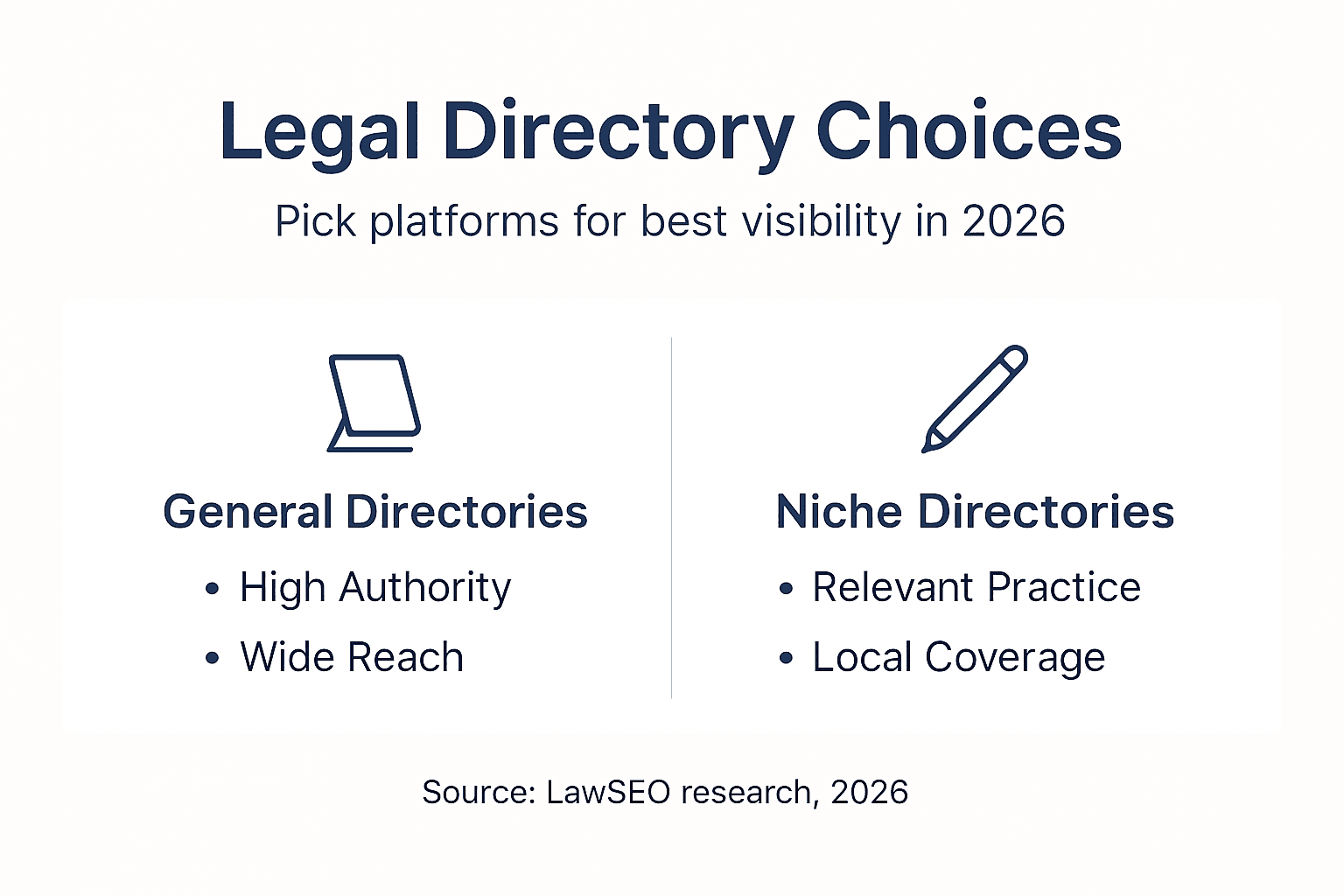
Not all legal directories deliver equal returns on your optimization investment. Avvo, FindLaw, Justia, and Lawyers.com are well-known U.S. legal directories with high domain authority and millions of monthly visitors, making them essential starting points for most firms.
Prioritize directories based on these criteria:
- Domain Authority: Higher authority directories pass more SEO value through backlinks and carry more weight in search algorithms.
- Relevancy: Practice area-specific directories (like NOLO for consumer law or NAELA for elder law) often deliver more qualified leads than general platforms.
- Traffic Volume: Monthly visitor counts indicate potential client exposure, though niche directories with lower traffic may convert better for specialized practices.
- AI Compatibility: Modern directories with structured data support and API access integrate better with AI search platforms.
| Directory | Domain Authority | Monthly Traffic | AI Integration | Best For |
|---|---|---|---|---|
| Avvo | 90+ | 15M+ | Excellent | General practice, reviews |
| FindLaw | 88+ | 10M+ | Good | All practice areas |
| Justia | 89+ | 8M+ | Excellent | Content marketing, Q&A |
| Lawyers.com | 87+ | 12M+ | Good | Established firms |
| Martindale-Hubbell | 86+ | 5M+ | Moderate | Corporate, large firms |
For solo practitioners and small firms, focus on the top four general directories plus 2-3 niche platforms relevant to your practice areas. Mid-sized firms should add state bar directories and regional platforms. Large firms benefit from comprehensive coverage including international directories if applicable.
Geographic considerations matter too. Local chamber of commerce directories, city-specific legal platforms, and regional bar associations provide valuable local SEO signals even with lower traffic. Your advanced SEO strategy should balance national visibility with hyperlocal presence.
Best Practices for Directory Optimization
Strategic directory optimization requires methodical execution across multiple dimensions. Consistent NAP, keyword-rich descriptions, profile updates, and schema markup implementation form the core of effective optimization.
Follow this systematic approach:
- Audit Existing Profiles: Search your firm name across all major directories to identify existing listings, claim unclaimed profiles, and document current information accuracy.
- Standardize Data: Using your centralized data repository, ensure perfect NAP consistency, standardized practice area descriptions, and uniform attorney credentials across every platform.
- Optimize Descriptions: Write unique, keyword-rich descriptions for each directory (not duplicated content) that naturally incorporate target search terms while highlighting competitive advantages and addressing client pain points.
- Implement Structured Data: Add schema markup wherever directories allow custom code, including Attorney, LegalService, LocalBusiness, and Organization schemas with complete property definitions.
- Manage Reviews Proactively: Request reviews from satisfied clients following ethical guidelines, respond professionally to all feedback, and leverage positive testimonials to enhance credibility and rankings.
- Update Regularly: Schedule quarterly reviews to refresh content, add new case results or credentials, verify information accuracy, and adapt to algorithm changes.
Ethical considerations are paramount. U.S. legal marketing rules prohibit misleading claims, guaranteed outcomes, and testimonials without disclaimers in some jurisdictions. Ensure every description complies with your state bar’s advertising regulations.
Integrate directory optimization with your broader efforts to boost Google rankings and implement comprehensive on-page SEO for maximum visibility.
Pro Tip: Create a review request email template that makes leaving feedback easy for clients. Include direct links to your top three directory profiles and your Google Business Profile. Time requests 2-3 weeks after case completion when satisfaction is highest but the experience remains fresh.
Common Misconceptions in Legal Directory Optimization
Several persistent myths mislead attorneys about directory optimization, wasting resources and creating false expectations. Understanding the reality prevents costly mistakes.
Myth vs. fact:
- Myth: More listings automatically improve rankings. Fact: Ten perfectly optimized, consistent listings outperform 50 poorly maintained profiles with conflicting information.
- Myth: AI search makes directories obsolete. Fact: AI platforms rely heavily on directories as trusted sources, making optimization more important than ever.
- Myth: Directory optimization is a one-time task. Fact: Search algorithms and AI systems favor recently updated information, requiring ongoing maintenance.
- Myth: Free listings provide the same value as premium. Fact: While free listings establish citations, premium profiles often include features like review management, enhanced visibility, and better AI integration that justify the investment.
- Myth: Directory rankings happen quickly. Fact: SEO benefits compound gradually over 6-12 months, requiring patience and sustained effort.
The biggest mistake firms make is treating directory optimization as an afterthought rather than a core component of their marketing strategy. Directories serve as the foundation for local SEO, provide essential backlinks for organic rankings, and increasingly function as primary data sources for AI-generated legal information.
Understanding these realities allows you to allocate resources effectively and set appropriate expectations for stakeholders evaluating your marketing ROI.
Timing and Results Expectations
Directory optimization delivers measurable results, but the timeline requires patience and realistic expectations. Most firms see initial improvements within 3-4 months, with substantial visibility gains materializing over 6-12 months as search engines and AI platforms recognize and trust the optimized data.
The compounding effect is crucial. Month one’s citation cleanup improves data consistency, enabling month three’s local pack improvements, which boost month six’s organic rankings, ultimately driving month twelve’s referral traffic growth. Each optimization layer builds on previous work.
Track these key success metrics:
- Local Search Rankings: Monitor position for target keywords in your geographic market, especially map pack placement.
- Organic Traffic: Measure visits from both your website and directory profiles themselves using UTM parameters and analytics.
- Directory Referrals: Track leads generated directly from directory profiles through unique phone numbers or contact forms.
- Citation Consistency Score: Use audit tools to maintain 95%+ consistency across all platforms.
- Review Velocity: Monitor the rate of new reviews and overall rating trends across directories.
Maintaining gains requires ongoing commitment. Search algorithms evolve, competitors optimize aggressively, and AI platforms update their data preferences. Firms that treat optimization as an ongoing process rather than a project sustain competitive advantages.
Set internal benchmarks: expect 15-25% improvement in local visibility within six months, 30-50% increases in directory referral traffic within a year, and compounding benefits as your optimized profiles age and accumulate authority.
Relationship with Local SEO and Google Business Profile
Legal directory optimization, local SEO, and Google Business Profile management form an integrated visibility strategy. Each channel reinforces the others, creating synergistic effects that exceed isolated efforts.
Directory optimization supports local SEO by building the citation foundation Google uses to validate your firm’s location and legitimacy. Your Google Business Profile benefits from consistent NAP data across directories, which Google cross-references when determining map pack rankings. Meanwhile, optimized directories provide authoritative backlinks that boost your website’s domain authority for organic search.
The relationship works both ways. A well-maintained Google Business Profile with frequent posts, reviews, and Q&A engagement signals active management that spills over into how directories evaluate your firm. Strong website structure with proper schema markup creates a data ecosystem that directories and search engines trust.
| Channel | Primary Benefit | Secondary Benefit | Management Frequency |
|---|---|---|---|
| Legal Directories | Citation building, backlinks | Referral traffic, AI visibility | Quarterly updates |
| Google Business Profile | Map pack rankings | Direct client calls, reviews | Weekly engagement |
| Website Local SEO | Organic rankings | Brand authority | Monthly optimization |
Integrated management prevents conflicting information that confuses search algorithms. When your website lists one address, your Google profile shows another, and directories display a third variation, all channels suffer ranking penalties.
The most successful firms coordinate updates across all three channels simultaneously. Address changes, new practice areas, additional attorneys, or service area expansions get implemented uniformly within 24-48 hours across your website, Google profile, and all directory listings.
This holistic approach maximizes your firm’s total search footprint, capturing potential clients regardless of which platform they use to research legal services.
Boost Your Law Firm’s Visibility with Expert SEO Services
Implementing the strategies in this guide requires expertise, time, and ongoing commitment. LawSEO specializes exclusively in legal marketing, delivering advanced SEO strategies tailored to attorneys’ unique needs. With 29 years of experience, we optimize legal directories alongside comprehensive AI search strategies to position your firm where potential clients discover legal services in 2026.
Our founder-led approach ensures every campaign receives strategic oversight rather than cookie-cutter templates. We boost Google rankings through integrated local SEO, content production, and technical optimization while maintaining exclusivity agreements that prevent us from working with your local competitors. Ready to dominate your market? Contact us today.
Frequently Asked Questions
What is legal directory optimization and why does it matter?
Legal directory optimization means managing your law firm’s profile details across specialized platforms so search engines and AI systems rank you highly for relevant queries. It matters because directories influence 22% of local ranking factors and serve as primary data sources for AI-generated legal answers, directly impacting client acquisition.
How does AI search affect my law firm’s directory listings?
AI platforms cite directories in 16% of legal queries, using them as trusted sources for generating answers. Optimizing for AI requires implementing structured data, maintaining perfect consistency, and writing natural-language content that AI systems can parse and understand. Firms with AI-optimized directories appear in chatbot recommendations and answer boxes before traditional search results.
Is it enough to list my law firm once on directories?
Absolutely not. Single listings miss the citation diversity and geographic coverage search algorithms expect. More importantly, directories require quarterly updates to maintain accuracy and responsiveness as your firm evolves. Inconsistent or outdated information across platforms causes ranking drops and sends potential clients to competitors instead.
How long does it take to see results from legal directory optimization?
Expect initial improvements within 3-4 months, with substantial visibility gains over 6-12 months as search engines recognize your optimized data. The impact compounds over time, so sustained effort yields increasing returns. Patience matters because SEO benefits accumulate gradually, but firms that maintain consistent optimization eventually dominate their markets through compounding authority and visibility.