


Many law firms believe keyword stuffing still works or that paying for ads equals SEO success. These misconceptions cost you clients. The reality: optimizing for emerging AI-driven search tools can increase legal website visibility by up to 20%, yet most firms ignore this factor entirely. Legal SEO demands a unique approach blending compliance, local dominance, content authority, AI adaptation, and ethical link building. This guide breaks down the exact ranking factors that drive visibility and client acquisition for law firms in 2026.
Table of Contents
- Introduction To Legal Website Seo Ranking Factors
- Local Seo: Dominating Geographic Search
- Content Authority And Compliance In Legal Seo
- Ai And Emerging Search Optimization For Lawyers
- Link Building And Technical Seo Factors
- Boost Your Law Firm’s Seo With Expert Help
Key Takeaways
| Point | Details |
|---|---|
| Compliance-driven content is non-negotiable | Authoritative, ABA-compliant content builds trust and avoids penalties while improving rankings. |
| Local SEO drives client leads | Optimizing Google My Business and using hyperlocal keywords captures clients actively searching for nearby legal help. |
| AI optimization unlocks new visibility | FAQ schema and structured data improve rankings in voice search and AI chatbot results. |
| Ethical link building boosts authority | Quality backlinks from reputable legal directories increase domain authority without violating ABA rules. |
| Avoid keyword stuffing | Unnatural keyword use triggers penalties that can drop rankings by over 25%. |
Introduction to Legal Website SEO Ranking Factors
SEO determines whether potential clients find your firm or your competitors. In 2026’s crowded digital legal market, ranking on page one of Google makes the difference between thriving and surviving. Law firms face distinct SEO challenges that generic strategies cannot address.
Strict compliance regulations govern what you can claim and how you market services. Local client targeting matters because most legal clients search for attorneys within their geographic area. Ethical constraints limit aggressive tactics that work in other industries.
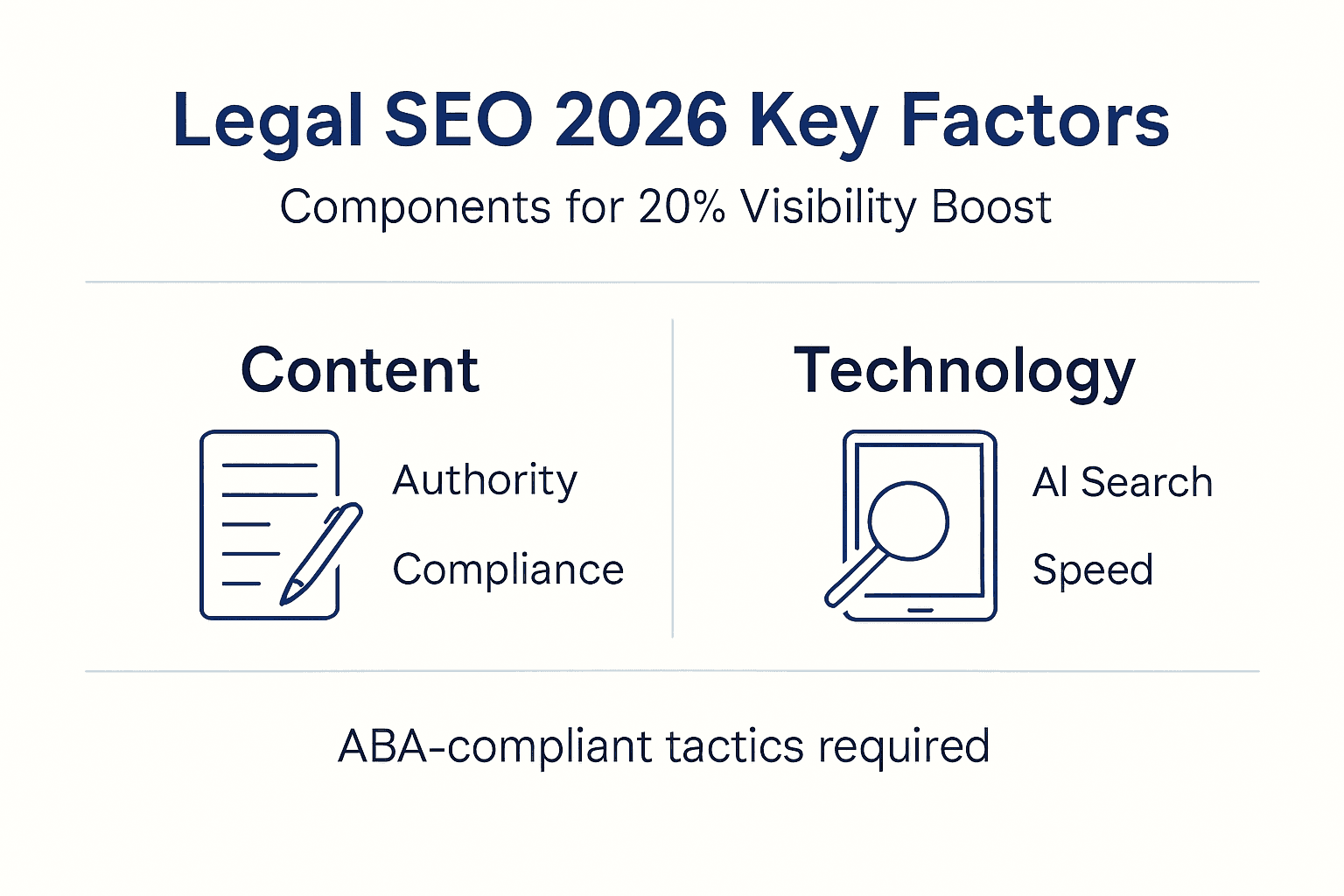
Successful legal SEO combines five critical factors:
- Content authority that demonstrates expertise while meeting ABA standards
- Local optimization to capture nearby clients actively seeking representation
- AI-ready content that performs in voice search and chatbot platforms
- Technical excellence ensuring fast, mobile-friendly experiences
- Ethical link building that strengthens domain authority within regulatory boundaries
Understanding why SEO matters for lawyers requires recognizing these unique requirements. Generic SEO tactics often fail or create compliance risks for legal websites. The strategies that follow address legal-specific ranking factors proven to increase visibility and client acquisition.
Local SEO: Dominating Geographic Search
Google prioritizes three factors when ranking local search results: proximity to the searcher, relevance to the query, and prominence of the business. For law firms, local SEO drives the majority of qualified leads because clients typically need attorneys within their jurisdiction.
Your Google My Business profile serves as your primary local ranking asset. Complete every field: accurate address, phone number, hours, practice areas, photos, and regular posts. Collect and respond to client reviews consistently. Google rewards active, detailed profiles with higher local pack placement.
Incorporate hyperlocal content targeting specific neighborhoods, courts, and regional legal issues. Instead of generic “personal injury lawyer” content, create pages for “car accident attorney serving downtown Austin” or “slip and fall lawyer near Travis County Courthouse.” This geographic specificity improves relevance signals.
Pro Tip: Update your GMB profile weekly with posts about case results, legal tips, or community involvement to signal active engagement and boost local authority.
| Local SEO Tactic | Estimated Impact on Rankings |
|---|---|
| Complete GMB optimization | 25-30% improvement |
| Consistent NAP citations | 15-20% improvement |
| Hyperlocal content pages | 20-25% improvement |
| Regular review generation | 15-20% improvement |
| Location-specific schema markup | 10-15% improvement |
Implementing local SEO for law firms requires ongoing attention to GMB management, citation consistency across directories, and content that speaks directly to your target geography. Firms that rank in Google Maps typically dominate local client acquisition because map pack results appear above organic listings.
The tactics that boost Google rankings for law firms start with local optimization because geographic relevance forms the foundation of legal search visibility.
Content Authority and Compliance in Legal SEO
Google’s E-A-T framework evaluates Expertise, Authority, and Trust. For legal websites, E-A-T directly impacts rankings because Google recognizes that legal advice requires verified credentials and ethical standards. Low-quality legal content can harm users, so Google scrutinizes legal sites more intensely than most industries.
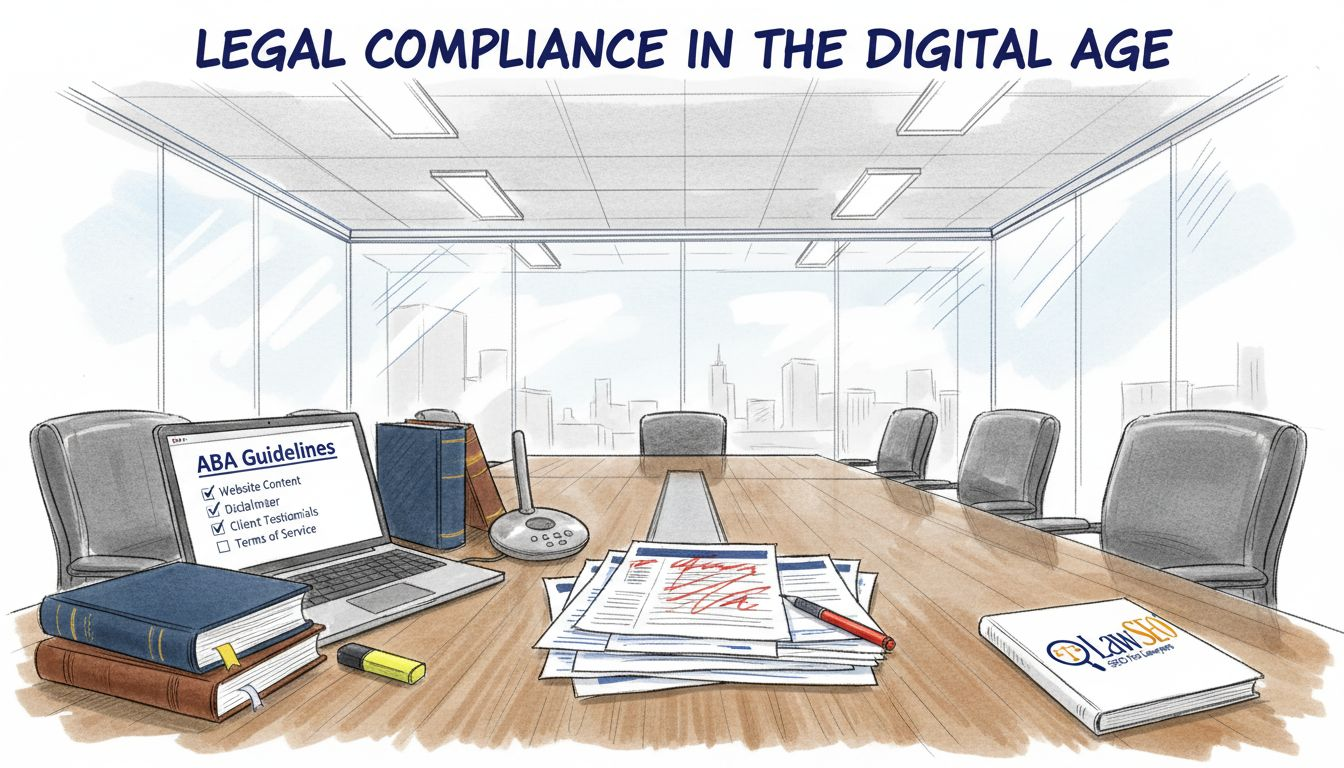
ABA marketing rules require honest, non-misleading content. You cannot guarantee outcomes, make unverifiable claims, or use manipulative tactics. Compliance is not optional. Violations risk both Google penalties and state bar discipline.
Building content authority requires transparency and expertise demonstration:
- Include comprehensive attorney bios with verifiable credentials, bar admissions, and relevant experience
- Publish verified client testimonials that comply with state bar testimonial rules
- Create in-depth legal guides that demonstrate subject matter expertise
- Cite authoritative legal sources and case law to support claims
- Regularly audit content to ensure ongoing compliance with evolving regulations
Pro Tip: Conduct quarterly content audits to identify outdated claims, verify compliance with current bar rules, and refresh statistics to maintain trust signals.
Your website signals authority through transparent credentials, detailed expertise demonstration, and ethical content practices. Google rewards sites that clearly establish who provides the legal information and why they are qualified. Attorney bios should read like professional resumes, not marketing fluff.
Implementing ethical SEO for attorneys means every content decision considers both ranking impact and regulatory compliance. The intersection of these priorities defines successful legal content marketing.
Content authority and compliance work together. You cannot achieve sustainable rankings through content that violates ethical guidelines, and compliant content without expertise demonstration will not outrank competitors.
AI and Emerging Search Optimization for Lawyers
AI-powered search platforms like ChatGPT, Google’s AI Overviews, and voice assistants are reshaping how potential clients discover attorneys. These tools prioritize structured, conversational content that directly answers questions. Traditional keyword optimization alone no longer suffices.
Adding FAQ schema can boost rich result chances by 15-20%, improving AI search discovery. Voice search queries tend to be longer and more conversational than typed searches. Someone might type “divorce lawyer Austin” but ask Siri “What should I do if my spouse filed for divorce?”
Implement these AI optimization tactics:
- Structure content around common legal questions using natural language
- Add FAQ schema markup to question-and-answer sections
- Create conversational content that matches how people actually speak
- Include People Also Ask content that anticipates follow-up questions
- Optimize for featured snippets with concise, direct answers
| Traditional SEO Focus | AI-Driven SEO Focus |
|---|---|
| Keyword density | Natural language patterns |
| Backlink quantity | Content comprehensiveness |
| Exact match keywords | Semantic relevance |
| Desktop optimization | Voice and mobile queries |
| Static content | Conversational, Q&A format |
The firms that master AI optimization for law firms gain visibility in channels their competitors ignore. AI Search Optimization for Law Firms requires restructuring content to answer questions directly and implementing technical markup that helps AI tools understand your content.
Understanding SEO and AI for law firms in 2026 means recognizing that AI platforms are becoming the first point of contact for many potential clients. Optimizing for AI search is no longer optional for firms seeking to capture emerging search traffic.
Link Building and Technical SEO Factors
Quality backlinks from reputable sources signal authority to Google. For law firms, ethical link building within ABA guidelines requires careful strategy. You cannot pay for links, participate in link schemes, or use manipulative tactics. Focus on earning links through genuine value.
Ethical link building tactics include:
- Listing in reputable legal directories like Avvo, Martindale-Hubbell, and state bar associations
- Contributing expert commentary to legal publications and news outlets
- Publishing original research or legal analysis that other sites naturally reference
- Participating in professional associations that link to member firms
- Creating valuable resources that attorneys and legal educators want to cite
Pro Tip: Use Google PageSpeed Insights monthly to monitor site speed and identify technical issues before they impact rankings.
Technical SEO forms the foundation for all other ranking factors. Pages loading under 3 seconds correlated with a 15% higher ranking and user retention. Mobile responsiveness is non-negotiable because most legal searches happen on phones. Secure HTTPS encryption builds trust and satisfies Google’s security requirements.
Key technical factors:
- Site speed optimization through image compression and efficient code
- Mobile-first design that provides excellent experiences on all devices
- SSL certificate for secure browsing
- Clean site architecture with logical navigation
- XML sitemap and robots.txt properly configured
- Schema markup for legal services, reviews, and local business information
The best legal link building services understand ABA constraints and focus on earning high-quality backlinks through legitimate methods. Regular SEO audit for attorneys identifies technical issues and link opportunities while ensuring ongoing compliance.
Monitor website speed and mobile usability regularly because technical problems accumulate over time. What worked six months ago may need updating as platforms evolve and user expectations increase.
Boost Your Law Firm’s SEO with Expert Help
Implementing comprehensive legal SEO requires specialized expertise in compliance, AI optimization, and local search tactics. Professional services ensure you avoid costly penalties while maximizing visibility. The strategies outlined in this guide work, but execution determines results. Partnering with experts who understand legal marketing regulations and search algorithm updates keeps your firm ahead of competitors. In 2026’s evolving search landscape, staying current on advanced SEO strategies for lawyers makes the difference between stagnant traffic and consistent client growth. Specialized local SEO for law firms and ethical SEO for attorneys services deliver measurable results while protecting your professional reputation.
FAQ
What are the top SEO ranking factors for legal websites?
The five critical factors are content authority demonstrating expertise and compliance, local SEO optimization capturing nearby clients, AI-ready content structured for voice and chatbot search, ethical link building from reputable legal sources, and technical excellence ensuring fast mobile experiences. These factors combine uniquely for legal websites because compliance requirements and geographic targeting matter more than in most industries. Firms that excel across all five areas consistently boost Google rankings and attract qualified leads.
How can law firms ensure their SEO practices comply with ethical guidelines?
Conduct quarterly audits of all content and backlinks to verify alignment with ABA rules and state bar regulations. Avoid guaranteed outcome claims, manipulative link schemes, and misleading service descriptions. Work with SEO professionals who understand legal marketing compliance. Review testimonials to ensure they meet state-specific disclosure requirements. Following ethical SEO guidelines protects both your rankings and your professional license.
What role does AI optimization play in legal SEO for 2026?
AI optimization dramatically enhances visibility on voice search and chatbot platforms where traditional SEO tactics fall short. Adding FAQ schema can boost rich result chances by 15-20%, improving AI search discovery. Structure content conversationally, implement proper schema markup, and create comprehensive question-and-answer resources. AI optimization for law firms captures traffic from emerging search channels that competitors ignore.
What are common SEO mistakes law firms should avoid?
Keyword stuffing triggers severe penalties. Sites penalized for keyword stuffing can experience ranking drops exceeding 25%. Write naturally for humans, not algorithms. Respect ethical link-building guidelines by avoiding paid links or schemes. Do not confuse paid advertising with organic SEO improvements because they serve different purposes. Many firms also neglect mobile optimization or ignore local SEO fundamentals. Learning how to avoid SEO mistakes prevents wasted effort and protects your rankings.