


Law firms competing for clients online face a crowded, expensive battlefield. In major metro areas, a single click on a personal injury or criminal defense keyword can cost $50 to $300 or more. Yet firms that run well-structured pay-per-click (PPC) campaigns consistently outpace competitors who rely on organic search alone. This guide walks you through every stage of building a legal PPC campaign, from initial setup to scaling for sustained lead growth, so you can avoid the costly missteps that drain budgets without delivering clients.
Key Takeaways
| Point | Details |
|---|---|
| Preparation is key | Having the right tools, budget, and landing pages in place saves money and maximizes lead potential. |
| Define measurable goals | Clear objectives let you track success and adjust PPC campaigns efficiently. |
| Research drives ROI | Targeted keywords and competitor analysis ensure your ads reach the right clients. |
| Continuous improvement | Monitoring and refining PPC strategies leads to ongoing growth and better client acquisition. |
What you need to get started with law firm PPC
Before you write a single ad, you need the right foundation. Jumping into Google Ads without preparation is one of the fastest ways to burn through budget with nothing to show for it. Think of this stage as assembling your toolkit.
Budget: Most competitive legal markets require a minimum monthly spend of $2,000 to $5,000 to generate meaningful data. Highly competitive practice areas like mass torts or personal injury may demand significantly more. Calculate your target cost per lead, then work backward from your monthly lead goal to set a realistic budget.
Platform selection: Google Ads dominates legal PPC because of its reach and targeting precision. Review the Google Ads requirements before creating your account. Microsoft Advertising (Bing Ads) is a secondary option worth testing, especially for older demographics who use Bing at higher rates.
Landing pages: Landing page optimization is critical for maximizing PPC leads. A generic homepage will not convert paid traffic. You need dedicated, practice-area-specific pages with a clear call to action, trust signals, and fast load times.

Tracking setup: Install Google Ads conversion tracking, Google Analytics 4, and a call tracking solution before spending a dollar. Without this, you cannot measure what is working.
Competitive research tools: Use tools like SpyFu or SEMrush to analyze what your local competitors are bidding on and what their ad copy looks like.
Here is a quick platform comparison to guide your decision:
| Platform | Avg. CPC for legal | Audience reach | Best for |
|---|---|---|---|
| Google Ads | $50–$300+ | Largest | High-intent leads |
| Microsoft Ads | $20–$120 | Smaller, older | Budget supplementation |
| Meta Ads | $5–$30 | Broad | Brand awareness |
Key prerequisites at a glance:
- Dedicated budget separate from general marketing spend
- A verified Google Ads account with billing configured
- At least one optimized landing page per practice area
- Conversion tracking installed and tested
- A baseline understanding of your competitors’ ad presence
For a deeper look at online lead generation for attorneys, review the full guide before moving forward.
Step 1: Define your PPC campaign objectives
With your campaign tools and setup ready, it’s time to decide what you want your PPC to accomplish. Vague goals produce vague results. Successful PPC campaigns start with well-defined goals and benchmarks you can measure weekly.
Set specific, numeric targets for each of the following:
- Lead volume: How many qualified consultations do you need per month?
- Cost per lead (CPL): What is the maximum you can spend to acquire one consultation while remaining profitable?
- Geographic targeting: Are you targeting a single city, a metro area, or statewide? Tighter geography usually means lower costs and higher relevance.
- Campaign purpose: Are you focused on direct lead generation, or do you also want to build brand recognition in your market?
Pro Tip: Set a CPL ceiling before you launch. If your average case value is $8,000 and you close one in five consultations, you can afford up to $1,600 per consultation and still profit. Use that math to guide every budget decision.
Defining lead generation goals for lawyers at this stage prevents scope creep and keeps your campaign accountable from day one.
Step 2: Research keywords and competitors
Objectives in hand, you’ll need the right keywords and competitor insights to reach your target clients. Keyword research for legal PPC is not the same as for general businesses. Search intent is extremely high, and the wrong keyword match type can waste thousands of dollars.
Follow these steps to build a strong keyword list:
- Use the Google Ads keyword planner to identify search volume and estimated CPC for your core practice areas.
- Segment keywords by intent: informational (“what is a DUI”) versus transactional (“DUI lawyer near me”). Bid heavily on transactional terms.
- Analyze competitor ads using SpyFu or SEMrush to identify gaps and opportunities in your local market.
- Build a negative keyword list immediately. Terms like “free,” “pro bono,” “law school,” and “paralegal jobs” will drain your budget if left unchecked.
Pro Tip: Branded keywords (your firm’s name) are often overlooked. Bidding on your own name protects your brand from competitors who may target it and typically converts at a very high rate.
Here is a comparison of keyword types for legal PPC:
| Keyword type | Example | Intent level | Recommended bid priority |
|---|---|---|---|
| Branded | “Smith Law Firm” | Very high | High |
| Transactional | “car accident lawyer Chicago” | High | High |
| Informational | “how to file a personal injury claim” | Low | Low or exclude |
| Competitor | “[Competitor] law firm” | Medium | Test carefully |
Applying legal SEO strategies alongside your PPC keyword research creates a unified approach that reinforces both paid and organic visibility.
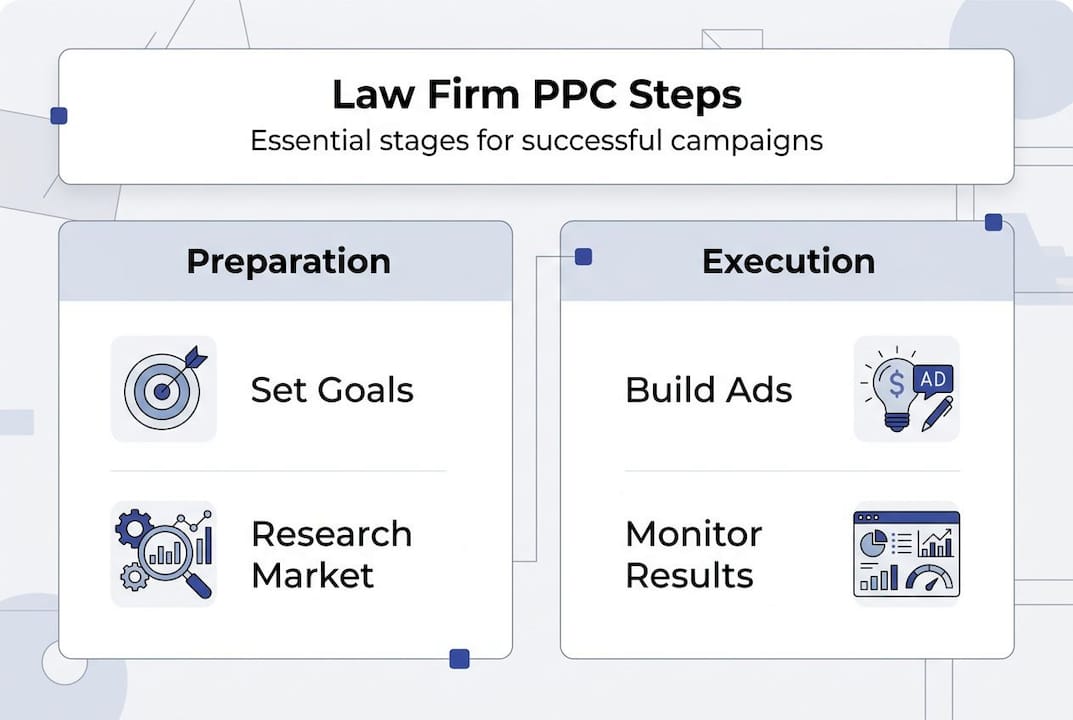
Step 3: Build and optimize your campaigns
Armed with keyword insights, let’s build your PPC campaign for the best legal results. Campaign structure is where most law firms make their first major mistake: dumping all keywords into one ad group and writing a single generic ad.
Follow this structured approach:
- Create one campaign per practice area. Personal injury, family law, and criminal defense each need separate campaigns with their own budgets.
- Build tightly themed ad groups. Each ad group should contain 5 to 15 closely related keywords. “Car accident attorney” and “auto accident lawyer” belong together. “Slip and fall” belongs in its own group.
- Write compelling, compliant ad copy. Every headline should speak directly to the searcher’s problem. “Injured in a car accident? Call now for a free consultation” outperforms generic copy every time. Ad copy must comply with legal advertising standards, including truthful claims and required disclaimers.
- Connect each ad group to a matching landing page. A searcher clicking a DUI ad should land on a DUI-specific page, not your homepage.
- Configure all conversion actions: phone calls from ads, form submissions, and live chat initiations.
“The quality of your landing page directly determines whether your PPC spend generates clients or just clicks. Every element, from headline to form placement, must be built for conversion.”
Review ABA advertising standards to ensure your ad copy and landing pages meet professional responsibility requirements. Non-compliant ads can result in bar complaints, not just poor performance.
Here is a reference table for campaign structure:
| Campaign | Ad group example | Landing page |
|---|---|---|
| Personal injury | Car accident, slip and fall | /personal-injury/ |
| Criminal defense | DUI, drug charges | /criminal-defense/ |
| Family law | Divorce, child custody | /family-law/ |
For detailed guidance on landing page optimization for lawyers, review the full resource before finalizing your pages.
Step 4: Launch and monitor your campaign
Once your campaign is live, keeping a close watch ensures your investment pays off. The first two weeks are critical. This is when you gather real performance data and make your first round of adjustments.
Key monitoring actions:
- Check search term reports daily for the first two weeks. Add irrelevant terms to your negative keyword list immediately.
- Monitor Quality Score for each keyword. A low Quality Score raises your CPC and lowers ad position. Improve it by tightening the match between keyword, ad copy, and landing page.
- Watch your impression share. If it is below 50%, your budget may be too low or your bids too conservative for your target market.
- Track cost per conversion, not just clicks. A keyword generating 100 clicks but zero conversions is a budget leak.
Pro Tip: Set up automated alerts in Google Ads to notify you when daily spend exceeds a threshold or when a campaign’s conversion rate drops below your baseline. This prevents silent budget waste.
Continuous monitoring and adjustment is necessary for law firm PPC success. Campaigns left unattended for weeks routinely overspend on low-quality traffic. Review PPC campaign monitoring best practices to set up your reporting dashboard correctly.
For a broader view of how paid and organic channels interact, the SEO vs PPC performance comparison is worth reviewing. Understanding both channels helps you allocate budget more strategically. You can also explore digital marketing for lawyers to see how PPC fits into a full-funnel strategy.
Step 5: Refine and scale for ongoing results
After launch, ongoing improvements will boost leads and ROI, ensuring sustainable results. Data collected in the first 30 to 60 days gives you the foundation to make smart, evidence-based decisions rather than guesses.
Focus your refinement efforts on these areas:
- Conversion data analysis: Identify which keywords, ad groups, and landing pages produce the lowest CPL. Shift budget toward those segments.
- A/B testing: Run two versions of your top ads simultaneously. Test one variable at a time, such as headline, call to action, or display URL. Let each test run for at least two weeks before drawing conclusions.
- Scaling winners: Once a campaign segment consistently delivers leads at or below your CPL ceiling, increase its budget incrementally, typically 15 to 20% at a time, to avoid triggering Google’s learning phase reset.
- Pausing underperformers: Keywords or ad groups that have spent three times your target CPL without a conversion should be paused or restructured.
Pro Tip: Do not scale too fast. Doubling a campaign budget overnight often disrupts performance because Google’s algorithm needs time to recalibrate. Gradual increases preserve the efficiency you have already built.
Refining PPC campaigns based on data drives better client acquisition results over time. Review PPC campaign optimization guidelines to understand how Google’s automated bidding strategies can support your scaling efforts. Explore digital marketing strategies and law firm SEO services to see how PPC integrates with a broader growth plan.
Next steps: Partner with experts for maximum impact
With your campaign running and evolving, partnering with specialists can accelerate your success and streamline your digital marketing efforts. Managing legal PPC in-house is possible, but the margin for error is slim when clicks cost $100 or more. At LawSEO.com, we work exclusively with law firms, which means every strategy we build reflects the competitive realities and ethical requirements of legal marketing. From initial keyword research to ongoing bid management, our team handles the details so you can focus on practicing law. Explore advanced legal SEO strategies that complement your PPC investment, or contact us directly through LawSEO.com to discuss a tailored campaign. You can also review our full range of digital marketing for law firms services to see how PPC fits into a complete growth strategy.
Frequently asked questions
How much budget should a law firm allocate for PPC?
Most law firms start with $1,000 to $5,000 monthly, adjusting based on location, competition, and lead goals. Budget planning is one of the most critical prerequisites before launching any paid campaign.
What is the best PPC platform for lawyers?
Google Ads offers the widest reach and the most precise targeting controls for most law firms, but Microsoft Advertising can supplement local targeting at a lower average cost per click.
How quickly can PPC generate leads for a law firm?
Legal PPC campaigns typically see initial results within one to two weeks after launch, though meaningful performance data usually requires 30 days of consistent spend.
What are common PPC mistakes for lawyers?
Missing conversion tracking, poor keyword targeting, and weak landing pages are the most frequent errors. Landing page optimization alone can dramatically reduce wasted ad spend.
How should legal ads comply with advertising regulations?
All ads must include required disclaimers and follow ABA advertising standards to avoid bar complaints and ensure truthful, non-misleading claims.