


Expect to pay roughly $1,500 to $3,000 a month for foundation-level local SEO, $3,000 to $6,500 for a growth campaign, and $6,500 or more for competitive metro or multi-location work. The right number for your firm depends on one calculation: divide your monthly retainer by the average net revenue of a signed case. If that ratio pencils out in one or two cases a month, the campaign is funded correctly. Practice area and market competition decide which end of that range you land on.
TL;DR:
- Practice-area competition significantly influences SEO costs, with high-stakes fields like personal injury costing more than low-competition areas.
- Content volume, quality, and attorney review requirements drive up project prices, especially for authoritative backlinks and accurate legal pages.
- A comprehensive SEO retainer should include technical, on-page, content creation, local SEO, link building, and analytics, with measurable monthly deliverables.
- Break-even typically occurs within 3 to 6 months, and measurable lead growth usually starts after 4 to 6 months, especially in competitive markets.
- Contract terms, onboarding fees, and hidden costs such as tool overages or platform migrations should be explicitly clarified before engagement.
How Much Does Law Firm SEO Cost, and What Do the Tiers Buy?
Most firms spend somewhere between $1,500 and $10,000 or more per month on SEO, and the spread is not random. A family law practice in a mid-sized city sits near the bottom of that band, while a personal injury firm competing in a top-20 metro sits at or above the top, according to pricing data compiled across the legal SEO industry. Three tiers cover almost every firm’s situation.
Foundation tier ($1,500 to $3,000/month). This funds basic technical cleanup, Google Business Profile management, a handful of new content pages each month, and light local citation work. It suits solo practitioners or small firms in low-competition practice areas, like general estate planning in a smaller market.
Growth tier ($3,000 to $6,500/month). This is where most competitive small and mid-size firms operate. It typically funds four to eight new content assets a month, ongoing technical audits, expanded local SEO across multiple service pages, and a real link-building program rather than token outreach.
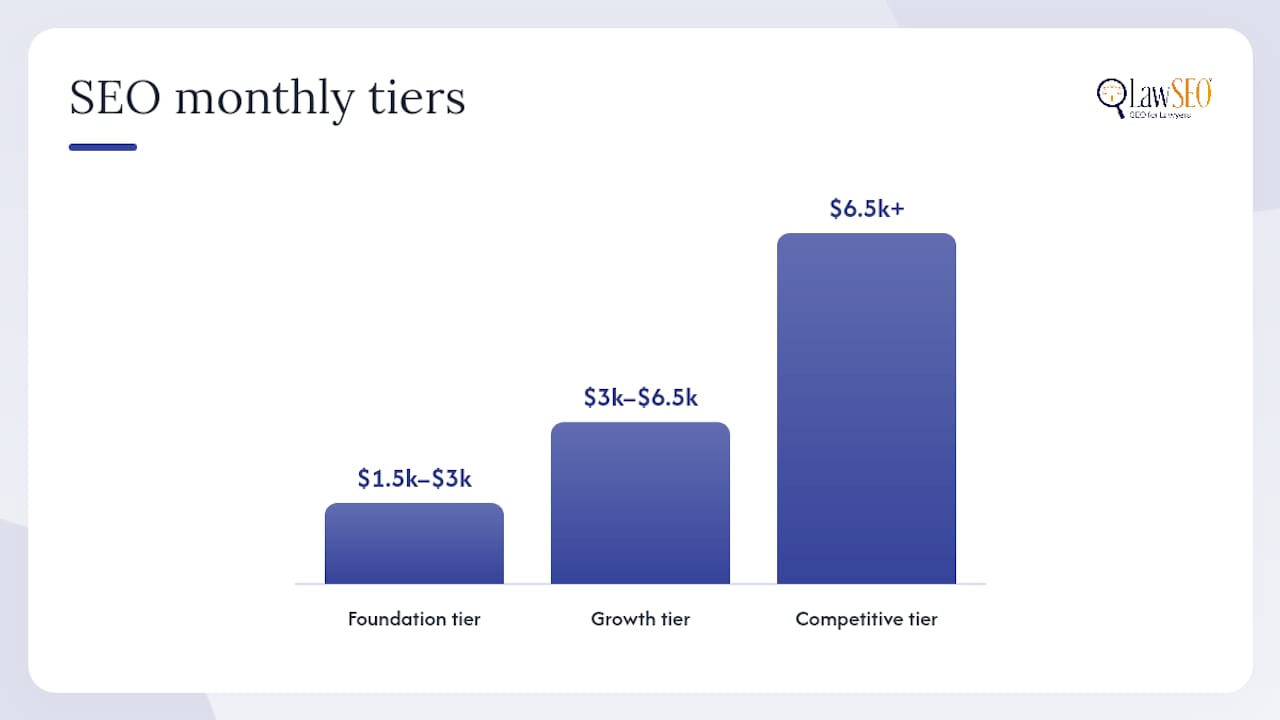
Competitive tier ($6,500 and up). Personal injury, mass tort, and multi-location firms live here. Budgets at this level fund higher content velocity, aggressive authority link building, dedicated conversion-rate work, and often multi-city local SEO campaigns run in parallel.
Pricing models vary within these tiers:
- Monthly retainer. The dominant model for ongoing SEO, because search visibility compounds over months, not single projects.
- Hourly. Common for narrow-scope work, like a one-time technical audit or a schema markup fix, but rare as a primary billing model for full campaigns.
- Project-based. Fits a fixed deliverable, such as a website migration audit or a one-time local citation cleanup.
- Performance-based. Rare in legal SEO because Google’s own guidelines discourage pay-per-ranking arrangements, and most reputable agencies avoid tying fees to rankings that can shift for reasons outside their control.
If a quote lands well under $1,500 a month for a competitive practice area, ask what is actually being cut. Underpriced engagements almost always mean less content, no real link building, or a template-based approach that ignores your specific market.
What Actually Drives the Price Difference Between Proposals?
Two agencies can quote wildly different numbers for what looks like the same scope, and the gap almost always traces back to a few measurable factors rather than markup.
Practice-area competition is the single biggest driver. Personal injury and mass tort keywords carry some of the highest commercial value online, and legal search terms rank among the most expensive keywords in any industry, which pushes both paid and organic competition higher. A criminal defense attorney in a mid-size market faces a fraction of that competitive pressure.
Other factors that move price:
- Geographic scope. A single-office local campaign costs far less than a multi-location or national build-out, since each additional market needs its own local optimization and citation work.
- Site health and technical debt. A firm migrating off an old platform with broken redirects and thin content needs remediation work before growth work even starts.
- Content volume and attorney review. Legal content requires subject-matter accuracy, and content that gets attorney review before publishing costs more to produce but reduces compliance risk.
- Link difficulty. Earning authoritative backlinks in law is harder than in most industries because legitimate legal publications and directories are selective.
- Regulatory oversight. Some practice areas, especially those touching consumer protection or advertising rules, need extra compliance review that adds time and cost.
Pro Tip: Before comparing quotes, ask each vendor to show you who currently ranks above you for your top three keywords. A serious proposal prices backward from what it will take to outrank those specific competitors, not from a generic package menu.
What’s Actually Included in a Law Firm SEO Retainer?
A retainer that only produces a monthly report and a vague promise of “optimization” is not a campaign. Real law-firm SEO work breaks into six functional areas, and every legitimate proposal should name deliverables in each one.
- Technical SEO. Site speed fixes, crawlability audits, schema markup for attorney profiles and practice pages, and mobile performance monitoring.
- On-page optimization. Title tags, header structure, internal linking, and page-level keyword targeting tied to practice areas and locations.
- Content creation. New practice-area pages, blog posts answering common client questions, and updates to existing pages that have gone stale.
- Local SEO and Google Business Profile management. Regular GBP posts, review response management, and citation consistency across directories, covered in more depth in guides on local SEO for law firms.
- Link building. Outreach to legal directories, press mentions, and guest contributions on relevant, authoritative sites.
- Reporting and attribution. Monthly ranking reports, call and form tracking, and clear attribution tying organic visits to actual leads.
Here is roughly what each budget tier should produce in a typical month:
| Tier | Content output | Link building | Local/GBP activity |
|---|---|---|---|
| Foundation | 1 to 2 new pages | Light citation cleanup | Basic GBP posting |
| Growth | 4 to 6 new pages | 2 to 4 quality links | Weekly GBP updates, review monitoring |
| Competitive | 6 or more pages | 5+ authoritative links | Multi-location GBP management |
To verify a vendor is delivering what was promised, ask for the actual published URLs each month, not just a summary slide. If a report shows “content optimization” with no new page to point to, that’s activity theater rather than output, a pattern flagged in industry breakdowns of law firm SEO deliverables.
What ROI Should a Law Firm Expect from SEO Spend?
Break-even math for SEO is simpler than most partners assume. Divide your monthly retainer by your average net revenue per signed case, and the result tells you how many cases you need per month to justify the spend.
Example: A personal injury firm paying $5,000 a month with an average signed case worth $10,000 in net fees needs to close exactly one case from organic search to hit break-even. Anything beyond one case is pure margin.
Given that legal keywords rank among the most expensive in paid search, every ranking you own organically is functionally a discount on what you would otherwise pay Google per click, and that discount compounds every month the ranking holds.
A few numbers to anchor your budget conversation:
- Legal marketing guides generally recommend allocating 2% to 10% of gross revenue to marketing, with the split between SEO and paid ads shifting based on practice area competition.
- Break-even typically arrives within the first 90 to 180 days for foundation and growth campaigns; sustained, compounding growth usually takes 6 to 12 months.
- Track leads, signed cases, and cost per signed case rather than rankings alone. Rankings are a leading indicator; signed cases are the actual outcome that matters to the firm.
A signed-case ROI calculator can turn this math into a monthly tracking habit instead of a one-time spreadsheet exercise.
How Do You Choose the Right SEO Provider Without Overpaying?
Comparing two proposals side by side only works if you’re comparing the same units: deliverables per month, not headline price. A $3,000 quote that includes six content pages and real link outreach beats a $2,500 quote that includes two pages and no link work.
Ask every vendor these questions before signing anything:
- What exactly gets delivered each month, in writing, with page counts and link targets?
- Who writes the content, and does an attorney review it before publication?
- Where do links come from, and can you name specific sites you’ve placed links on for other legal clients?
- How is success measured, and will you share raw analytics access rather than just a summary report?
- What happens to the work already completed if we cancel?
Red flags that should end a conversation immediately: guaranteed first-page rankings, vague deliverables described only as “optimization,” and any mention of link schemes, private blog networks, or bulk directory submissions. Google’s guidelines treat manipulative link building as a penalty risk, and a firm’s website is not the place to gamble on that.
Pro Tip: Require a written scope document listing exact monthly deliverables before you sign, not after. If a vendor resists putting deliverables in writing, that resistance is the answer to whether they’ll deliver them.
Contract terms matter as much as the monthly number. Require clear language on scope, what happens at cancellation, whether any exclusivity is offered for your geographic market, and who owns the content and backlink work if you leave.
How Long Does It Take to See Results from Law Firm SEO?
SEO timelines follow a predictable arc, and knowing the milestones helps you judge whether a campaign is on track or stalling.
- 30 to 90 days: Technical fixes go live, Google Business Profile activity increases, and you should start seeing early signals like improved crawl reports and small ranking movement on lower-competition terms.
- 4 to 6 months: Ranking momentum builds on primary practice-area keywords, and lead volume typically starts climbing in a measurable way.
- 6 to 12 months: Growth becomes consistent and compounding, particularly for competitive practice areas where displacing established competitors simply takes longer.
Delays usually trace back to one of three causes: a technically broken site that needed remediation before growth work could start, a content backlog that never got cleared, or a practice area so competitive that the original budget tier was mismatched to the goal. Any of these should prompt a scope conversation with your vendor, not a decision to quit the channel entirely.
Why Publisher Experience Matters When You’re Evaluating SEO Claims
Legal SEO advice is only as good as the person giving it. Todd R. Stager, founder of LawSEO.com, has worked in SEO for more than 29 years and personally reviews strategy on every client campaign the firm runs.
A few things worth knowing about how LawSEO approaches this work:
- The firm works exclusively with law firms and attorneys, rather than treating legal clients as one vertical among many.
- Services span local SEO, content production, authority link building, and generative AI optimization for firms wanting visibility in AI-driven search results.
- Exclusivity agreements mean LawSEO does not work with a client’s direct local competitor once engaged.
Case studies and specific client results are best evaluated directly with the firm during a scoped consultation, since every practice area and market carries different baseline numbers.
Are There Setup or Onboarding Fees to Budget For?
Many agencies charge a separate onboarding fee, typically ranging from a few hundred dollars to $2,000, before the first full month of ongoing work begins. This fee usually covers the technical audit, competitor research, keyword mapping, and initial Google Business Profile cleanup, work that has to happen before recurring monthly deliverables can start.
Not every agency structures pricing this way. Some fold onboarding costs into the first month or two of a longer retainer, effectively spreading the setup work across a higher initial invoice instead of billing it separately. Neither approach is inherently better, but you should know which one you’re agreeing to before signing.
The question worth asking directly: what specific work does the onboarding fee cover, and does it duplicate anything already included in the first month’s retainer? A vendor should be able to itemize this without hesitation. If the onboarding fee description sounds identical to ongoing monthly deliverables, you may be paying twice for the same audit work, once as “setup” and again as month one of the retainer.
For firms evaluating multiple proposals, ask each vendor to quote the onboarding fee and the first three months of retainer costs together, so you can compare true first-quarter investment rather than just the recurring monthly number.
Is In-House SEO Cheaper Than Hiring an Agency?
On paper, hiring an in-house SEO specialist looks cheaper than an agency retainer. In practice, it rarely is, once you account for the full skill set a real campaign needs.
A single in-house hire, even a skilled one, typically covers only one or two disciplines well: maybe content writing, or maybe technical SEO, but rarely both plus link building, local SEO, and analytics. A full agency team brings specialists across all of those areas for a combined monthly cost that often lands below what one experienced in-house generalist would command in salary and benefits.
There’s also a ramp-up cost most firms underestimate: a new in-house hire needs months to learn your practice areas, your competitive landscape, and your case value economics before producing useful output. An established agency has already run these campaigns across dozens of legal markets and starts with that context on day one.
The realistic middle path many firms choose is a hybrid model: a marketing coordinator on staff who manages the relationship, reviews content for accuracy, and handles day-to-day client questions, paired with an agency handling execution across technical, content, and link-building work. This tends to outperform either pure in-house or pure agency staffing for firms without the budget to build a full internal marketing department.
How Do Contract Length and Cancellation Terms Affect Total Cost?
Contract length changes your effective cost more than most firms realize going in. Annual contracts often come with a lower monthly rate in exchange for that commitment.
The tradeoff is flexibility. If a campaign underperforms and you’re locked into a 12-month term with no clear exit clause, you’re stuck paying for underperformance until the term ends, unless the contract includes a performance-based exit provision. Read cancellation terms specifically: what notice period is required, whether any completed but unpublished content transfers to you, and whether link-building work already placed remains active after you leave.
Pro Tip: Ask for a 90-day initial term with month-to-month renewal after that, rather than a full annual commitment upfront. This gives the vendor enough runway to show early signals while protecting you if the relationship isn’t working.
Some agencies also offer exclusivity, meaning they won’t work with a competing firm in your geographic market while you’re a client. Exclusivity often extends the expected commitment length, since the agency is turning away other business in your market to protect your position, so it’s worth asking how exclusivity terms interact with contract length before you sign.
What Hidden Costs Show Up in Law Firm SEO Contracts?
Beyond the advertised monthly retainer, several cost categories tend to surprise firms after they’ve already signed.
Content revision fees. If your attorney review process requires significant edits to every article, some agencies charge extra revision rounds beyond an initial pass included in the base price.
Paid tools and software. Some proposals list rank tracking, call tracking, or reporting software as a separate line item rather than folding it into the retainer, adding $100 to $300 a month.
Website platform limitations. If your existing website runs on a restrictive or outdated content management system, technical SEO work may require a platform migration that wasn’t priced into the original quote.
Link building overages. A base retainer might promise “link building” without specifying volume, and higher-difficulty link placements sometimes come with per-link add-on pricing once the initial batch is placed.
Local citation cleanup for multi-location firms. Firms with several office locations sometimes discover mid-campaign that citation consistency work across all locations costs more than a single-location quote implied.
Ask for an itemized scope document that explicitly states what is and isn’t included, and request written confirmation of what triggers any additional charge before you sign.
The Real Question Isn’t Price, It’s What You’re Buying
Most of the advice circulating about law firm SEO pricing treats it as a simple shopping decision: find the lowest number that fits the budget. That framing gets the math backward. A $2,000 monthly retainer that produces two thin content pages and no real link building is more expensive than a $5,000 retainer that closes even one additional case a year, because the cheap option burns budget without moving the needle that actually pays the bills.
The conventional wisdom also underweights how fast legal keyword costs are climbing. Every dollar spent building an organic ranking is a dollar that stops competing against some of the highest-priced clicks in any industry, and that math only gets more favorable over time, not less.
What should change first is how firms evaluate proposals. Stop asking “what’s the price” as the opening question. Start asking “what will you deliver in month one, and can you show me exactly who I’m trying to outrank.” Vendors who can’t answer that specifically are pricing a template, not your market.
— TODD
Get a Scoped SEO Audit Built Around Your Practice Area
Generic SEO packages price by tier and hope the deliverables fit your market. Lawseo prices by auditing the attorneys currently outranking you and building a plan to displace them, backed by Todd Stager’s 29-plus years running legal SEO campaigns and exclusivity agreements that keep your local competitors off the client roster. Whatever proposal you’re comparing this against, ask that vendor for the same thing: a written list of monthly deliverables, not just a number. If you want that comparison done for your firm specifically, request a scoped SEO audit and see exactly what a properly funded campaign in your practice area and market would look like before committing to any monthly figure.
Sources
- Marketing Budget Guide for Legal Firms – Scale Growth Digital
- Why SEO Costs Vary for Law Firms | AAMAX
FAQ
How Much Does SEO Cost in the USA?
General SEO pricing in the U.S. ranges widely by industry, but for law firms specifically, most campaigns run between $1,500 and $10,000 or more per month depending on practice area and market competition.
Which SEO Company Is Best for Law Firms in the U.S.?
The strongest fit is usually a firm that specializes exclusively in legal SEO rather than treating law firms as one vertical among many. A strong fit is usually a firm that specializes exclusively in legal SEO rather than treating law firms as one vertical among many and may offer exclusivity agreements per market.
How Much Should a Law Firm Spend on Google Ads?
Legal marketing budgets typically allocate 2% to 10% of gross revenue across marketing overall, with the split between paid ads and SEO shifting toward SEO over time as organic rankings reduce dependence on expensive legal keyword clicks.
How Much Does SEO Typically Cost?
Outside the legal industry, general SEO retainers often run lower, but legal SEO costs more on average because legal keywords carry some of the highest commercial value in any industry, driving both content and link-building costs higher.
What’s a Realistic Timeline Before SEO Pays for Itself?
Most law firm SEO campaigns reach break-even within 90 to 180 days, with consistent, compounding lead growth typically visible between 6 and 12 months into the campaign.