

TL;DR:
- Organic search is earned through SEO based on relevance, authority, and content quality, not paid advertising.
- Building organic rankings takes 4 to 18 months of consistent investment in content, technical health, and link building.
Organic search is defined as the unpaid, algorithmically ranked listings that appear on a search engine results page based on relevance, authority, and content quality. Unlike paid ads, these results are earned through SEO, not purchased through an auction. The meaning of organic search goes deeper than most businesses realize. Google’s E-E-A-T framework (Experience, Expertise, Authoritativeness, and Trustworthiness) governs which pages rank, meaning your content must genuinely serve users to compete. Treating organic search as a free channel is the most common and costly mistake in digital marketing. It requires real, sustained investment in content, technical health, and link building.
What is organic search and how does it differ from paid results?
Organic search results are the natural listings a search engine displays because its algorithm judges them most relevant to a query. They appear below any paid ads and carry no “Sponsored” label. Google’s ranking algorithm evaluates hundreds of signals, including page authority, content depth, backlink quality, and user engagement, to determine placement.
Paid search results, by contrast, appear at the top of the page and are labeled as ads. Advertisers bid on keywords through a pay-per-click auction, paying each time a user clicks. The placement is immediate but temporary. Paid search traffic stops the moment spending stops, while organic rankings persist and continue delivering visitors.
User behavior strongly favors organic listings. Only 5% of consumers always click paid ads, reflecting a deep-seated preference for results that feel earned rather than bought. That trust gap is not trivial. It directly affects click-through rates, lead quality, and conversion rates.
The cost structures are also fundamentally different. Paid search costs remain constant because every click carries a price set by auction competition. Organic search investment shifts cost from variable per-click fees to fixed spending on content creation, technical SEO, and link building. Over time, the effective cost per visitor from organic search falls as rankings compound.
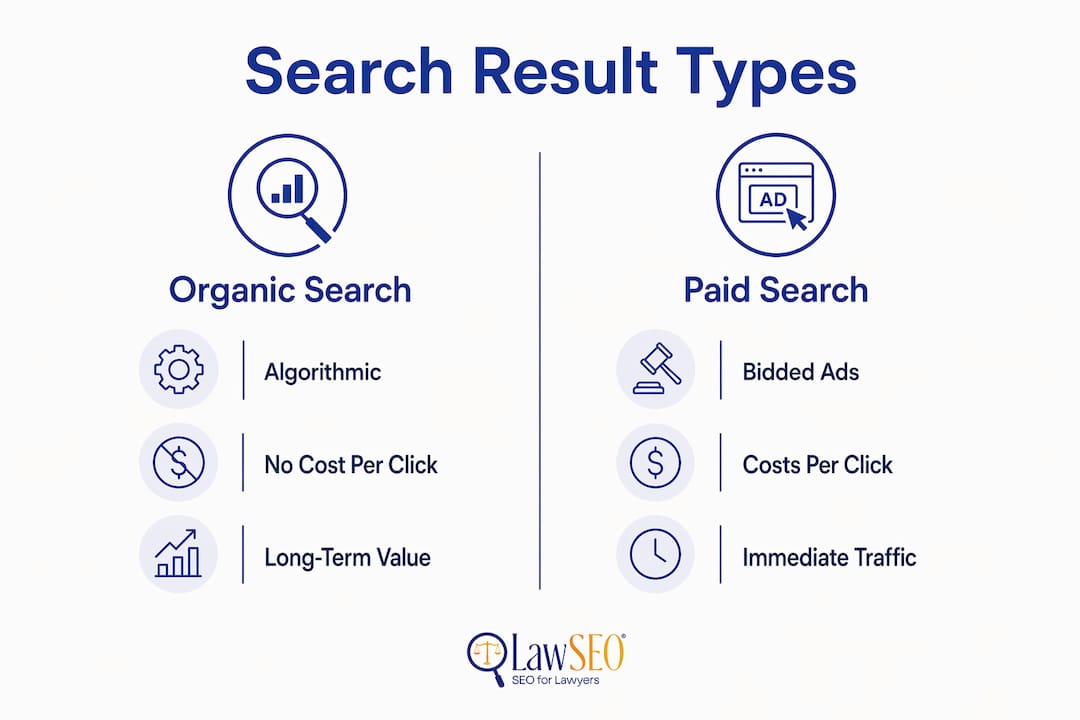
Here is a direct comparison of the two channels:
| Factor | Organic search | Paid search |
|---|---|---|
| Cost model | Recurring investment in content and SEO | Pay-per-click auction, ongoing spend |
| Placement | Below ads, no label | Top of page, labeled “Sponsored” |
| Speed to results | 4–18 months | Immediate |
| Durability | Persistent, compounds over time | Stops when budget stops |
| User trust | High | Lower |
| Long-term ROI | Increases over time | Flat or rising cost per lead |
Key advantages organic search holds over paid channels:
- Rankings build cumulative authority that paid ads cannot replicate
- Organic traffic continues even when marketing budgets tighten
- High-intent searchers click organic results at significantly higher rates
- Content assets created for SEO serve multiple channels simultaneously
How long does it take to build organic search visibility?
Organic SEO is an asset-building process, not a quick-win tactic. Organic SEO typically takes 4–8 months to generate meaningful traffic, with full competitive authority reached in 12–18 months. That timeline surprises many businesses expecting faster results.
The growth follows predictable stages:
- Foundation (months 1–3): Technical SEO audit and fixes, site architecture improvements, keyword research, and initial content production. Google begins crawling and indexing new pages, but rankings remain low.
- Momentum (months 4–8): Content volume grows, backlinks accumulate, and rankings for lower-competition terms improve. Traffic starts climbing. This is when most businesses see the first measurable organic leads.
- Authority (months 9–18): Topical authority deepens. Competitive keywords begin ranking on page one. Organic ROI surpasses paid ROI around months 7–8 with consistent investment, making this the crossover point most SEO strategies target.
- Compounding (18+ months): Established authority attracts links naturally. Rankings stabilize and expand. The cost per acquired lead continues to fall.
The investment components at each stage include content creation (articles, practice area pages, FAQs), technical optimization (site speed, schema markup, mobile performance), and link building (earning citations from authoritative external sites). Skimping on any one of these slows the entire process.
Typical risks for organic search include payoff uncertainty and wasted effort when a site’s technical foundation is poor. A slow, poorly structured website will not rank regardless of content quality. Technical health is the prerequisite, not an afterthought.
Pro Tip: Before investing in content, run a full technical SEO audit. Broken links, duplicate content, and slow page speed will cancel out even the best writing. Fix the foundation first, then build.
How has organic search evolved beyond traditional blue links?
The definition of organic search has expanded significantly. Modern organic search visibility now includes AI-generated answer panels, featured snippets, People Also Ask boxes, and conversational search interfaces, not just the classic list of ten blue links. This shift changes what it means to rank.
Google’s AI Overviews and tools like Perplexity and ChatGPT now surface answers directly in the search experience. Users get information without clicking through to a website. For businesses, this creates a new challenge: you must appear in AI-generated summaries, not just traditional results pages.
Optimizing for AI citations requires structuring content so that AI systems can extract clear, authoritative answers. That means using direct definitions, structured headings, schema markup, and entity-rich content that signals topical authority to both Google and generative AI systems.
Key practices for organic visibility in 2026:
- Write clear, direct answers in the first paragraph of every section
- Use structured data (schema) to label content types for search engines
- Build topical authority by covering subjects comprehensively, not superficially
- Optimize for AI-driven search features that now serve as primary discovery points for many users
- Earn citations from authoritative external sources to signal credibility to AI systems
“Organic content must be optimized for AI citations for maximum discovery. The search results page is no longer a list of links. It is an answer engine, and your content either feeds it or gets ignored by it.”
For law firms specifically, this evolution matters enormously. A potential client searching “personal injury lawyer near me” may receive an AI-generated summary naming specific attorneys. If your firm’s content does not meet the criteria for AI citation, you are invisible at the most critical moment in the client acquisition process.
How should businesses use organic search as a growth strategy?
Organic search is not a standalone tactic. Viewing organic and paid search as a portfolio strategy yields better marketing outcomes than treating them as competing choices. Paid search provides speed and real-time data for testing. Organic search builds durable visibility that paid advertising cannot replicate.
The most dangerous misconception is that organic search is free traffic. That framing leads businesses to under-invest, then wonder why results never materialize. Organic search requires a shift in cost structure: from variable pay-per-click spending to fixed investment in content, technical health, and authority building.
A sound organic search strategy rests on four pillars:
- Technical health: A fast, crawlable, mobile-friendly site is the baseline. Without it, no content strategy succeeds. Review technical SEO fundamentals before scaling content production.
- Topical authority: Publish content that covers your subject area deeply and consistently. Thin content does not rank in competitive markets.
- Link building: Earn backlinks from credible, relevant sources. Links remain one of Google’s strongest ranking signals.
- Performance measurement: Track organic traffic, keyword rankings, and conversion rates monthly. Use Google Search Console and Google Analytics to identify what is working and where gaps exist.
Businesses that treat organic search as an asset, rather than an expense, build a compounding advantage over competitors who rely solely on paid advertising. The authority building process takes time, but the result is a digital presence that generates leads without a per-click cost attached to every visitor.
Pro Tip: Run paid search campaigns during the first 6–12 months of an organic SEO program. Paid gives you immediate traffic and keyword data while organic authority builds. Then shift budget progressively as organic rankings take hold.
Key takeaways
Organic search is a long-term asset that requires sustained investment in content, technical health, and authority to deliver compounding returns that paid advertising cannot match.
| Point | Details |
|---|---|
| Organic search is earned, not bought | Rankings reflect relevance and authority, not ad spend, making them more trusted by users. |
| Paid and organic serve different roles | Use paid search for speed and testing; use organic search for durable, compounding visibility. |
| Timeline is 4–18 months | Expect meaningful traffic in 4–8 months and competitive authority in 12–18 months with consistent effort. |
| AI surfaces are now part of organic | Optimizing for AI answer panels and featured snippets is now required for full organic visibility. |
| “Free traffic” is a costly myth | Organic search demands real investment in content, links, and technical SEO to produce results. |
Why organic search still rewards patience more than any other channel
After nearly three decades working in SEO, I have watched businesses make the same mistake repeatedly: they treat organic search as a budget line item to cut when cash gets tight, then restart from scratch six months later. Every restart costs more than staying the course would have.
The firms that win in organic search, including the law firms I work with at Lawseo, share one trait. They commit to the process before they see results. They understand that the authority they build in month three pays dividends in month eighteen. That is not a comfortable investment posture for most businesses, but it is the only one that works.
The AI shift makes this even more urgent. Generative search tools are now selecting which sources to cite based on content structure, topical depth, and domain authority. Those signals take months to build. Firms that start now will be the ones cited by AI systems when a potential client asks for a recommendation. Firms that wait will find the door closed.
Organic search is not a marketing tactic. It is a business asset. Treat it accordingly.
— TODD
Lawseo’s approach to organic search for law firms
Law firm SEO operates in one of the most competitive organic search environments online. Every practice area, from personal injury to estate planning, attracts well-funded competitors fighting for the same first-page rankings. Lawseo works exclusively with attorneys and law firms, applying over 29 years of SEO experience to build the technical health, topical authority, and link profiles that drive sustainable organic growth.
Todd R. Stager personally reviews strategy for every client campaign, and Lawseo’s exclusivity model means your local competitors do not benefit from the same work. For firms ready to treat organic search as the long-term asset it is, the advanced SEO strategy guide for lawyers at Lawseo outlines exactly how that process works. You can also explore the full range of law firm SEO services built to deliver measurable, lasting results.
FAQ
What is the definition of organic search?
Organic search refers to the unpaid, algorithmically ranked results that appear on a search engine results page based on relevance, authority, and content quality. These listings are earned through SEO, not purchased through advertising.
How does organic search differ from paid search?
Organic search results are free to click and ranked by algorithm, while paid search results are labeled “Sponsored” and cost the advertiser money for each click. Only 5% of users consistently click paid ads, reflecting stronger trust in organic listings.
How long does organic search take to show results?
Organic SEO generates meaningful traffic in 4–8 months and reaches full competitive authority in 12–18 months. The ROI crossover point, where organic outperforms paid on cost per lead, typically occurs around months 7–8.
Is organic search really free?
Organic search is not free. It requires ongoing investment in content creation, technical SEO, and link building. Framing it as free traffic leads to under-investment and poor results.
Does organic search include AI-generated answers?
Yes. Modern organic visibility now includes AI-generated answer panels, featured snippets, and conversational search interfaces. Businesses must structure content for AI citation, not just traditional blue-link rankings.