


Many attorneys invest thousands in digital marketing without understanding the language their agencies use. When your SEO consultant mentions backlinks, schema markup, or Core Web Vitals, do you nod along while feeling uncertain about what these terms actually mean for your firm’s growth? This knowledge gap costs law firms real money and missed opportunities. SEO is a primary driver of new client leads for law firms, yet most attorneys lack the vocabulary to evaluate strategies, question recommendations, or measure results effectively. This guide clarifies the essential SEO concepts every legal professional needs to make informed marketing decisions and communicate confidently with digital teams.
Key Takeaways
| Point | Details |
|---|---|
| Know the language | Understanding key SEO terms is the foundation for smart legal marketing decisions. |
| Apply with confidence | Using SEO terms in agency communication and reports helps attorneys avoid costly mistakes. |
| Stay competitive | Regularly updating your SEO vocabulary ensures your law firm adapts to ongoing search engine changes. |
| Boost local visibility | Mastering concepts like local SEO directly impacts new client growth in your region. |
Why SEO terms matter for law firms
Legal SEO operates under unique constraints that general marketers rarely encounter. Bar association advertising rules, competitive practice areas, and geographic service boundaries create a specialized environment where standard SEO advice often falls short. Understanding the specific terminology allows you to navigate these complexities and make strategic decisions aligned with both marketing goals and ethical obligations.
Knowing SEO vocabulary transforms your relationship with digital agencies. You can evaluate proposals critically, identify red flags in monthly reports, and ask questions that reveal whether your marketing partner truly understands legal industry dynamics. When an agency discusses local pack rankings or citation consistency, you’ll recognize whether they’re addressing your actual business needs or delivering generic recommendations.
Consider this scenario: A personal injury firm invests heavily in content marketing but ignores local SEO optimization. They rank well for broad terms like “car accident lawyer” nationally but remain invisible when potential clients search “car accident lawyer near me” in their city. This misalignment happens when attorneys don’t understand the distinction between general organic visibility and location-specific optimization. The firm wastes budget competing in markets they can’t serve while missing qualified leads in their backyard.
Core SEO terminology appears everywhere in your marketing operations:
- Monthly performance reports from your agency
- Proposals from web developers and content creators
- Analytics dashboards tracking website performance
- Strategic planning sessions about marketing budget allocation
- Competitive analysis comparing your firm to rivals
Fluency in this language enables you to participate actively in these discussions rather than passively accepting recommendations. You’ll spot inconsistencies, challenge assumptions, and ensure your marketing investments align with firm growth objectives. Why SEO matters for lawyers extends beyond rankings to encompass the entire client acquisition process, and understanding the terminology puts you in control of that process.
Core SEO glossary for attorneys
Now that you know why SEO language is crucial, let’s define the basics, starting with the most common and law firm-relevant terms. These foundational concepts form the vocabulary you’ll encounter in virtually every marketing conversation.
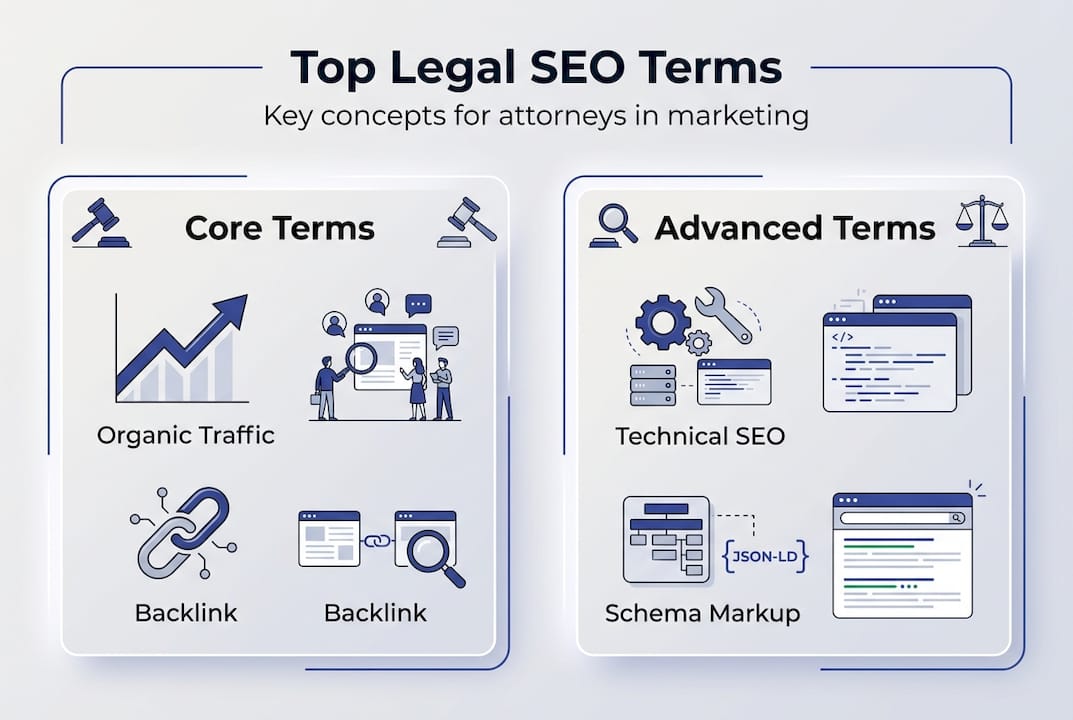
Organic Traffic: Visitors who find your website through unpaid search results rather than advertisements. For law firms, organic traffic represents potential clients actively searching for legal services. High organic traffic indicates strong visibility for relevant search queries and typically correlates with qualified lead generation.
Backlink: A link from another website pointing to your law firm’s site. Search engines view backlinks as votes of confidence, with links from authoritative legal directories, bar associations, and reputable publications carrying more weight. Quality backlinks remain one of the strongest ranking factors, though legal ethics rules restrict certain link-building tactics available to other industries.
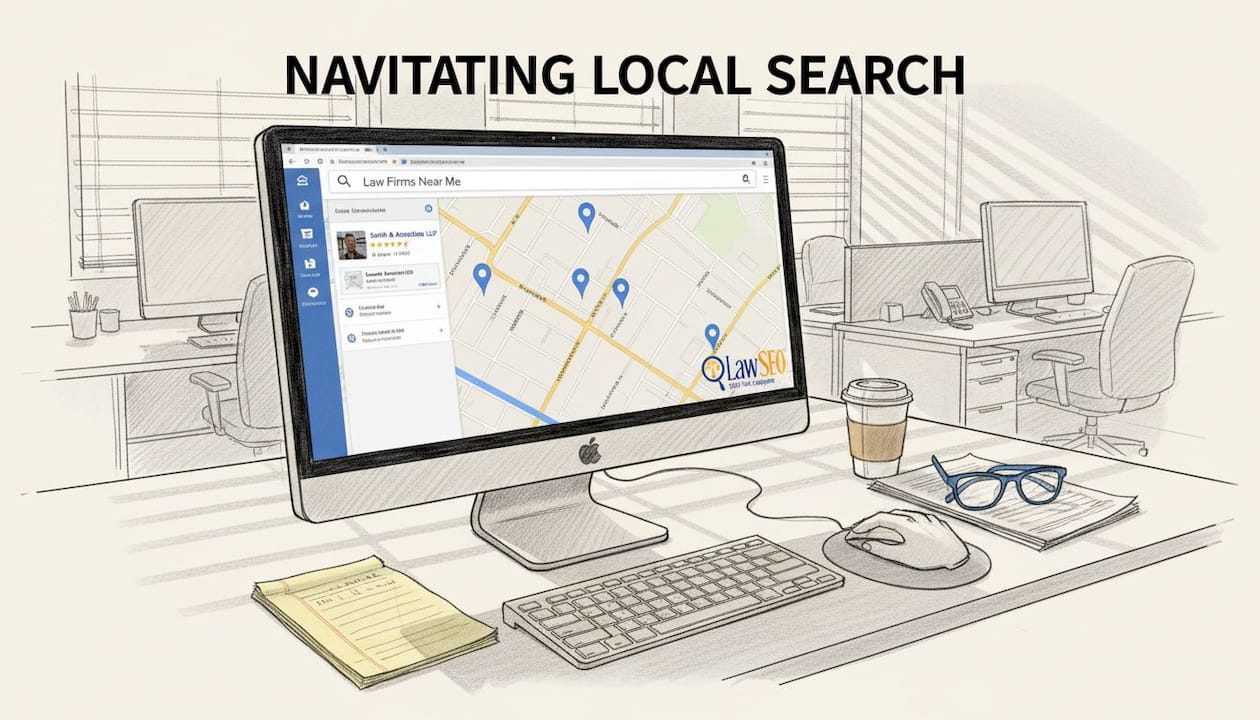
Local Pack: The map-based results appearing at the top of Google search results for location-specific queries. When someone searches “divorce attorney Chicago,” the three law firms displayed with map pins constitute the local pack. Appearing here dramatically increases visibility and click-through rates for local searches.
Meta Description: The brief text snippet appearing below your page title in search results. While meta descriptions don’t directly influence rankings, they significantly impact click-through rates. An effective meta description for a law firm page clearly states the legal service offered and includes a compelling reason to visit.
Authority: A measure of your website’s trustworthiness and expertise in search engine algorithms. Law firms build authority through consistent publication of high-quality legal content, backlinks from reputable sources, positive user engagement signals, and technical website optimization. Higher authority typically translates to better rankings across all practice area pages.
Keyword: The specific words and phrases people type into search engines. For attorneys, keywords range from broad terms like “criminal defense lawyer” to specific long-tail phrases like “expungement attorney for felony conviction in Dallas.” Effective legal SEO targets keywords matching your practice areas and geographic service area.
SERP (Search Engine Results Page): The page displaying results after someone performs a search. Understanding SERP features like featured snippets, knowledge panels, and local packs helps you optimize for maximum visibility beyond traditional organic listings.
On-Page SEO: Optimization elements you control directly on your website pages, including title tags, headings, content quality, internal linking, and image optimization. On-page SEO for lawyers forms the foundation of any successful legal marketing strategy.
Domain Authority: A predictive metric estimating how well a website will rank in search results. While not an official Google metric, domain authority provides a useful benchmark for comparing your site’s competitive strength against other law firms in your market.
| Term | Definition | Legal Application |
|---|---|---|
| Citation | Online mention of your firm’s name, address, and phone number | Essential for local SEO; must be consistent across directories |
| Schema Markup | Structured data code helping search engines understand page content | Enables rich results for attorney profiles, reviews, and practice areas |
| Crawl | Process where search engines discover and index web pages | Ensures your new practice area pages appear in search results |
| Index | Database of web pages search engines can display in results | Pages must be indexed to rank; check coverage in Google Search Console |
| Anchor Text | Clickable text in a hyperlink | Descriptive anchor text helps search engines understand linked page topics |
Key SEO elements for law firms are covered in advanced guides that explore implementation strategies beyond basic definitions. These foundational terms, however, provide the vocabulary baseline every attorney needs for productive marketing conversations.
Advanced SEO concepts for legal professionals
With fundamental terms defined, attorneys ready to go deeper can benefit from knowing these advanced concepts that separate basic optimization from sophisticated digital strategy.
Technical SEO encompasses the backend website elements affecting search engine crawling and indexing. This includes site speed optimization, mobile responsiveness, XML sitemaps, robots.txt configuration, and structured data implementation. For law firms, website security for legal SEO has become increasingly critical as search engines prioritize secure, fast-loading sites that protect client information.
Topic Clusters represent an evolved content strategy where you create a comprehensive pillar page covering a broad practice area, then develop multiple supporting pages addressing specific subtopics, all interlinked strategically. A personal injury firm might create a pillar page on car accident claims, with cluster content covering specific issues like determining fault, dealing with insurance adjusters, and calculating damages.
Core Web Vitals measure user experience through three specific metrics: loading performance, interactivity, and visual stability. Google now uses these metrics as ranking factors, meaning law firm websites must deliver smooth, fast experiences across all devices. Poor Core Web Vitals scores can suppress rankings even when content quality is excellent.
Schema Markup adds structured data to your website code, helping search engines understand specific information about your firm, attorneys, practice areas, and client reviews. Proper schema implementation can trigger enhanced search results displaying attorney credentials, star ratings, and practice area details directly in search listings.
AI Optimization involves structuring content to appear in responses from ChatGPT, Google’s AI Overviews, and other generative AI platforms. As potential clients increasingly use AI tools for initial legal research, law firm website structure must accommodate both traditional search engines and AI-driven discovery.
| Basic Concept | Advanced Equivalent | Strategic Difference |
|---|---|---|
| Keyword targeting | Semantic search optimization | Focuses on topic comprehensiveness and user intent rather than exact keyword matching |
| Link building | Digital PR and authority building | Earns links through newsworthy content and relationship development rather than directory submissions |
| Content creation | Content experience optimization | Considers page layout, multimedia elements, and user engagement beyond text quality |
| Local listings | Entity optimization | Establishes your firm as a recognized entity across multiple platforms and knowledge graphs |
Pro Tip: Legal ethics rules significantly impact advanced SEO tactics. Bar associations prohibit certain link exchange practices, restrict testimonial usage, and regulate how you can describe case results. Always vet advanced SEO strategies against your jurisdiction’s advertising rules before implementation. An effective legal SEO partner understands these constraints and designs compliant strategies that still deliver competitive results.
Signs your agency uses advanced SEO effectively:
- They discuss user intent and search journey mapping, not just keyword rankings
- Monthly reports include technical metrics like page speed and crawl errors alongside traffic data
- Content recommendations align with your actual practice strengths and case types
- They proactively address mobile experience and site security
- Strategy adapts to algorithm updates and emerging search features
- They understand legal advertising ethics and build compliant campaigns
How law firms apply SEO terms in practice
With a working knowledge of these terms, here’s how attorneys can apply them to their firm’s marketing operations and make data-driven decisions that improve results.
Step 1: Audit Your Agency Reports
Open your most recent SEO report and identify every metric mentioned. Do you understand what each number represents and why it matters? Look for organic traffic trends, keyword ranking changes, backlink acquisition, and local pack performance. If your report shows “50 new backlinks acquired” but doesn’t specify their source or quality, you now know to ask for that context.
Step 2: Evaluate Web Development Proposals
When reviewing proposals for website redesigns or new practice area pages, assess whether vendors address technical SEO fundamentals. Do they mention mobile optimization, page speed, schema markup, and proper heading structure? A proposal focused solely on visual design without addressing these elements reveals a vendor who doesn’t understand modern search requirements.
Step 3: Set Meaningful KPIs
Establish key performance indicators using proper SEO terminology. Instead of vague goals like “improve online presence,” specify measurable targets: increase organic traffic by 30%, achieve local pack rankings for five priority practice areas, or earn 20 high-authority backlinks from legal publications. Clear KPIs enable accurate progress tracking and accountability.
Step 4: Conduct Competitive Analysis
Use your SEO vocabulary to analyze competitor strategies systematically. Compare domain authority scores, evaluate their content depth on shared practice areas, identify their backlink sources, and assess their local SEO optimization. This analysis reveals opportunities where you can differentiate and outperform rivals.
Pro Tip: The most common mistake attorneys make is confusing impressions with clicks in performance reports. Impressions measure how often your site appears in search results, while clicks measure actual visits. High impressions with low clicks indicate visibility without compelling reasons to visit. Focus on improving meta descriptions and title tags to convert impressions into traffic.
Lawyers should prioritize on-page and technical SEO for measurable growth, and understanding the terminology enables you to direct resources toward high-impact activities rather than superficial tactics that look impressive but deliver minimal results.
Next steps: Leveraging your SEO vocabulary for firm growth
To wrap up, let’s focus on what you can do now to use your SEO knowledge for immediate impact and long-term competitive advantage.
Search algorithms evolve constantly, with Google implementing thousands of updates annually. Your SEO vocabulary must stay current to remain effective. Subscribe to reputable legal marketing publications, attend industry conferences focused on law firm growth, and schedule quarterly reviews of your SEO glossary to add emerging terms and concepts.
Immediate action items for applying your SEO knowledge:
- Schedule monthly SEO review meetings with your marketing team using proper terminology to discuss performance and strategy
- Create a shared glossary document for your firm, defining terms in the context of your specific practice areas and markets
- Integrate SEO vocabulary into staff training so everyone from partners to intake coordinators understands how online visibility drives growth
- Set up Google Analytics and Search Console dashboards tracking the metrics you now understand
- Audit your current website using your new knowledge to identify obvious optimization gaps
- Request detailed explanations from your agency for any terms or strategies you don’t fully grasp
The payoff for this investment in SEO literacy extends beyond better marketing results. Informed attorneys make smarter budget allocation decisions, avoiding wasteful spending on tactics that sound impressive but deliver poor returns. You’ll ask better questions during agency presentations, catching inconsistencies or unrealistic promises before signing contracts. When competitors outrank you for valuable search terms, you’ll understand why and know which strategic adjustments to prioritize.
Advanced and ongoing SEO understanding is vital for law firm success in an increasingly competitive digital landscape. The attorneys who master this vocabulary gain a decisive advantage, controlling their marketing destiny rather than depending entirely on external experts who may not fully understand legal industry dynamics.
How your law firm can get expert SEO support
For attorneys seeking guidance customized to their practice, here’s where specialized support makes all the difference. While understanding SEO terminology empowers better decision-making, implementing sophisticated strategies requires dedicated expertise and consistent execution that most law firms can’t maintain internally.
Professional legal SEO for law firms combines technical knowledge with deep understanding of legal industry constraints, competitive dynamics, and client acquisition patterns. The right partner doesn’t just execute tactics but educates you throughout the process, ensuring you understand the strategy behind every recommendation and can evaluate results using the vocabulary you’ve now mastered.
Consider exploring proven approaches through local SEO case studies that demonstrate how strategic optimization translates to measurable client growth. These real-world examples show the connection between technical implementation and business outcomes, helping you set realistic expectations and identify the strategies most relevant to your practice areas and markets.
Working with law firm SEO experts who specialize exclusively in legal marketing ensures your strategies remain compliant with advertising ethics while maximizing competitive advantage. Your new SEO vocabulary enables productive collaboration, allowing you to participate actively in strategy development and hold your marketing partners accountable for results that matter to your firm’s growth.
Frequently asked questions
What are the top 5 SEO terms every attorney should know?
The top 5 are local SEO, backlinks, organic traffic, meta description, and authority, all crucial for legal marketing success and client acquisition.
How does local SEO help law firms attract clients?
Local SEO optimizes your visibility for people searching legal services in your city or region, increasing qualified leads from your actual service area.
Is technical SEO important for small law firms?
Yes, strong site structure and technical SEO boost rankings and are essential regardless of firm size or practice area focus.
Why do attorneys need to know SEO terminology?
Fluency in SEO terms prevents misunderstandings, making it easier to assess agency results and ensure optimal marketing spend that drives real growth.
Where can attorneys learn more about law firm SEO?
Explore advanced guides and industry case studies designed specifically for the legal field and addressing unique challenges attorneys face online.