


TL;DR:
- Effective off-page SEO for law firms involves earning authoritative backlinks, accurate directory listings, and genuine brand mentions. Building community ties and media presence further enhances trust signals that Google highly values in competitive legal markets. Consistent measurement of rankings, referral traffic, and brand mentions ensures sustained off-page authority growth.
Most attorneys invest significant time and budget into on-page SEO: refining keywords, polishing meta descriptions, and optimizing page titles. But search rankings for law firms are not decided by on-page work alone. The websites that consistently rank above yours and capture the clients you want are almost always winning the off-page battle. Off-page SEO, which covers everything from inbound links and legal directory listings to brand mentions and media coverage, signals to Google that your firm is authoritative, credible, and trustworthy. This article covers the core off-page tactics that consistently move the needle for legal practices.
Key Takeaways
| Point | Details |
|---|---|
| Focus on authority | Genuine authority links and mentions far outweigh high volumes of basic directory listings. |
| Leverage trusted directories | Prioritize established legal directories that consumers and Google both trust. |
| Brand mentions build trust | Strategic media and PR mentions quickly boost your firm’s credibility for both clients and search engines. |
| Track relevant metrics | Use up-to-date SEO tools focused on authority and relevance, not just link quantity. |
What is off-page SEO and why does it matter for law firms?
Off-page SEO refers to all the actions taken outside your own website that influence how Google and other search engines rank your pages. While you control your site’s content and technical structure, off-page signals come from third parties: other websites linking to you, directories listing your firm, journalists citing your expertise, and users mentioning your name across the web.
For law firms specifically, these external signals carry exceptional weight. Legal services represent one of the most competitive categories in local and national search. A personal injury attorney in Dallas or a family law practice in Chicago competes against dozens of equally polished websites. In this environment, on-page quality creates a baseline, but off-page authority is what pushes you to the top of results.
Google evaluates law firm authority through a framework called E-E-A-T, which stands for Experience, Expertise, Authoritativeness, and Trustworthiness. While your content demonstrates experience and expertise, the external web demonstrates authoritativeness and trustworthiness. According to current SEO guidance, quality trumps link quantity, with brand mentions and E-E-A-T signals growing in importance as AI systems increasingly prioritize topical authority over raw link counts.
Key signals Google uses to evaluate your law firm’s off-page authority include:
- Inbound links from reputable legal websites, bar associations, and news outlets
- Legal directory listings on platforms like Justia, Avvo, and FindLaw
- Unlinked brand mentions across news articles, blog posts, and forum discussions
- Social proof signals including reviews on Google Business Profile and third-party sites
- Local citations that confirm your firm’s name, address, and phone number (NAP) across the web
“In competitive legal markets, building off-page authority is not optional. It is the mechanism by which Google separates established, trusted practices from everyone else.”
Understanding brand mentions and trust signals is increasingly important, particularly as AI-driven search platforms scan the broader web for evidence that your firm is genuinely recognized within your practice area.
Proven off-page SEO tactics for law firms
Given how strategic off-page SEO is, which tactics actually move the needle for law firm sites? The answer depends on your practice area, geographic market, and competitive landscape. But the following approaches have demonstrated consistent results across legal practices of all sizes.
Guest posting on authoritative legal sites
Publishing content on respected legal publications and bar association blogs earns you editorially placed links, which carry far more authority than links you can simply purchase or self-place. Targets include state and local bar association websites, established legal blogs in your practice area, and publications like Above the Law or law school alumni networks. Each article you contribute positions you as a subject matter expert while creating a durable link back to your firm’s website.
Legal directory listings
Directories remain a foundational element of local off-page SEO for law firms. The best legal directories provide both direct referral traffic and authoritative backlinks. Justia, Avvo, FindLaw, Martindale-Hubbell, and Lawyers.com are among the highest-value platforms. Critically, your directory profiles should be fully completed with accurate NAP data, practice area descriptions, attorney bios, and client reviews where permitted.
HARO and media outreach
Help a Reporter Out (HARO) connects journalists with expert sources. Attorneys who respond promptly and substantively to relevant queries frequently earn citations in major news publications, which generate high-authority links and significant brand exposure. Media mentions in outlets like Reuters, Bloomberg Law, or regional newspapers signal expertise to both users and search algorithms.
Pro Tip: Create a dedicated response template for HARO queries in your practice area, emphasizing your credentials and offering specific, quotable insights. Journalists under deadline appreciate brevity and precision, qualities that legal professionals are well-positioned to deliver.
Local sponsorships and community partnerships
Sponsoring local events, charitable organizations, or community programs often results in links from .org and municipal websites, which carry substantial trust signals. A family law firm sponsoring a local nonprofit or a personal injury practice supporting a community 5K race can earn links from high-trust local domains that would be otherwise impossible to obtain through outreach alone.

Niche edits and strategic link placement
Niche edits involve placing your link within existing, already-indexed content on relevant legal or local websites. Unlike guest posts, these insertions leverage the existing authority of established pages. When executed ethically and selectively, niche edits through a structured workflow can accelerate authority building faster than waiting for new content to accumulate links organically.
According to established off-page SEO guidance, effective law firm link building incorporates guest posting, niche edits, directory listings, local sponsorships, and HARO responses as a coordinated strategy rather than isolated efforts.
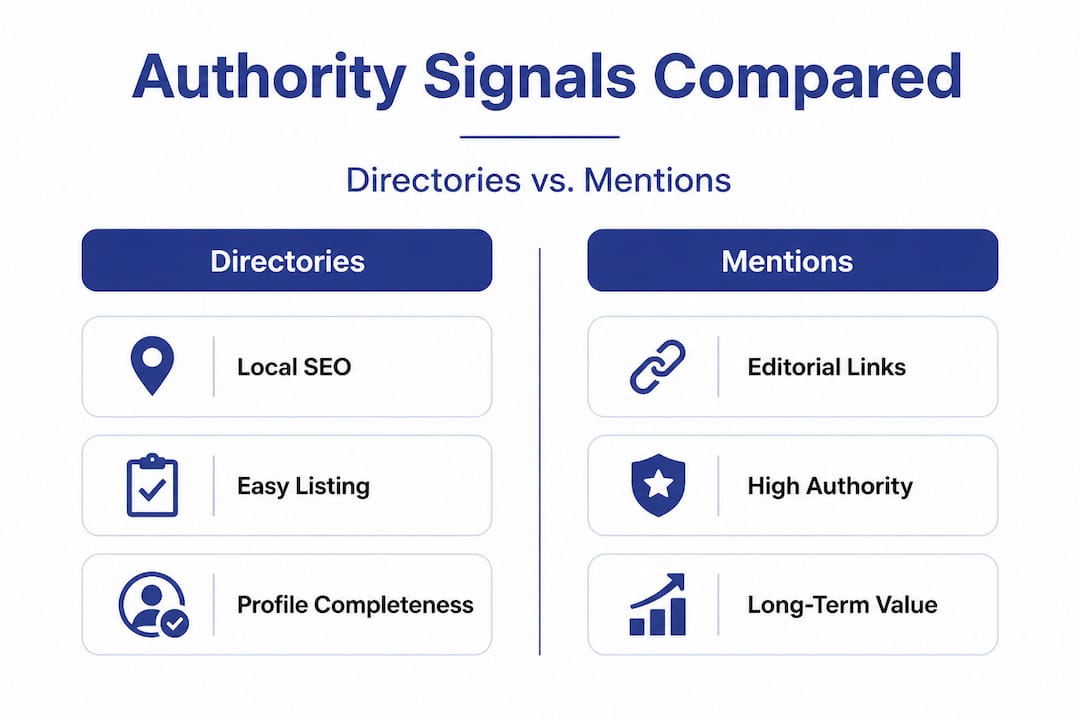
Legal directories and authoritative mentions: A comparison
Among the many tactics, legal directories and third-party mentions spark the most debate. Here’s how they stack up for your firm.
| Signal type | Authority value | Local SEO impact | Ease of acquisition | Longevity |
|---|---|---|---|---|
| Justia / Avvo / FindLaw | High | High | Moderate | Long-term |
| Bar association sites | Very High | High | Low (merit-based) | Long-term |
| Media / news mentions | Very High | Moderate to High | Low (earned) | Long-term |
| General web directories | Low | Low | Easy | Short-term |
| Niche legal blogs | High | Moderate | Moderate | Long-term |
| Community sponsorships | Moderate to High | Very High | Moderate | Long-term |
As the table illustrates, not all directory listings carry equal weight. Directories remain valuable for local SEO, but only when you stick to reputable platforms and avoid spammy general directories that can dilute your link profile. A listing on a low-quality directory that accepts any business without editorial review offers little benefit and can even create negative associations for your domain.
Proper directory optimization goes beyond simply claiming a profile. You need to ensure every detail is accurate and consistent across all platforms, select the correct practice areas, upload professional photos, and actively solicit client reviews where the platform allows.
Brand mentions operate somewhat differently. Even when a news article or blog post cites your firm’s name without a hyperlink, Google’s algorithms can recognize the mention as a trust signal. These unlinked mentions contribute to your overall entity authority, essentially confirming that your firm exists, operates in a specific market, and is recognized by credible sources.
Key considerations when evaluating your brand mentions and off-page trust signals:
- Relevance: A mention from a legal news site matters more than one from a general lifestyle blog
- Domain authority: Citations from high-authority domains carry greater weight
- Context: Mentions that reference your practice area and location reinforce your topical and local relevance
- Frequency: A pattern of consistent mentions over time builds cumulative authority
Evaluating and tracking off-page SEO success
To ensure your off-page SEO pays off, you need strong measurement. Here’s how smart firms do it now.
Many law firms make the mistake of tracking the wrong metrics. Raw link counts, total referring domains, or directory listings completed are not meaningful measures of off-page SEO performance on their own. What actually matters is whether those signals translate into improved rankings, increased organic traffic, and ultimately more qualified leads.
Here is a practical, modern approach to tracking off-page SEO performance:
-
Monitor domain authority trends. Use tools like Ahrefs, Moz, or SEMrush to track how your domain authority score changes over time as you acquire new links. Look for steady upward movement rather than sudden spikes, which can indicate artificial link building.
-
Audit link quality regularly. Review your backlink profile quarterly to identify and disavow any low-quality or spammy links that could harm your rankings. Focus on the ratio of high-authority links to total links rather than raw counts.
-
Track local ranking positions. Use local rank trackers to monitor how your firm ranks in your target city or region for key practice-area terms. Local pack rankings in Google Maps are heavily influenced by off-page signals including citations and directory consistency.
-
Measure referral traffic from directories. Google Analytics will show you how much traffic arrives via Avvo, FindLaw, Justia, and other platforms. This helps you identify which directories generate actual visits versus which ones offer purely SEO value.
-
Monitor brand mention volume. Tools like Google Alerts, Mention.com, and Brand24 let you track when your firm is cited across the web. Tracking mention velocity over time reveals whether your PR and outreach efforts are generating real visibility.
Pro Tip: Set up a simple monthly tracking dashboard that captures four core metrics: new referring domains, local ranking positions for your top ten keywords, referral traffic from legal directories, and new brand mentions. This gives you a clear, actionable view of off-page momentum without getting lost in data overload.
Current guidance on best local SEO tools for lawyers highlights platforms that consolidate these signals into single dashboards, saving significant time for busy legal marketing teams.
| Metric | Why it matters | Recommended tool |
|---|---|---|
| Domain authority score | Reflects cumulative link equity | Ahrefs, Moz |
| Local pack rankings | Measures local search visibility | BrightLocal, Whitespark |
| Referral traffic from directories | Validates directory ROI | Google Analytics |
| New referring domains per month | Tracks link acquisition pace | Ahrefs, SEMrush |
| Brand mention volume | Measures authority and PR reach | Google Alerts, Mention |
Because AI systems prioritize topical authority rather than sheer link counts, tracking the thematic relevance of your incoming links matters as much as tracking volume. Links from sources discussing legal topics, your specific practice area, or your geographic market carry compounding value in 2026’s AI-influenced search environment.
The overlooked levers in law firm off-page SEO
Most law firms that invest in off-page SEO follow a familiar playbook: claim a few directory listings, maybe commission one guest post per month, and call it done. That approach no longer separates you from competitors who are doing exactly the same thing.
The firms that dominate their markets are building genuine off-page authority through channels that most legal marketers ignore. Real community presence, for example, generates a category of links and mentions that no amount of outreach can replicate. When a law firm actively sponsors local youth sports leagues, funds law school scholarships, or participates in bar association continuing education programs, the resulting links come from high-trust institutions with deep local roots. These are the kinds of real-world link building relationships that Google’s algorithms are specifically designed to reward, because they cannot be easily manufactured or purchased.
The second overlooked lever is strategic PR. Most law firms think about public relations purely in terms of brand image. In practice, a single well-placed article in a regional business publication or a quoted comment in a major news story generates more SEO authority than months of directory maintenance. Law firms with genuine expertise in emerging areas like AI liability, cannabis law, or cryptocurrency regulation have an enormous opportunity to position attorneys as go-to media sources, generating a steady stream of earned mentions that would cost tens of thousands of dollars to replicate through paid link building.
The third lever is the most counterintuitive: unlinked mentions can matter as much as linked ones in the current AI-driven environment. Google’s natural language processing capabilities mean that when your firm’s name appears in context alongside your practice area and city, it registers as an authority signal even without a hyperlink. Focusing exclusively on link acquisition while ignoring earned media and community presence leaves significant authority on the table.
The uncomfortable truth is that off-page SEO for law firms is fundamentally a reputation-building discipline. Firms that treat it as a purely technical exercise, chasing links and directory entries in isolation, will always be outpaced by competitors who understand that genuine market authority, built through real relationships, community involvement, and media expertise, translates directly into search dominance.
Ready to elevate your law firm’s results?
Implementing the strategies covered in this article requires both technical knowledge and consistent execution over time. At LawSEO.com, we specialize exclusively in SEO and digital marketing for attorneys and law firms, so every recommendation we make is grounded in the specific competitive realities of legal search. From comprehensive law firm marketing strategies to targeted directory optimization services, our team brings over 29 years of SEO experience to your practice. Contact us to learn how we can build a customized off-page strategy that positions your firm as the recognized authority in your market.
Frequently asked questions
What are the most important off-page SEO strategies for law firms?
The most essential strategies include building links from respected legal sites, getting listed in trusted legal directories like Justia, Avvo, and FindLaw, and securing high-quality brand mentions through guest posting, media outreach, and local sponsorships.
Do all directory listings help law firm SEO?
No, only reputable directories like Justia, Avvo, and FindLaw meaningfully boost SEO. Spammy directories can actually dilute your link profile and should be avoided entirely.
What matters more: link quantity or quality?
Quality links from authoritative, topically relevant sources matter far more than quantity. As AI prioritizes topical authority, a single link from a respected legal publication outweighs dozens of links from low-authority sources.
How long does off-page SEO take to show results for law firms?
Most law firms see measurable improvements in rankings and organic traffic within 3 to 6 months of consistent off-page activity, though results vary based on your competitive market and the quality of strategies executed.