


TL;DR:
- E-E-A-T in SEO stands for Experience, Expertise, Authoritativeness, and Trustworthiness, which Google uses to assess content credibility. It relies on proxy signals like backlinks, content freshness, and user engagement rather than being a direct ranking factor. Demonstrating genuine experience and transparent credibility is crucial, especially for YMYL topics like legal content, to build lasting search visibility.
E-E-A-T in SEO is defined as Experience, Expertise, Authoritativeness, and Trustworthiness, the four-pillar framework Google uses to evaluate content quality and credibility across the web. Google’s Search Quality Rater Guidelines formalize this framework, directing human evaluators to assess whether content creators have genuine, demonstrable knowledge of their subject. The framework expanded in December 2022 when Google added “Experience” to the original E-A-T, signaling that first-hand, real-world involvement with a topic carries distinct value beyond theoretical knowledge alone. For digital marketers and SEO professionals, understanding E-E-A-T is not optional. It shapes how Google’s algorithms reward content, how AI-driven search surfaces results, and how users decide whether to trust your site.
What is E-E-A-T in SEO and why does it matter?
E-E-A-T is the lens through which Google’s quality raters judge whether a page deserves to rank. It is not a score, a plugin setting, or a checklist item you complete once. It is a signal ecosystem that Google’s algorithms approximate through proxy indicators like backlinks, content freshness, engagement patterns, and spam detection.
The practical stakes are high. Google’s Helpful Content System and Core Updates reward content embodying E-E-A-T qualities more explicitly than earlier algorithm iterations. AI-driven search platforms, including Google’s AI Mode and SGE, pull from content that demonstrates these same qualities when generating cited responses. If your content lacks credible authorship, verifiable expertise, or transparent publishing practices, it is at a structural disadvantage regardless of keyword optimization.
For law firms and legal marketers specifically, E-E-A-T carries extra weight. Legal content falls under YMYL (Your Money or Your Life) topics, where Google assigns greater scrutiny to content accuracy and source credibility. A personal injury attorney’s practice area page is evaluated far more rigorously than a recipe blog post.
Breaking down the four pillars: experience, expertise, authority, and trust
Each pillar of E-E-A-T plays a distinct role in how Google and its quality raters assess content. Understanding each one separately prevents the common mistake of treating them as interchangeable.
| Pillar | Definition | Example | Why it matters |
|---|---|---|---|
| Experience | First-hand, real-world involvement with the topic | A lawyer writing about a case type they have personally litigated | Differentiates original content from aggregated summaries |
| Expertise | Formal qualifications or deep subject knowledge | A board-certified physician authoring medical content | Signals professional-grade accuracy |
| Authoritativeness | Industry recognition, citations, backlink profile | A law firm cited by state bar publications | Builds domain credibility over time |
| Trustworthiness | Accuracy, transparency, security, user safety | HTTPS, clear contact info, updated privacy policy | The foundational pillar; without it, the others lose value |
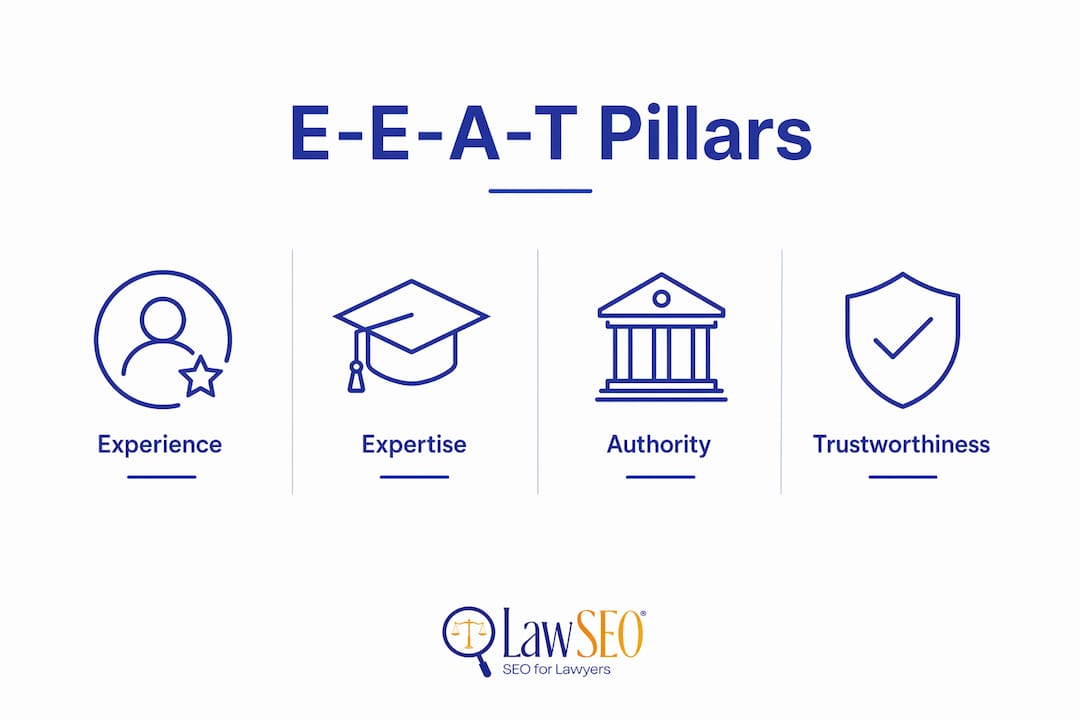
Experience requires concrete proof of direct involvement. Screenshots of actual work, case study data, original test results, and user-generated content all qualify. Generic claims like “we have years of experience” do not. Evidentiary experience means showing, not telling.
Expertise covers formal credentials and demonstrated depth of knowledge. A tax attorney writing about IRS audit procedures carries more expertise signal than a generalist content writer covering the same topic. Author bios that list bar admissions, publications, and speaking engagements communicate expertise directly to quality raters.
Authoritativeness is measured largely through backlink profiles and recognition from trusted industry sources. Backlinks from credible sources signal authoritativeness and influence E-E-A-T perception indirectly. A single citation from a state bar journal or a legal news outlet carries more weight than dozens of links from unrelated directories.
Trustworthiness is the pillar that holds the others together. Untrustworthy pages can have low E-E-A-T regardless of how experienced or credentialed the author is. Trust includes factual accuracy, transparent publishing practices, site security, and clear editorial standards.
Pro Tip: Add a structured author bio to every content page. Include credentials, professional affiliations, and a link to a verifiable profile such as a LinkedIn page or state bar directory listing. This single change communicates expertise and trust simultaneously.
How Google uses E-E-A-T: quality raters, algorithms, and ranking impact
A common misconception is that E-E-A-T is a direct ranking factor Google calculates and applies to each page. It is not. E-E-A-T is a framework used by human quality raters to evaluate search result quality, not a score that feeds directly into the ranking algorithm.
What Google’s algorithms do instead is measure proxy signals that correlate with high E-E-A-T content:
- Backlink quality and quantity from authoritative, topically relevant domains
- Content engagement signals including time on page, return visits, and low bounce rates
- Content freshness measured by update frequency and publication recency
- Spam and manipulation detection through systems like SpamBrain
- Structured data and schema markup that clarifies authorship and content type
“E-E-A-T is best understood as what Google wants raters to notice, not a manipulable algorithm factor.” The implication is direct: you cannot game E-E-A-T through technical tricks. You build it through genuine content quality and verifiable credibility signals over time.
YMYL topics receive the most rigorous E-E-A-T scrutiny. Finance, health, and legal content all fall into this category. For a law firm’s website, every practice area page, blog post, and FAQ is evaluated through this heightened lens. The importance of E-A-T guidelines for YMYL content means that thin, unattributed legal articles carry real ranking risk, not just quality concerns.
Google’s AI Mode and generative search features compound this dynamic. AI-generated summaries pull from content that already demonstrates strong E-E-A-T signals. If your firm’s content is not trusted by Google’s quality systems, it will not appear in AI-cited responses either.
How to implement E-E-A-T in your SEO strategy
Building E-E-A-T is a long-term content and reputation strategy. The following steps address each pillar with specific, verifiable tactics.
-
Audit your author credentials. Every content page should have a named author with a bio that lists relevant qualifications, professional experience, and verifiable affiliations. Anonymous content fails the expertise and experience tests immediately.
-
Produce original evidence. Replace generic claims with original research, case outcomes (where ethically permissible), client testimonials, and screenshots. Original evidence like case studies is what separates content that passes quality rater review from content that does not.
-
Build authoritative backlinks. Pursue citations from legal directories like Avvo and Martindale-Hubbell, state bar publications, local news outlets, and legal trade associations. Each credible link strengthens your domain’s authority signal. Review how client testimonials affect SEO for law firms as an additional trust-building tactic.
-
Secure your site and publish transparently. HTTPS is non-negotiable. Add a clear privacy policy, a terms of service page, and a contact page with a physical address and phone number. Transparent publishing practices including contact information and security measures directly bolster trustworthiness scores in quality rater evaluations.
-
Update content regularly. Outdated legal information is a trust liability. Set a content review calendar and add “last updated” timestamps to practice area pages and blog posts. Freshness signals matter to both algorithms and human readers.
-
Avoid superficial E-E-A-T audits. Sprinkling phrases like “our experienced attorneys” throughout a page does not satisfy quality raters. Substantive experience must be demonstrable and verifiable through concrete proof, not marketing language.
Pro Tip: Use schema markup for author entities and legal service pages. Schema helps Google’s algorithms connect your content to verified author profiles and business entities, strengthening the algorithmic proxy signals that approximate E-E-A-T.
Comparing E-A-T and E-E-A-T: what the added Experience changes
Google’s original E-A-T framework, introduced in the 2014 Search Quality Rater Guidelines, covered Expertise, Authoritativeness, and Trustworthiness. For years, SEO professionals built content strategies around these three pillars. In December 2022, Google added Experience to create E-E-A-T, and the addition was not cosmetic.
| Framework | Components | Content implication | When it applies |
|---|---|---|---|
| E-A-T (pre-2022) | Expertise, Authoritativeness, Trustworthiness | Credentials and citations were sufficient | All content types |
| E-E-A-T (2022 onward) | Experience + Expertise, Authoritativeness, Trustworthiness | First-hand proof of involvement now required | All content, especially YMYL |
The distinction between Experience and Expertise is specific. Expertise means you have studied and know a subject deeply. Experience means you have done it. A personal injury attorney who has litigated 200 cases brings both. A content writer who researched personal injury law for a week brings neither. The added Experience pillar differentiates practical knowledge from pure theoretical expertise, increasing content usefulness for real users.
This change matters most in an AI-saturated content environment. Generative AI tools can produce technically accurate, well-structured content on almost any topic. What AI cannot produce is genuine first-hand experience. A blog post written by an attorney who personally handled a specific type of case, complete with real outcomes and original observations, is structurally differentiated from AI-generated content in ways that quality raters can identify and that algorithms increasingly reward.
For SEO professionals advising clients, this means the content brief has changed. You are no longer just specifying keyword targets and word counts. You are specifying the evidence of experience that must appear in the content, and who is qualified to provide it.
Key takeaways
E-E-A-T in SEO requires demonstrable experience, verifiable expertise, earned authority, and transparent trustworthiness to satisfy Google’s quality standards and improve search visibility.
| Point | Details |
|---|---|
| E-E-A-T definition | Experience, Expertise, Authoritativeness, and Trustworthiness form Google’s content quality framework. |
| Trust is foundational | Untrustworthy pages score low on E-E-A-T regardless of credentials or content depth. |
| Not a direct ranking factor | Google uses proxy signals like backlinks and engagement to approximate E-E-A-T algorithmically. |
| Experience requires proof | Screenshots, case studies, and original data demonstrate Experience; generic claims do not. |
| YMYL content faces higher scrutiny | Legal, health, and finance content receives the most rigorous E-E-A-T evaluation from quality raters. |
Why trust is the pillar SEO professionals underestimate most
After nearly three decades working in SEO, I have watched practitioners chase every algorithm update with tactical fixes. E-E-A-T is different, and the reason is trust. Most SEO teams invest heavily in backlink acquisition and content production, but they underinvest in the signals that communicate basic credibility: named authors, transparent contact information, clear editorial policies, and content that is corrected when it is wrong.
The Experience addition in 2022 confirmed what I had observed for years in competitive legal SEO. The firms that consistently outrank their competitors are not the ones with the most content. They are the ones whose attorneys are visibly present in the content, whose case results are documented, and whose sites communicate institutional credibility at every touchpoint. That is a competitive moat that no content farm can replicate.
AI-driven search makes this more urgent, not less. When Google’s AI Mode or Perplexity cites a source, it is drawing from content that has already passed a credibility threshold. If your firm’s content does not meet that threshold, you are invisible in the fastest-growing search channel. The SEO ranking factors for law firms in 2025 and beyond are increasingly weighted toward exactly these trust and authority signals.
The firms that treat E-E-A-T as a strategic mindset rather than a quarterly audit item are the ones building durable search visibility. The ones treating it as a checklist are the ones calling me after a Core Update.
— TODD
How Lawseo helps law firms build E-E-A-T that ranks
Law firm content operates in the highest-scrutiny YMYL category, where weak E-E-A-T signals translate directly into lost rankings and lost clients. Lawseo specializes exclusively in legal SEO, applying E-E-A-T principles across every campaign through attorney-credentialed content, citation building, and reputation management. Todd R. Stager personally reviews every strategy, bringing 29 years of SEO experience to campaigns that require both technical precision and legal sector knowledge. If your firm needs stronger authority signals and better search visibility, explore the proven legal SEO strategies Lawseo uses to help attorneys outrank their competitors. You can also review the full scope of legal SEO services built specifically for law firms.
FAQ
What does E-E-A-T stand for in SEO?
E-E-A-T stands for Experience, Expertise, Authoritativeness, and Trustworthiness. It is the framework defined in Google’s Search Quality Rater Guidelines to evaluate content quality and credibility.
Is E-E-A-T a direct Google ranking factor?
E-E-A-T is not a direct ranking factor or a single score Google calculates. Google’s algorithms use proxy signals like backlinks, content quality, and engagement to approximate E-E-A-T indirectly.
How does E-E-A-T differ from the original E-A-T?
Google added “Experience” to the original E-A-T framework in December 2022 to emphasize first-hand, real-world involvement with a topic, distinguishing it from theoretical expertise alone.
Why is E-E-A-T especially important for law firm websites?
Legal content falls under YMYL (Your Money or Your Life) topics, where Google applies heightened E-E-A-T scrutiny because inaccurate information can directly harm users’ financial, legal, or physical well-being.
How do you demonstrate Experience for E-E-A-T purposes?
Experience requires concrete proof such as case studies, original data, screenshots, or documented outcomes. Generic claims of experience do not satisfy Google’s quality rater standards.