


TL;DR:
- Effective legal content strategy focuses on outcome-oriented planning aligned with business goals, audience needs, and ethical standards. Compliance, attorney review, and regular updates are essential for building trust and search visibility in 2026. Measuring performance through traffic, engagement, and conversions guides continuous optimization and long-term success.
Most law firms treat content as a volume game. Publish more blog posts, cover more topics, and hope Google notices. That approach misses what legal content strategy actually means, and it leaves enormous growth on the table. Understanding what is legal content strategy requires shifting from output thinking to outcome thinking. A real strategy aligns every piece of content with specific business goals, audience needs, and ethical compliance requirements. This guide walks through the definition, compliance essentials, a practical step-by-step framework, and how AI is reshaping everything in 2026.
Key takeaways
| Point | Details |
|---|---|
| Strategy beats volume | Publishing fewer, well-targeted pieces outperforms high-volume content that lacks focus or audience alignment. |
| Compliance is non-negotiable | ABA Model Rules 7.1 through 7.3 govern every piece of legal marketing content, including AI-assisted drafts. |
| Build a step-by-step plan | Effective legal content development follows clear goals, audience research, topic planning, and a consistent refresh cycle. |
| AI requires attorney oversight | Law firms using AI to draft content must have attorneys review every output for accuracy and ethical compliance. |
| Measure and refine regularly | Traffic, leads, and engagement data should guide content audits and updates every 6 to 12 months. |
What is legal content strategy, defined
Legal content strategy is the deliberate planning, creation, management, and distribution of content that serves a law firm’s business objectives while meeting the ethical and regulatory standards of legal marketing. It is not simply writing articles about legal topics. It is a structured system that connects what your audience needs to know with what your firm wants to achieve.
The scope of legal content strategy covers several interconnected elements:
- Search engine optimization (SEO): Selecting and targeting keywords that potential clients actually search for, then creating content that satisfies both the search engine and the reader.
- Audience targeting: Identifying the specific client profiles your firm serves, including their industry, geography, legal problems, and decision-making behavior.
- Ethical compliance: Ensuring all content meets state bar requirements and ABA guidelines, including disclaimers, truthfulness standards, and restrictions on solicitation.
- Content formats: Choosing between blog posts, practice area pages, FAQs, video scripts, client alerts, and white papers based on what best serves the audience at each stage of their search.
- Distribution and promotion: Determining how content reaches the right people through organic search, email, social media, and earned media placements.
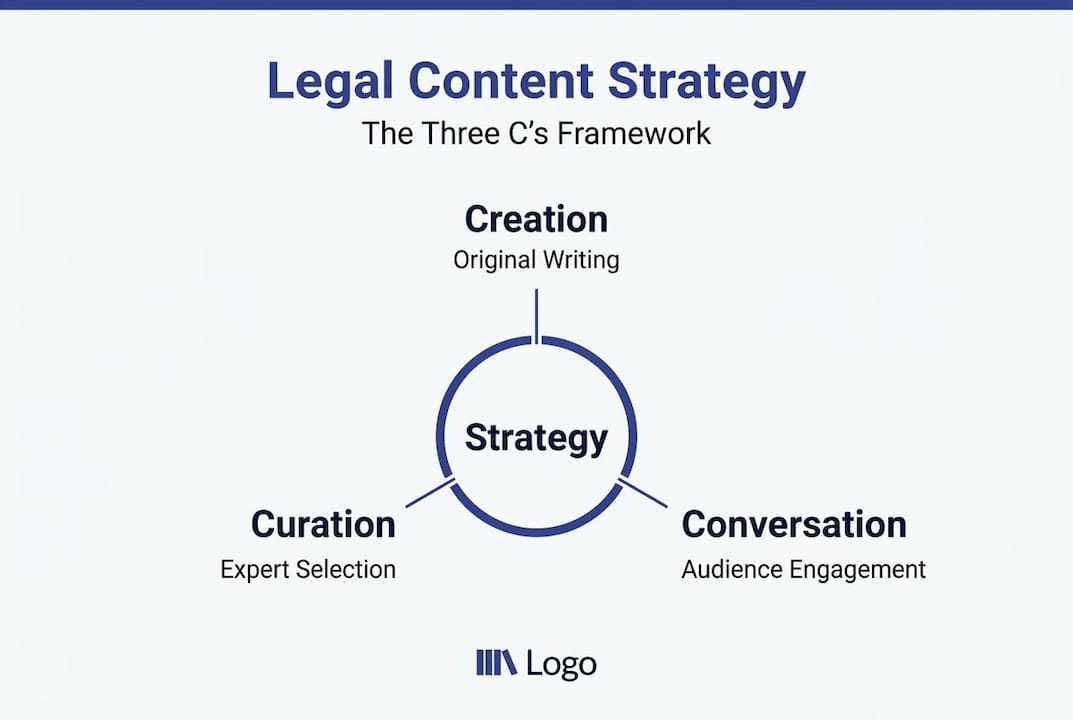
One practical framework is the three C’s applied to the legal context: Creation, Curation, and Conversation. Creation means producing original, authoritative content your audience cannot find elsewhere. Curation means organizing and amplifying existing high-value legal resources in a way that positions your firm as a trusted guide. Conversation means using content to prompt direct engagement, whether through contact forms, newsletter signups, or consultation requests.
The distinction between legal content strategy and general content marketing matters. General content marketing focuses on brand awareness and audience growth. Content strategy for lawyers carries an additional layer of responsibility because the stakes for the reader are real. A prospective client reading your article may make a legal decision based on it. That changes how you write, what you publish, and how carefully you review every claim.
Legal content compliance in 2026
Compliance is where many law firms stumble, and the consequences are serious. ABA Model Rules 7.1 through 7.3 require that all legal marketing communications be truthful, non-misleading, and properly disclaimed. Violating these rules can trigger state bar investigations, fee disputes, or unintended attorney-client relationships.
The most common compliance failures in legal content include:
- Missing or inadequate disclaimers: Every piece of content that touches on legal subjects should include a disclaimer stating the content does not constitute legal advice and does not create an attorney-client relationship.
- Jurisdiction errors: Content that implies your firm can practice in states where it is not licensed creates both ethical and liability exposure.
- Misleading outcome claims: Statements like “We win every case” or “Guaranteed results” violate Rule 7.1’s prohibition on false communications.
- Inadequate supervision of AI-generated content: AI content errors can cause competence and supervision violations when attorneys do not review drafts before publication.
Attorney review is not optional. Model Rule 7.1 prohibits false communications, and an AI tool can produce plausible-sounding but factually incorrect legal statements. The attorney whose name appears on that content or whose firm published it remains responsible.
Another compliance area that firms overlook is archiving. Event-driven archiving of published legal content provides timestamped proof of compliance, disclaimers, and content integrity at the time of publication. If a bar complaint arises six months after an article goes live, your live website may have changed. Archived versions serve as your evidentiary record.
Pro Tip: Build a two-stage content review workflow. The marketing team handles SEO, readability, and audience targeting in the first pass. A supervising attorney then reviews for accuracy, compliance, and disclaimer completeness before anything publishes. This keeps both functions focused on what they do best.
How to create a legal content strategy step by step
Building a legal content strategy that produces measurable results follows a clear sequence. Skipping steps is the most common reason law firm content programs stall after three months.
-
Define specific goals. Vague goals produce vague results. Instead of “we want more clients,” set targets like “increase organic traffic to our personal injury practice area pages by 40% in 12 months” or “generate 20 qualified consultation requests per month from content.” Goals shape every decision that follows.
-
Research your audience deeply. Identify the industries, geographies, and legal problems your ideal clients face. Sector-specific content builds higher trust than generic legal writing. A corporate employment attorney who publishes “What multi-state healthcare employers need to know about the 2026 noncompete rule” will attract more qualified readers than one who publishes “Employment Law Updates.”
-
Build a keyword strategy tied to client intent. Legal keyword research differs from standard SEO because you are targeting people at moments of real urgency. Focus on problem-aware queries like “how to fight a DUI charge in Texas” rather than awareness-stage terms like “types of criminal law.” Use tools designed for legal SEO to surface the specific queries your practice area attracts.
-
Plan topics, formats, and cadence. Map out at least three months of content at a time. Assign each piece a primary keyword, a target audience segment, a format (blog post, FAQ page, video, etc.), and a publish date. 58% of law firms use marketing plans but fail due to inconsistent schedules and unfocused messaging. A content calendar eliminates that inconsistency.
-
Prioritize quality over frequency. One well-researched, thoroughly reviewed 1,500-word article beats five thin posts. Search engines prioritize content with new information, practical insights, and unique conclusions. Generic content that restates what every other law firm has already published loses rankings and loses readers.
-
Build in refresh cycles. Updating content every 6 to 12 months improves audience trust and SEO more reliably than producing unplanned new content. Schedule quarterly audits to identify outdated statistics, changed laws, or shifting keyword performance.
Pro Tip: Add a “published and last reviewed” date to every practice area page and article. It signals to both readers and search engines that your firm takes content accuracy seriously. Readers notice, and Google’s helpful content system evaluates that kind of attention to currency.
For deeper context on how this connects to broader marketing efforts, Lawseo’s overview of legal content marketing provides useful background on where content strategy fits within the larger SEO picture.
AI, Google’s helpful content system, and 2026 SEO trends
Technology is reshaping what legal content strategy means at a foundational level. Understanding these shifts separates law firms that adapt from those that fall behind.
Google’s helpful content system in 2026 evaluates content on a site-wide basis, not just page by page. If a significant portion of your site is thin, AI-generated without meaningful human expertise, or written primarily to rank rather than to help, your entire domain can face ranking suppression. Recovering from that suppression takes 6 to 12 months of consistent quality improvement.
The comparison below illustrates how content approaches differ in terms of search impact:
| Content approach | Search engine signal | Recovery timeline if penalized |
|---|---|---|
| People-first, attorney-reviewed | Positive ranking signal across site | N/A (no penalty) |
| AI-drafted, no attorney review | Compliance risk, quality flag | 6 to 12 months |
| Thin, keyword-stuffed content | Ranking suppression | 6 to 12 months |
| Outdated content, no refresh | Declining rankings over time | 2 to 4 months with audits |
Beyond Google, AI search tools are becoming a new front door for client acquisition. When someone asks ChatGPT or a similar tool “who is the best employment attorney in Denver,” the tool pulls from sources it considers authoritative. If your firm is not cited in those AI-generated answers, you are invisible in that channel. Tracking your AI citation gaps and creating content designed to answer the specific questions AI tools reference is now a core part of advanced legal SEO.
Key practices for adapting to this environment include:
- Reviewing which AI-generated search answers cite your competitors, then identifying the content types and topics those citations come from.
- Creating authoritative, structured answers to the questions your potential clients ask AI tools, with proper schema markup to help those tools recognize your content as a reliable source.
- Using AI-focused SEO tools built for law firms to monitor citation performance and identify gaps.
- Maintaining human attorney oversight on all content, regardless of whether AI assisted in drafting it, as a protection against both ethical violations and AI content quality issues that affect rankings.
Measuring and optimizing your strategy over time
A legal content strategy without measurement is just publishing. You need data to know what is working, what to fix, and where to invest next.
The most useful performance indicators for legal content include:
- Organic traffic by page: Which practice area pages and articles drive the most search visits? Which are declining?
- Engagement rate: Are readers spending time with your content, or bouncing immediately? Short time-on-page suggests a mismatch between what the title promises and what the content delivers.
- Lead conversion rate: How many content visitors take a next step, such as requesting a consultation or downloading a resource?
- Keyword ranking movement: Are your target terms moving up or down? Track this at the individual page level, not just the domain.
Regular audits should happen at least twice per year. Use those audits to prune content that no longer serves a purpose, consolidate thin posts into stronger comprehensive pages, and archive outdated material that could create compliance exposure. Content updates produce measurable SEO gains by signaling freshness and ongoing expertise to search engines.
Firms with limited resources should prioritize auditing and refreshing existing content over producing new pieces. A well-updated existing page typically produces faster ranking gains than a brand-new post starting from zero authority.
My perspective on legal content strategy
In my experience working with law firms across every practice area, the most persistent misconception I see is that content strategy is a marketing department problem. Attorneys often view it as peripheral to practicing law. That view is expensive.
What I have learned over nearly three decades in legal SEO is this: the firms that treat content as a direct extension of their professional expertise, and not as promotional copy, consistently outperform those that outsource it entirely without attorney involvement. The content that wins is content that reads like it was written by someone who has actually handled the case type, seen the client’s fear, and knows the outcome they are looking for.
The arrival of AI tools has made this more urgent, not less. I have watched firms publish AI-drafted articles that contain factual errors about statute of limitations periods or jurisdiction-specific rules. Those errors create liability exposure and erode the trust that takes years to build. The compliance requirements around AI content are not bureaucratic obstacles. They are the mechanism that keeps the strategy credible.
The importance of legal content is not that it produces clicks. It is that it produces trust at scale. Done right, a well-maintained content library works for your firm every hour of every day, answering the questions your potential clients are asking before they ever pick up the phone.
— TODD
How Lawseo can help you execute your strategy
Building and maintaining a legal content strategy takes expertise across SEO, compliance, legal writing, and analytics. That is a demanding combination for any firm to handle internally. Lawseo works exclusively with law firms, which means every recommendation comes from deep familiarity with bar compliance requirements, competitive legal verticals, and the AI-driven search changes reshaping how clients find attorneys. If you are ready to move from content volume to content strategy, the law firm SEO services at Lawseo are built for exactly this. You can also review the advanced SEO strategy guide to see how content strategy integrates with technical SEO for law firms in 2026.
FAQ
What is a legal content strategy?
A legal content strategy is a structured plan for creating, managing, and distributing content that aligns a law firm’s business goals with audience needs and ethical compliance requirements. It integrates SEO, audience targeting, and regulatory standards to drive visibility and client engagement.
Why is compliance central to legal content development?
ABA Model Rules 7.1 through 7.3 require that all legal marketing content be truthful, properly disclaimed, and non-misleading. Ignoring these rules risks bar complaints, liability exposure, and unintended attorney-client relationships.
How often should law firms update their content?
Updating content every 6 to 12 months improves both audience trust and search rankings more reliably than publishing new unplanned pieces. Quarterly audits help identify which pages need refreshing first.
Does AI-generated content work for law firm marketing?
AI tools can accelerate drafting, but attorney review is mandatory for every AI-generated piece. Errors in AI-drafted legal content can trigger competence and supervision violations under Model Rule 7.1.
What metrics should law firms track for content performance?
Track organic traffic by page, keyword ranking movement, engagement rate, and lead conversion rate. These four indicators give a clear picture of whether your content is reaching the right audience and driving meaningful business results.