

TL;DR:
- Citations verify a law firm’s legitimacy and are crucial for local SEO rankings.
- Consistent, high-authority legal directory listings outperform generic or inconsistent citations.
- Ongoing citation management and ethical compliance are essential for maximizing visibility and rankings.
Most law firms invest heavily in content strategy and keyword targeting, assuming that strong writing alone will drive local search visibility. It won’t. Citations, the online mentions of your firm’s name, address, and phone number, are a foundational ranking signal that search engines use to verify your firm’s legitimacy. Neglecting them means competing with one hand tied behind your back. This article explains what citations are in the context of legal SEO, why they carry more weight for law firms than for most other industries, and exactly how to build and manage them to maximize your visibility and client acquisition.
Key Takeaways
| Point | Details |
|---|---|
| Citations build trust | Consistent, high-quality citations in legal directories increase your firm’s credibility online. |
| Higher rankings | Accurate legal citations are a key ranking factor for law firms in local search results. |
| Avoid citation pitfalls | Ethical compliance and NAP consistency prevent common citation errors that can hurt your visibility. |
| Manage citations proactively | Regularly auditing and updating citations ensures ongoing SEO performance and client trust. |
What are citations in legal SEO?
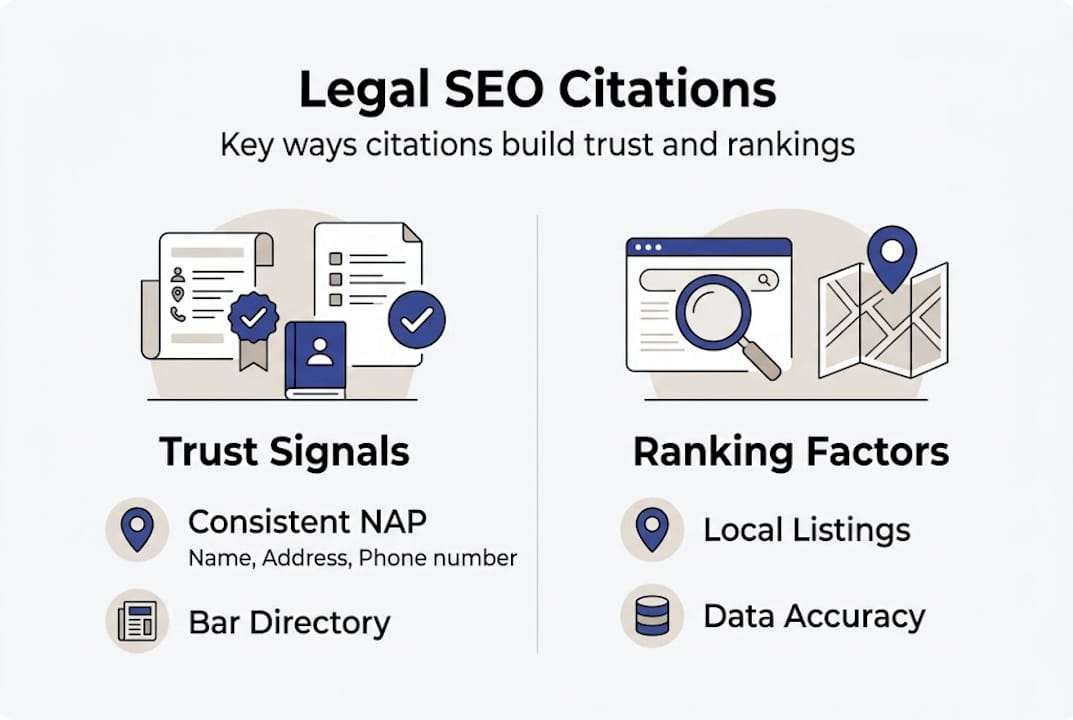
A citation, in the SEO sense, is any online reference to your law firm’s name, address, and phone number, commonly abbreviated as NAP. These mentions appear on legal directories, business listing platforms, social profiles, local news sites, and association websites. They do not need to include a hyperlink to count as a citation, though links add extra SEO value.
For law firms, citations carry a unique weight that most other local businesses do not experience. Potential clients searching for legal help are making high-stakes decisions. They want to hire someone they can trust. Search engines know this. Google and other search engines treat citations from authoritative legal sources as credibility signals, not just data points.
Here are the most common citation examples for lawyers you should know:
- Legal-specific directories: Avvo, Justia, Martindale-Hubbell, FindLaw, Lawyers.com, and state bar association directories
- General business directories: Google Business Profile, Yelp, Bing Places, and Apple Maps
- Chamber of commerce listings: Local and regional business associations
- Legal news and media sites: Law360, Above the Law, and regional legal publications
- University and government sites: Law school alumni directories and court-related listings
Legal directories carry significantly more SEO authority for law firms than generic business directories. A listing on Avvo or your state bar’s website tells Google that a real, verified attorney practice operates at that address. That specificity matters.
“Prioritize 40-80 high-authority legal directories (e.g., Avvo, Justia, Martindale-Hubbell, state bar associations) over general ones; use data aggregators for efficiency.”
NAP consistency is the foundation of citation trust. If your firm’s name appears as “Smith & Jones Law” on one directory and “Smith and Jones Law Firm” on another, search engines register that as a discrepancy. Over time, inconsistencies erode the trust signals your citations are supposed to build. Every listing must match exactly, including suite numbers, phone number formats, and business name spelling.
How citations impact legal SEO and local search rankings
Search engines use citations to validate that your law firm is a real, established business operating at a specific location. When Google sees your NAP information confirmed across dozens of authoritative sources, it gains confidence in your firm’s legitimacy. That confidence translates directly into higher local map pack rankings and stronger organic visibility.
Here is how the process works in practice:
- Google cross-references your NAP across directories, aggregators, and social platforms to confirm your firm’s existence and location.
- Consistent citations increase trust scores, which influence your position in the local map pack, the three-result block that appears above organic results for local searches.
- High-authority legal directory listings pass more trust and relevance signals than generic directories because they are topically aligned with legal services.
- Citation volume matters, but only when quality is maintained. Fifty accurate listings on legal directories outperform two hundred inconsistent entries on low-authority platforms.
| Directory type | Authority level | SEO impact for law firms |
|---|---|---|
| State bar association | Very high | Strongest trust signal |
| Avvo, Justia, Martindale | High | Strong relevance and trust |
| Google Business Profile | Very high | Direct map pack influence |
| General directories (Yelp) | Medium | Supporting signal only |
| Low-authority aggregators | Low | Minimal, can cause NAP drift |
Firms that invest in legal directory optimization consistently see stronger local map pack performance compared to those relying on content alone. The reason is straightforward: citations provide external validation that no amount of on-site content can replicate.
For firms serious about authority building for lawyers, citations are the first layer of a credibility stack that includes reviews, backlinks, and schema markup. You cannot skip this layer and expect the others to compensate.
Pro Tip: Use data aggregators like Neustar Localeze and Data Axle to push your NAP information to hundreds of downstream directories simultaneously. This saves significant time and reduces the risk of manual entry errors across platforms.
A well-structured citation profile also supports organic discovery beyond the map pack. When your firm appears consistently across authoritative legal platforms, prospective clients encounter your name multiple times during their research process. That repeated exposure builds familiarity and trust before they ever visit your website.
Reviewing a complete SEO checklist for law firms will show you that citation management is one of the earliest and most impactful steps in any local SEO strategy.
Best practices: Building and managing citations for law firms
Building a strong citation profile requires a systematic approach. Random submissions to directories without a clear strategy waste time and create inconsistencies. Follow these steps to build citations that actually move the needle.
- Audit your existing citations. Before adding new listings, find out what already exists. Use tools like BrightLocal or Whitespark to identify current citations, flag inconsistencies, and locate duplicate listings that need to be removed or corrected.
- Standardize your NAP. Decide on one official version of your firm’s name, address, and phone number. Document it. Every future submission must match this standard exactly, including punctuation and abbreviations.
- Target 40 to 80 high-authority legal directories. As data aggregators for efficiency confirm, prioritizing legal-specific directories over general ones produces better results for law firms.
- Submit to data aggregators. Platforms like Neustar Localeze and Data Axle distribute your NAP to hundreds of downstream directories. This creates broad coverage without manual entry for every individual listing.
- Monitor and maintain ongoing accuracy. Citations can change without your knowledge. Directories sometimes auto-populate incorrect information, merge duplicate listings, or allow third-party edits.
| Citation source | Recommended for | Management priority |
|---|---|---|
| Google Business Profile | All law firms | Critical, manage weekly |
| State bar directory | All licensed attorneys | Critical, verify annually |
| Avvo, Justia, Martindale | All law firms | High, update quarterly |
| Neustar Localeze | Multi-location firms | High, set and monitor |
| Yelp, Bing Places | Consumer-facing practices | Medium, review monthly |
Reviewing examples of legal citations gives your team a concrete reference point when building out your directory list. A legal directory optimization guide can further streamline the process for firms with complex practice area structures.
Pro Tip: Assign citation management to a single team member or agency contact who owns the master NAP document. When your firm moves offices, changes phone numbers, or adds attorneys, that person updates the master record first and then pushes changes to all directories. This single-source-of-truth approach prevents NAP drift, the gradual accumulation of small inconsistencies that silently erode your rankings over time.
Avoiding common pitfalls: Ethical, multi-location, and practical challenges
Even firms with strong citation strategies make avoidable mistakes. The consequences range from ranking drops to ethical violations. Knowing where the traps are helps you sidestep them entirely.
The most damaging citation problems law firms face include:
- NAP mismatches across locations: A firm with three offices that lists the same main phone number for all three confuses search engines about which location serves which geographic area.
- Using informal or marketing names: Listing your firm as “The Injury Guys” when your bar registration reads “Johnson & Williams Personal Injury Law” creates an ethical compliance issue and a trust discrepancy.
- Duplicate listings: Multiple Google Business Profile entries for the same location split your authority and can trigger spam filters.
- Outdated information after a move: Firms that relocate often forget to update all directories, leaving old addresses active for months or years.
- Ignoring niche legal directories: Skipping practice-area-specific directories in favor of only general platforms leaves authority on the table.
For multi-location firms, the solution is to treat each office as a completely separate entity with its own NAP, its own Google Business Profile, and its own directory submissions. As confirmed by research on multi-office NAP consistency, inconsistent NAP across locations fragments authority and undermines the ranking potential of every office.
“Use official bar-registered names to comply with legal marketing ethics and boost consistency.”
Ethical compliance is not optional. Your firm’s name on every citation must match your official bar registration. This protects you from disciplinary issues and reinforces the consistent identity that search engines reward. When you boost Google rankings for law firms, ethical compliance and SEO best practices align more often than they conflict.
Why most law firms underestimate citations and what actually works
Here is an uncomfortable truth: most law firms treat citations as a one-time setup task rather than an ongoing strategic asset. They submit to a handful of directories, move on to content and link building, and never look back. Then they wonder why a competitor with a less impressive website outranks them in the local map pack.
The conventional wisdom in legal marketing overweights content and underweights the foundational data layer that citations represent. Automated tools help, but they cannot replace a manual audit that catches the edge cases: the old address still live on a state bar sub-page, the attorney profile with a different phone number, the aggregator that pulled outdated information from a closed business.
One mid-size personal injury firm we observed doubled its case inquiry volume within six months, not by publishing more blog posts, but by cleaning up 140 inconsistent citations and building 35 new listings on high-authority legal directories. The content was already strong. The citations were the missing layer.
For firms serious about building real authority with citations, the lesson is clear: stop chasing citation volume and start prioritizing accuracy. Forty clean, consistent, authoritative listings will outperform two hundred sloppy ones every time. Quality and precision are the actual competitive advantage here.
Supercharge your legal SEO: Next steps
Citations are not a minor technical detail. They are a core trust signal that search engines and potential clients both rely on when evaluating your firm. Getting them right means more visibility in the local map pack, stronger organic rankings, and a steady pipeline of qualified leads. If your firm is ready to move beyond guesswork and build a citation strategy that actually delivers results, LawSEO offers comprehensive legal SEO services built specifically for attorneys. Explore our directory optimization for law firms to see exactly how we approach citation management for maximum impact.
Frequently asked questions
What is the most important citation for law firms?
High-authority legal directories like Avvo, Justia, and Martindale-Hubbell provide the most impactful citations for law firm SEO, followed closely by your state bar association listing and Google Business Profile.
Can inconsistent citations hurt law firm SEO?
Yes. Inconsistent NAP across locations fragments authority and directly harms your firm’s local rankings, particularly for practices with multiple offices.
How many legal directories should we target for maximum SEO benefit?
Targeting 40 to 80 high-authority legal directories provides optimal local SEO results, with legal-specific platforms prioritized over general business directories.
Do citations have to exactly match our bar registration?
Yes. Using your official bar-registered name on every citation ensures both ethical compliance and the consistent identity that search engines reward with stronger rankings.