


TL;DR:
- Client testimonials enhance SEO by serving as fresh content, keyword sources, and E-E-A-T signals that search engines reward.
- Implementing review schema markup and internal links from testimonials improve visibility, relevance, and ranking potential for law firm websites.
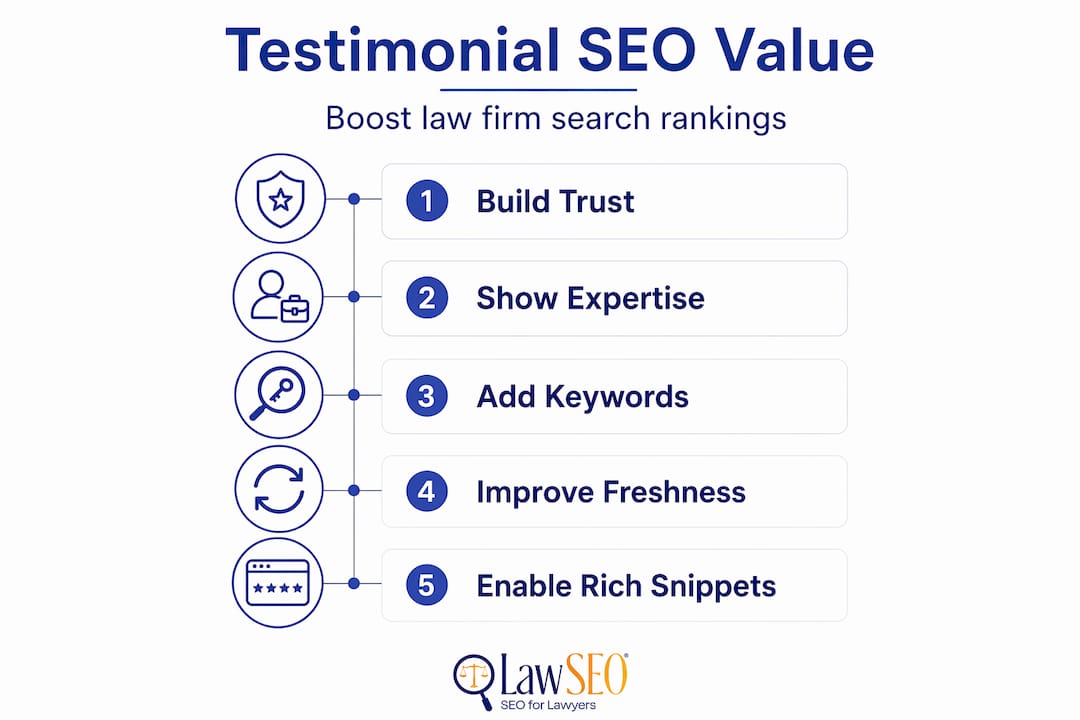
Most law firm marketing conversations about client testimonials stop at trust and conversions. That framing misses the bigger opportunity. Understanding why client testimonials help SEO is where the real competitive advantage lives, because testimonials are not just social proof. They are fresh content, keyword repositories, E-E-A-T signals, and structured data assets that Google reads and rewards. Law firms that treat testimonials as a core SEO strategy consistently outperform those that treat them as an afterthought on the “About Us” page.
Key takeaways
| Point | Details |
|---|---|
| Testimonials build E-E-A-T | Named, outcome-focused client reviews signal real-world credibility to Google beyond what sales copy can achieve. |
| Fresh content drives crawl frequency | Regularly updated testimonials tell search engines your site is actively maintained, improving crawl and indexation. |
| Schema markup multiplies visibility | Review structured data enables star ratings in search results, which can increase click-through rates measurably. |
| Natural keywords from clients | Client language in testimonials introduces long-tail, problem-aware phrases that mirror real legal search queries. |
| Internal linking opportunities | Testimonials with geographic and practice area references create anchor text that strengthens local SEO signals. |
Why client testimonials help SEO through E-E-A-T signals
Google’s E-E-A-T framework, which stands for Experience, Expertise, Authoritativeness, and Trustworthiness, is the evaluative lens Google applies to pages before assigning ranking authority. Law firm websites sit squarely in the “Your Money or Your Life” category, meaning Google holds them to a higher editorial standard than a recipe blog. Testimonials directly address the “Experience” and “Trust” components in ways that no amount of polished firm biography ever can.
The core reason is simple. A firm can write anything about itself. A past client describing a specific outcome carries a different weight entirely. Named, verified testimonials with full attribution, such as a client’s name, city, and the type of case resolved, signal real-world validation to both Google’s algorithms and human quality reviewers. Anonymous quotes like “Great firm!” contribute almost nothing to E-E-A-T and very little to SEO.
For legal practices, the specificity of the testimonial matters. Compare these two examples:
“Excellent attorney, very professional.” (generic, unattributed, no SEO value)
“After my husband’s trucking accident in Dallas, this firm secured a settlement that covered all our medical expenses and lost wages. I felt informed throughout the entire process.” (specific outcome, geographic reference, named service type)
The second version introduces named legal services, a geographic signal, and client-journey language. It reads as credible to both users and Google’s crawlers. Testimonials improve SEO precisely through this combination of E-E-A-T reinforcement, keyword injection, fresh content, and markup eligibility.
- Place full-name attributed testimonials on practice area pages, not only on a standalone “Reviews” page
- Include the client’s city or county to reinforce local relevance signals
- Highlight case outcomes without disclosing confidential details, which satisfies both ethics rules and SEO specificity
Pro Tip: Ask your bar association’s ethics guidance before referencing specific case results in testimonials. Many states permit outcome references so long as they are accurate and not misleading. Getting this right protects you ethically and makes your testimonials far more valuable for SEO.
Fresh content and keyword relevance from testimonials
Google’s preference for fresh, regularly updated content is well established. When a law firm adds new testimonials to a practice area page, it signals to Google’s crawlers that the page is actively maintained. This tends to increase crawl frequency, which in turn speeds up the indexation of other updates made to the same page. For a personal injury practice that adds three or four client reviews each month, the compound effect on content freshness is significant.

The keyword dimension is equally valuable. Clients do not write testimonials using polished legal jargon. They write the way they searched. A client might write, “I didn’t know if I had a case after the slip and fall at the grocery store.” That phrase, unscripted and authentic, maps directly to the kind of long-tail search terms clients use when looking for legal help. No copywriter inventing content from scratch would reliably produce that phrasing.
Here is a systematic approach to collecting testimonials that consistently generate SEO-relevant language:
- Ask problem-aware questions. Instead of “What did you think of our service?”, ask “What problem were you facing when you first contacted us?” This pulls out the exact pain-point language that mirrors search queries.
- Ask solution-aware questions. Follow up with “How did we help you resolve that problem?” This generates outcome language that search engines associate with credible legal service delivery.
- Ask journey questions. “What would you tell someone in your situation who is searching for a lawyer?” This produces testimonial language that often reads like a search query itself.
- Request geographic specificity. Prompt clients to mention their city or neighborhood naturally within their response. This reinforces local SEO signals without fabricating location references.
- Collect testimonials consistently, not in bursts. A steady stream of new reviews signals sustained activity. Uploading thirty reviews at once and then going quiet for a year does not produce the same freshness benefit.
Pro Tip: Pair your testimonial collection system with your case closing process. Build a follow-up email into your case management workflow that goes out automatically two weeks after case resolution. Timing matters. Clients are most willing to share detailed feedback when the experience is recent.
For law firms that also want to see how updating legal content more broadly affects rankings, the freshness principle extends well beyond testimonials.
Technical SEO benefits of review schema markup
Collecting strong testimonials is only half the equation. The technical side determines whether search engines can read and display them. Review schema markup, also called structured data, is code you add to a page that tells search engines exactly what type of content they are looking at, who wrote it, what rating was given, and when it was submitted. Without this markup, all of that rich information is invisible to Google’s indexing systems.
Structured data translates client sentiment into a machine-readable format that qualifies pages for rich snippet eligibility. Rich snippets are the star ratings and review counts you see displayed directly in Google’s search results. These visual enhancements increase the visibility of your listing relative to competitors who show only a plain blue link. Review schema usage can lift click-through rates by up to 58%, which is a meaningful traffic gain without any change in ranking position.
The table below compares pages with and without review schema implementation:
| Feature | With review schema | Without review schema |
|---|---|---|
| Star ratings in search results | Visible to users | Not displayed |
| Click-through rate | Higher (up to 58% lift) | Baseline only |
| Crawl interpretation | Machine-readable sentiment | Plain text only |
| Rich snippet eligibility | Qualified | Ineligible |
| AI search citation confidence | Stronger | Weaker |
Google prioritizes pages with clear schema, consistent brand signals, and structured content when determining AI visibility and citation rates. As generative AI tools increasingly surface law firm recommendations, schema becomes a prerequisite, not an optional enhancement.
Several pitfalls undermine schema implementation for law firms:
- Placing testimonials in image files or non-crawlable elements, which makes the text invisible to search engines
- Using schema that does not match the actual review content displayed on the page
- Implementing review schema on pages that aggregate invented or incentivized reviews, which violates Google guidelines and risks manual penalties
- Failing to nest review schema correctly within the firm’s main entity schema, which can reduce rich snippet eligibility
How testimonials support internal linking and site architecture
Beyond their content value, testimonials create structured internal linking opportunities that most law firms completely ignore. When a client mentions “my wrongful termination case in Houston” within a testimonial on your homepage, you have a natural opportunity to link that phrase directly to your employment law practice area page. This is not just a UX convenience. It sends topical relevance signals through your site architecture and reinforces the geographic authority of the linked page.
Testimonials with geographic and practice area references provide keyword-rich anchor text opportunities that feel organic rather than forced. When you link “personal injury settlement in Phoenix” from a homepage testimonial to your Phoenix personal injury page, you are passing relevance and authority in a way that Google’s crawlers recognize as editorially justified.
Effective strategies for using testimonials in site architecture include:
- Linking client-referenced practice areas within testimonial text to the corresponding service page
- Using city or county references as anchors that point to location-specific landing pages
- Placing practice-specific testimonials directly on practice area pages rather than centralizing all testimonials in one section
- Cross-linking between a dedicated testimonials page and individual practice area pages to distribute crawl equity
For a law firm with pages covering multiple practice areas and multiple geographic markets, this internal linking strategy can meaningfully improve how Google understands the topical depth and local relevance of the entire site. Review the local SEO checklist for law firms to see how testimonial placement fits within a broader local search strategy.
Best practices for collecting and displaying testimonials
The quality of your testimonials determines how much SEO benefit you actually extract. Vague praise generates no keyword value and does nothing for E-E-A-T. The goal is specificity, attribution, and regular volume.
Pro Tip: When requesting testimonials, send a short email with two or three specific questions rather than an open-ended request. Specific questions produce specific answers. Specific answers produce specific SEO value.
The most effective practices for law firm testimonial collection and display include:
- Ask clients to describe their situation before contacting the firm, the outcome achieved, and how the experience compared to their expectations
- Always publish testimonials with the client’s full name and, where permitted, their city and case type. Authentic attribution carries substantially more E-E-A-T weight than initials or first names alone
- Avoid editing testimonials for polish. Authentic, unscripted language contains the exact keyword phrases your prospective clients are searching
- Update your testimonials section at minimum quarterly. Stale testimonials from several years ago signal neglect rather than active reputation management
- Never fabricate reviews or use incentivized testimonials that violate Google’s guidelines or your bar association’s ethics rules. Genuine negative reviews handled professionally actually improve authenticity signals and can support E-E-A-T
My perspective on testimonials as a legal SEO asset
I’ve worked with law firms on SEO strategy for decades, and the most consistent oversight I see is that testimonials get handed to a web designer and placed on a single page with no structured data, no internal links, and no system for ongoing collection. The firm checks the box and moves on. That approach generates almost zero SEO return.
What I’ve found actually works is treating testimonials as living content infrastructure. Every new testimonial is a content update, a potential keyword source, and a schema-eligible asset. Firms that integrate testimonial collection into their case management workflow and pair it with proper markup see compounding benefits over 12 to 18 months that are genuinely difficult for competitors to replicate.
The uncomfortable truth is that most law firm marketers understand testimonials matter for trust, but they have not connected the technical dots between what a client writes and how a search engine reads it. Once you make that connection, the strategy becomes clear. Collect specific testimonials consistently, mark them up with proper schema, link them contextually to practice area pages, and treat every new review as a signal that your site is active, credible, and authoritative. That is not a minor tactic. It is a sustained authority-building system.
— TODD
How Lawseo helps law firms turn testimonials into SEO assets
If the strategies above sound compelling but the implementation feels complex, that is exactly where Lawseo delivers value. At Lawseo, every client campaign is built around the specific competitive dynamics of the legal market, and testimonial optimization is a core component of that work. The team handles schema markup implementation, testimonial collection systems, internal linking architecture, and the legal SEO strategies that turn client feedback into measurable ranking improvements.
Lawseo works exclusively with law firms, which means the strategies deployed account for bar association ethics rules, attorney advertising requirements, and the specific search behavior of legal consumers. For law firms ready to stop treating testimonials as a trust badge and start treating them as a technical SEO asset, Lawseo offers the specialized expertise to make that transition. Explore the full scope of legal SEO services available at Lawseo to understand how a structured approach to testimonials fits within a broader ranking strategy.
FAQ
Do client testimonials directly affect Google rankings?
Yes. Testimonials contribute to Google’s E-E-A-T signals, introduce natural long-tail keywords, generate fresh page content, and qualify pages for rich snippet eligibility through review schema, all of which influence ranking performance.
What is review schema and why do law firms need it?
Review schema is structured data code that makes testimonial content machine-readable to search engines. Without it, star ratings and review data are invisible to Google and ineligible for rich snippet display in search results.
How often should a law firm add new testimonials?
Adding testimonials consistently each month is more effective than batch uploads. Regular additions signal page freshness to Google, which tends to increase crawl frequency and improve the indexation of other content updates on the same page.
Can a single negative review hurt a law firm’s SEO?
Not necessarily. Genuine negative reviews balanced by a majority of positive ones can actually improve authenticity signals, which supports E-E-A-T. The damage comes from ignoring reviews entirely or from fabricated content that violates Google’s guidelines.
Where should law firms place testimonials on their website?
Place practice-specific testimonials directly on the corresponding practice area pages rather than only on a standalone reviews page. This placement maximizes the keyword relevance, internal linking value, and E-E-A-T signals for each individual page.