


AI search traffic jumped 527% year over year, and ChatGPT now ranks as the fourth most visited website globally. For law firms, this shift means potential clients increasingly get legal answers directly from AI tools without ever clicking through to your website. If your firm isn’t optimized for AI search engines, you’re invisible to a massive and growing segment of prospective clients. This guide explains why AI search optimization matters for law firms, how it differs from traditional SEO, and practical steps you can take today to capture more leads through AI powered platforms.
Key Takeaways
| Point | Details |
|---|---|
| AI search dominance | AI driven search now handles the majority of informational queries, so AI visibility is essential for law firms. |
| Three core methods | LLMO, GEO, and AEO guide AI optimization to earn citations and direct answers. |
| Structured data and EEAT | Implement structured data and schema markup and build EEAT signals to boost AI recognition and trust. |
| High quality content | Human edited, expert authored content outperforms AI generated material in earning trust and AI recommendations. |
Why AI search optimization is critical for law firms
AI driven search platforms have fundamentally changed how potential clients discover legal services. AI search traffic increased 527% year over year, and clients now get answers directly from AI without clicking through to law firm websites. This creates what industry experts call “quiet invisibility.” Your firm might have excellent traditional SEO rankings, but if AI tools don’t recommend you, a growing portion of your target audience never knows you exist.
Consider these realities facing law firms today:
- AI search handles approximately 9 out of 10 informational queries from prospective clients
- ChatGPT has become the fourth most visited website, surpassing many traditional search engines
- Clients increasingly trust AI generated answers over clicking multiple law firm websites
- Traditional SEO tactics alone fail to capture visibility in AI recommendation engines
- Law firms without AI optimization lose leads to competitors who appear in AI results
The shift isn’t just about traffic volume. It’s about client behavior. When someone asks ChatGPT or Perplexity “What should I do after a car accident?” or “How do I file for divorce in Texas?” the AI provides a comprehensive answer. If your firm’s content isn’t optimized to be cited or recommended by these tools, you’ve lost that client before they even considered reaching out.
“Law firms that ignore AI optimization face a fundamental marketing crisis. Clients are getting legal guidance without ever visiting attorney websites, and firms lose the opportunity to convert those information seekers into paying clients.”
This isn’t a future problem. It’s happening now. The legal marketing landscape has split into two worlds: firms visible to AI search engines and firms that aren’t. AI optimization for law firms has become as essential as having a mobile responsive website was a decade ago. Without it, your marketing budget works harder for diminishing returns.

Core methodologies for optimizing law firms for AI search
Effective AI search optimization requires understanding three core methodologies that differ significantly from traditional SEO approaches. LLMO (Large Language Model Optimization) focuses on earning AI recommendations by becoming the authoritative source AI tools cite. GEO (Generative Engine Optimization) positions your firm as a trusted source that AI engines pull from when generating answers. AEO (Answer Engine Optimization) structures your content to directly answer the specific questions clients ask.
These methodologies share common tactical requirements:
- Implement structured data and schema markup, especially LegalService, Attorney, and FAQ schemas
- Build E-E-A-T signals: Expertise, Experience, Authority, and Trustworthiness specific to legal practice
- Create content with question based headings that match client search intent
- Use short paragraphs and clear formatting that AI engines can easily parse
- Ensure fast page load speeds and mobile responsiveness as technical prerequisites
- Develop authoritative backlink profiles from respected legal and industry sources
Structured data acts as a translation layer between your website and AI engines. When you mark up your attorney profiles with proper schema, AI tools understand exactly who you are, what you practice, where you’re licensed, and why clients should trust you. Without this markup, even excellent content gets overlooked because AI engines struggle to extract relevant signals.
| AI Optimization Tactic | Purpose | Impact on Visibility |
|---|---|---|
| Schema markup (LegalService, Attorney, FAQ) | Helps AI understand content structure and expertise | High: Direct signal to AI engines |
| E-E-A-T optimization | Demonstrates attorney expertise and trustworthiness | Critical: Primary ranking factor |
| Question based content structure | Matches user intent and query patterns | High: Increases citation probability |
| Fast, mobile responsive site | Meets technical quality standards | Medium: Prerequisite for consideration |
| Authoritative backlinks | Signals industry trust and credibility | High: Validates expertise claims |
| Attorney authored content | Provides genuine expertise signals | Critical: Differentiates from AI content |
Pro Tip: Focus on attorney authored, human edited content rather than relying solely on AI generated text. AI search engines prioritize content demonstrating genuine expertise and experience, which purely AI generated content lacks. Have your attorneys write or thoroughly review all published content to maximize E-E-A-T signals.
The difference between firms that succeed with AI optimization and those that don’t often comes down to content authenticity. AI engines have become sophisticated at detecting generic, template driven, or purely AI generated content. They prioritize sources demonstrating real legal expertise through case examples, jurisdiction specific guidance, and nuanced explanations that only practicing attorneys can provide.
Comparing AI search optimization with traditional SEO for law firms
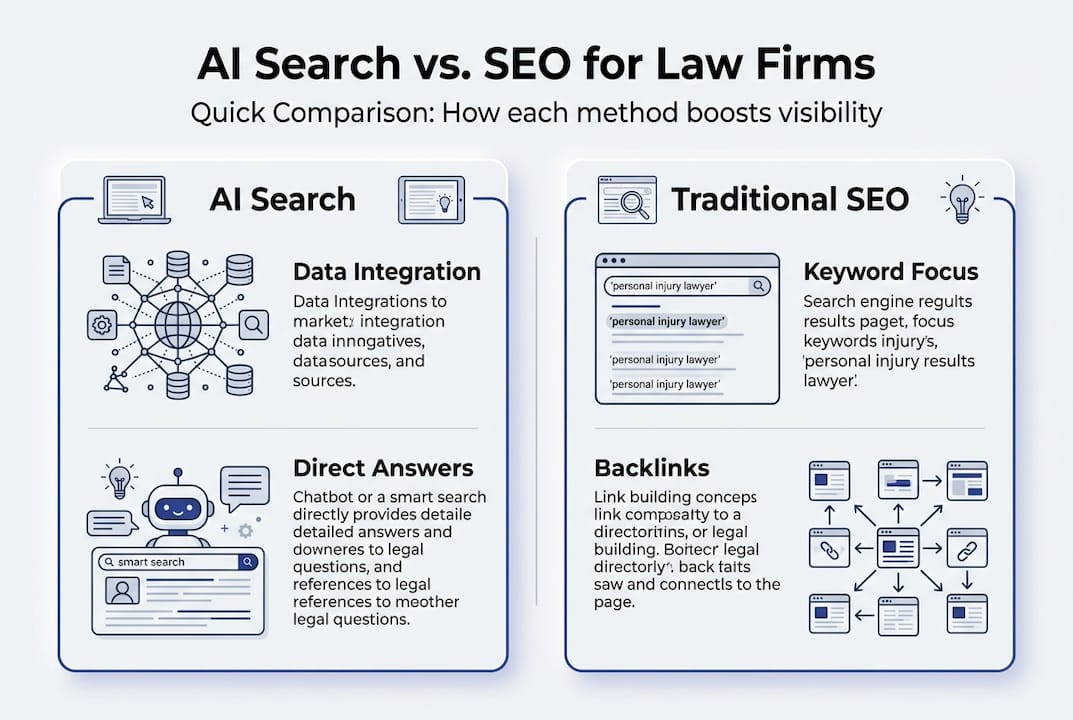
Traditional SEO for law firms centers on keyword research, backlink building, on page optimization, and local search signals. You identify high value keywords like “personal injury lawyer Chicago,” optimize your pages for those terms, build links from legal directories, and work to appear in the local map pack. The goal is ranking on page one of Google search results and driving clicks to your website.
AI search optimization shares some foundations but diverges in critical ways. AI engines don’t just rank pages, they synthesize information from multiple sources to generate answers. Your firm needs to become a cited source rather than just a ranked result. This means AI optimization focuses heavily on structured data, direct answer formats, and E-E-A-T signals that help AI tools trust and cite your content.
| Feature | Traditional SEO | AI Search Optimization |
|---|---|---|
| Primary goal | Rank on page one for target keywords | Become cited source in AI answers |
| Traffic model | Click through visits to website | Direct answers with optional attribution |
| Key ranking factors | Keywords, backlinks, domain authority | E-E-A-T, structured data, answer quality |
| Content format | Keyword optimized long form articles | Question answer pairs, clear structure |
| Success metric | Organic traffic volume | Citation frequency, recommendation rate |
| Technical requirements | Mobile friendly, fast load times | Schema markup, semantic HTML |
The most effective approach integrates both strategies. Here’s how to blend AI optimization with your existing SEO program:
- Audit your current content to identify pages with strong traditional SEO performance but weak AI optimization signals
- Add comprehensive schema markup to all attorney profiles, practice area pages, and FAQ content
- Restructure existing articles to include question based H2 and H3 headings that match client queries
- Layer in E-E-A-T signals by adding attorney bylines, credentials, case results, and experience details
- Create dedicated FAQ pages that directly answer common client questions in 2 to 3 sentence formats
- Maintain your backlink building efforts while prioritizing links from high authority legal sources
- Continue local SEO tactics while ensuring your Google Business Profile includes complete structured data
Traditional SEO drives traffic, but AI optimization captures the growing segment of users who never leave AI platforms. A client might ask ChatGPT about divorce procedures, get a comprehensive answer citing your firm’s expertise, and then search specifically for your firm name. That’s the integration working. You need visibility in both channels because different clients use different search methods.
The mistake many firms make is treating AI optimization as a replacement for SEO rather than a complement. Your legal SEO strategies still matter for capturing high intent searches and local clients. AI optimization extends your reach to informational queries and early stage research that traditional SEO often misses.
Practical steps for law firms to start optimizing for AI search today
You don’t need a complete website overhaul to begin capturing AI search visibility. Start with high impact changes that signal expertise and structure to AI engines. The fastest wins come from adding structured data and creating answer focused content that demonstrates your attorneys’ knowledge.
Begin with a content and technical audit:
- Review your top performing pages and identify which lack schema markup
- Check whether attorney profiles include comprehensive credentials, bar admissions, and practice areas
- Assess your FAQ pages for question based formatting and direct answer structure
- Test your site speed and mobile responsiveness using Google’s tools
- Evaluate whether your content demonstrates genuine attorney expertise or reads like generic legal information
Once you’ve identified gaps, implement these foundational changes. Add LegalService and Attorney schema markup to your website immediately. This structured data tells AI engines exactly what services you offer, who your attorneys are, where you practice, and what makes you qualified. Most content management systems support schema through plugins, or your developer can add JSON-LD code to your pages.
Develop authoritative, question and answer style FAQ pages with headings that match actual client questions. Instead of a heading like “Divorce Information,” use “How long does a divorce take in Texas?” or “What documents do I need to file for divorce?” Answer each question in 2 to 4 sentences using clear, jargon free language. This format perfectly matches how AI engines extract and cite information.
Enhance your site’s technical foundation. AI engines prioritize fast, mobile responsive sites that provide good user experiences. If your pages load slowly or break on mobile devices, you’re fighting an uphill battle regardless of content quality. Invest in performance optimization, image compression, and responsive design.
Build high quality backlinks to increase authority signals. Focus on earning links from:
- State and local bar associations
- Legal news publications and industry blogs
- University law school resources
- Respected legal directories beyond basic listings
- Guest articles on authoritative legal marketing sites
Regularly update your content with authentic attorney expertise and proper citations. Have your attorneys review and edit all published content, adding case examples, jurisdiction specific nuances, and practical insights that only experienced lawyers can provide. Attorney authored content significantly outperforms generic or purely AI generated text in earning AI citations.
Pro Tip: Collaborate with marketing professionals who specialize in AI search optimization for law firms to accelerate results. The intersection of legal expertise, technical SEO, and AI optimization requires specialized knowledge. Working with experts helps you avoid costly mistakes and implement proven strategies faster than trial and error.
Consistency matters more than perfection. Start with your highest traffic pages and most important practice areas, then systematically expand AI optimization across your site. Track which content gets cited by AI tools, monitor referral traffic from AI platforms, and refine your approach based on results.
Boost your law firm’s AI search visibility with expert marketing
Optimizing for AI search while maintaining strong traditional SEO requires specialized expertise and consistent execution. Law firms that partner with marketing professionals focused on both AI and legal SEO see faster results and higher lead generation. If you’re ready to ensure your firm appears when potential clients search for legal help through AI platforms, explore proven legal SEO strategies and comprehensive AI optimization approaches designed specifically for attorneys. Working with specialists who understand the unique challenges of legal marketing helps you capture visibility across both traditional search engines and emerging AI platforms. Discover how professional legal marketing services can position your firm for sustained growth in an AI driven search landscape.
Frequently asked questions
What is AI search optimization for law firms?
AI search optimization means tailoring your law firm’s content and website to rank well in AI powered search engines like ChatGPT, Perplexity, and Google’s AI overviews. This involves using structured data, building authority signals, and creating content that AI engines can easily understand and cite. It helps your firm appear in the direct answers that clients increasingly rely on when researching legal issues.
How does AI search affect client acquisition for attorneys?
AI search often provides direct answers to legal questions, reducing the number of clients who click through to law firm websites. Without proper optimization, your firm risks being invisible to prospective clients using AI search tools, even if you have strong traditional SEO. Optimizing ensures clients see your firm’s name and expertise when AI tools generate answers, increasing the likelihood they’ll contact you.
What are simple first steps my law firm can take to optimize for AI search?
Start by adding structured data like LegalService and Attorney schema markup to your website so AI engines understand your services and credentials. Create clear FAQ pages with questions clients commonly ask, formatted as headings with concise answers. Ensure your website loads quickly and works well on mobile devices, as these technical factors affect how AI engines evaluate and cite your content.
Is AI generated content enough for effective AI search optimization?
Pure AI generated content alone typically underperforms because it lacks the genuine expertise and experience signals that AI search engines prioritize. Combining AI writing tools with thorough human editing and attorney review produces better results. Content demonstrating real legal expertise through case examples, jurisdiction specific guidance, and nuanced explanations earns more citations and trust from AI platforms than generic AI generated text.