


TL;DR:
- Many law firms invest heavily in SEO without tracking its effectiveness, risking wasted resources. Proper measurement using key metrics like clicks, impressions, CTR, and rankings links SEO efforts directly to client acquisition outcomes. Continuous performance monitoring and strategic analysis help firms respond swiftly, maintain competitiveness, and justify ongoing SEO investments.
Many law firms pour significant budget into SEO without ever measuring whether it works, and the cost of that blind spot is real. SEO without tracking wastes resources and turns marketing decisions into guesswork. Knowing why track SEO performance is essential shifts your entire approach from activity-based spending to outcome-based accountability. This guide breaks down the metrics that matter, the patterns that reveal problems, and the systems that connect your SEO investment directly to new client acquisition in the legal sector.
Understanding the core metrics for SEO performance tracking
With the stakes this high in legal marketing, you cannot afford to treat SEO as a set-it-and-forget-it function. Effective tracking starts with knowing which numbers actually tell you something useful, and which ones only feel important.
Google Search Console should be your first stop. It tracks four foundational metrics that represent different stages of the SEO funnel:
- Clicks: The actual number of visitors arriving at your site from organic search. This is the closest free metric to measurable traffic impact.
- Impressions: How many times your pages appear in Google search results. High impressions with low clicks signal a visibility problem in your content or meta descriptions.
- Click-through rate (CTR): The percentage of impressions that convert to clicks. A low CTR on a high-impression page tells you the snippet is not earning attention.
- Average position: Your mean ranking across all queries where your pages appear. Useful as a trend line, but requires careful interpretation.
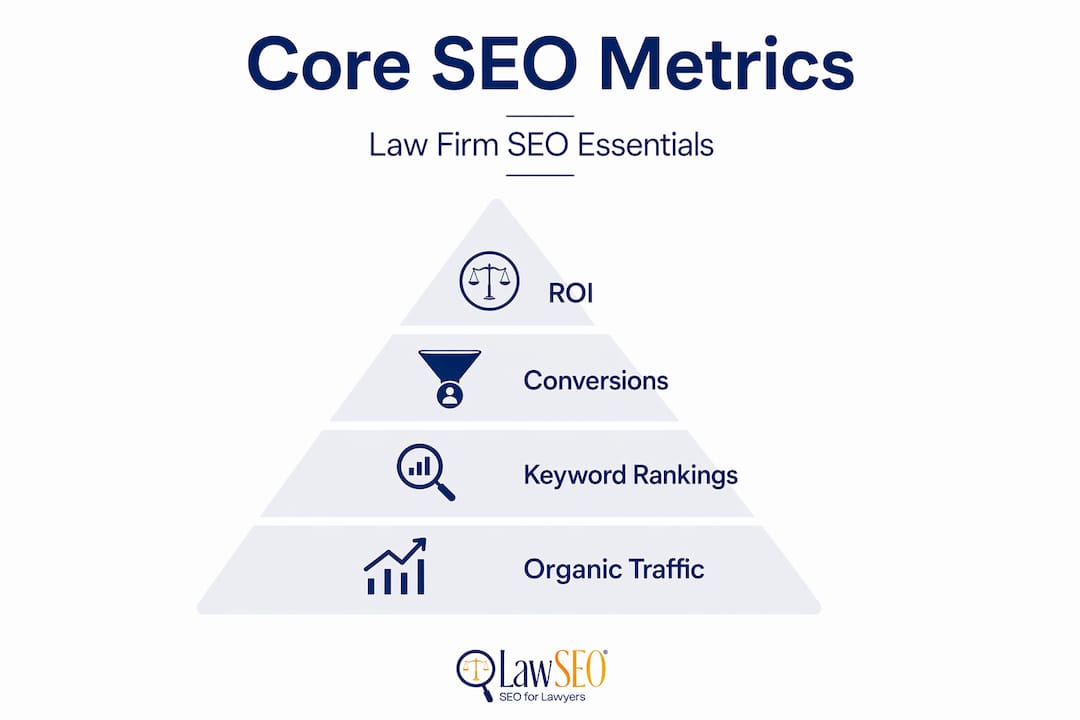
Beyond those four, legal SEO KPIs extend into business outcomes: organic traffic volume, keyword rankings for practice area terms, consultation request conversion rates, and cost-per-lead. These metrics connect search visibility directly to client acquisition, which is the outcome that actually matters for a law firm.
Understanding what these metrics measure and why they matter for law firm growth is foundational before any deeper analysis begins. And why SEO matters for lawyers in the first place becomes far clearer once you see how each metric maps to a stage in a prospective client’s decision process. You can also explore why measure SEO performance from a broader strategic lens to round out your foundational understanding.
Diagnosing SEO issues through performance patterns
Knowing which metrics to track is step one. Reading them together to identify specific problems is where the real intelligence lives.
Pattern analysis using GSC data is one of the most practical diagnostic tools available. Here is how to read common patterns:
- Impressions rising, clicks flat or declining: Your pages are being seen more often, but searchers are not clicking. This almost always points to weak meta titles or descriptions that fail to match user intent.
- Clicks dropping without impression loss: Something about your result changed or became less competitive. Competitors may have taken featured snippets, or your title tag may have been rewritten by Google’s algorithm.
- Both impressions and clicks declining together: This suggests a ranking drop, a technical issue, or a content relevance problem.
- CTR low across multiple pages: Your brand or domain may not carry enough authority in search results to earn trust on first impression.
One critical caution: average position is a mean calculated across impressions, devices, and geographic locations. Looking at a single aggregate number can be deeply misleading. A position of 8.4 could mean some queries rank at position 3 while others hover at position 20. Always drill down to the query and page level.
Regular review of these patterns, ideally weekly, allows your firm to catch traffic erosion before it compounds. A single overlooked CTR problem on a high-impression practice area page could mean dozens of missed consultation requests each month.
Pro Tip: Filter GSC data by page type, for example, practice area pages versus blog posts, to isolate where specific performance issues are concentrated. This focus saves time and surfaces the problems with the highest business impact first.
Also consider running your content through an LLM SEO checker to evaluate how AI-driven search tools interpret your pages, since generative AI is increasingly influencing how prospective clients discover legal services.
Measuring SEO ROI beyond last-click attribution
Beyond identifying issues, understanding SEO’s true financial impact is critical for justifying continued investment. The most common mistake law firms make here is relying on last-click attribution to evaluate SEO results.

Last-click attribution assigns full conversion credit to the final touchpoint before a lead submits a form or calls your office. But SEO frequently assists conversions earlier in the buyer journey, often at the research stage, without getting credit. A prospective client who finds your personal injury practice through a blog post, leaves, and later converts via a Google Ads click? Under last-click, SEO gets nothing. The real contribution goes unrecorded.
A more accurate approach uses a two-layer model:
- Direct conversions: Track leads where organic search was the last-click source. Set this up in Google Analytics 4 (GA4) using goal completions tied to form submissions or phone call tracking.
- Assisted conversions: Use GA4’s multi-channel funnel reports to capture sessions where organic search appeared anywhere in the conversion path, not just at the final step.
- Estimate lead value: Multiply your average case value by your close rate to assign a consistent dollar figure to each qualified consultation request.
- Calculate total SEO value: Add direct conversion value plus assisted conversion value, then compare against your total SEO investment.
- Integrate with your CRM: Connect GA4 to your practice management software so leads can be tracked from first organic touchpoint through to signed retainer.
- Report monthly: Reliable ROI measurement requires consistent reporting cycles. Monthly reports let you see trends, justify budget, and make informed decisions about where to invest next.
Law firms that invest in SEO for lasting results understand that ROI is not a single number but a picture built from multiple data points over time.
The competitive edge: monitoring SEO performance to react swiftly
Monitoring ROI and diagnosing problems are essential. Equally important is staying competitive through consistent performance vigilance. The legal search landscape does not stay static. Google updates can shift rankings materially within days, and competitors in your market are actively working to take your positions.
Continuous KPI monitoring gives your firm the ability to react to algorithm changes and SERP shifts rather than discovering problems weeks after the damage is done. Law firms that review SEO data quarterly are operating on a significant delay. By the time a quarterly report lands, a ranking drop from six weeks ago has already cost real leads.
Key areas to monitor for competitive edge:
- Keyword ranking shifts for your top practice area terms, especially positions 1 through 10
- Competitor content activity, particularly new pages targeting your primary keywords
- Technical SEO health, including crawl errors, page speed scores, and Core Web Vitals
- Local pack visibility, which for most law firms drives more consultation calls than national rankings
- SERP feature changes, such as featured snippets, People Also Ask boxes, or AI Overview appearances replacing traditional results
Here is a direct comparison of tracking approaches and their impact on your ability to respond:
| Approach | Frequency | Response time | Best for |
|---|---|---|---|
| Manual GSC review | Weekly | 1 to 7 days | Small firms with limited budgets |
| Automated rank tracking | Daily | Same day | Firms in competitive practice areas |
| Dashboard with alerts | Real-time | Hours | High-volume practices and multi-location firms |
| Quarterly agency report | Every 90 days | 30 to 90 days | Firms with minimal SEO activity |
Ranking shifts can happen quickly, and firms that detect them early recover faster. The difference between catching a drop on day two versus day thirty is the difference between a minor correction and a significant client loss.
Pro Tip: Set up automated alerts in GA4 for traffic drops exceeding 20% week-over-week. Pair this with an advanced SEO strategy that includes scheduled rank tracking for your top 20 keywords so nothing significant goes unnoticed.
Implementing an effective SEO tracking system for law firms
Having seen why continuous tracking matters, here is how your law firm can practically implement a system that delivers consistent insights and drives client growth.
- Define business goals first. Every KPI should map back to a business outcome: more consultation requests, lower cost-per-lead, or higher case volume in a specific practice area.
- Set up your core tools. Google Search Console and GA4 are non-negotiable. Add a paid rank tracker for daily keyword monitoring and backlink tracking for off-page SEO visibility.
- Establish a review cadence. Daily quick scans for critical anomalies, weekly KPI reviews for ranking and traffic trends, and monthly detailed reports for strategy decisions.
- Build a unified dashboard. Looker Studio (formerly Google Data Studio) pulls GSC, GA4, and third-party data into one view, saving time and making trends easier to spot.
- Include all four pillars. Your tracking system should cover technical SEO health, content performance, backlink growth, and conversion data.
- Attach action plans to every report. Data without a next step is just information. Every report should end with two or three specific actions based on what the data shows.
A clear framework built around the right metrics and cadence transforms an overwhelming amount of data into decisions you can act on. Weekly KPI reviews combined with monthly reporting give law firms the best visibility without drowning in numbers.
Here is a reference table for core tracking metrics:
| Metric | Definition | Tracking frequency | Purpose |
|---|---|---|---|
| Organic clicks | Visits from unpaid search results | Weekly | Measure traffic volume |
| Average position | Mean ranking across tracked queries | Weekly | Monitor ranking health |
| CTR | Clicks divided by impressions | Weekly | Evaluate snippet appeal |
| Consultation conversions | Form fills and calls from organic | Weekly | Tie SEO to revenue |
| Cost-per-lead | SEO spend divided by leads generated | Monthly | Measure budget efficiency |
| Backlink growth | New referring domains over time | Monthly | Track authority building |
| Core Web Vitals | Page speed and user experience scores | Monthly | Monitor technical health |
Pro Tip: Avoid the temptation to track every available metric. More data does not equal better decisions. Focus on the metrics that directly connect to client acquisition and use everything else as supporting context.
Why ignoring SEO tracking risks much more than lost rankings
Here is the uncomfortable reality most agencies will not tell you: many law firms that invest in SEO are not losing because of bad tactics. They are losing because they have no idea which tactics are working.
The assumption that SEO activity produces results automatically is pervasive in the legal sector. A firm publishes blog posts, builds some links, and assumes the pipeline will follow. But lack of tracking creates excessive data noise with no clear signal, which fosters false optimism and lets wasted spending go undetected for months or years.
There is also the problem of misreading data without a proper framework. Firms that do track sometimes get distracted by vanity metrics, ranking for 500 keywords that bring no consultation traffic, while missing that their three highest-intent pages have declining CTR. That is a compounding loss hiding in plain sight.
The assisted conversion blind spot causes real financial damage too. When SEO’s role in multi-touch client journeys goes unmeasured, decision-makers cut the budget because they cannot see the full picture. They invest more in paid ads, which get the last click, and starve the organic channel that was doing much of the early-stage persuasion.
And then there is the competitive cost of delayed detection. A competitor who catches a SERP shift in two days and adjusts content, while you discover it in your next monthly report, has already captured the clients you lost during that gap. In competitive markets like personal injury, family law, or criminal defense, that gap can represent significant case volume.
Understanding why SEO matters for lawyers is the first step. Tracking is what turns that understanding into a real business advantage. Without it, you are operating on faith rather than evidence.
How LawSEO.com empowers law firms with actionable SEO tracking
With a solid understanding of why and how to track SEO performance, the next step is working with specialists who already know how to read these signals in the legal market specifically. LawSEO.com provides data-driven tracking dashboards built exclusively for law firms, with monthly performance reports that connect organic metrics directly to client leads and revenue. The firm’s approach to legal SEO strategies is grounded in over 29 years of SEO experience, applied specifically to the competitive dynamics of attorney marketing. Every reporting cycle includes clear action steps, not just numbers. If your firm wants to stop guessing and start growing, explore what legal SEO for law firms looks like when tracking and strategy work together.
Frequently asked questions
What are the most important SEO metrics law firms should track?
Law firms should prioritize organic traffic, keyword rankings for top practice area terms, consultation request conversion rates, and cost-per-lead, since these metrics connect SEO activity directly to client acquisition outcomes.
How can tracking SEO performance improve my law firm’s marketing ROI?
Tracking reveals which SEO activities generate qualified leads and which consume budget without return, enabling precise allocation decisions and demonstrating accountable outcomes that justify continued investment.
Why is last-click attribution insufficient for measuring SEO value?
SEO often assists conversions at earlier stages of the client journey without receiving last-click credit, which causes its financial contribution to be systematically underreported when only last-click data is used.
How often should law firms review SEO performance data?
Weekly reviews of key metrics allow timely detection of issues, while monthly reports support strategic planning. Firms that check KPIs weekly identify and address opportunities significantly faster than those reviewing monthly or quarterly.
What tools are recommended to track SEO performance effectively?
Google Search Console and GA4 provide essential free data, while paid rank-tracking tools add keyword-level depth. Combining GSC and GA4 with a custom Looker Studio dashboard gives law firms a clear, unified view of performance across all key metrics.