

TL;DR:
- Internal linking is a powerful SEO tactic often underused by law firms, leading to missed rankings.
- Strategic internal links improve page authority, enhance topical relevance, and boost organic traffic.
- Regular audits and content clusters can significantly increase search rankings, traffic, and client inquiries.
Most law firms pour budget into new content and backlinks while ignoring one of the most powerful SEO levers already built into their website. Internal linking, the practice of connecting your own pages to each other with descriptive anchor text, is consistently underused across legal websites. The result is lost rankings, orphaned pages that Google never finds, and practice area pages that never reach their full authority potential. Studies show that strategic internal linking improved rankings for 83% of previously unranked pages and drove a 43% increase in organic traffic through content clusters. This guide gives you the exact framework to fix that.
Key Takeaways
| Point | Details |
|---|---|
| Massive SEO impact | Strategic internal linking can lift rankings for 83% of overlooked law firm pages. |
| Smart link placement | Carefully chosen anchor text and site areas maximize organic search visibility. |
| Frameworks boost results | Content clusters and structured link maps can drive up to 43% more traffic. |
| Ongoing audits matter | Regular internal link audits and updates can trigger dramatic keyword growth for legal sites. |
Why internal linking matters for legal websites
Google’s crawlers follow links to discover and evaluate pages. When your site lacks strong internal links, entire sections of your content may go unindexed or receive minimal authority from Google’s ranking algorithm. For law firms, this is a critical vulnerability. Legal websites operate in some of the most competitive search verticals online, where personal injury, criminal defense, and family law keywords carry high cost-per-click values and intense organic competition.
The structural challenge for law firms is real. Practice area pages often exist in silos, disconnected from supporting blog content, attorney bios, and local landing pages. Google interprets isolated pages as lower-priority content. When you build intentional internal links between related pages, you signal topical relevance and distribute what SEO professionals call “link equity” or “PageRank” across your site.
The numbers behind internal linking are hard to ignore. 83% of orphan pages gained rankings after receiving strategic internal links, and content clusters drove a 43% organic traffic increase across audited legal sites. These are not marginal gains. They represent the difference between a practice area page ranking on page three and appearing in the top five results.
For attorneys, the benefits extend beyond raw rankings:
- Higher keyword rankings across practice area and location-specific pages
- More organic traffic from Google and AI-driven search platforms
- Lower bounce rates as users navigate naturally through your site
- Increased client inquiries from visitors who find answers across multiple linked pages
- Stronger topical authority that positions your firm as a credible resource
Thoughtful website structure for law firms is the foundation that makes internal linking effective. Without logical site architecture, even well-placed links lose much of their impact.
The anatomy of an effective legal site internal link
An internal link has three core components: the anchor text (the clickable words), the destination URL, and the surrounding context. Each element carries SEO weight, and getting all three right separates a high-performing legal site from one that stagnates in search results.
Anchor text is the most important variable. It tells Google what the destination page is about. Generic anchor text like “click here” or “learn more” wastes the opportunity. Descriptive, keyword-informed anchor text such as “Chicago car accident attorney” or “wrongful termination claims” reinforces the topic of the page you are linking to. This is what SEO professionals call legal SEO intent, aligning your link language with the actual search queries your prospective clients use.
Link placement also matters significantly. Links embedded within body content carry more weight than footer links or navigation menus because Google’s algorithm treats in-content links as editorial endorsements. Navigation links are useful for site structure, but they should not be your only internal linking strategy.
Here is a direct comparison of strong versus weak internal link practices for legal sites:
| Element | Weak example | Strong example |
|---|---|---|
| Anchor text | Click here | Personal injury claims process |
| Destination | Homepage | Practice area page |
| Placement | Footer only | Within body paragraph |
| Context | Unrelated paragraph | Topically relevant section |
| Keyword alignment | None | Matches target search query |
After a thorough internal linking audit, sites have recorded 382% keyword growth, demonstrating how much unrealized potential most legal websites carry. Pairing strong anchor text with an SEO-friendly URL structure amplifies these gains further.
Best practices for legal anchor text:
- Use descriptive, practice-specific phrases
- Vary anchor text across multiple links to the same page
- Avoid over-optimizing with exact-match keywords on every link
- Keep language compliant with your state bar’s advertising guidelines
- Match anchor text to the user’s likely intent at that point in their reading
Pro Tip: Link your legal FAQ pages and procedural guides directly to relevant practice area pages. A page explaining “how to file a workers’ compensation claim” should link to your workers’ compensation practice page. This drives topical relevance and answers user queries in a way that converts visitors into leads.
Building a powerful internal link structure for law firms
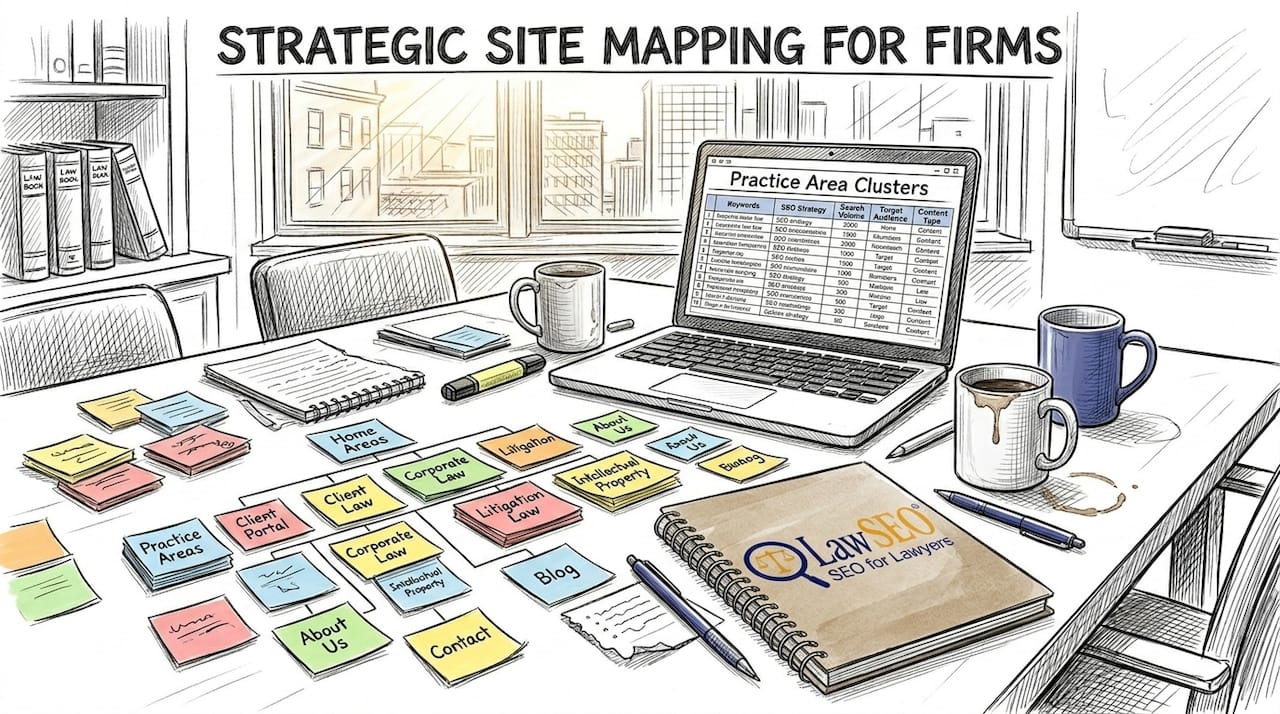
The most effective internal linking strategy for law firms uses a content cluster model. A content cluster groups a central “pillar” page, typically a main practice area page, with multiple supporting pages that cover related subtopics. These supporting pages link back to the pillar and to each other, creating a web of relevance that Google rewards with higher rankings.
For example, a personal injury pillar page would connect to supporting pages on car accidents, medical malpractice, slip and fall injuries, and wrongful death claims. Each supporting page links back to the main personal injury page. The result is a tightly organized topical cluster that signals deep expertise to search engines.
Here is a sample internal linking structure for a 10-attorney law firm:
| Source page | Anchor text example | Destination page | Estimated SEO lift |
|---|---|---|---|
| Personal injury blog post | car accident settlements | Car accident practice page | High |
| Attorney bio (injury focus) | personal injury representation | Personal injury pillar page | Medium |
| FAQ: medical malpractice | medical negligence claims | Medical malpractice page | High |
| Local landing page (Chicago) | Chicago criminal defense | Criminal defense practice page | High |
| Blog: DUI consequences | DUI defense attorney | DUI practice area page | Medium |
To build this structure for your firm, follow these steps:
- Inventory your site. List every page: practice areas, attorney bios, blog posts, location pages, and FAQ sections.
- Identify your pillar pages. These are your most important practice area and service pages.
- Map supporting content. Match every blog post and FAQ page to its most relevant pillar page.
- Add contextual links. Within each supporting page, link naturally to the pillar page using descriptive anchor text.
- Link attorney bios to practice areas. An attorney bio for a family law partner should link directly to the family law practice page.
- Connect location pages. Local landing pages should link to the relevant practice area pages and vice versa.
Content clusters drove a 43% increase in organic traffic for firms that implemented this model proactively. Your full website optimization guide can help you align this linking structure with broader on-page and technical SEO improvements.
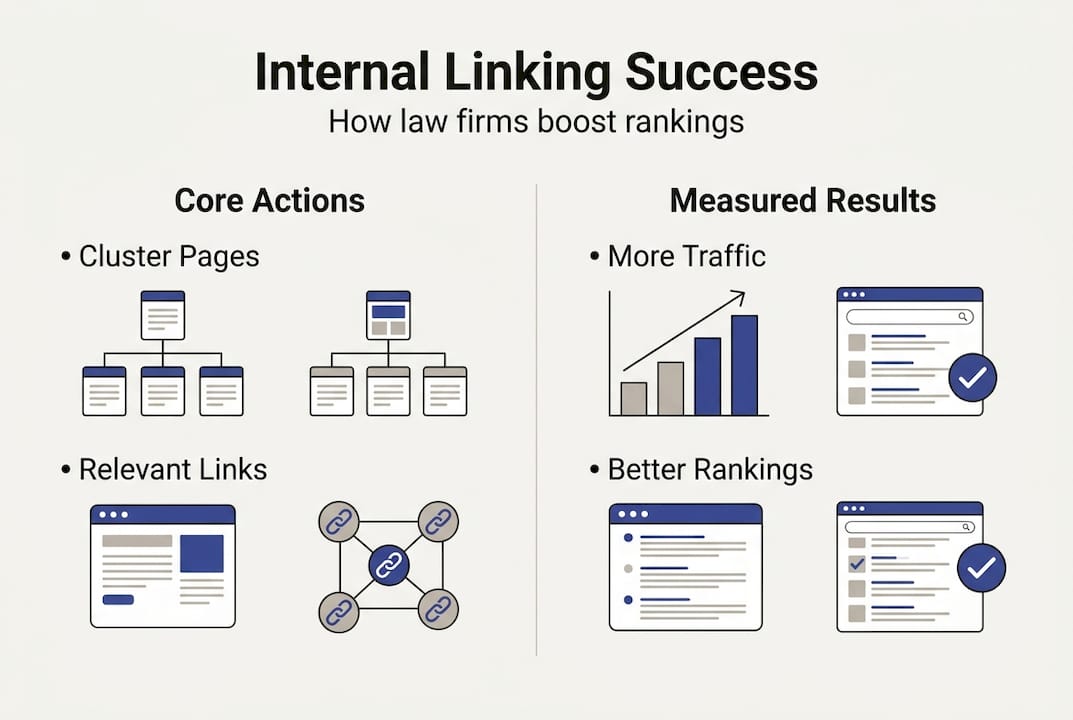
Internal linking workflow: Auditing, optimizing, and tracking results
Building your internal link structure is not a one-time task. Legal websites evolve constantly, new blog posts go live, practice areas expand, and attorney rosters change. Without a regular audit process, your internal linking strategy degrades over time, and orphan pages quietly accumulate.
Start with a site inventory. Tools like Screaming Frog, Ahrefs, or Semrush can crawl your site and identify pages with zero or very few internal links. These are your orphan pages, and they represent immediate ranking opportunities. A structured SEO audit for attorneys will surface these gaps faster than a manual review.
Follow this repeatable audit workflow:
- Crawl your site monthly using an SEO tool to identify new orphan pages.
- Prioritize high-value gaps such as practice area pages with few inbound internal links.
- Update existing content by adding contextual links from high-traffic blog posts to underperforming pages.
- Track anchor text diversity to ensure you are not over-optimizing any single page.
- Measure organic traffic monthly using Google Search Console to confirm ranking improvements after link additions.
- Document every change so you can attribute traffic gains to specific linking decisions.
Pro Tip: Your highest-traffic blog posts are your most valuable internal linking assets. Identify the top 10 blog posts by organic sessions in Google Search Console, then add contextual links from those posts to your lower-performing practice area pages. This transfers authority where you need it most, and it costs nothing but time.
“Law firms saw up to 382% keyword growth after comprehensive internal link audits.”
Monitoring your results through a structured lawyer link building workflow ensures that internal linking gains compound over time rather than plateauing after a single round of updates.
The overlooked power of internal links in law firm SEO
Here is an uncomfortable truth most legal marketing consultants will not tell you: the majority of law firms chasing new backlinks and publishing more content are skipping the single most cost-effective SEO tactic available to them. Internal linking requires no outreach, no content budget, and no third-party cooperation. Yet it consistently delivers compounding ranking gains that external link building alone cannot replicate.
In highly competitive practice areas like personal injury, criminal defense, and family law, the firms ranking at the top of Google are not always the ones with the most content. Often, they are the ones with the most coherent internal architecture. Their pages reinforce each other. Their authority flows where it matters.
The real opportunity here is that most of your competitors are not doing this well. They are publishing new content while leaving existing pages disconnected. That is your opening. Before you commission another blog post or pursue another backlink, run an internal link audit. You may find that why SEO matters for lawyers becomes immediately clearer when you see how much ranking potential is already sitting untapped inside your current site.
Get expert help boosting your law firm’s SEO
If you are ready to stop leaving rankings on the table, LawSEO legal SEO experts offer attorney-specific site audits that identify every internal linking gap, orphan page, and missed authority opportunity across your firm’s website. Our team builds and implements custom linking strategies aligned with your practice areas, local markets, and competitive landscape. Explore our advanced SEO guide for lawyers to see the full scope of what strategic SEO can do for your firm, or review our top SEO platforms for lawyers comparison to understand which tools and services best fit your goals.
Frequently asked questions
What is internal linking and why is it vital for law firm SEO?
Internal linking connects pages within your law firm’s website, helping search engines index your content and distribute authority to improve organic rankings. 83% of orphan pages gained rankings after receiving strategic internal links, making this one of the highest-return SEO activities available.
How many internal links should a legal website page include?
Most SEO experts recommend 3 to 5 relevant internal links per page, but quality, logical context, and user value should always take priority over hitting a specific number.
What pages should law firms prioritize for internal linking?
Prioritize links to practice area pages, local service location pages, attorney bios, and high-conversion blog posts to maximize both SEO performance and client inquiry rates.
Can better internal linking increase my law firm’s client leads?
Yes. Strong internal linking has driven 43% more organic traffic for firms that implemented content cluster strategies, directly increasing visibility and inbound inquiries for legal services.