


TL;DR:
- AI-driven search understands query intent and context, providing synthesized, relevant legal answers.
- Content optimized for human understanding and specific legal questions outperforms keyword-focused pages in AI search rankings.
- Law firms must reframe their digital strategy around substantive, clear, and intent-aligned content to stay competitive.
Many law firms assume AI search is just a smarter version of what Google has always done. That assumption is costing them clients. AI-driven search systems use natural language processing, machine learning, and large language models to understand query context and intent, then return synthesized answers rather than a list of links. For law firms competing in one of the most expensive digital markets in existence, understanding this distinction is not optional. It is the foundation of every effective marketing decision you will make in 2026 and beyond.
Key Takeaways
| Point | Details |
|---|---|
| AI search deciphers intent | AI-driven platforms interpret the context and purpose behind legal queries, not just keywords. |
| Hybrid approaches boost relevance | Combining semantic and keyword search delivers more accurate, trustworthy results for legal research. |
| Pipeline structure matters | Every search step—from query interpretation to citation—impacts your law firm’s online visibility. |
| Content clarity is critical | Optimizing for AI-driven search means structuring content for meaning, not merely for keywords. |
| Proactive adaptation wins clients | Law firms aligning with AI search now will lead in visibility and client acquisition as generative search becomes standard. |
Defining AI-driven search: How it works
Traditional search engines work by matching words in your query to words on a web page. AI-driven search works differently. It interprets what a person means by their query, not just what words they typed, and it returns results or synthesized answers calibrated to that meaning.
Here is what powers AI-driven search at its core:
- Natural language processing (NLP): Allows the system to parse grammatical structure, detect intent, and recognize legal terminology used in context.
- Machine learning (ML): Enables the system to improve its interpretations over time, learning which results satisfy users in similar situations.
- Large language models (LLMs): Generate fluent, context-aware responses that synthesize multiple sources into a single, readable answer.
- Conversational follow-up capability: Users can refine or extend their queries without starting over, creating a dialogue rather than a one-shot keyword search.
According to IBM’s explanation of the technology, AI search analyzes context and returns personalized results by understanding the semantic meaning behind a query, not just the literal words used.
“An AI-driven search system uses AI to understand query context and intent, then returns results or synthesized answers rather than relying only on keyword matching.” — IBM Think
This matters enormously for law firms. A prospective client searching for “what happens if I get injured at work and my employer doesn’t have insurance” is not just typing keywords. They are describing a legal situation with emotional urgency and a need for immediate, trustworthy guidance. AI-driven search recognizes that context and prioritizes sources that address the full question with authority and specificity.
Pro Tip: Structure your practice area pages to answer the full legal question, not just target a keyword phrase. AI-driven search rewards intent alignment over keyword density every time. For a deeper look at how to position your firm for this shift, explore AI search optimization for law firms.
AI search vs. traditional search: Key differences
Understanding what AI-driven search is, let’s see how it stacks up against traditional legal search methods. The differences are architectural, behavioral, and strategically significant.
Traditional search relies on lexical retrieval. It matches exact or approximate keywords, applies link-based authority signals like PageRank, and returns a list of pages ranked by relevance. It is powerful. It is also limited by its inability to infer meaning from context alone.
AI-driven search adds several layers on top of that foundation:
- Semantic search: Understands synonyms, related concepts, and professional terminology in legal queries.
- Vector retrieval: Converts text into mathematical representations to find conceptually similar content even when exact words don’t match.
- Retrieval-augmented generation (RAG): Pulls from external documents or databases and uses an LLM to generate a grounded, cited answer.
- Hybrid models: Combine lexical and semantic retrieval for optimal precision and recall.
Modern AI search commonly combines vector and semantic retrieval with traditional lexical retrieval, and may use RAG to ground an LLM’s response in external documents. Cloudflare’s technical breakdown reinforces that AI-driven search architecture is not one thing. It can mean semantic vector search, hybrid retrieval with BM25 keyword scoring, or generative answer construction. The marketing implications differ depending on which layer the platform uses to decide what to cite or recommend.
| Feature | Traditional search | AI-driven search |
|---|---|---|
| Query interpretation | Keyword matching | Semantic intent analysis |
| Ranking signals | Links, authority, keywords | Relevance, clarity, trust signals |
| Personalization | Limited, broad | Context-aware, session-adaptive |
| Follow-up queries | New search required | Conversational continuation |
| Citation accuracy | URL ranking | Source attribution in generated answers |
| Best for legal marketing | Broad keyword visibility | Intent-matched, high-conversion queries |
For law firms, this table translates into a clear strategic shift. If your firm’s content is structured around keyword stuffing and generic landing pages, it will perform poorly in AI-driven search environments. Understanding why AI search matters for law firm marketing is the first step toward closing that gap. Firms that get ahead now by using AI and SEO together are already capturing leads their competitors are missing entirely.
The AI-driven search pipeline: Step-by-step for law firms
To understand how to appear in AI-generated answers, you need to understand how those answers are built. Let’s walk through a typical AI-driven search pipeline from the moment a user types a query to the moment they see a response.
-
Interpret the query. The system uses NLP and LLMs to determine the user’s intent, topic, entities involved, and the type of answer needed. For a legal query like “how to fight a wrongful termination claim in California,” the system identifies jurisdiction, legal category, and desired outcome.
-
Retrieve relevant documents. Using vector search, semantic search, or hybrid retrieval, the system pulls candidate passages from indexed content. High-quality, clearly structured legal content is far more likely to be retrieved at this stage.
-
Rank and select passages. The system scores retrieved passages for relevance, authority, and trustworthiness. Signals include content clarity, source credibility, and how directly the passage answers the query.
-
Generate a response. The LLM synthesizes the top-ranked passages into a coherent, readable answer. It does not simply copy text. It generates language that addresses the user’s specific intent.
-
Attribute citations. On platforms that show citations, the system selects which sources to credit. Being cited here drives direct traffic and establishes authority in AI-mediated search.
A common pipeline for generative AI search follows this exact sequence: interpret the query, retrieve relevant documents, rank and select useful passages, generate an answer structure, and choose citations. Each step is a potential entry point for your law firm’s content.

| Pipeline step | Marketing funnel stage | Law firm implication |
|---|---|---|
| Query interpretation | Awareness | Content must match real user intent and legal language |
| Document retrieval | Awareness / Consideration | Clear page structure and topic authority improve retrieval rate |
| Passage ranking | Consideration | Trust signals, source credibility, and content precision matter |
| Answer generation | Decision | Synthesized mentions build brand authority without requiring a click |
| Citation selection | Conversion | Being cited drives direct traffic from high-intent users |
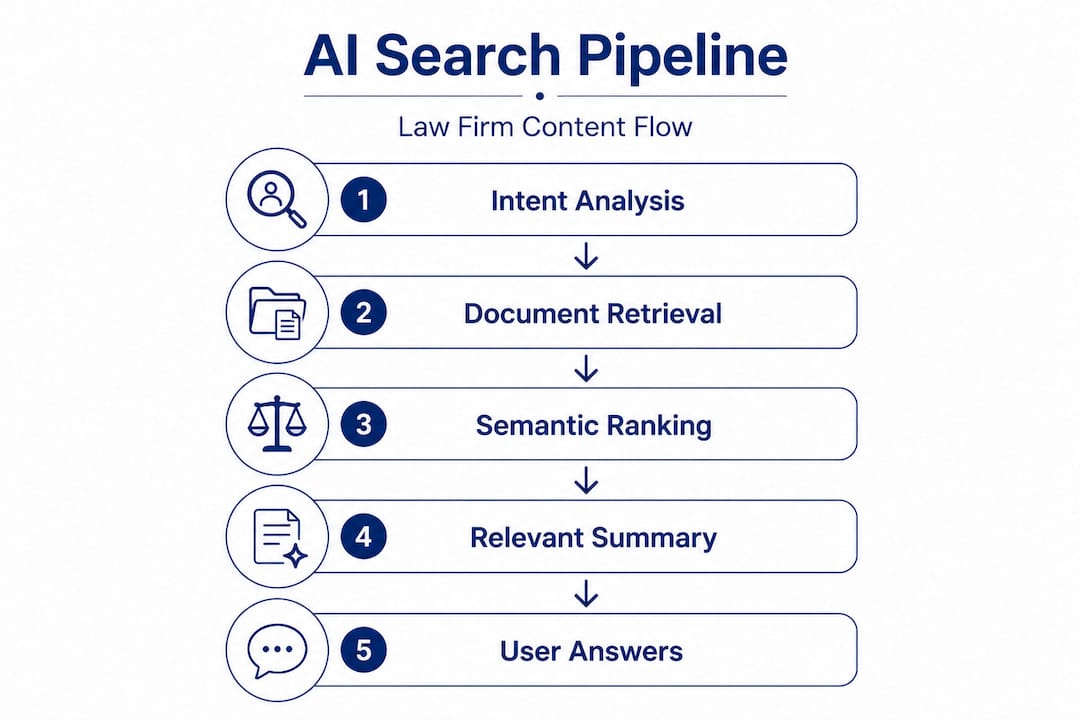
For law firms tracking AI search platform gains, this pipeline explains why some firms are seeing dramatic increases in qualified leads while others remain invisible. The firms gaining ground are the ones whose content is built to pass through every stage of this pipeline successfully. Evaluating the top AI SEO tools for law can accelerate how quickly your firm adapts its strategy.
Practical implications: How law firms can leverage AI-driven search
Having mapped the technical process, let’s translate it into practical steps your law firm can act on right now. The goal is not to become a technology expert. The goal is to create content and a digital presence that AI systems treat as authoritative, clear, and relevant.
AI-driven search supports conversational follow-ups and delivers personalized, highly relevant results. This means users are asking increasingly specific questions, and they expect complete answers. Generic practice area pages no longer satisfy that expectation. Here is what you should prioritize:
-
Map every page to a specific user intent. Instead of a generic “Personal Injury” page, create pages that address specific scenarios: “What to do after a slip and fall in a grocery store,” “How to file a workers’ compensation claim without a lawyer,” or “When is it worth suing after a car accident.”
-
Write in plain, precise language. AI systems favor content that answers questions clearly. Legal jargon without explanation signals low accessibility, which reduces retrieval probability.
-
Use structured formatting. Headings, bullet lists, numbered steps, and short paragraphs help AI systems parse your content and extract relevant passages for generated answers.
-
Include authoritative citations. Content that references statutes, case law, or credible legal organizations signals trustworthiness to AI ranking layers.
-
Update content regularly. AI search systems favor fresh, accurate content, especially in fast-changing legal areas like immigration, tax law, or regulatory compliance.
-
Optimize for questions. Use the actual questions your clients ask. Include FAQ sections. Structure content as direct answers to common legal queries.
Pro Tip: Optimizing for AI means thinking beyond keywords. Answer real legal questions with enough context that a user could take meaningful action from your answer alone. Firms doing this are seeing their content cited in AI-generated responses, which is the new equivalent of a first-page ranking. Start by reviewing your optimizing for AI overviews strategy and applying those principles at the page level. For a complete framework, the AI optimization guide for law firms provides actionable direction on structuring your entire digital presence for AI retrieval.
Measuring your results in AI search requires tracking beyond traditional keyword rankings. Monitor your firm’s appearance in AI-generated summaries, citation frequency in tools like ChatGPT, Google AI Overviews, and Perplexity, as well as referral traffic from AI-attributed sources. These metrics are increasingly available through advanced analytics configurations and third-party AI visibility tools.
A new era for law firm marketing: What most experts miss about AI-driven search
With these practical steps in hand, it is worth stepping back and examining a broader strategic reality that most law firm marketing conversations overlook entirely.
The dominant narrative in legal SEO right now treats AI-driven search as a refinement of existing practice. Update your metadata, add FAQ schema, write longer content. These are incremental tactics applied to a foundational shift. The firms that will lead their markets in three years are not the ones that tweaked their SEO. They are the ones that fundamentally rethought what it means to be authoritative online.
AI systems do not rank websites the way Google’s traditional algorithm ranks websites. They evaluate whether your content satisfies a human’s information need at the level of meaning. That is a different standard. A page optimized for “personal injury attorney Chicago” with keyword repetition and thin explanatory content will be outperformed by a page that actually explains how Illinois personal injury law works, what damages are recoverable, and what a realistic timeline looks like.
Most law firms treat AI search as a minor tweak to their existing SEO approach. In reality, it restructures how visibility and authority are determined entirely. Law firms that invest in semantically rich, substantive answers are positioned for exponential lead growth. Those that don’t are building visibility on a foundation that is already eroding.
The uncomfortable truth is that content quality has always mattered in SEO. But it was possible to rank with mediocre content if your backlink profile was strong enough. AI-driven search removes that loophole almost entirely. Substance, clarity, and genuine usefulness are now the primary ranking variables.
Pro Tip: Law firms that fully align content with real user intent, clear legal context, and demonstrable trust signals will consistently outpace competitors. This is not a future concern. It is a present competitive advantage that is already playing out in search results today. Understanding why optimizing for AI search is critical is the strategic starting point every firm needs before investing in tactical execution.
Accelerate your firm’s growth with AI-powered visibility
Ready to move from understanding to action? LawSEO.com specializes exclusively in SEO for lawyers, and our AI-focused strategies are built specifically for the competitive legal market. From technical optimization to content that earns citations in generative AI responses, we offer end-to-end support that turns your website into a consistent client acquisition engine. Explore our detailed AI optimization strategies for law firms to see exactly how we approach AI visibility, or review our full advanced SEO strategy for lawyers to understand what a complete digital marketing program looks like when built around your firm’s specific practice areas and market.
Frequently asked questions
How does AI-driven search help law firms attract more clients?
AI-driven search helps your firm surface answers that match potential clients’ intent, making your website more visible in meaningful legal queries because it delivers personalized results that go well beyond simple keyword matching.
Is AI-driven search only for large law firms?
No, law firms of any size can benefit from AI search, especially by optimizing for intent and authority in niche practice areas, since AI-driven search adapts to different use cases ranging from document recall to tailored marketing across organizations of any scale.
Do I need to change my website for AI-driven search?
Yes, structuring content clearly, focusing on user intent, and using strong citations all improve your visibility in AI-powered search because content structure and clarity carry significantly more weight in systems that evaluate semantic relevance rather than keyword frequency.
What is “hybrid retrieval” in AI search?
Hybrid retrieval means combining traditional keyword search with semantic and vector search for more effective results, and hybrid AI search combines vector and lexical retrieval, often supported by retrieval-augmented generation, to improve both precision and relevance.
How soon will AI-driven search become the norm for legal research and marketing?
AI-driven search is already gaining rapid adoption in the legal field and will soon be essential for competitive law firms, as legal professionals increasingly rely on AI-driven platforms for faster, context-aware answers that traditional search engines cannot provide.