


TL;DR:
- The best law firm marketing approach in 2026 is a hybrid model that combines open top-of-funnel content with gated high-value assets. Gated resources should be interactive, proprietary, or deliver unique outputs, while educational content remains ungated for visibility. Proper planning ensures compliance, effective follow-up, and maximizes qualified lead capture without overloading intake teams.
Gate selectively and strategically. The most effective approach for law firms in 2026 is a hybrid model: leave top-of-funnel (TOFU) content fully open for SEO and AI discovery, then gate genuinely high-value middle- and bottom-of-funnel (MOFU/BOFU) assets that deliver personalized, proprietary outputs.
- Gate when: the asset is interactive, proprietary, or delivers a specific output the prospect cannot get elsewhere (a settlement estimator, a jurisdiction-specific checklist, a business formation template pack).
- Keep open when: the content is educational, definitional, or designed to build awareness. Gating blog posts and FAQ pages kills your search visibility and blocks AI agents from citing your expertise.
- Immediate next step: audit your existing content library, identify one MOFU asset that delivers real utility, and convert it into a gated landing page with a minimal form before building anything new.
Before you gate anything, confirm two checkpoints: your state bar’s advertising and solicitation rules, and whether your intake team has the capacity to follow up on every lead you capture.
What gated content is and how it differs from ungated content
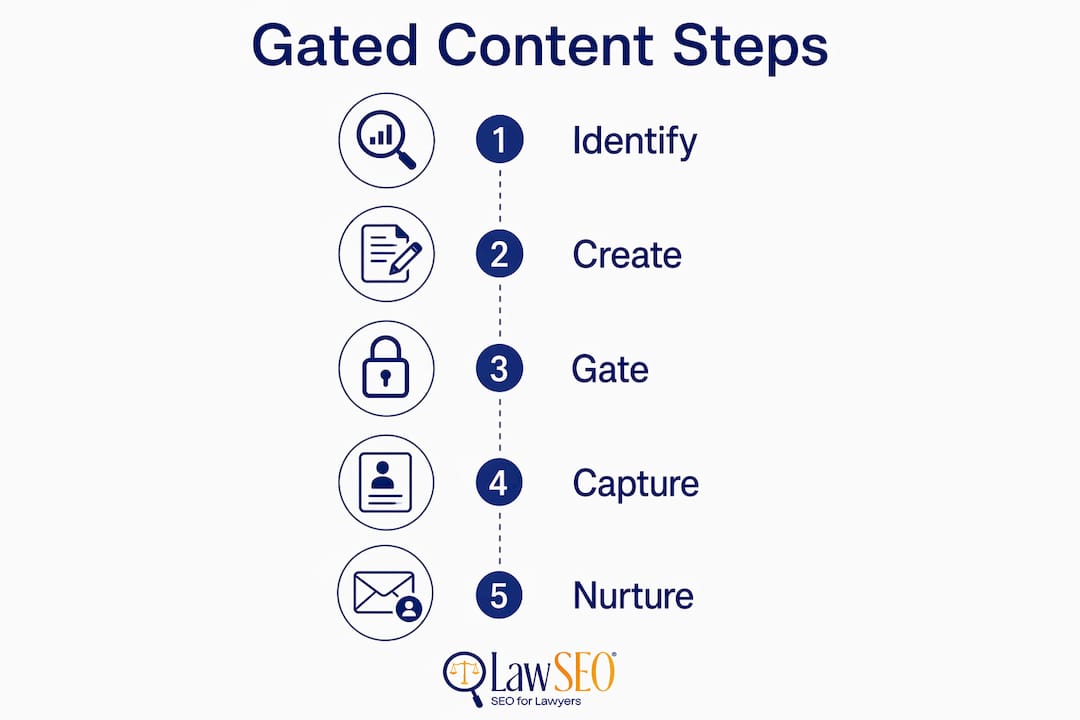
Gated content requires a visitor to submit contact information before accessing the material. The exchange model is simple: the firm offers something genuinely useful, and the prospect trades their name, email, and phone number for it. Ungated content, by contrast, is publicly accessible and indexed by search engines and AI platforms without any barrier.
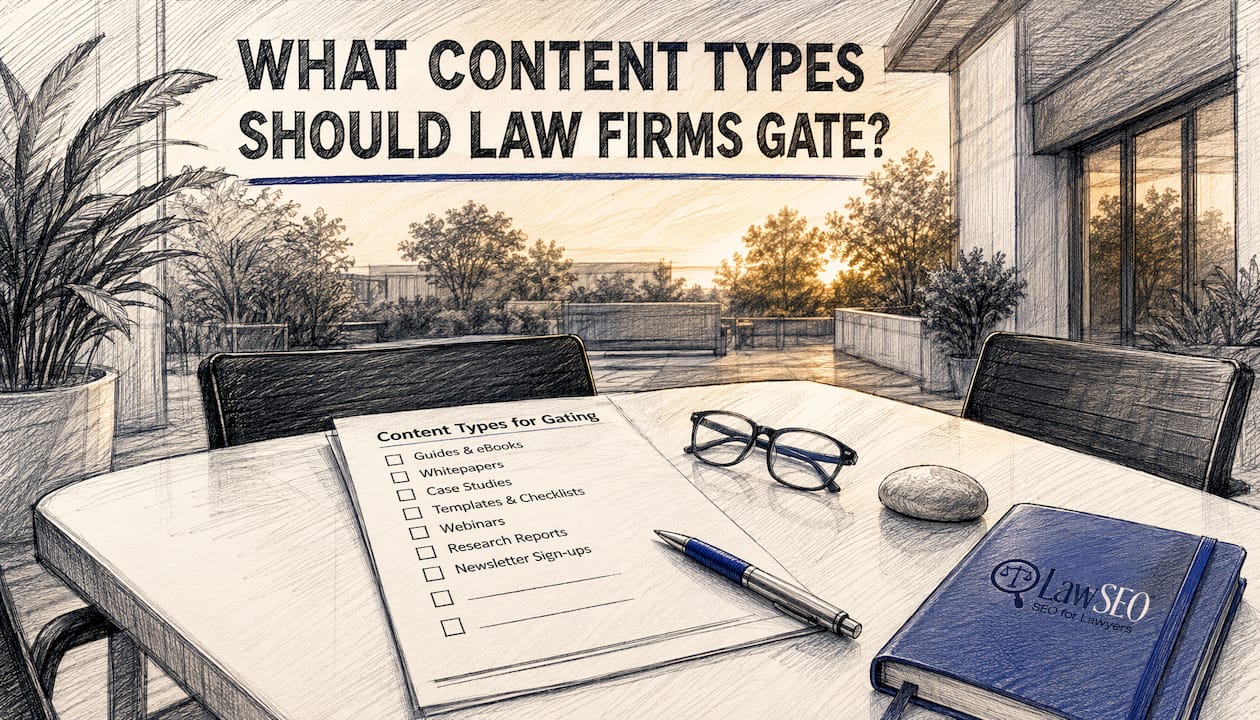
Common gated asset types for law firms include:
- Interactive calculators and estimators (settlement value tools, alimony calculators)
- Downloadable templates and legal form packs (business formation documents, estate planning worksheets)
- Original research reports (local verdict data, industry-specific compliance guides)
- Webinar replays with Q&A transcripts
- Practice-area checklists with jurisdiction-specific guidance
Funnel position matters. TOFU assets (blog posts, explainer videos, general FAQs) should stay ungated to maximize reach and legal SEO performance. MOFU assets (guides, calculators, templates) are the right candidates for gating. BOFU assets (case evaluations, consultation booking) should be frictionless, not gated in the traditional sense.
Advantages and disadvantages of gating for law firms
Pros:
- Gated assets capture qualified signals. A prospect who downloads a “Business Formation Checklist for Texas LLCs” has identified their practice need, their jurisdiction, and their stage in the decision process before your intake team makes a single call.
- Contact data enables personalization. You know what the lead downloaded, which tells you what problem they are trying to solve.
- Earlier pipeline intelligence. Gated content turns your website into an active business intelligence tool when paired with CRM workflows and intake automation.
Cons:
- Gated content is invisible to search crawlers and AI agents. A gated PDF cannot be indexed, cited, or surfaced by ChatGPT, Perplexity, or Google’s AI Overviews.
- Lower volume. Fewer people will access gated content than ungated content, by design.
- AI discovery loss. Gating TOFU content can make a firm’s expertise invisible to next-generation search engines, which is a strategic error in an AI-first world.
The most overlooked con is operational: capturing leads you cannot act on is worse than capturing none. If your intake team is already at capacity, a high-converting gated asset will create a backlog that damages client experience and wastes marketing spend.
Pro Tip: Before launching any gated asset, map your intake workflow end to end. Confirm that a new lead can receive a personal response within one business day. If that is not possible today, fix the process before you build the gate.
Which content types work best as gated resources for law firms
Interactive lead magnets consistently generate higher-intent leads than static PDFs because they require user input and deliver personalized outputs. A prospect who enters their injury details into a settlement estimator is far more committed than one who downloads a generic ebook.
Effective gated asset types by category:
- Interactive tools: settlement estimators, alimony calculators, business entity comparison tools, immigration eligibility assessments
- Proprietary research: local verdict databases, industry compliance benchmarks, regional market data
- Template and form packs: LLC operating agreements, demand letter templates, estate planning document checklists
- Webinar replays: recorded CLE-adjacent sessions with Q&A, especially for business law and employment practice areas
Practice-area examples:
- Personal injury: a settlement range estimator that takes injury type, liability percentage, and medical costs as inputs
- Estate planning: a “What Documents Do You Need?” checklist personalized by family structure and asset type
- Business law: a business formation document pack with state-specific operating agreement templates
- Immigration: a visa eligibility self-assessment tool that maps the prospect’s situation to the most likely pathway
Build interactive tools when client-specific numbers matter and the output changes based on input. Use downloadable templates when the value is in the document itself and personalization is secondary. For creative content ideas that pair well with gated assets, the practice-area blog is still the best traffic driver to feed the gate.
How to decide what to gate: a practical decision checklist
Use this framework before committing to a gating decision:
- Is the asset unique or proprietary? If a prospect can find equivalent information with a Google search, gating it will only reduce your reach.
- Does it deliver a personalized output? Calculators and assessments that return a result specific to the user’s inputs justify a gate. Generic PDFs usually do not.
- Does the searcher’s intent signal purchase readiness? MOFU and BOFU intent warrants a gate. Informational intent does not.
- Is your intake team ready to follow up? If not, do not gate yet.
- Does gating this asset create a compliance risk? Review state bar advertising rules before collecting contact data for any asset that could be construed as solicitation.
The recommended approach for 2026 is clear: ungate TOFU, gate genuinely proprietary MOFU/BOFU assets. The hybrid model works like this: publish an ungated executive summary or infographic that AI agents can index and cite, then gate the full methodology, raw data, or downloadable deliverable behind a form. The public version builds authority and discoverability; the gated version captures qualified interest.
How to set up a gated asset: tech, forms, and workflow
A gated asset launch has seven components. Work through them in order:
- Landing page: a dedicated URL with a headline, benefit bullets, a preview image or sample, and the form. No navigation menu. One goal per page.
- Form design: collect Name, work email, phone, and one qualifying question (e.g., “What is your primary legal concern?”). Over-fielding kills conversion; four fields is the ceiling for a first touch.
- Privacy notice: place a one-line consent statement directly below the form submit button, linked to your full privacy policy.
- Delivery mechanism: email the asset immediately via an automated sequence. Do not rely on a thank-you page download link alone; email delivery confirms the address is real.
- CRM integration: tag every submission with the asset name, practice area, and download date. This data drives personalization in every subsequent touchpoint.
- Automation sequence: trigger a two-step follow-up: a delivery email at minute one, and a value-add follow-up at day three that offers a related resource or a consultation booking link.
- Analytics tagging: use UTM parameters on every traffic source and set up a goal or conversion event in your analytics platform to track form submissions by channel.
Pro Tip: Use progressive profiling for returning visitors. If a prospect downloads a second asset, your form platform can suppress fields you already have and ask one new qualifying question instead. This builds your data profile without increasing friction at any single touchpoint.
Tools by category: any major CMS (WordPress, Webflow) handles landing pages; form providers like Gravity Forms or Typeform handle field logic and conditional display; HubSpot, Salesforce, or Clio Grow handle CRM integration and automation for law firms specifically.

US ethics, privacy, and advertising rules you must review before gating
State bar advertising and solicitation rules apply to the emails you send after a prospect downloads your gated asset, not just the asset itself.
NYSBA Ethics Opinion 1039 establishes the key distinction: offering an educational report or newsletter in exchange for contact details is generally not an “advertisement” if the primary purpose is educational. But subsequent promotional emails using that data may trigger advertising or solicitation rules. Every follow-up email that describes your firm’s services for the purpose of securing retention is an advertisement under Rule 7.1(a) and must comply accordingly.
NYSBA Opinion 947 confirms that educational newsletters and seminar invitations are not advertisements under Rule 7.1, provided they do not primarily promote the firm’s services. The practical implication: your delivery email and value-add follow-up can be educational. The moment you pivot to describing your firm’s qualifications and asking for a consultation, advertising rules apply.
Practical compliance checklist:
- Label promotional follow-up emails “Attorney Advertising” in the subject line or first line (Rule 7.1(f) in New York; check your state’s equivalent)
- Include your firm name, principal office address, and phone number in every advertisement (Rule 7.1(h))
- Retain a copy of every advertisement for at least three years (Rule 7.1(k))
- Confirm your state bar’s specific rules before scaling any email sequence
Consent language to place directly below your form submit button: “By submitting this form, you agree to receive the requested resource and related legal information from [Firm Name]. You may unsubscribe at any time. This is not legal advice and does not create an attorney-client relationship. [Firm Name] | [Address] | [Phone].”
CAN-SPAM compliance requires a physical mailing address, a clear unsubscribe mechanism, and no deceptive subject lines in every commercial email. GDPR applies if any of your prospects are located in the European Union, regardless of where your firm is based.
This article is general information, not legal or ethics advice. Confirm the current rules with your state bar counsel before implementing any gated content program.
How to measure gated content performance
| Metric | Why it matters | Action if low | Action if high |
|---|---|---|---|
| Form conversion rate | Measures landing page and offer effectiveness | Simplify the form; strengthen the headline or benefit statement | Test a higher-value asset or add a qualifying question |
| MQL to SQL rate | Shows whether gated leads match your ideal client profile | Tighten the qualifying question; adjust asset topic | Scale distribution; increase ad spend to that asset |
| Lead-to-client rate | The ultimate ROI signal | Improve intake speed and follow-up sequence | Replicate the asset format in adjacent practice areas |
| Engagement depth | Reveals whether prospects read the asset or ignore it | Redesign the asset; shorten it; add interactive elements | Use asset topic as a signal for content expansion |
| Assisted conversions | Shows gated content’s role in multi-touch journeys | Increase ungated TOFU content to feed the gate | Attribute pipeline value to the asset in CAC calculations |
For well-built interactive tools, expect form conversion rates in the low double digits, roughly 11–15%, when the landing page is well-optimized and the asset delivers genuine personalized value. Static PDFs and generic ebooks typically convert at lower rates. Use law firm analytics to connect gated asset submissions to pipeline stages and calculate cost per acquired client by channel.
Best practices and common mistakes to avoid
Do:
- Publish an ungated executive summary for every gated asset so search engines and AI agents can index your expertise
- Use schema markup (FAQPage, HowTo, Article) on ungated summary pages to maximize AI citation potential
- Design the thank-you page as a conversion step: offer a consultation booking link, a related resource, or a short video from the attorney
Don’t:
- Gate blog posts, FAQ pages, or any content a prospect would expect to read freely
- Ask for more than four fields on a first-touch form
- Send a gated asset and then go silent; the follow-up sequence is where the conversion actually happens
Pro Tip: The thank-you page is the most underused conversion asset in legal marketing. Place a calendar booking widget directly on it. A prospect who just downloaded your estate planning checklist is at peak intent. Give them a one-click path to a 15-minute call with an attorney before that intent cools.
A content architecture that organizes ungated pillar content around gated assets preserves discoverability while feeding the gate with qualified traffic. The pillar page ranks; the gated asset converts.
Short tactical templates you can copy
-
Personal injury settlement estimator
- Form fields: Name, email, phone, injury type (dropdown), state of incident
- Follow-up step 1 (day 0): deliver the estimator result summary by email with a note from the attorney
- Follow-up step 2 (day 3): send a “What to expect in a PI case” guide with a consultation booking link
- Expected outcome: high-intent leads who have already quantified their claim; conversion to consultation call is the primary KPI
-
Estate planning document checklist
- Form fields: Name, email, phone, marital status (dropdown)
- Follow-up step 1 (day 0): deliver the personalized checklist with a brief attorney introduction
- Follow-up step 2 (day 4): send a “Common estate planning mistakes” email with a free 20-minute review offer
- Expected outcome: prospects who are actively planning; lead quality is high, sales cycle is typically 2–6 weeks
-
Business formation document pack
- Form fields: Name, work email, phone, entity type of interest (dropdown)
- Follow-up step 1 (day 0): deliver the template pack with a cover note on state-specific requirements
- Follow-up step 2 (day 3): send a “5 things to do after forming your LLC” guide with a link to schedule a formation consultation
- Expected outcome: early-stage business owners with an immediate legal need; fastest path to a retained engagement
Place each gated asset on a dedicated landing page, embed a teaser on the relevant practice-area page, and add an exit-intent trigger on high-traffic blog posts in the same practice area.
Research-backed notes and expert guidance
NYSBA Ethics Opinion 1039 is the most directly applicable ethics guidance for law firm gated content programs in New York. Firms in other states should locate the equivalent opinion from their state bar, as the advertising/solicitation distinction varies by jurisdiction.
Key industry finding: Hybrid gating, where public summaries are open and full deliverables are gated, is the most effective conversion architecture in 2026. Public summaries let AI agents index your expertise while gating the full methodology or downloadable report captures qualified interest.
Practical notes for marketing managers:
- Most gated-content failures are organizational, not technical: over-capturing leads without intake capacity or automation to act on them wastes marketing resources and damages client experience
- Use your analytics platform to de-anonymize high-intent accounts; tools like Clearbit or RB2B can identify the company or individual behind an anonymous visit, letting intake teams prioritize outreach before a form is even submitted
- Align marketing and intake on a shared definition of a qualified lead before launching any gated asset; misalignment here is the single most common reason gated programs fail to generate revenue
Timeline and approximate costs for implementation
A minimal gated asset program, one landing page, one asset, one two-step email sequence, and CRM integration, can be live in four to six weeks from a standing start. A more complete program covering three practice areas with interactive tools takes three to four months.
Approximate cost ranges for US law firm marketing budgets:
- Landing page design and copywriting: $1,500–$4,000 per page, depending on complexity
- Interactive calculator or estimator build: $3,000–$12,000, depending on logic complexity and the development platform
- Static PDF or checklist design: $500–$2,000
- CRM setup and automation sequence: $1,000–$3,500 for initial configuration; ongoing platform fees vary by provider
- Ongoing management and optimization: typically included in a monthly retainer with a legal marketing agency
The largest variable is the interactive tool. A simple calculator built on a form platform costs far less than a custom-coded estimator with conditional logic and a personalized output page. Start with a form-based tool to validate the concept before investing in a custom build.
International privacy laws and considerations beyond US state bars
If your firm serves clients in the European Union or the United Kingdom, or if EU/UK residents can access your website and submit your forms, GDPR and UK GDPR apply. The core requirements: you must have a lawful basis for processing personal data (typically explicit consent for marketing communications), you must disclose what data you collect and how you use it, and you must honor deletion requests.
California’s CCPA/CPRA applies to law firms that meet its thresholds and collect personal information from California residents. At minimum, your privacy policy must disclose the categories of data collected, the purposes of collection, and the consumer’s right to opt out of the sale or sharing of their data.
Practical steps for US-based firms with any international exposure:
- Add a GDPR-compliant consent checkbox (unchecked by default) to any form accessible to EU/UK residents
- Maintain a data processing record that documents what you collect, why, and how long you retain it
- Review your email service provider’s data processing agreement to confirm it meets GDPR standards
- Consult privacy counsel before launching a gated program if your firm has significant international client exposure
How personalization increases gating effectiveness for legal services
Personalization works at two levels in a gated content program: asset selection and follow-up sequencing. At the asset level, the more closely the gated resource matches the prospect’s specific situation, the higher the conversion rate. A “Divorce Checklist for Texas Residents” outperforms a generic “Family Law Guide” because it signals relevance before the prospect even reads the first line.
At the follow-up level, the data collected at the gate drives every subsequent message. A prospect who selected “LLC formation” from a dropdown receives a different email sequence than one who selected “partnership agreement.” This segmentation is only possible if your form captures a qualifying question and your CRM routes leads by that answer.
Three personalization tactics specific to legal services:
- Practice-area routing: tag every lead with their practice area at the point of form submission and route to the attorney or intake specialist who handles that area
- Geographic segmentation: if your firm serves multiple markets, include a state or city field and use it to send jurisdiction-specific follow-up content
- Stage-based sequencing: a prospect who downloads a TOFU checklist gets an educational sequence; one who requests a BOFU template pack gets a faster path to a consultation offer
Nurturing gated leads through the legal services sales cycle
Legal services sales cycles are longer than most B2B categories. A prospect researching estate planning may take six to twelve weeks from first download to retained engagement. A personal injury prospect may move faster, but only after a triggering event (an accident, a diagnosis) that you cannot predict or accelerate.
The nurturing strategy must match the cycle. For longer-cycle practice areas like estate planning, business law, and immigration, a four to eight touch sequence spread over six to eight weeks is appropriate. For shorter-cycle areas like personal injury or criminal defense, compress the sequence to two to four touches in the first ten days.
Effective nurturing tactics for legal leads:
- Touch 1 (day 0): deliver the asset with a brief, personal note from the attorney. No pitch.
- Touch 2 (day 3–4): send a related educational resource that addresses the next logical question the prospect has.
- Touch 3 (day 7–10): offer a low-commitment next step, a free 15-minute call, a short video, or a second resource.
- Touch 4 (day 14–21): a direct but non-aggressive consultation offer with a specific benefit statement (“In 30 minutes, we can tell you whether you have a viable claim and what it might be worth”).
- Re-engagement (day 45–60): for prospects who have not converted, send a single re-engagement email with a new resource or a time-sensitive offer.
The post-download experience is as important as the gate itself. A strong asset with a weak follow-up sequence will consistently underperform a simpler asset with a well-designed nurture track.
Key Takeaways
Gated content for legal sites generates qualified leads when applied selectively to high-value MOFU/BOFU assets, paired with minimal forms, compliant follow-up sequences, and intake capacity to act on every lead captured.
| Point | Details |
|---|---|
| Gate MOFU/BOFU only | Leave TOFU content open for SEO and AI discovery; gate interactive tools, templates, and proprietary research. |
| Four-field form maximum | Name, email, phone, and one qualifying question; over-fielding kills conversion at the point of capture. |
| Expect good conversion rates for well-built interactive tools, while static PDFs typically convert at lower rates. | |
| Comply before you scale | Review state bar advertising rules and CAN-SPAM/GDPR requirements before sending any follow-up email sequence. |
| Lawseo audit-first approach | Lawseo’s audit-to-pilot process identifies your highest-value gating opportunity and builds the intake workflow before you invest in a full program. |
The case for selective gating, not maximum gating
The conventional wisdom in B2B marketing is to gate everything that took effort to produce. For law firms, that logic breaks down fast. Every piece of content you gate is a piece of content that Google cannot index, that ChatGPT cannot cite, and that a prospective client cannot find when they search at 11 PM after an accident or a business dispute.
The firms that will win the next five years of legal marketing are not the ones with the most gated assets. They are the ones with the most visible expertise, backed by a small number of high-converting gated tools that capture the prospects who are already convinced. Gate the calculator. Gate the template pack. Gate the webinar replay. Leave everything else open and make it so good that AI agents quote it by name.
There is also a practical argument against over-gating that rarely gets made: most law firms do not have the intake infrastructure to handle a high volume of gated leads well. A firm that captures 200 downloads a month and follows up with 40 of them is not running a gated content program. It is running a lead-waste program. The gate is only as valuable as the process behind it.
Exclusivity and local SEO compound this effect. When a firm owns the top organic position in its market and gates one well-built interactive tool, the leads that come through are already pre-qualified by geography, intent, and practice area. That combination, local dominance plus selective gating, is the highest-ROI configuration available to most law firms today.
How Lawseo helps law firms build and convert gated content programs
Lawseo works exclusively with law firms, which means every gated content recommendation comes with an understanding of state bar advertising rules, intake workflow realities, and the SEO tradeoffs that generic marketing agencies miss. The process starts with an asset audit: identifying which content you already have that could be converted into a gated tool, and which gaps represent the highest-value build opportunities.
From there, Lawseo builds the landing page, the form, the delivery sequence, and the CRM integration, then connects the program to your law firm SEO strategy so ungated content drives qualified traffic to the gate. The result is a program where every lead is tagged, routed, and followed up within a defined window. To get started, request a content audit at lawseo.com and bring your current content inventory and intake process to the first call.
Authoritative resources and citations to consult
- NYSBA Ethics Opinion 1039 — the primary guidance on when gated educational content becomes advertising and when follow-up emails trigger solicitation rules in New York
- NYSBA Ethics Opinion 947 — confirms that educational newsletters and seminar invitations are not advertisements under Rule 7.1, provided they do not primarily promote the firm’s services
- To Gate or Not to Gate? A Decision Framework for 2026 — analysis of hybrid gating, AI discoverability, and benchmark conversion rates for interactive tools
- Expertise into leads: how professional service firms use gated content to drive ROI — practical guidance on using gated assets as business intelligence tools and the case for interactive formats
- Top lead magnets for law firms to capture more clients — form field best practices, thank-you page design, and format-specific conversion benchmarks
- Gated vs Ungated Content: When to Gate (2026) — funnel mapping framework and the 2026 recommendation to ungate TOFU
Confirm state-specific rules with your bar counsel before implementing any gated content or email follow-up program. Ethics opinions from New York are cited here as illustrative examples; your state bar may apply different standards.