

Traditional SEO strategies that once dominated legal marketing are losing ground as AI-powered search engines reshape how potential clients find attorneys. Generative Engine Optimization (GEO) focuses on optimizing content for AI tools like ChatGPT, Perplexity, and Gemini rather than traditional search rankings. Law firms that ignore this shift risk invisibility in AI-generated answers that increasingly drive client acquisition. This guide explains GEO fundamentals, contrasts it with SEO, and provides actionable tactics law firms can implement now to capture AI-driven traffic in 2026.
Key takeaways
| Point | Details |
|---|---|
| GEO targets AI synthesis | Optimization focuses on being cited in AI-generated answers rather than traditional search rankings. |
| Evidence-based content wins | AI engines prioritize structured data, citations, statistics, and authoritative sources when generating responses. |
| Legal-specific tactics matter | Attorney bylines, case citations, jurisdiction schema, and quotable segments boost law firm visibility. |
| Hybrid approach required | GEO complements rather than replaces SEO; successful firms blend both strategies for maximum reach. |
| Early adopters gain advantage | Implementing GEO now builds compounding authority as AI search adoption accelerates. |
What is generative engine optimization (GEO)?
Generative Engine Optimization (GEO) is the practice of optimizing content to increase visibility, citations, and mentions in AI-powered generative search engines like ChatGPT, Gemini, and Perplexity. Unlike traditional SEO that aims for high rankings in search results, GEO focuses on synthesis and attribution in generated responses. When someone asks an AI tool for legal advice or attorney recommendations, GEO-optimized content gets cited and synthesized into the answer.
This distinction matters because AI engines don’t simply rank pages. They analyze, extract, and repackage information into conversational responses. Your law firm’s content might rank first in Google but never appear in ChatGPT’s answer if it lacks the structure and evidence AI systems prefer. As more potential clients turn to AI-powered search tools for legal guidance, visibility in these platforms becomes critical for client acquisition.
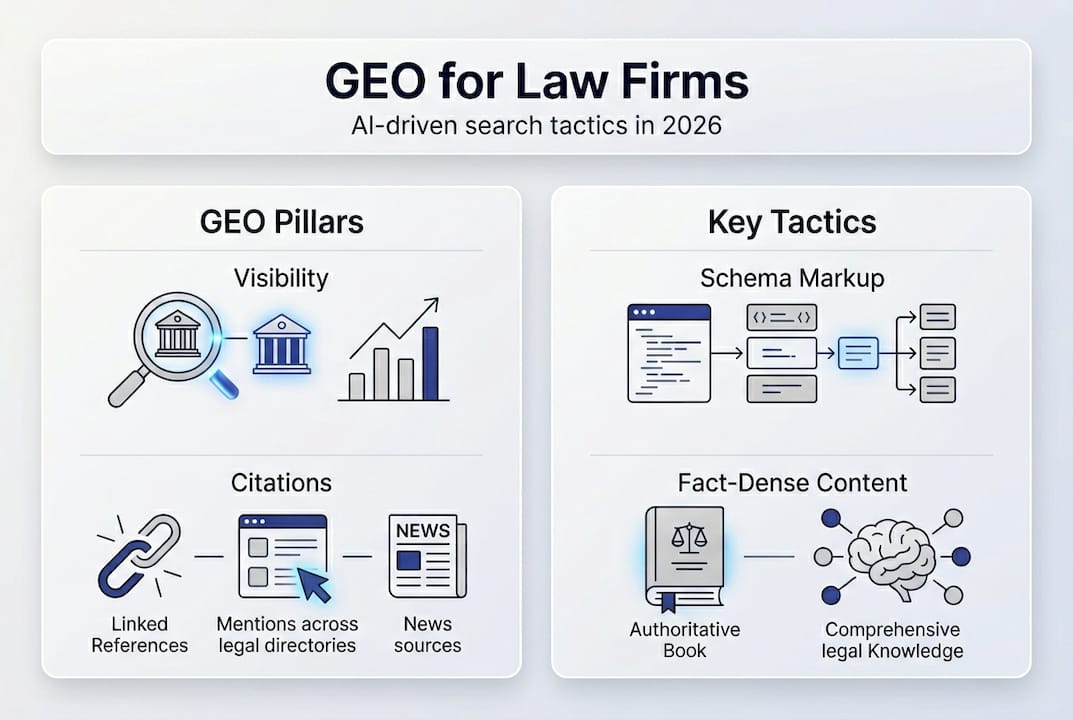
AI-generated answers prioritize content with specific characteristics. Schema markup helps machines understand your expertise and jurisdiction. Citations and statistics provide the evidence AI needs to trust your content. Quotable segments make it easy for AI to extract and attribute information. Attorney bylines establish authorship and credibility. These elements signal authority to AI systems in ways traditional keyword optimization never could.
Law firms face unique challenges in this landscape. Legal content requires precision, jurisdiction-specific guidance, and ethical compliance. Generic marketing tactics fail because AI tools recognize and reward genuine expertise. Your content must demonstrate deep knowledge of case law, statutes, and procedural nuances while remaining accessible to potential clients searching for help.
Core GEO content characteristics include:
- Embedded citations linking to authoritative legal sources and case law
- Structured data markup identifying practice areas, jurisdictions, and attorney credentials
- Statistics and data points that AI can extract and verify
- Quotable expert insights formatted for easy attribution
- FAQ sections addressing common legal questions with evidence-based answers
The AI optimization landscape for law firms demands this new approach because AI captures increasing search traffic. Firms that adapt early gain compounding advantages as AI systems learn which sources provide reliable legal information.
The core mechanics and methods of GEO for law firms
Core mechanics rely on Retrieval-Augmented Generation (RAG) involving query understanding, retrieval, and synthesis. When someone asks an AI tool about personal injury claims or estate planning, the system first interprets the query intent. It then retrieves relevant passages from its knowledge base or real-time web searches. Finally, it synthesizes these passages into a coherent response, citing sources it deems authoritative.
Understanding this process reveals optimization opportunities. AI systems favor content that’s easy to retrieve and synthesize. Legal content buried in dense paragraphs or lacking clear structure gets overlooked. Content with explicit jurisdiction markers, practice area labels, and evidence-based claims gets prioritized. Your optimization strategy must align with how AI systems process and evaluate legal information.

GEO methods improve visibility by up to 40% when implemented systematically. The most effective tactics combine technical optimization with content quality improvements. Schema markup tells AI exactly what your content covers. Citations provide the verification AI needs. Statistics offer concrete data points AI can extract. Quotable text gives AI ready-made segments to include in responses.
| Tactic | Visibility Gain | Implementation Difficulty |
|---|---|---|
| Adding citations | +41% | Medium |
| Including statistics | +30% | Low |
| Using quotations | +32% | Low |
| Fluent authoritative tone | +20% | High |
| Schema markup | +25% | Medium |
Implementing GEO for legal content follows a systematic process:
- Audit existing content to identify pages with high expertise but low AI visibility through manual queries in ChatGPT and Gemini
- Implement legal schema markup specifying practice areas, jurisdictions, attorney credentials, and case types
- Add citations to case law, statutes, and authoritative legal sources throughout your content
- Craft quotable expert insights formatted as clear, attributable statements from named attorneys
- Create structured FAQ sections addressing common legal questions with evidence-based answers
- Test AI visibility by querying prominent AI tools with relevant legal questions and tracking citation frequency
Pro Tip: Set up a monthly audit process where you query AI tools with questions your target clients ask. Track which competitors get cited and analyze what makes their content more attractive to AI systems. This competitive intelligence reveals gaps in your AI search optimization strategy you can address.
The technical foundation matters as much as content quality. Legal jurisdiction schema helps AI understand geographic and practice area relevance. Attorney schema establishes credentials and expertise. FAQ schema formats Q&A content for optimal extraction. These structured data elements act as signals that guide AI systems toward your content when generating relevant answers.
Understanding GEO nuances and its relation to traditional SEO
GEO and SEO serve complementary but distinct purposes in legal marketing. Traditional SEO drives organic traffic through search rankings. GEO drives visibility through AI citations and synthesis. Both matter because potential clients use multiple discovery paths. Some search Google directly. Others ask ChatGPT or Perplexity for recommendations. Your comprehensive strategy must address both channels.
| Aspect | Traditional SEO | Generative Engine Optimization |
|---|---|---|
| Primary Focus | Search rankings and click-through | Citations in AI-generated responses |
| Key Metric | Organic traffic and keyword position | Mention frequency and attribution |
| Technical Approach | Backlinks, keywords, site speed | Schema markup, citations, quotable text |
| Content Style | Keyword-optimized, comprehensive | Evidence-rich, structured, authoritative |
| Success Timeline | 3-6 months for rankings | Immediate for some AI tools, variable overall |
GEO presents unique challenges law firms must navigate carefully:
- Temporal inconsistency where AI responses vary significantly between queries and tools
- Phantom citations where AI attributes information to sources that don’t contain that specific claim
- Brand authority bias favoring established names over smaller firms with superior expertise
- Content hallucination risks where AI generates plausible but inaccurate legal information
- Attribution volatility as AI systems update training data and ranking algorithms
Critics argue GEO is repackaged SEO hype with risks of misinformation; emphasis should be on E-E-A-T and earned media.
This skepticism carries weight. AI responses can be volatile and show brand bias, making GEO results less predictable than traditional SEO. Some vendors oversell GEO as a magic solution while downplaying risks. Law firms must approach GEO strategically, focusing on fundamentals rather than chasing every new tactic.
The most effective approach combines 60% traditional SEO with 40% GEO-specific optimization. This hybrid strategy maintains organic search visibility while building AI citation authority. Traditional SEO provides stable, measurable traffic. GEO captures the growing segment of users who rely on AI tools for legal guidance. Together, they create comprehensive online visibility.
Expertise, experience, authoritativeness, and trustworthiness (E-E-A-T) matter more in GEO than traditional SEO. AI systems evaluate content quality more holistically than keyword-focused algorithms. Attorney bylines, case citations, jurisdictional specificity, and evidence-based claims signal genuine expertise. Generic content written by non-lawyers gets filtered out. This quality focus rewards law firms that invest in authentic, authoritative content.
Applying generative engine optimization tactics for law firms
Successful GEO implementation requires specific tactical adjustments to legal content. Generic optimization advice fails because legal content demands precision, jurisdiction awareness, and ethical compliance. These tactics address the unique requirements of law firm marketing while maximizing AI visibility.
Key implementation tactics for legal content:
- Attorney bylines with credentials, bar admissions, and case citations establishing expertise
- Jurisdiction-specific schema markup identifying practice areas and geographic coverage
- Evidence-based facts linking to case law, statutes, and authoritative legal databases
- Structured FAQ sections addressing common legal questions with cited answers
- Quotable expert insights formatted as clear, attributable statements
- Semantic mapping connecting related legal concepts and practice areas
Case studies show +43% AI traffic and 25X higher conversion rate using GEO tactics with fact-dense content and semantic mapping. These results come from systematic implementation, not isolated changes. Law firms that treat GEO as an ongoing optimization process see compounding returns as AI systems learn to trust their content.
| Content Element | Traditional Approach | GEO-Optimized Approach |
|---|---|---|
| Author Attribution | Generic firm name or no byline | Named attorney with credentials and bar number |
| Legal Claims | General statements about law | Specific citations to cases and statutes |
| Geographic Relevance | Broad service area mentions | Jurisdiction schema and location-specific guidance |
| Evidence | Minimal or no supporting data | Statistics, case outcomes, and authoritative links |
| Question Answers | Brief, generic responses | Detailed, cited answers with structured markup |
Pro Tip: Prioritize earned media and trust signals over branded content for better AI citation. Guest articles on legal publications, quoted expertise in news stories, and case study publications carry more weight with AI systems than self-promotional website content. Build relationships with legal journalists and contribute expert commentary to establish authority AI tools recognize.
Iterative testing drives GEO success. Query AI tools monthly with questions your target clients ask. Track which law firms get cited and analyze their content structure. Identify patterns in how AI synthesizes legal information. Adjust your content to match successful formats while maintaining accuracy and ethical compliance. This continuous optimization approach adapts to AI system updates and changing user behavior.
Semantic mapping connects related legal concepts throughout your content. When writing about personal injury claims, link to content about negligence, damages, and statute of limitations. This interconnected structure helps AI understand your comprehensive expertise. It also provides multiple entry points for AI retrieval, increasing citation opportunities across various query types.
Fact-dense writing improves shareability in AI-generated answers. Each paragraph should contain specific, verifiable claims rather than general observations. Replace “Many accident victims struggle with insurance companies” with “Insurance companies deny 15% of valid personal injury claims in initial reviews, requiring attorney intervention.” Specific data points give AI concrete information to extract and cite.
Explore advanced legal SEO and AI optimization services
Navigating GEO complexity while managing a law practice demands specialized expertise and dedicated resources. Legal SEO and AI optimization services tailored for law firms accelerate implementation and maximize results. Professional guidance helps avoid common pitfalls while capitalizing on emerging opportunities in AI-driven search.
Comprehensive services address every aspect of GEO implementation:
- Content audits identifying high-value pages lacking AI visibility
- Schema markup implementation for practice areas, jurisdictions, and attorney credentials
- Citation strategy development linking to authoritative legal sources
- AI visibility analysis tracking mention frequency across major AI platforms
- Competitive intelligence revealing what works for rival firms
- Ongoing optimization adapting to AI system updates and algorithm changes
Pro Tip: Early adoption of GEO strategies provides compounding authority and competitive advantage in legal marketing. AI systems learn which sources provide reliable legal information over time. Firms that establish citation patterns now benefit from accumulated trust as AI adoption accelerates. Waiting means competing against established authorities AI already recognizes.
Combining SEO fundamentals with innovative AI-focused tactics is essential for law firms in 2026 and beyond.
Specialized AI optimization services understand legal marketing’s unique requirements. They navigate ethical restrictions on attorney advertising. They recognize jurisdictional nuances affecting content strategy. They balance promotional goals with the authoritative, educational tone AI systems reward. This expertise prevents costly mistakes while accelerating time to results.
The investment in professional GEO implementation pays dividends through increased visibility, higher-quality leads, and improved conversion rates. AI search optimization captures clients at the earliest research stage, when they’re forming opinions about which attorneys to contact. Early visibility builds trust and positions your firm as the authoritative choice.
Frequently asked questions about generative engine optimization
What distinguishes GEO from traditional SEO for law firms?
GEO optimizes content for citation in AI-generated responses rather than search engine rankings. Traditional SEO focuses on keywords, backlinks, and technical site factors to improve organic search position. GEO emphasizes structured data, evidence-based claims, and quotable content that AI systems can easily extract and attribute. Both strategies complement each other in a comprehensive legal marketing approach.
How can law firms effectively audit their AI-driven search visibility?
Manually query major AI platforms like ChatGPT, Gemini, and Perplexity with questions your target clients ask. Track which law firms get cited and how frequently your firm appears in responses. Document the specific content AI extracts and the context in which it’s presented. Repeat this process monthly to identify trends and measure optimization impact. This hands-on approach reveals real visibility better than automated tools.
What types of content work best for GEO in the legal sector?
Content with attorney bylines, specific case citations, jurisdiction markers, and evidence-based claims performs best. FAQ sections addressing common legal questions with cited answers get extracted frequently. Articles explaining complex legal processes with step-by-step guidance and supporting data attract AI attention. Practice area pages with schema markup, statistics, and quotable expert insights also drive strong visibility.
Are there risks of misinformation when focusing on GEO and how to avoid them?
AI systems occasionally generate phantom citations or hallucinate legal information not present in source content. Mitigate this by ensuring every claim in your content links to verifiable sources. Use precise language avoiding ambiguity. Include jurisdiction-specific disclaimers. Monitor AI-generated responses mentioning your firm to catch and correct any misattributions. Focus on accuracy over volume to build trustworthy authority.
Should law firms replace SEO with GEO or combine both strategies?
Combine both strategies in a hybrid approach allocating roughly 60% effort to traditional SEO and 40% to GEO. Traditional SEO provides stable, measurable organic traffic while GEO captures emerging AI-driven search behavior. Most potential clients still use traditional search engines, but AI adoption grows rapidly. Maintaining strength in both channels ensures comprehensive visibility regardless of how clients search for legal services.