


TL;DR:
- Precise geo-targeting significantly increases law firm leads and reduces wasted ad spend.
- Targeting specific neighborhoods or ZIP codes creates highly relevant ad messaging tailored to local clients.
- Avoid common pitfalls like confusing geo-targeting with geofencing and overly narrow or broad targeting.
Most law firms assume that reaching more people online means spending more on broad digital campaigns. That assumption is costing them clients. Geo-targeting flips this logic entirely: instead of broadcasting to everyone, you deliver your message precisely to people in the neighborhoods, ZIP codes, and cities where your firm actually practices. One legal marketing case recorded +1300% lead growth and a 645% surge in organic traffic after implementing geo-optimized SEO and PPC. That is not an outlier. It is what happens when targeting precision replaces guesswork. This article gives you a clear framework for understanding, implementing, and optimizing geo-targeting so your law firm attracts the right clients in the right places.
Key Takeaways
| Point | Details |
|---|---|
| Geo-targeting defined | Geo-targeting means reaching the right local clients with tailored marketing—crucial for law firm growth. |
| Proven impact with data | Law firms using geo-targeted SEO and PPC have achieved up to 1300 percent more leads and much higher engagement rates. |
| Know the difference | Geo-targeting targets wider local areas, while geofencing focuses on specific locations—each has unique uses in legal marketing. |
| Avoid common mistakes | Steer clear of over-targeting, confusing geo-targeting for geofencing, or using generic ads everywhere. |
| Win with strategy | Success comes from choosing the right platforms, customizing messages, and adapting based on geo performance. |
What is geo-targeting for law firms?
Geo-targeting is the practice of delivering digital ads, content, or search results to users based on their physical location. For law firms, this means your Google Ads, Facebook campaigns, and local SEO efforts are shown specifically to people searching within your service area, whether that is a single city, a cluster of ZIP codes, or a defined radius around your office.
The concept sounds simple, but many firms confuse geo-targeting with a related but distinct tactic: geofencing. Geofencing creates virtual boundaries around high-intent physical locations such as hospitals, courthouses, or accident scenes, then triggers ads when a device enters or exits that boundary using GPS or WiFi signals. Geo-targeting, by contrast, focuses on broader defined areas rather than real-time location triggers.
Here is a side-by-side comparison to make the distinction clear:
| Feature | Geo-targeting | Geofencing |
|---|---|---|
| Scope | City, ZIP code, region | Specific building or block |
| Trigger | User location at search time | Physical entry/exit of boundary |
| Best for | Broad local awareness | High-intent, moment-based outreach |
| Technology | IP address, GPS, device data | GPS, WiFi, Bluetooth |
| Common use | Local SEO, PPC campaigns | Personal injury, courthouse targeting |
Channels that support geo-targeting for law firms include:
- Google Ads: Set location targets down to ZIP code or radius
- Facebook and Instagram Ads: Reach users by city, neighborhood, or custom map area
- Google Maps and Google Business Profile: Appear in local map pack results
- Bing Ads: Often overlooked but effective for older demographics
- Programmatic ad networks: Serve display ads across websites to users in your target area
“Geo-targeting is not just about where you advertise. It is about making every ad dollar work harder by ensuring your message reaches someone who can actually walk through your door.”
For law firm PPC campaigns, geo-targeting is not optional. It is the foundation of any cost-effective paid strategy. Without it, you are paying to reach people in states or cities where you are not even licensed to practice.
How geo-targeting boosts client acquisition
The performance data behind geo-targeting is difficult to ignore. Localized PPC campaigns generate a click-through rate 30% higher than national campaigns. Geofencing alone can increase foot traffic by up to 20% and delivers a CTR of 4% compared to just 0.7% for standard display ads. For law firms, these numbers translate directly into more consultations booked.
Consider what a typical law firm campaign looks like before and after geo-targeting:
| Metric | Before geo-targeting | After geo-targeting |
|---|---|---|
| Monthly leads | 12 | 45 |
| Cost per lead | $320 | $90 |
| Organic traffic | 800 visits/month | 6,000 visits/month |
| Ad click-through rate | 1.1% | 4.3% |
| Consultation bookings | 4 | 18 |
These shifts happen because geo-targeting removes wasted spend and aligns your message with users who have genuine local intent. Here is how the client acquisition improvement unfolds step by step:
- Define your service geography. Identify the specific ZIP codes, cities, or counties where your firm handles cases and where your ideal clients live.
- Segment campaigns by location. Create separate ad groups or campaigns for each target area rather than running one blanket campaign.
- Tailor ad copy to local context. Reference neighborhood names, local landmarks, or county court names to signal relevance.
- Align landing pages with location. Send users from a specific ZIP code to a page that mentions their area and addresses their local legal concerns.
- Track conversions by geography. Monitor which locations generate the most leads and shift budget toward high-performing areas.
The interplay between SEO vs PPC for law firms matters here. Geo-targeted PPC delivers immediate visibility, while geo-optimized on-page SEO for lawyers builds long-term authority in local search results. Used together, they create a compounding effect on lead volume.
Pro Tip: Set your lead volume goals based on your local market size. A personal injury firm in Chicago can realistically target 80 to 120 leads per month from geo-targeted campaigns. A family law firm in a mid-size city should target 20 to 40. Overpromising to yourself leads to poor budget decisions.
Geo-targeting methods: Platforms, strategies, and best practices
Choosing the right platforms and executing correctly separates firms that see results from those that burn budget. Here is a practical breakdown of the major options:
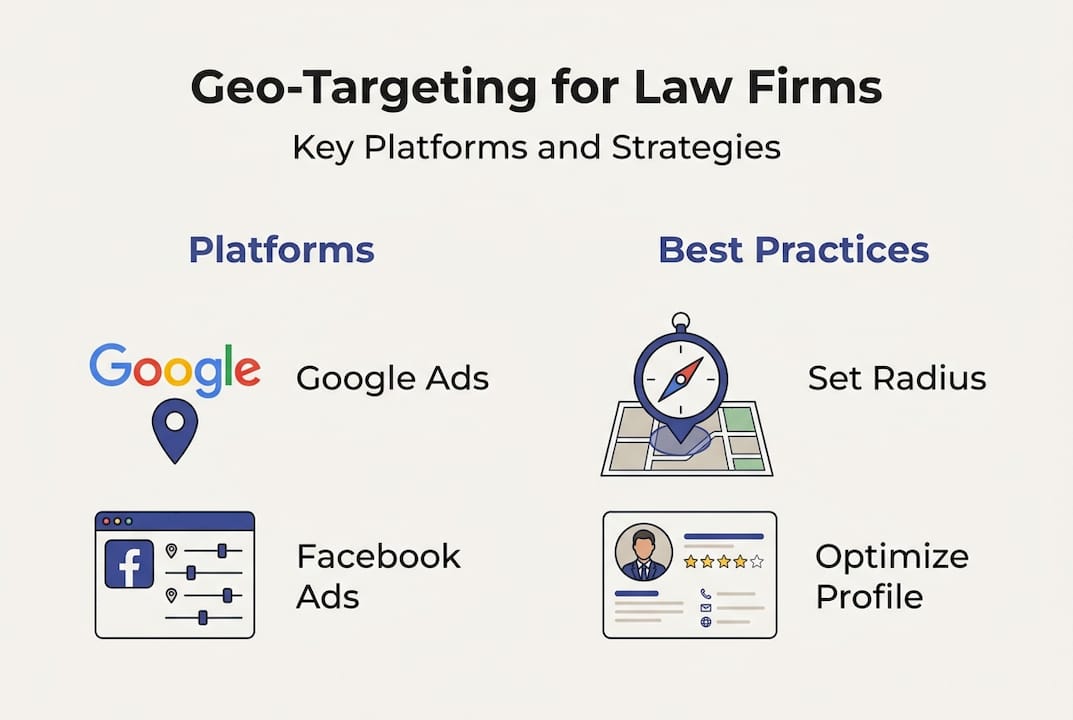
Google Ads remains the most powerful platform for law firm geo-targeting. You can target by radius, ZIP code, city, or state, and layer in bid adjustments to spend more in your highest-converting areas. The localized PPC CTR advantage of 30% over national campaigns is most pronounced here.
Facebook and Instagram Ads allow hyper-local targeting by neighborhood or even a custom map polygon. These platforms work particularly well for brand awareness and retargeting people who visited your website from a specific area.
Google Business Profile is your anchor for organic local visibility. Keeping your profile optimized with accurate service areas, photos, and reviews directly influences your placement in the local map pack.
Programmatic ad vendors like StackAdapt or Centro allow you to serve display and video ads to users across thousands of websites based on their geographic data. These are effective for geofencing campaigns near courthouses or hospitals.
Action steps for launching geo-targeted campaigns:
- Audit your current campaigns and identify any locations outside your actual service area receiving ad spend.
- Build a location list using ZIP codes and city names from your client intake records.
- Create location-specific ad copy and landing pages for your top three target areas.
- Set bid adjustments in Google Ads to increase spend in ZIP codes with historically high conversion rates.
- Implement geofencing around two to three high-intent locations relevant to your practice area.
- Schedule a monthly review of geographic performance data to reallocate budget.
For a deeper look at managing these campaigns, the law firm PPC guide at LawSEO.com covers bidding strategy in detail. You can also compare tools using this SEO platforms for lawyers comparison to find the right tech stack.
Pro Tip: Avoid over-targeting. If you restrict your radius too aggressively, say to just two miles around your office, you may exclude potential clients who live nearby but commute or travel through adjacent areas. Start with a 10 to 15 mile radius and tighten based on data.
Common pitfalls in geo-targeting for law firms
Knowing what works is only half the battle. Understanding common missteps ensures your law firm’s geo-targeting is both efficient and effective.
The most frequent error is confusing geo-targeting with geofencing and applying the wrong tactic for the wrong goal. A firm trying to reach all residents of a county does not need geofencing. A personal injury firm wanting to reach people who just visited an emergency room does. Mixing these up wastes budget and produces confusing data.
Here are the most common mistakes and how to fix them:
- Targeting too narrowly: Restricting campaigns to a one or two mile radius excludes clients who travel to your area. Fix: Start broader and narrow based on conversion data.
- Targeting too broadly: Running ads statewide when you only serve three counties inflates costs. Fix: Match your target geography to your actual case intake geography.
- Running identical ads across all locations: A generic ad performs poorly everywhere. Fix: Write location-specific copy that references the city or neighborhood by name.
- Ignoring high-intent location signals: Failing to geofence near courthouses, hospitals, or police stations misses motivated prospects. Fix: Map out the top five high-intent locations for your practice area and build geofence campaigns around them.
- Skipping geographic performance reviews: Many firms set campaigns and forget them. Fix: Pull a geographic performance report monthly and reallocate spend based on cost per lead by location.
Applying these fixes alongside proven legal SEO strategies ensures your geo-targeting operates as part of a coherent, results-driven marketing system rather than an isolated tactic.
Pro Tip: Set a calendar reminder to review geographic performance data every 30 days. Look at cost per lead, conversion rate, and impression share by location. Shift 10 to 15% of your budget toward the top-performing areas each month until you find the optimal distribution.
A smarter path: Our unconventional take on geo-targeting for law firms
Most agencies hand law firms a geo-targeting template and call it strategy. Target the city. Run the ad. Track the clicks. That approach produces average results because every competitor in your market is doing the same thing.
The firms that genuinely outperform their competition do something different: they treat each ZIP code as its own micro-market with its own messaging, its own landing page, and its own budget logic. A personal injury firm advertising in an affluent suburb needs a different tone and value proposition than one targeting a dense urban neighborhood two miles away. The legal need may be similar, but the client’s context, concerns, and search language are not.
Granular targeting combined with dynamic localization consistently outperforms broad city-wide campaigns. This is not a theory. It is what the data shows when you segment results by geography rather than averaging them across a metro area.
The deeper lesson is this: geo-targeting is not a media buy. It is a client communication strategy. When you understand legal SEO through that lens, every location decision becomes a question of relevance rather than reach. Relevance wins cases. Reach just fills dashboards.
Ready to make geo-targeting work for your law firm?
Geo-targeting done correctly transforms your digital marketing from a broad expense into a precise client acquisition engine. The firms seeing the biggest gains are those combining location-specific ad copy, optimized landing pages, and ongoing geographic performance analysis into a single coordinated strategy. At LawSEO.com, we build exactly these systems for law firms across the country, applying proven legal SEO strategies alongside targeted paid campaigns. If you are ready to stop paying for clicks that never convert, explore our full range of law firm marketing strategies and schedule a consultation with our team today.
Frequently asked questions
What is geo-targeting in law firm marketing?
Geo-targeting delivers tailored ads or content to prospective clients based on a defined geographic area, which significantly increases relevant local leads. Unlike broad national campaigns, it focuses your budget on users who are physically located where your firm practices.
How does geo-targeting differ from geofencing for lawyers?
Geo-targeting focuses on broader local areas such as cities or ZIP codes, while geofencing uses tight boundaries around specific locations like courthouses to trigger ads when a device enters or exits that boundary.
What are the benefits of geo-targeting for law firms?
Law firms using geo-optimized strategies have recorded +1300% lead growth and a 645% increase in organic traffic, primarily because campaigns reach high-intent local users rather than a broad, unqualified audience.
Which marketing platforms support geo-targeting for law firms?
Google Ads, Facebook Ads, Google Maps, Bing Ads, and most major programmatic ad platforms offer robust geo-targeting features that attorneys can configure down to the ZIP code or neighborhood level.
What mistakes should law firms avoid with geo-targeting?
Misapplying geo-targeting and geofencing, targeting too narrowly, or running identical ads across all locations are the most common errors that reduce campaign efficiency and inflate cost per lead.