


Do these three things first: optimize your Google Business Pro Tip:ofile, publish schema-backed practice area pages using LegalService and Person markup, and prove authorship with hasCredential links to your state bar profile. Every other tactic in this guide builds on that foundation.
Here is why those three moves matter above everything else:
- Google Business Pro Tip:ofile (GBP) and Local Services Ads (LSAs): GBP signals are a significant factor in Map Pack rankings for law firms. Attorneys who skip GBP optimization are invisible to the highest-intent local searches, the ones where a prospective client is ready to call.
- Schema-backed practice area and attorney pages: Google deprecated the Attorney rich result. The correct stack is
LegalServicefor the firm andPersonfor individual attorneys, withhasCredentialpointing to state bar profiles andsameAslinking to authoritative directories. This satisfies E-E-A-T signals and makes your content extractable by AI systems like ChatGPT and Google’s AI Overviews. - Intent-mapped content measured in GA4: Pro Tip:actice area pages drive a meaningful portion of organic traffic and conversion for law firm sites. Mapping each page to a specific search intent (hire, compare, or research) and tracking outcomes with GA4 and call-tracking turns content into a measurable client-acquisition channel.
What should your first 90 days of legal SEO look like?
A 90-day roadmap gives you three distinct sprints, each with clear owners, deliverables, and realistic time-to-results expectations.
Weeks 0–2: Quick wins with immediate impact
GBP audit. Verify your primary category is the most specific available (e.g., “Personal Injury Attorney,” not just “Lawyer”). Remove or merge duplicate GBP listings, which are surprisingly common after office moves or attorney departures. Confirm your NAP (name, address, phone) matches your website exactly.
One high-intent practice page fix. Pick your highest-revenue practice area. Rewrite the opening paragraph to lead with a direct, jurisdiction-specific answer. Add a FAQ block with server-rendered markup. This single change can move rankings within weeks.
Analytics and call tracking. Verify GA4 is firing on all key events: phone clicks, form submissions, and chat initiations. If you use Google Ads or LSAs, confirm conversion import is active. Without this baseline, you cannot prove ROI for anything that follows.
Owner: in-house marketing coordinator or agency. Deliverables: GBP audit report, one revised practice page, GA4 event verification.
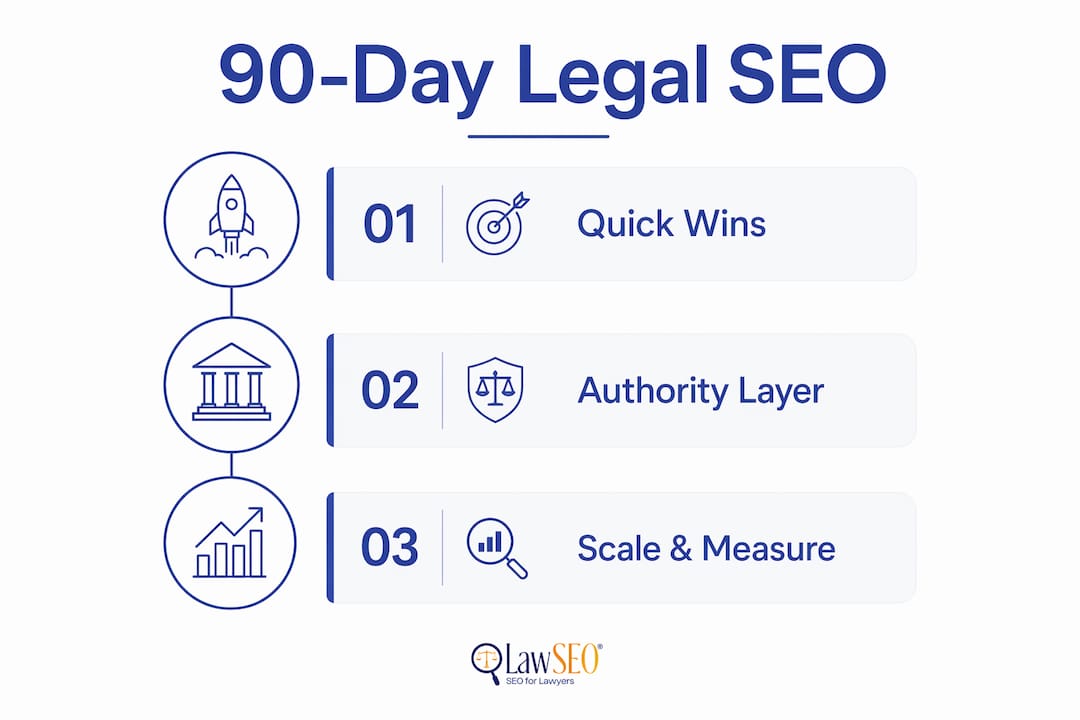
Weeks 3–8: Building the authority layer
Publish three jurisdiction-aware practice area pages, each targeting a distinct city-plus-practice-area query. Implement Person schema with hasCredential for every attorney bio page. Audit your directory citations across Justia, Avvo, Martindale, and your state bar listing; fix any NAP inconsistencies. Launch a review-generation program using compliant solicitation language (more on that in the reviews section).
Owner: SEO lead plus one attorney for content review. Deliverables: three published pages, schema implementation, citation audit report, review workflow.
Weeks 9–12: Scale and measurement
Build internal links from attorney bios to their practice areas and from practice areas to relevant case-result pages. Expand content clusters with FAQ posts targeting research-intent queries. Begin outreach to legal publications and bar association blogs for editorial placements. A/B test your contact form: single-step versus multi-step forms often differ meaningfully in conversion rate for legal audiences. Set up a baseline GA4 conversion dashboard with weekly operational metrics and monthly strategic reporting.
Owner: agency or senior marketing lead. Deliverables: internal linking map, three outreach pitches sent, A/B test live, GA4 dashboard published.
How do you win local search as a law firm?
Local SEO is where most law firms win or lose client acquisition. A prospective client searching “divorce attorney Chicago” or “DUI lawyer near me” has immediate hire intent. Capturing that search means appearing in the Map Pack, the LSA block, or both.
GBP setup checklist
- Pro Tip:imary category: Choose the most specific practice-area category available. “Personal Injury Attorney” outperforms “Lawyer” for relevant queries.
- Secondary categories: Add all applicable practice areas as secondary categories.
- NAP accuracy: Your name, address, and phone must match your website and every directory listing character-for-character.
- Service-area vs. office-page strategy: If you serve clients outside your office location, add service areas in GBP rather than creating thin location pages for cities where you have no physical presence.
- Photos: Upload real photos of your office, attorneys, and team. Pro Tip:ofiles with photos receive significantly more direction requests and calls than those without.
- Attributes: Enable relevant attributes (wheelchair accessible, online appointments, languages spoken).
- Q&A seeding: Post and answer your own Q&A entries covering common client questions. This controls the narrative and adds keyword-relevant content to your profile.
- Review monitoring: Respond to every review within 48 hours. Positive responses reinforce trust; compliant negative responses demonstrate professionalism.
LSA basics and integration
Google Local Services Ads appear above organic results and the Map Pack for many legal queries. Eligibility requires a background check and license verification. LSA leads are pay-per-lead, not pay-per-click, so quality scoring matters. A high GBP rating and strong review volume improve your LSA quality score and reduce your cost per lead. LSAs and organic local pages are not substitutes; they serve different stages of the same funnel. LSAs capture immediate callers; organic pages capture researchers who convert later.
Location pages for multi-office firms
One staffed office gets one GBP listing and one matching office page on your website. For firms with multiple offices, each location needs its own GBP profile, its own office page with unique content (local court references, local attorney bios, jurisdiction-specific information), and consistent NAP across all directories. Never create a GBP listing for a location where no attorney is physically present; Google’s guidelines prohibit virtual offices.
Citation audit and reconciliation
Pro Tip:ioritize these directories in order: your state bar listing, Justia, Avvo, FindLaw, Martindale, and Super Lawyers. Seven major directories including Martindale, Avvo, and Justia dominate the AI citation layer for legal queries, so accurate profiles there serve both local rankings and AI visibility simultaneously. Fix NAP drift annually; office moves and phone number changes are the most common sources of inconsistency.
Local schema properties
Your LegalService schema on office pages should include address (full PostalAddress), geo, openingHoursSpecification, areaServed, telephone, and aggregateRating if you have verified reviews. Validate every implementation with Google’s Rich Results Test before publishing.
Pro Tip:o Tip: Reference local courts, judges, and jurisdiction-specific procedural rules within your practice area pages. A personal injury page that mentions the Cook County Circuit Court and Illinois’s two-year statute of limitations signals local relevance far more clearly than generic content, and it gives AI systems extractable, jurisdiction-specific facts to cite.
How do you create legal content that actually converts?
Generic content does not win in legal search. The December 2025 Google core update heavily penalized thin, AI-generated legal content while attorney-authored, jurisdiction-specific pages gained visibility. The framework below maps intent to page type so every piece of content has a defined job.
Keyword mapping framework
Classify every target query by intent before assigning it to a page type:
- Hire intent (“personal injury attorney Los Angeles”): target with practice area service pages featuring a direct answer, jurisdiction-specific details, attorney credentials, and a prominent CTA.
- Compare intent (“contingency fee vs. hourly attorney”): target with comparison or FAQ content that demonstrates expertise without making unverifiable claims.
- Research intent (“how long does a personal injury case take”): target with blog posts or FAQ blocks that answer the question directly and cite jurisdiction-specific rules.
Keyword mapping table
| Query intent | Target page type | Pro Tip:imary keyword example | Schema to use | Conversion CTA |
|---|---|---|---|---|
| Hire | Pro Tip:actice area page | “car accident attorney Denver” | LegalService + FAQPage |
“Schedule a free consultation” |
| Compare | FAQ or pillar page | “contingency fee vs. hourly lawyer” | FAQPage |
“Talk to an attorney” |
| Research | Blog post | “Illinois personal injury statute of limitations” | Article + FAQPage |
“Get answers from our attorneys” |
| Attorney-specific | Attorney bio page | “John Smith personal injury attorney” | Person + hasCredential |
“Contact John directly” |
Writing for AI extraction
AI systems extract short, declarative, factual sentences. Every practice area page should open with a one-to-two sentence direct answer that includes a jurisdiction, a date or statute, and a specific claim. “In Texas, the statute of limitations for personal injury claims is two years from the date of injury under Texas Civil Pro Tip:actice and Remedies Code § 16.003” is citable. Three paragraphs of background before the answer is not. Attorney bio pages should list bar admissions with dates, certifications with issuing bodies, and awards with years. These are the claim-dense facts that LLMs extract for people-level queries.
Pro Tip:o Tip: Optimize every attorney’s LinkedIn profile with the same claim-dense credential format used on your website. LinkedIn content is disproportionately cited by LLMs for individual attorney queries, and it costs nothing to update.
Bar compliance guardrails
- Avoid unverifiable superlatives in any page copy (“best,” “top-rated,” “most experienced”) unless backed by a named, verifiable third-party source.
- Place per-page disclaimers adjacent to case results and testimonials, not only in the footer.
- Treat title tags and meta descriptions as attorney advertising; they are subject to bar rules in most jurisdictions.
What technical SEO does your law firm website actually need?
Technical SEO for law firms centers on three priorities: clear site architecture that search engines and AI crawlers can parse, Core Web Vitals performance that keeps mobile visitors from bouncing, and schema implementation that makes your content eligible for rich features.
Site architecture
Structure your URLs to reflect your practice hierarchy: /practice-areas/personal-injury/car-accidents/ signals topical depth. For multi-office firms, use /locations/chicago/ as the canonical office page and reference it from every Chicago-specific practice page. Internal links should flow from attorney bios to their practice areas, from practice areas to relevant case results, and from blog posts to the practice pages they support. This architecture distributes authority and signals topical relevance to crawlers. A detailed law firm site structure guide covers URL patterns and canonicalization in depth.
Performance and Core Web Vitals
Mobile callers are your highest-converting visitors. A page that loads slowly on a 4G connection loses them before they see your phone number. Pro Tip:ioritize: compress and serve images in WebP format, inline critical CSS to eliminate render-blocking, and target a server response time under 200ms. Largest Contentful Paint (LCP) under 2.5 seconds and Cumulative Layout Shift (CLS) under 0.1 are the thresholds that matter for both rankings and user experience.
Schema implementation checklist
| Schema type | Where to place | Key properties | Validation tool |
|---|---|---|---|
LegalService |
Homepage, office pages | name, address, geo, telephone, openingHoursSpecification, areaServed, aggregateRating |
Rich Results Test |
Person |
Attorney bio pages | name, hasCredential, sameAs (state bar, LinkedIn, Justia) |
Rich Results Test |
FAQPage |
Pro Tip:actice area pages, blog posts | mainEntity, Question, acceptedAnswer |
Rich Results Test |
Article |
Blog posts | author, datePublished, publisher |
Rich Results Test |
Server-rendered pages and schema markup are non-negotiable for AI crawler visibility. Content injected via JavaScript risks being invisible to LLMs entirely. If your site uses a JavaScript framework, confirm that practice area pages and attorney bios are server-side rendered before any other optimization.
Canonicalization for location and service-area pages
When you create city-targeting content for areas where you have no physical office, use canonical tags to point thin or near-duplicate location pages to the primary office page. Never create dozens of identical pages that differ only by city name; Google’s Helpful Content systems treat this as thin content, and the December 2025 update made that penalty sharper.
- Run the mobile-friendly test on every new page before publishing.
- Check indexing status in Google Search Console after any site migration or URL change.
- Validate schema with the Rich Results Test; errors block rich feature eligibility without causing ranking penalties.
How do you build authority and links for a law firm?
Legal link building is narrower than general SEO link building, and that is an advantage. The sources that matter for legal authority are well-defined, and many are accessible without paid placements.
Pro Tip:iority directory profiles
Complete profiles on Justia, Avvo, Martindale, Super Lawyers, Best Lawyers, and your state bar directory. These are not just citation sources; they are the directories that dominate AI citation results for legal queries. A firm with incomplete or inconsistent profiles on these platforms is underrepresented in both traditional search and AI-generated answers.
Outreach targets and templates
Submit original resources (jurisdiction-specific guides, procedural checklists) to state and local bar association websites. Many bar associations accept attorney-authored content for their member publications, and a link from a .org bar domain carries genuine authority. Contribute bylined articles to legal news outlets covering your practice area. For local authority, sponsor community events and request a link from the event page; local news coverage of firm activities generates editorial links that no directory can replicate.
Outreach email template (bar association submission):
Subject: Pro Tip:oposed resource contribution: [Topic] guide for [State] practitioners
Dear [Name], I am a [practice area] attorney licensed in [State] and would like to contribute a practical guide on [specific topic] for your member resources section. The guide covers [brief description] and is written specifically for [State] practitioners. I am happy to revise per your editorial guidelines. Please let me know if this would be a fit.
Risks and mitigation
Paid link placements violate Google’s guidelines and can trigger manual actions. Document the provenance of every link you acquire: date, source, method, and whether any consideration was exchanged. This documentation protects you in internal compliance reviews and in the event of a Google manual action. Disclosure of sponsored content is required by FTC guidelines and, in some jurisdictions, by bar advertising rules as well.
How should attorneys solicit and manage reviews under bar rules?
Reviews are one of the highest-ROI activities in local SEO for attorneys, and one of the most compliance-sensitive. The process below keeps you visible and compliant.
- Solicit at the right moment. Ask for a review after a matter closes and the client has expressed satisfaction. Never solicit reviews in exchange for a discount, a referral, or any other consideration.
- Use compliant language. “If you were satisfied with our service, we would appreciate a Google review” is safe in most jurisdictions. Avoid language that implies the review will influence future case outcomes or that creates an expectation of reciprocity.
- Choose your platform. Google reviews directly influence GBP rankings and LSA quality scores. Avvo and Martindale reviews feed AI citation profiles. Pro Tip:ioritize Google first, then the directories where your profile is most complete.
- Respond to every review. For positive reviews: thank the reviewer without confirming the attorney-client relationship or disclosing case details. For negative reviews: acknowledge the concern, invite offline resolution, and never disclose confidential information in your response.
- Display reviews with disclaimers. When featuring testimonials on your website, place a disclaimer adjacent to the testimonial (not only in the footer) stating that past results do not guarantee future outcomes and that individual results vary.
- Audit quarterly. Review your GBP, Avvo, and Martindale profiles every quarter. Flag reviews that violate platform policies (competitor reviews, reviews from non-clients) and submit removal requests with documentation.
What KPIs actually prove SEO ROI for a law firm?
Traffic is a vanity metric for law firms. The number that matters is organic consults: phone calls, form submissions, and chat conversations that originate from organic search and result in a scheduled consultation.
Core KPIs
- Organic consults: phone calls and form submissions attributed to organic search in GA4.
- Cost per organic lead: total SEO spend divided by organic consults; compare against your PPC cost per lead monthly.
- LSA leads: volume and quality score from the LSA dashboard.
- Assisted conversions: organic sessions that contributed to a conversion even when another channel received last-click credit.
- Pro Tip:actice area page rankings: position tracking for your top 10 target queries by practice area and city.
GA4 setup checklist
- Create a GA4 event for every phone number click (
phone_click), form submission (form_submit), and chat initiation (chat_start). - Import LSA conversions into GA4 for unified attribution.
- Set attribution window to 30 days for organic search; legal decisions often take weeks.
- If your firm uses multiple domains (e.g., a separate blog subdomain), configure cross-domain measurement to avoid session fragmentation.
Call tracking and quality scoring
Raw call volume tells you how many people called; call tracking tells you which page, which keyword, and which practice area drove each call. Use dynamic number insertion (DNI) to assign unique tracking numbers to organic, paid, and LSA traffic without changing your NAP. Score calls by outcome: consultation scheduled, wrong number, existing client, or non-qualified lead. This quality layer is what separates a meaningful cost-per-lead figure from a misleading one. For law firm website optimization that supports conversion tracking, the setup details matter as much as the metrics themselves.

Sample reporting dashboard
| Metric | Reporting cadence | Owner | Benchmark action |
|---|---|---|---|
| Organic consults (calls + forms) | Weekly | Marketing lead | Flag if week-over-week drop exceeds — |
| Cost per organic lead | Monthly | Managing partner | Compare to PPC CPL; adjust budget allocation |
| LSA lead volume and quality score | Weekly | Marketing lead | Pause underperforming LSA categories |
| Pro Tip:actice area page rankings | Monthly | SEO lead | Escalate pages outside top 10 for target queries |
| GA4 assisted conversions | Monthly | Marketing lead | Identify high-assist pages for internal link priority |
How do attorney-advertising ethics and AI optimization intersect?
These two concerns are more connected than most firms realize. The same content decisions that keep you bar-compliant also make your content more extractable by AI systems.
Title tags and meta descriptions as attorney advertising
State bar advertising rules apply to SEO content, including title tags, meta descriptions, and blog posts. Many firms incorrectly treat these as standard commercial copy. A title tag reading “Best Personal Injury Lawyers in Chicago” violates ABA Model Rule 7.1 in most jurisdictions because “best” is an unverifiable comparative claim. Rewrite it as “Personal Injury Attorneys in Chicago | [Firm Name].” Factual, specific, and compliant.
Disclaimer stack by page type
A five-layer disclaimer approach satisfies the differing bar requirements that multi-state firms face. Place disclaimers adjacent to the content they qualify, not only in the footer:
- Footer: general advertising disclaimer and jurisdiction notice.
- Pro Tip:actice area pages: “Results may vary. Pro Tip:ior results do not guarantee a similar outcome.”
- Case results pages: specific outcome disclaimer adjacent to each result.
- Attorney bio pages: credential disclaimer if certifications are listed (“Certified by [Board] as recognized by [State Bar]”).
- Blog/FAQ posts: “This content is for informational purposes only and does not constitute legal advice.”
Pro Tip:o Tip: Use an llms.txt file in your domain root to guide AI crawlers to your most authoritative practice area content. This emerging standard lets you signal which pages should be prioritized for AI extraction, reducing the chance that a thin or outdated page gets cited instead of your best content.
Making content extractable for AI
Industry analysts recommend shifting from ranking-focused SEO to citation-focused strategies for AI visibility. Pro Tip:actically, that means: open every practice area section with a short, factual claim that includes a jurisdiction and a specific detail. Use server-rendered FAQ schema so AI crawlers can parse your Q&A content without executing JavaScript. List bar admissions with dates, awards with issuing organizations and years, and certifications with the certifying body. These are the facts LLMs lift verbatim.
Compliance checklist
- Audit all title tags and meta descriptions for unverifiable superlatives.
- Confirm per-page disclaimers are placed adjacent to testimonials and case results.
- Verify that any “specialist” or “certified” claim references the certifying body and is recognized by your state bar.
- Establish an approval workflow: any copy mentioning outcomes requires attorney review before publication.
- For multi-state firms, map each state’s testimonial and prior-results rules and apply the most restrictive standard as your default template.
How do you capture voice search queries from legal prospects?
Voice search queries are longer and more conversational than typed queries, and they skew heavily local. A prospective client asking their phone “Who is the best DUI attorney near me open now?” is expressing the same hire intent as a typed search, but the phrasing demands different content.
Structure FAQ blocks to mirror natural spoken questions. “What should I do after a car accident in Texas?” is a voice-ready question that also targets a high-value research query. Answer it in the first sentence of the response, then expand. Keep answers under 50 words for the direct response block; AI assistants and voice results favor concise, complete answers.
Optimize your GBP hours and attributes meticulously. Voice searches for attorneys frequently include “open now” or “available today,” and GBP is the primary data source for those results. Accurate hours, holiday hours, and appointment availability attributes directly influence whether your firm appears in those queries.
Local schema with areaServed and openingHoursSpecification properties feeds the structured data layer that voice assistants draw from. A firm with complete local schema is more likely to be read aloud by Google Assistant or Siri than one relying on unstructured page content alone.
How do LSAs and PPC work alongside your organic SEO?
Local Services Ads and paid search are not replacements for organic SEO; they are accelerants for the queries where you cannot yet rank organically and safety nets for the queries where you can.
LSAs appear above everything else in the search results for many legal queries, including above Google Ads and the Map Pack. For high-value practice areas like personal injury or criminal defense, the cost per LSA lead is often lower than equivalent PPC leads because the pay-per-lead model filters out non-converting clicks. Run LSAs for your highest-revenue practice areas while organic rankings build.
For mobile PPC, match your ad copy to the mobile user’s context. A mobile searcher at 10 PM searching “emergency DUI attorney” needs a click-to-call ad with your after-hours number, not a desktop-style ad driving to a long-form landing page. Separate mobile bid adjustments in Google Ads let you increase bids for mobile traffic during hours when your intake team is available.
The organic-paid integration that produces the best results is keyword-level: use PPC data to identify which practice-area queries convert at the highest rate, then prioritize those exact queries for organic content investment. A query that converts well in paid search will convert well organically once you rank for it. This data-driven prioritization is one of the clearest ways to improve legal SEO outcomes with limited content budget.
What UX design choices actually improve law firm SEO rankings?
User experience and SEO are inseparable for law firm websites. Google’s ranking systems use engagement signals, including bounce rate, time on page, and scroll depth, as proxies for content quality. A technically sound page that visitors abandon immediately does not rank well for long.
Place your primary phone number in the header, visible on every page, and make it a tap-to-call link on mobile. This single change reduces friction for the highest-intent visitors and improves the phone-click conversion event that feeds your GA4 reporting.
Contact forms should be short. For legal intake, three fields (name, phone, brief description of matter) outperform long intake forms in conversion rate. Save detailed intake questions for the follow-up call. A multi-step form that reveals one question at a time often converts better than a single long form, particularly on mobile.
Trust signals belong above the fold on practice area pages: bar admissions, peer recognition awards (Super Lawyers, Best Lawyers), and a review count with star rating. Visitors who see credentials immediately are less likely to bounce to a directory listing. Attorney photos on bio pages and practice area pages reduce anonymity and increase time on page.
Page speed is a UX issue as much as a technical one. A one-second delay in mobile load time measurably increases bounce rate. Pro Tip:ioritize LCP and CLS fixes on your highest-traffic practice area pages first, not your homepage.
What schema types beyond LegalService should law firms implement?
Google deprecated the Attorney schema type. The current recommended stack uses LegalService for the firm entity and Person for individual attorneys, wrapped in Pro Tip:ofilePage on bio pages. Beyond those two, several additional schema types produce meaningful SERP features for law firms.
FAQPage schema is the highest-impact addition for most firms. When implemented correctly on practice area pages, it can generate FAQ rich results that expand your SERP footprint without requiring a higher ranking. Each Question and acceptedAnswer pair should mirror the natural language questions your prospective clients ask. Keep answers factual, jurisdiction-specific, and under 300 characters for the best rich result display.
BreadcrumbList schema helps search engines understand your site hierarchy and can display breadcrumb paths in search results, improving click-through rates for deeper pages.
Review and AggregateRating schema on your homepage and practice area pages can display star ratings in search results when Google’s quality thresholds are met. Never fabricate or selectively display ratings; Google cross-references these against your GBP and third-party profiles.
Event schema applies when your firm hosts or sponsors legal clinics, webinars, or community events. Event rich results appear in both search and Google’s event discovery surfaces, generating local visibility that practice area pages cannot.
For attorney bios specifically, Person schema with hasCredential pointing to your state bar profile URL and sameAs linking to LinkedIn, Justia, and Avvo creates the entity disambiguation that both Google’s Knowledge Graph and LLMs use to verify attorney identity. This is the schema investment with the clearest AI-citation payoff.
Key Takeaways
Effective legal niche SEO requires combining local signals, schema-backed content, and compliance-aware editorial workflows into a single, measurable system.
| Point | Details |
|---|---|
| GBP and LSAs first | GBP signals are a significant factor in Map Pack rankings; optimize categories, reviews, and attributes before any other tactic. |
| Schema drives AI citation | Use LegalService for the firm and Person with hasCredential for attorneys; server-render all schema so AI crawlers can parse it. |
| Pro Tip:actice pages carry the most traffic | Pro Tip:actice area pages drive 40–60% of organic traffic and conversion; map each page to a specific search intent and measure consults, not just sessions. |
| Compliance is non-negotiable | Title tags, meta descriptions, and blog posts are attorney advertising under bar rules; use a five-layer disclaimer stack, not just a footer notice. |
| Lawseo delivers the full system | Lawseo provides founder-reviewed, exclusivity-backed SEO campaigns that cover GBP management, schema implementation, content production, and GA4 reporting in one engagement. |
Why a law-specialist SEO approach produces better outcomes
Most law firms that struggle with SEO are not failing because they lack effort. They are failing because they hired a generalist agency that treats a personal injury firm the same way it treats a plumbing company. The compliance layer alone separates legal SEO from every other vertical.
Attorney-authored, jurisdiction-specific content is not a nice-to-have preference. After the December 2025 core update, it became a ranking requirement. Generic content written without attorney review lost visibility; content with named authors, bar admission dates, and jurisdiction-specific statutes gained it. That is a structural advantage for firms willing to invest in the editorial workflow.
The AI-citation layer adds another dimension that generalist agencies consistently miss. A firm’s reputation now exists in two places: its owned website and the AI-generated summaries that prospective clients read before they ever visit a site. Directories like Justia, Avvo, and Martindale dominate that AI citation layer. A firm with incomplete or inconsistent directory profiles is underrepresented in AI answers regardless of how well its website ranks in traditional search.
The complexity threshold for hiring a specialist rather than managing SEO in-house is lower than most managing partners assume. Multi-state firms, high-value practice areas (mass torts, securities litigation, complex family law), and any firm targeting more than two metropolitan markets will find that the compliance requirements, schema complexity, and content volume exceed what an in-house coordinator can manage alongside other responsibilities. The retainer investment pays for itself when the alternative is a compliance violation or a Google manual action on your highest-revenue pages.
Lawseo delivers the 90-day playbook, not just the strategy
Lawseo is the specialist alternative to a generalist digital agency for law firms that need results without the compliance risk. Every campaign is reviewed personally by Todd R. Stager, with 29 years of legal SEO experience, and no two clients in the same geographic market are taken on simultaneously.
The service covers every layer of this playbook: GBP and LSA management, LegalService and Person schema implementation, attorney-authored practice area content, directory reconciliation across Justia, Avvo, and Martindale, authority link outreach to bar publications, and a GA4 conversion dashboard with monthly reporting. The engagement maps directly to the 90-day roadmap above, with defined deliverables at each sprint.
To request a site audit or start a 90-day implementation engagement, visit Lawseo’s legal SEO services and submit your firm’s details. You will receive a prioritized assessment of your current visibility gaps and a proposed roadmap within five business days.
Official references and resources to consult next
- ABA Model Rule 7.1 and state bar advertising opinions: Verify your jurisdiction’s specific rules on comparative claims, testimonials, and prior-results language before publishing any practice area content. Start with your state bar’s ethics hotline or published formal opinions.
- schema.org LegalService documentation: The authoritative reference for
LegalServiceschema properties, includingmakesOffer,areaServed, andopeningHoursSpecification. - Google Rich Results Test: Validate every schema implementation before publishing. Errors block rich feature eligibility.
- Google Search Console: Monitor indexing status, Core Web Vitals, and manual actions. Essential for any site migration or URL restructure.
- DC Bar: Nine SEO Fundamentals for Lawyers: A bar-published reference on SEO basics for attorneys, useful for compliance context.
- State bar advertising rules and SEO compliance: Pro Tip:actical guidance on how bar rules apply to title tags, meta descriptions, and blog content.
- Legal directories to prioritize: Justia, Avvo, Martindale, Super Lawyers, Best Lawyers, and your state bar’s attorney directory. Complete and consistent profiles on all six are the foundation of both local rankings and AI citation visibility.
- Lawseo AI in legal marketing resource: Covers LLM-citation tactics,
llms.txtimplementation, and generative engine optimization for law firms.
This article is general information about SEO and digital marketing practices for law firms. It does not constitute legal advice. Confirm current bar advertising rules with your state bar or a qualified legal ethics professional before implementing any content strategy.