


TL;DR:
- Strong digital infrastructure and optimized website are essential before running marketing campaigns.
- Focus on local SEO, reviews, and zero-click search strategies to increase high-intent traffic.
- Continuous testing, measuring, and improving intake and follow-up processes are crucial for sustainable lead generation.
Most law firms lose potential clients not because their attorneys lack skill, but because their digital marketing fails to connect the right people with the right message at the right moment. Generating qualified legal leads online is a persistent challenge, and the firms that solve it consistently are not just spending more on ads. They are building systematic, conversion-focused digital presences that attract, engage, and convert prospective clients at every stage of the decision process. This guide walks you through the specific tools, tactics, and processes top-performing firms use to generate legal leads reliably.
Key Takeaways
| Point | Details |
|---|---|
| Lay the right foundation | Effective legal lead generation requires an optimized website, strong SEO, and lead tracking from the start. |
| Follow a defined process | Success comes from consistently applied steps: SEO, reviews, PPC, conversion optimization, and nurturing. |
| Avoid costly mistakes | Ignoring conversion, intake, or new search trends will waste your efforts and budget. |
| Measure and improve continually | Track results monthly and make changes based on real data—not gut feeling—for sustained growth. |
What you need before you start: tools and foundations
With the core challenge established, let’s examine the tools and foundations you need to begin generating leads with confidence.
Before you run a single ad or publish a single blog post, your digital infrastructure must be sound. Think of it as building a client intake system before opening your doors. If the foundation is weak, every dollar and hour you invest in traffic generation will leak through the cracks.
The non-negotiables for legal lead generation
- A conversion-optimized website. Your site must load in under three seconds, be fully mobile-responsive, and present clear calls to action (CTAs) on every key page. Forms, phone numbers, and chat widgets should be visible without scrolling. Review our website optimization guide for a full technical and design checklist, and use the law firm website conversion guide to benchmark your current performance.
- Core content assets. Every practice area needs a dedicated service page. Attorney bio pages should communicate expertise and approachability. FAQ sections answer the questions your prospects are actually typing into Google.
- Accurate local citations. Your Google Business Profile must have consistent name, address, and phone number (NAP) data across every directory, including Avvo, FindLaw, Justia, and Yelp. Inconsistencies erode local search trust and push your listing down in the local pack.
- Tracking and analytics. Install Google Analytics 4 and a call tracking solution such as CallRail before you start any campaigns. You cannot improve what you cannot measure. Tracking call volume by source, form submission rates, and chat conversions is essential from day one.
Understanding zero-click searches
One development many law firms overlook is the rapid rise of zero-click search behavior. Zero-click searches now exceed 65% of all Google searches, meaning more than half of searchers get an answer directly on the results page without ever visiting a website. For law firms, this creates a clear strategic imperative: you must optimize for featured snippets, People Also Ask (PAA) boxes, and local packs to drive phone calls and direct inquiries, even when users never click through to your site.
| Foundation element | Why it matters | Quick check |
|---|---|---|
| Mobile-optimized website | 60%+ of legal searches happen on mobile | Test with Google’s Mobile-Friendly tool |
| Google Business Profile | Drives local pack visibility | Verify all NAP data is consistent |
| Call tracking software | Attributes calls to correct source | Confirm tracking numbers are installed |
| Schema markup | Enables rich results and featured snippets | Use Google Rich Results Test |
| Google Analytics 4 | Full funnel measurement | Confirm goals and events are firing |
Pro Tip: Before launching any paid campaign, run a full conversion audit of your website. If your contact form has more than five fields, you are likely losing leads. Reduce friction to the bare minimum: name, phone, and a brief message.

Step-by-step process to generate legal leads
Once you’re set up, here’s a proven process you can follow to start generating a steady stream of legal leads.
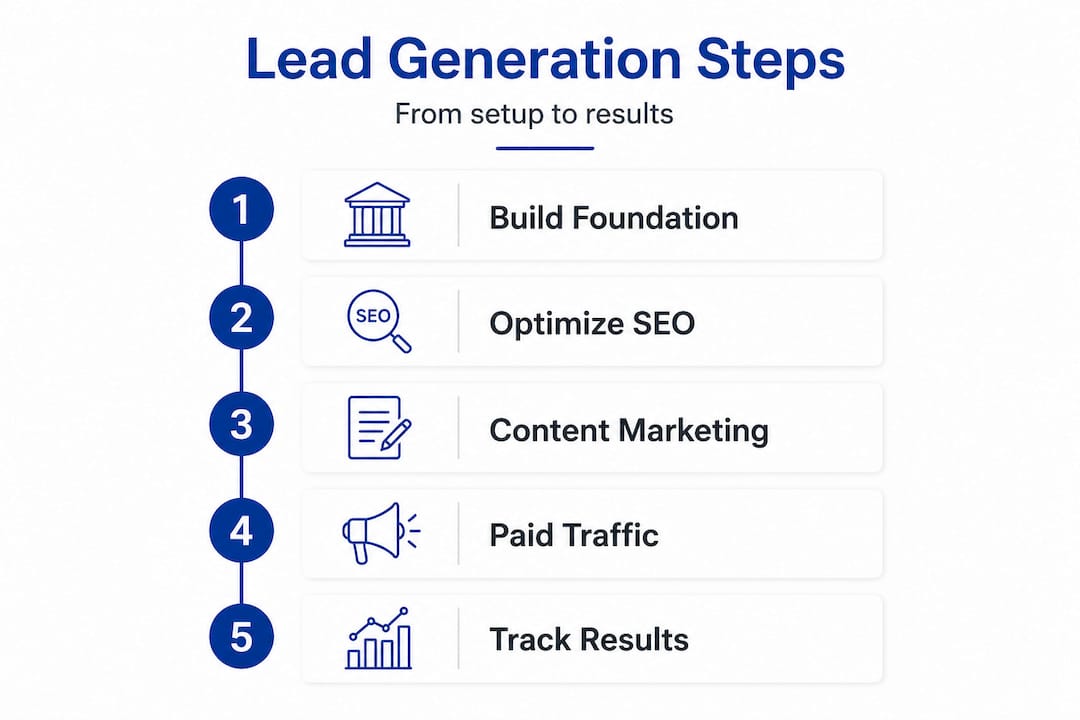
This is where structure separates high-performing firms from those that chase tactics without a system. The following process is ordered intentionally. Skipping steps creates gaps that will cost you leads later.
-
Build and optimize your foundational SEO. Start with on-page SEO for your practice area pages. Target specific, intent-rich keywords such as “DUI attorney in [city]” or “personal injury lawyer free consultation.” Use proper header hierarchy, include schema markup for attorneys and local businesses, and ensure your meta titles and descriptions include geographic modifiers and service terms. This is not optional; it is the foundation everything else rests on.
-
Claim and optimize your local SEO presence. Publish consistent NAP data across every major legal directory. Actively solicit Google reviews from satisfied clients and respond to every review professionally. Local SEO drives the highest-intent traffic at the lowest cost, and the results compound over time. Firms that invest consistently in local SEO see measurable improvements in local pack rankings within three to six months.
-
Generate and manage reviews systematically. Reviews influence both local pack rankings and consumer decision-making. Build a simple post-case workflow that prompts satisfied clients to leave a Google review. A single attorney in a competitive market who accumulates 50 more reviews than competitors will often outrank them in the local pack, regardless of other SEO factors.
-
Integrate PPC advertising strategically. Pure PPC is risky when intake is weak, and SEO alone is slow for newer firms. The proven approach is to use PPC to generate revenue while your SEO authority builds, then reinvest those returns into content and link building. This dual-track method reduces financial risk while accelerating long-term organic growth.
-
Optimize every page for conversion. A prospective client should be able to contact you within two clicks of any page. Place your phone number in the header, use sticky chat widgets, and position consultation forms above the fold on high-traffic pages. Detailed guidance on this is available through our conversion rate optimization resources. Also, review our guidance on optimizing landing pages for practice-specific campaigns.
-
Nurture leads who are not yet ready to hire. Many legal prospects are still researching. Capturing their email with a free checklist or guide, then following up with a targeted email sequence, keeps your firm top-of-mind until they are ready to move forward. Our lead nurturing strategies outline exactly how to structure these sequences for legal audiences.
-
Test, measure, and iterate. Every tactic you implement should be measured. A/B test your contact forms, try different CTAs, and compare landing page variations. Lead generation is not a one-time project.
| Strategy | Speed to results | Cost level | Sustainability |
|---|---|---|---|
| Local SEO | 3 to 6 months | Low to medium | High |
| Google PPC | Immediate | High | Medium |
| Content marketing | 6 to 12 months | Medium | Very high |
| Legal directories | 1 to 3 months | Low | Medium |
| Email nurturing | Ongoing | Low | High |
Pro Tip: When launching PPC campaigns for legal services, start with exact match and phrase match keywords only. Broad match in legal advertising burns budget on irrelevant queries fast. Refine first, then expand.
Mistakes that stop your legal lead funnel
Even experienced marketers can fall into these costly traps, and recognizing and fixing them is key to success.
Identifying where your funnel breaks is often more valuable than adding new traffic sources. These are the most common and costly failure points in legal lead generation.
- Slow response time. Research consistently shows that responding to a lead within five minutes dramatically increases the likelihood of conversion. Waiting hours or until the next business day often means the prospect has already hired a competitor. Automated text confirmations and intake scheduling tools can fill this gap.
- Mobile neglect. If your website delivers a poor mobile experience, loads slowly on cellular networks, or presents forms that are difficult to complete on a small screen, you are turning away the majority of your potential clients before they ever read your content.
- Weak client intake. Marketing can fill your pipeline, but a disorganized intake process drains it just as fast. Every inquiry deserves a professional, warm, and prompt response. Review your client intake optimization process as critically as you review your ad spend.
- Treating paid ads as the only strategy. Firms that rely solely on PPC without building organic presence are one algorithm change or budget cut away from losing all their leads. SEO and content marketing protect you from that single point of failure.
- Ignoring local and zero-click search trends. Zero-click searches exceed 65% of Google searches, and if your content is not structured to appear in featured snippets, PAA boxes, and local packs, you are invisible in a huge portion of the search landscape.
- Failing to track conversion metrics. Many firms track traffic and rankings but never measure the percent of visitors who actually contact them. Without conversion data, you cannot identify which pages are underperforming or where your budget is being wasted. Common optimization mistakes often stem from this blind spot.
“Combining PPC with a solid intake process and SEO investment is the most resilient approach for law firms at any growth stage. Leaning entirely on one channel creates unnecessary risk and leaves significant revenue on the table.” — Lawyer Lead Generation, Legal Practice Marketing
Each of these mistakes has a fix. The problem is that firms often address symptoms, adding more ad spend when conversions drop rather than diagnosing the actual leak in the funnel.
How to know it’s working: metrics and verification
To ensure you’re not just getting busier but landing more clients, here’s how to measure real success.
More traffic is not the same as more clients. You need to measure the right signals to know whether your legal lead generation is genuinely working or simply generating noise.
-
Track leads by channel. Count form fills, inbound calls, and chat contacts separately for each traffic source: organic search, paid search, social, referral, and direct. This tells you which channels are worth scaling and which are draining budget without return.
-
Monitor your conversion rate. Conversion rate is the percentage of visitors who take a desired action, such as submitting a contact form or calling your office. A well-optimized legal landing page typically converts between three and eight percent of visitors. If yours is below two percent, the page needs structural changes. Review detailed benchmarks at measuring conversion rates.
-
Calculate cost per lead. Divide your total marketing spend by the number of leads generated in a given period. For legal services, cost per lead varies widely by practice area. Personal injury and mass tort campaigns may see costs of $100 to $500 per lead, while estate planning or family law may be significantly lower.
-
Evaluate call and chat quality. Not all leads are equal. A high volume of short, low-quality calls may indicate your targeting is off. Review call recordings (with appropriate disclosures) to assess whether callers match your ideal client profile and whether your intake team is handling inquiries effectively.
-
Look for trend lines, not just numbers. Consistent lead growth over 90-day periods is a stronger indicator of a healthy system than a dramatic spike in a single week. Spikes often result from one-time promotions or ranking fluctuations, while steady trends reflect compound marketing momentum.
| Metric | What it tells you | Healthy benchmark |
|---|---|---|
| Form conversion rate | Page effectiveness | 3% to 8% |
| Call-to-consult rate | Intake quality | 40% to 60% |
| Cost per lead | Channel efficiency | Varies by practice area |
| Lead-to-client rate | Full funnel health | 15% to 35% |
| Avg. response time | Speed of follow-up | Under 5 minutes |
Pro Tip: Set up a simple weekly dashboard in Google Looker Studio (formerly Data Studio) that pulls from Analytics, your call tracking platform, and your CRM. Thirty minutes of review each week will surface patterns that would otherwise take months to notice.
What most law firm marketers get wrong about legal lead generation
Years of working specifically in legal SEO reveal a pattern that most marketing advice misses entirely. The conversation around legal lead generation almost always gravitates toward acquisition: more traffic, higher ad spend, newer tools, broader keyword targeting. What it rarely addresses is the internal infrastructure that determines whether any of that investment actually converts.
Quick fixes like increasing Google Ads budgets or stacking new SaaS tools onto an already fragmented workflow rarely solve the real problem. The firms that plateau are usually not losing leads because their ads are too narrow or their content is too thin. They are losing leads because their intake process is slow, their follow-up is inconsistent, and no one has ever audited the experience a prospective client actually has between submitting a form and signing a retainer.
Sustainable success in legal lead generation comes from tight feedback loops. You should be auditing your intake and follow-up processes as frequently as you review your ad spend and keyword rankings. Ask your intake team what objections they hear most often. Record and review intake calls. Track how many leads are marked as “no response” versus “not qualified” versus “hired someone else.” These distinctions matter enormously.
The biggest wins in legal marketing consistently come from iteration, not volume. Testing a new form layout, rewriting a single call to action, shortening the intake script, or adding a live chat option to one high-traffic page can outperform a $5,000 monthly increase in ad spend. Deeper lead nurturing is part of that equation. But so is having the discipline to look inward at your own processes rather than always searching for the next external lever to pull.
Ready to amplify your legal leads?
If you have read this far, you understand that legal lead generation is a system, not a single tactic. At LawSEO.com, we specialize exclusively in SEO and digital marketing for law firms, which means every strategy we develop is grounded in the specific competitive dynamics, ethical constraints, and client acquisition patterns of the legal industry. Our founder, Todd R. Stager, has over 29 years of experience building these systems for attorneys across the country. Whether you need a full legal SEO overview to orient your strategy, want to compare the best local SEO tools for your practice, or are ready to partner with a team that offers exclusivity agreements so your competitors cannot use the same playbook, we are built for exactly this work. Let’s build something that grows.
Frequently asked questions
What is the fastest way to generate legal leads for my law firm?
PPC advertising can deliver leads quickly, but intake must be strong first or you will waste significant budget on prospects your team cannot convert efficiently.
How important are featured snippets and local packs for legal firms?
They are critical. Since zero-click searches exceed 65% of all Google searches, appearing in featured snippets and local packs is often the only way to drive calls from users who never visit your website.
How do I know if my lead generation campaign is successful?
Track leads by channel, conversion rate, and cost per lead on a consistent schedule. Steady growth trends over 90-day periods indicate a healthy, compounding system rather than random fluctuations.
What is a common mistake law firms make when trying to generate leads?
The most damaging mistake is treating legal lead generation as a one-time setup rather than a continuous process of testing, measuring, and improving every step in the funnel.