


TL;DR:
- Law firm blogs often fail because they lack strategic execution rather than legal knowledge. Effective posts require clear target audiences, SEO research, plain language, and ethical compliance to attract and convert clients. Consistent planning, quality writing, and ongoing review help blogs serve as powerful client acquisition tools.
Most law firm blogs are invisible. They exist, they get published, and then they sit quietly while competing firms capture the leads that should have been yours. The problem is rarely a lack of legal knowledge. It is a lack of strategy. Knowing how to write legal blog posts that actually rank on Google and convert readers into consultations requires a specific framework, one that balances SEO fundamentals, plain-language writing, and the ethical standards attorneys must uphold. This guide walks you through every step, from planning to post-launch review, so your blog becomes a genuine client acquisition tool.
Key Takeaways
| Point | Details |
|---|---|
| Use strategic outlines | A repeatable, research-driven outline ensures your legal blog answers real client questions and ranks higher. |
| Prioritize scannable formatting | Direct headlines, short paragraphs, and bullet points boost readability and conversions. |
| Update content regularly | Review and improve posts every 3 to 6 months for ongoing SEO and compliance. |
| Keep attorney oversight | Ethical, accurate, and compliant blogs require attorney review, especially when AI tools are used. |
| Focus on real information gain | Providing genuinely useful answers sets your legal blog apart in today’s competitive search landscape. |
Key ingredients for effective legal blog posts
Before you write a single word, you need to understand what separates a high-performing legal blog from one that collects digital dust. The difference is almost never the quality of the legal analysis. It is the execution.
Here is a quick reference table of what every effective legal blog post needs:
| Element | Why it matters | Common mistake |
|---|---|---|
| Defined target audience | Shapes tone, vocabulary, and topic | Writing for other attorneys, not clients |
| Keyword research | Drives organic search traffic | Guessing topics instead of researching demand |
| Ethical compliance | Protects your license and reputation | Publishing AI content without attorney review |
| Plain-language writing | Keeps non-lawyer readers engaged | Overusing legal jargon |
| Clear calls to action (CTAs) | Converts readers into consultations | Ending posts with no next step |
| Scannable structure | Reduces bounce rate, improves UX | Publishing walls of unbroken text |
The core ingredients that make legal content work include:
- Scannable structure: Short paragraphs, subheadings, and bullet points. Legal blog posts should be scannable and conversion-ready, not formatted like a legal brief.
- Practical guidance: Readers want to know what their situation means for them, not a recitation of statutes.
- On-page SEO: Title tags, meta descriptions, header hierarchy, and optimizing legal blog posts for target keywords.
- Professionalism: Every post reflects your firm’s credibility. Errors, unsupported claims, or misleading statements can damage trust and create ethical exposure.
- Direct engagement: Write to the reader, not at them. Use “you” and address their specific concern.
On the question of AI tools: they can accelerate research and drafting, but legal blogging in 2025 and 2026 should treat AI as an assistive tool while keeping ethical and professional standards at the center. Attorney review is not optional.
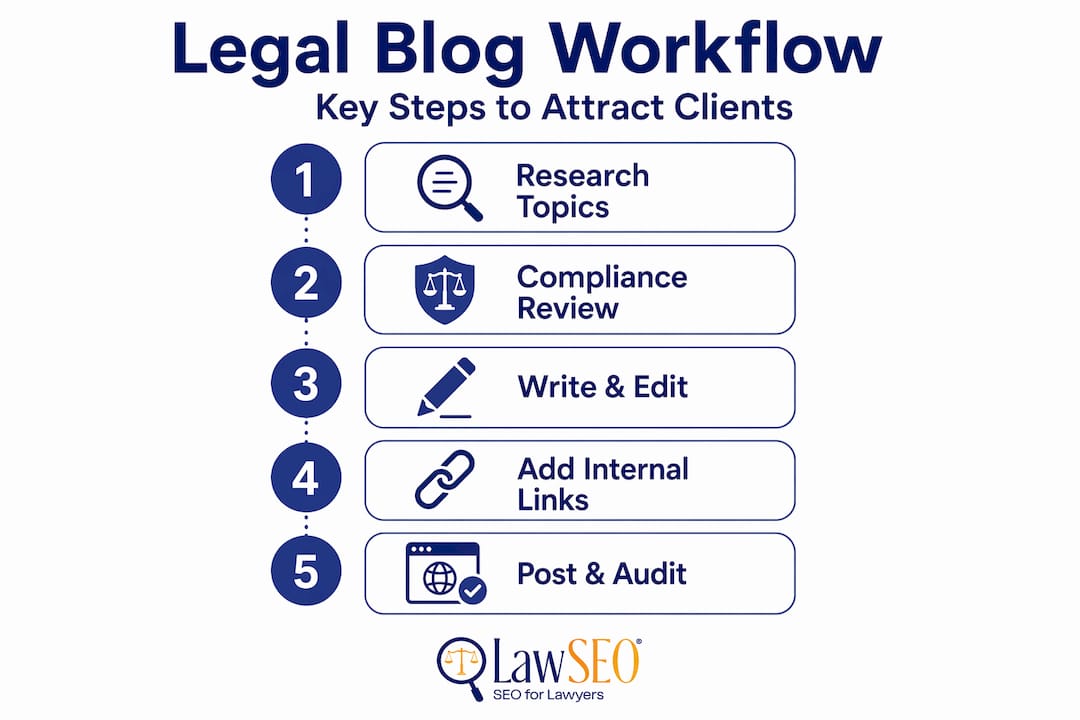
Pro Tip: Before writing any post, complete a two-part checklist: a compliance review (does this post meet your state bar’s advertising rules?) and a content brief (target keyword, audience, outline, and CTA). This five-minute step prevents the most common legal blogging mistakes.
Good internal linking strategies are also part of the foundation, not an afterthought. Plan your links before you write, not after.
How to plan your legal blog post for SEO and client attraction
With your foundations set, it is time to plan your content for both SEO impact and client conversion. Skipping this step is why most legal blogs underperform. Planning is not bureaucratic overhead. It is the work that makes writing faster and results better.
Follow this process before you open a blank document:
- Identify your target audience and their real questions. A personal injury client asks “What happens if I was partly at fault?” A business owner asks “Can I fire an employee for social media posts?” Start there, not with what you want to say.
- Conduct keyword and SERP analysis. Search your topic and study the first page of results. What questions do the top posts answer? What do they miss? Build content around a target keyword and SERP coverage using a repeatable briefing process.
- Map your outline with H2s and supporting bullets. Every post should have a logical flow: problem, context, answer, next step. Your H2 headings should mirror how a client thinks about the issue, not how a lawyer would organize a memo.
- Run a compliance review on your outline. Before you write, confirm your planned claims are accurate, that you are not inadvertently creating an attorney-client relationship, and that your CTA language meets bar advertising rules.
- Define your CTA. Every post needs one clear next step: schedule a consultation, download a guide, or call your office. Decide this before you write, so the entire post builds toward it.
Here is how content planning differs depending on firm size:
| Planning factor | Solo attorney | Large firm |
|---|---|---|
| Topic selection | Client FAQs, local search terms | Practice area silos, competitive keywords |
| Keyword tools | Free tools (Google Search Console) | Paid platforms with SERP tracking |
| Review process | Self-review plus bar checklist | Designated compliance reviewer |
| Publishing frequency | 1 to 2 posts per month | 4 to 8 posts per month |
| Content strategy | Single practice area depth | Multi-practice content silos for law firm SEO |
Building content around questions clients ask is one of the most effective ways to show expertise and increase search visibility simultaneously. One strong approach: keep a running list of every question a client asks during intake. That list is your editorial calendar.

Pro Tip: Browse legal blog topic ideas organized by practice area to find angles your competitors have not covered. Unique angles outperform keyword-stuffed topics every time.
The critical distinction here is between keyword stuffing and semantic SEO. Keyword stuffing means repeating a phrase mechanically. Semantic SEO means covering a topic so thoroughly, from every relevant angle, that search engines recognize your post as the authoritative answer. That is what earns rankings that last.
Writing and structuring your legal blog for readability and trust
With your blog structure and outline in hand, here is how to write and organize each post for maximum engagement and trust. The writing phase is where most attorneys either win or lose the reader in the first 30 seconds.
Follow this writing process:
- Open with intent. Your first paragraph should tell the reader exactly what problem this post solves and why it matters to them. No preamble. No “In today’s legal landscape.” Get to the point.
- Use direct, specific headlines. “What to do after a car accident in Texas” outperforms “Car accident information.” Your H2s should answer questions, not announce topics.
- Break up every paragraph. Three to four sentences maximum. White space is not wasted space. It is what keeps a non-lawyer reading.
- Use headings and bullets to organize complex information. A reader who cannot find the answer in 15 seconds will leave. Structure your post so the key answer is visible without reading every word.
- Link to service pages and related posts. Legal blog posts should link to relevant internal pages using clear, descriptive anchor text. This builds topical authority and guides readers toward conversion. Learn more about how legal blogs attract clients through strategic internal linking.
Common formatting pitfalls to avoid:
- Burying the answer: Do not make readers scroll through three paragraphs of legal history before getting to the practical point.
- Passive voice throughout: “The claim must be filed within two years” is weaker than “You must file your claim within two years.”
- No visual breaks: A post with no subheadings or bullets reads like a legal brief. Most clients will not finish it.
- Inconsistent tone: Switching between formal legal language and casual phrasing confuses readers and undermines credibility.
- Missing CTAs: A post that educates but does not guide the reader to a next step is a missed opportunity.
Every claim in your legal blog post should be accurate, sourced where appropriate, and written in plain language a non-lawyer can act on. The structure of good legal advice follows a clear path: state the purpose, identify the issue, present your findings, and give actionable next steps. Apply that same logic to every blog post you publish.
Strong internal links for legal blogs connect your posts into a cohesive content network, which search engines reward with higher authority scores across your entire domain.
Proofreading, updating, and ethical review: Your post-launch checklist
With your draft complete, it is time for a review that protects both your reputation and your rankings. Publishing is not the finish line. It is the starting point for a post’s long-term performance.
Work through this checklist before and after every post goes live:
- Proofread for grammar, spelling, and factual accuracy. A single error in a legal post can undermine years of credibility-building.
- Check for plain language throughout. Read your post as if you are a client who just received a frightening legal notice. Would you understand every sentence? If not, simplify.
- Vet all claims for accuracy. Every statistic, legal standard, or procedural statement must be current and correct. Laws change. Your content must reflect that.
- Add substantive updates when ranking potential exists. Update and republish pages with real improvements, not just a date change, when a post has ranking potential. Refreshing thin or outdated content is one of the fastest ways to recover or improve rankings.
- Confirm compliance and refine your CTA. Does your post meet your state bar’s advertising rules? Is your CTA clear, ethical, and specific? Attorney review is necessary for accuracy, compliance, and to avoid misleading claims, especially when AI tools are involved in drafting.
The numbers support this investment. Up to 53% of attorneys get clients directly from well-optimized, maintained blog content. That figure does not apply to posts that are published once and forgotten.
Pro Tip: Schedule a post-launch audit every three to six months for any post targeting a competitive keyword. Check rankings, update outdated information, and confirm all internal links still work. This routine maintenance is where most of the long-term SEO value from legal blogging is captured. Review SEO basics for legal blogs to build this process into your content workflow.
A legal marketing expert’s perspective: The real key to standing out
Here is what most attorneys miss, even after reading every guide to legal blog writing available. The firms that rank and convert are not the ones with the most keywords. They are the ones with the most useful answers.
Most legal blogs fail for a simple reason: they summarize what the law says without explaining what it means for the person reading the post. A potential client searching “what happens if I miss a statute of limitations deadline” does not want a definition. They want to know if their case is still viable, what their options are, and who can help them. The blogs that answer those questions specifically, with real scenarios and honest guidance, are the ones that earn trust and generate calls.
This is where semantic SEO and information gain become the real differentiators for modern legal blogging. Search engines, and increasingly AI-driven platforms, are designed to surface content that adds something new to the conversation. Restating what every other law firm’s blog already says does not earn rankings. Providing a fresh angle, a real example, or a practical answer that competitors skipped does.
The actionable shift is this: before writing any post, ask yourself what a client who has already read three other articles on this topic still does not know. Then answer that question. That is information gain, and it is what content’s role in law firm SEO is increasingly built around as AI search platforms reshape how clients find attorneys.
The firms that will own search results in the next three to five years are treating their legal blog like a standalone publication, with editorial standards, attorney review, consistent publishing, and a genuine commitment to answering client questions better than anyone else. That is not a content marketing tactic. It is a long-term competitive position.
Next steps: Get expert help optimizing your law firm’s legal blog
Writing strong legal blog posts is a skill that compounds over time. Each well-optimized post builds your domain authority, attracts qualified traffic, and positions your firm as the credible answer to a potential client’s most pressing legal questions. If you are ready to accelerate that process, the right resources and expert guidance make a measurable difference.
Explore proven legal SEO strategies built specifically for law firms competing in today’s search environment. If SEO terminology feels like a barrier, the SEO glossary for attorneys breaks down every key concept in plain language. And if you want to understand how AI-driven search is changing client acquisition, the AI optimization guide for law firms is the place to start. LawSEO.com works exclusively with attorneys and law firms, so every strategy is built around the unique compliance, competitive, and conversion demands of legal marketing.
Frequently asked questions
How long should a legal blog post be for SEO?
Most effective legal posts are between 1,000 and 2,000 words, which is enough to cover a topic thoroughly for both clients and search engines. Building content around client questions naturally produces posts in this range while demonstrating genuine expertise.
Can attorneys use AI tools to write legal blog posts?
Yes, but all AI-generated text must be attorney-reviewed for accuracy, ethics, and compliance before publishing. Attorney review is necessary to catch errors, misleading claims, and content that may violate bar advertising rules.
What makes a legal blog post conversion-ready?
Scannable formatting, direct headlines, clear CTAs, and internal links to service pages all increase conversion rates. Legal blog posts should be direct with short paragraphs and clear internal links that guide readers toward taking action.
How often should law firms update their blog content for SEO?
Review and update legal blog posts every three to six months to keep rankings and user experience high. Substantive improvements to content that has ranking potential, not just date changes, are what actually move the needle.
Do legal blogs actually attract new clients?
Yes, up to 53% of attorneys report getting clients directly from effective legal blog content. The key word is effective: posts that are well-structured, regularly updated, and written to answer real client questions.