


Yes, TV can be measured for law firms, but only when call-level tracking and CRM conversion imports work alongside incrementality testing or marketing mix modeling to prove incremental cases. The tactical starting point is dynamic number insertion, persistent first-touch data in the CRM, and conversion imports that feed an experiment. Attribution models alone tend to undercount TV-driven calls, so we treat them as an optimization layer, not proof of impact.
TL;DR:
- Before launch, assign campaign specific tracked numbers, preserve first touch source in the CRM, train intake staff, and import retained cases as offline conversions.
- Use attribution to adjust creative and airtimes, but validate budget decisions quarterly or twice yearly with matched market tests or marketing mix modeling.
- A useful market test needs several months of call and case history, comparable markets, and consistent tracking in both test and comparison areas.
- Do not judge a new flight during its first two to three weeks; a meaningful read requires a full cycle of four to twelve weeks.
- Require daily airing logs with exact times, station identifiers, creative versions, and markets, then reconcile them against call and web traffic.
Why TV still matters for law firm client acquisition
Television remains the backbone of legal advertising spend, and that scale is exactly why measurement discipline matters. In 2024, legal-service advertisers spent an estimated $2.5 billion on more than 26.9 million ads across media, with TV remaining the largest channel by both spend and volume; television ad counts peaked in 2023 at over 16.4 million spots. At that volume, a firm running TV without a measurement plan is spending blind.
TV’s job for most firms is awareness and trust-building, and the response it generates is overwhelmingly a phone call, not a web form. That matters because most analytics platforms are built to track clicks, not calls, which means a viewer who sees a spot and later dials the number shows up in reporting as a direct or organic lead unless the call itself is tracked. The measurement challenge is not whether TV works, it is whether your systems can see the response it creates.
Different TV formats carry different measurement signals:
- Linear spot TV airs on a fixed schedule with station-reported logs, making it possible to correlate airtimes with call and traffic spikes.
- Local cable offers narrower geographic targeting, which supports cleaner market-level comparisons for holdout experiments.
- National or network buys reach broad audiences but make isolating incremental effect harder without geo-level splits.
- Connected TV (CTV) and streaming can deliver impression-level and household-level data, giving far more granular measurement than traditional spot buys.
The format you choose shapes which measurement method will actually produce a usable signal.
Attribution approaches: data-driven, multi-touch, last-touch, incrementality, and MMM
Last-touch attribution assigns credit to whatever channel preceded the conversion event, which for a phone-first practice area means the call log, the intake form, or sometimes nothing at all if the call isn’t tracked. A caller who saw a TV spot three days earlier and then searched a firm’s name on Google gets logged as “organic” or “direct,” and the TV spend behind that conversion disappears from the report.
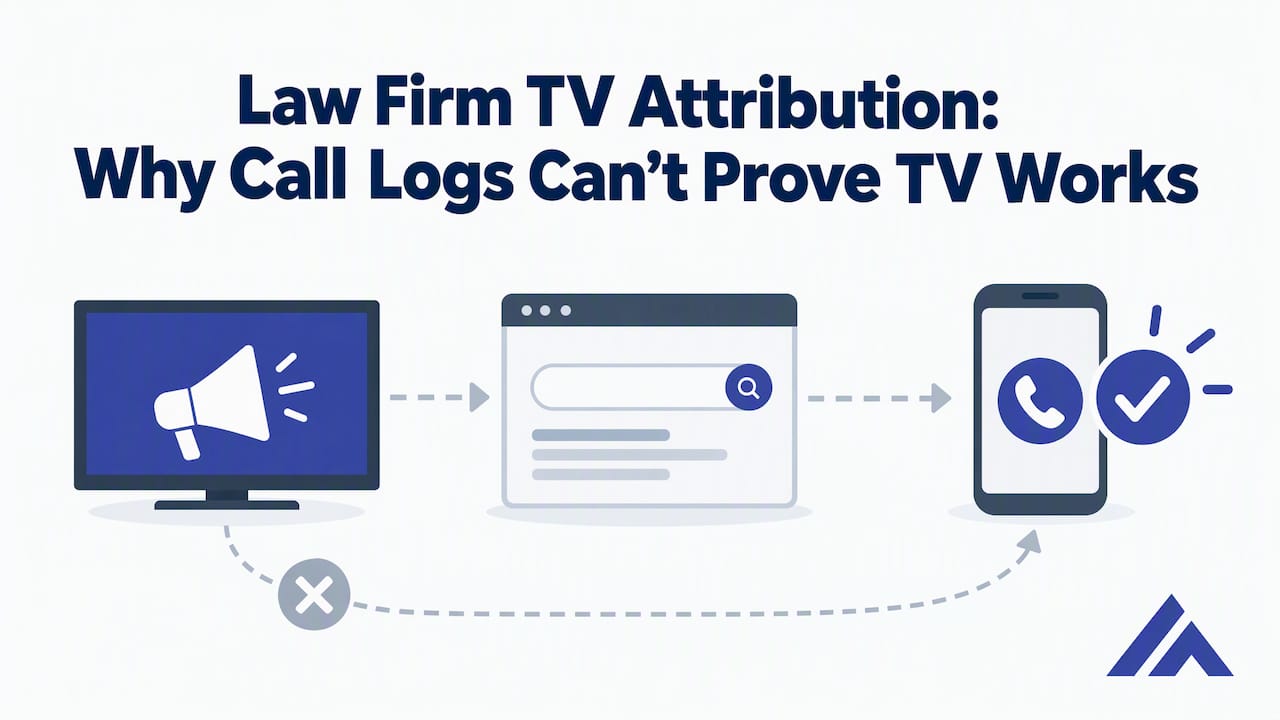
Data-driven multi-touch attribution improves on this by weighting multiple touchpoints along a visitor’s path, but it still depends on digital identifiers (cookies, click IDs, session data) that TV simply doesn’t generate. A viewer doesn’t click a television commercial, so multi-touch models can only pick up TV’s influence indirectly, through branded search lift or direct traffic spikes that coincide with airtimes. Our guide on phone-first multi-touch attribution breaks down how to layer call data into these models so offline touches aren’t invisible.
Incrementality testing answers a different question entirely: not “which touchpoint got credit” but “would this conversion have happened without the ad.” A geo holdout, where TV runs in some markets and is paused in matched comparison markets, isolates the lift TV actually created. Marketing mix modeling takes a broader, statistical view across all channels and historical spend, useful when a firm has been running TV continuously and can’t easily create a clean holdout. The marketing measurement handbook from Think with Google recommends exactly this combination: data-driven attribution for granular, near-real-time optimization, paired with incrementality and MMM to validate real-world impact and account for the offline conversions and privacy constraints that attribution alone can’t capture.
A practical decision rule follows from this:
- Use attribution data to optimize creative, dayparts, and station mix week to week.
- Use incrementality tests or MMM on a quarterly or semi-annual cadence to validate whether TV spend is actually producing cases, not just correlated activity.
- Reconcile the two: attribution gives an optimistic upper bound on TV’s contribution, while incrementality or MMM gives a more conservative lower bound, per the same Think with Google measurement guidance.
Pro Tip: Never let a single attribution model make a budget decision on its own; pair it with at least one incrementality read before cutting or expanding a TV flight.
Tracking checklist for law firms: call tracking, CRM, and conversion imports
Making TV auditable starts with infrastructure, not reporting. Build it in this order:
- Deploy dynamic number insertion (DNI) so each campaign, station, and flight gets its own tracked phone number, then map every number to a campaign identifier in your call-tracking platform.
- Persist first-touch metadata at first contact. When a visitor lands on your site after seeing a spot, capture UTM parameters, click identifiers, and timestamp data, then write that record permanently to the CRM lead profile rather than letting it get overwritten by a later touchpoint.
- Train intake staff to log referral source on every call, especially for calls that don’t originate from a tracked number, since not every caller will dial the exact number shown on screen.
- Import CRM-qualified conversions back into ad platforms and analytics as offline conversions, so the system that reports performance reflects actual retained cases, not just raw call volume.
- Reconcile station airing logs against call and web traffic daily, flagging spikes that align with specific spot airtimes.
A few operational habits make this durable:
- Keep one consistent CRM field reserved for first-touch source across every intake channel.
- Review DNI number pools monthly to confirm no numbers have been reassigned or dropped from tracking.
- Audit a sample of “untracked” calls each week to estimate how much volume intake is missing.
Our conversion tracking guide for legal websites walks through the technical mapping between web events, call records, and CRM fields in more detail, and it’s worth a close read before you touch your call-tracking settings.
Designing incrementality experiments and MMM for TV
Once tracking infrastructure is in place, the next step is proving incremental lift, not just logging activity. A geo holdout experiment is the most direct design for spot or local cable TV: pause advertising in a subset of comparable markets while continuing normal flighting elsewhere, then compare call and case volume between the two groups over a matched time window.
Running a true randomized holdout isn’t always feasible, especially for firms with always-on national campaigns. When that’s the case, synthetic control methods or CausalImpact-style modeling can estimate what would have happened in a market absent the ad spend, by building a statistical comparison from markets with similar historical patterns. The Think with Google measurement handbook specifically suggests ramping down a defined set of markets temporarily when a clean holdout isn’t practical, then applying synthetic-control analysis to the gap.
Data requirements matter here. A usable experiment needs:
- At least several months of historical call and case data per market to establish a reliable baseline.
- Markets of comparable population and case mix so the holdout and test groups aren’t skewed by unrelated demand shifts.
- Consistent tracking infrastructure (DNI, CRM persistence) active in every market being compared, so the comparison isn’t contaminated by measurement gaps.
MMM outputs can be more cost-efficient to interpret than they sound at first glance: a Think with Google case study found that online video delivered higher cost efficiency than national TV at certain investment levels in that advertiser’s model, which is the kind of channel-level comparison MMM is built to surface. Use MMM outputs to set conservative upper and lower bounds on what each channel, including TV, is actually contributing, rather than taking any single model’s point estimate at face value.
Script and creative decisions that improve measurement
The spot itself can make or break your ability to measure it. A few creative choices carry real measurement consequences:
- Use a distinct phone number or short tracking URL for each flight and market so response can be isolated to a specific airing schedule rather than lumped into a general firm number.
- Keep the call-to-action simple and repeated, since a caller who has to hunt for the number or remember a long URL is a caller you lose from your tracking entirely.
- Choose spot length and frequency to create a measurable response window. A 30-second spot airing with enough frequency to register a detectable spike in calls is more useful for measurement than a single long-form placement that airs once.
Compliance shapes these choices too. Attorney advertising on television has been protected commercial speech since Bates v. State Bar of Arizona in 1977, though state bars still require that claims be verifiable and non-misleading. FTC staff commentary has consistently recommended that bar rules favor disclosure requirements over outright prohibitions on truthful, non-deceptive advertising techniques, which supports using clear, trackable CTAs rather than vague branding language that would be harder to measure and potentially harder to defend. Our TV advertising examples for law firms page shows how firms structure spots that stay compliant while still giving a measurement team something to track.
Pro Tip: Write the tracked phone number into the script itself, not just the on-screen graphic, so viewers who are listening rather than watching still get a trackable path to call.
What to demand from media vendors before you sign
Your ability to measure TV is only as good as the data your media buy gives you access to. Before committing to a flight, require vendors to provide:
- Daily airing logs with exact timestamps and station identifiers, not a weekly summary, so spikes in calls or traffic can be matched to specific spots.
- Spot metadata including creative version and market, so you can tell which script or which region drove a given response.
- Reconciliation files that confirm spots actually aired as scheduled, since preemptions and make-goods are common and silently distort attribution if unaccounted for.
For CTV and streaming buys, push further: ask for impression-level delivery data and audience-segment exports where the platform allows it, since this granularity is what makes CTV meaningfully easier to measure than traditional spot TV.
Flighting strategy affects detectability as much as creative does. A low-frequency spot buy spread thin across many dayparts produces a weak, noisy signal that’s hard to separate from normal call volume. Concentrated frequency within a defined flight window, paired with targeted CTV placement, produces a sharper, more detectable spike that both attribution models and incrementality tests can actually pick up.
How a law-specialist agency runs TV attribution in practice
Running TV attribution well is an operational discipline, not a one-time setup. For every campaign we manage, the checklist looks the same regardless of firm size or market:
- Confirm dynamic number insertion is live and every number maps to a campaign and flight identifier before the first spot airs.
- Verify CRM fields are persisting first-touch source data rather than being overwritten by the last interaction before intake.
- Set up offline conversion imports so retained cases, not just raw calls, feed back into reporting.
- Design the incrementality test or MMM cadence before the campaign launches, not after the first budget review.
- Reconcile station logs against call and traffic data daily for the first several weeks of any new flight, then move to weekly once patterns stabilize.
This sequence exists because the order matters: tracking infrastructure that goes live after a campaign has already started leaves a permanent gap in the data that no later analysis can fully recover. Getting the measurement plumbing right before launch is what makes the incrementality and MMM work downstream possible at all.
The typical TV buying and campaign lifecycle for law firms
Understanding the buying cycle helps set realistic expectations for when attribution data becomes meaningful. Most law firm TV campaigns move through a few distinct phases.
Planning and negotiation with stations or networks typically runs four to eight weeks before a flight launches, during which markets, dayparts, and frequency are set. Production of the spot itself, if not reusing existing creative, often takes two to four weeks, including scripting for compliance review.
Once a flight launches, early weeks are noisy. Call and traffic patterns take time to stabilize as audiences are exposed to the spot with enough frequency to register a response, and we generally advise against drawing conclusions from the first two to three weeks of a new campaign. A meaningful read on performance, let alone incrementality, usually requires a full flight cycle, commonly four to twelve weeks depending on frequency and market size.
Renewal and optimization decisions then follow, informed by the attribution and incrementality data gathered during the flight. Firms that build their tracking and experiment design into the planning phase, rather than bolting it on mid-flight, get a usable read much closer to the end of that first cycle instead of waiting for a second campaign to generate clean data.
Cost analysis: what TV attribution actually requires to implement
Measuring TV well involves three cost categories, and firms underestimate at least one of them in most cases we see.
Technology costs include a call-tracking platform with dynamic number insertion, CRM software capable of persisting custom first-touch fields, and either an analytics platform or a dedicated MMM tool for the incrementality and modeling work. These are typically recurring subscription costs layered on top of existing marketing technology stacks.
Staffing costs cover the people who maintain the system: someone to manage DNI number pools and campaign mapping, intake staff trained to log referral sources consistently, and either an in-house analyst or an outside partner to design and interpret incrementality tests or MMM output. This is often the most underfunded piece, since tracking infrastructure without someone actively reconciling it degrades quickly.
Agency or vendor costs cover media buying support, creative production, and measurement design itself, whether that work is handled in-house or through a specialist partner. Firms that try to build incrementality testing and MMM capability entirely in-house often find the statistical design work requires expertise beyond what a general marketing hire brings, which is where a specialist agency partnership tends to shorten the path from campaign launch to a trustworthy measurement read.
What most firms get wrong about TV measurement
The most common mistake we see is treating a dashboard as proof. Firms watch call volume rise after a flight launches and declare TV is working, without ever checking whether those calls would have come in anyway. Correlation with airtime is a starting point, not an answer, and the firms that get burned are usually the ones that scaled a budget based on attribution alone.
The second mistake is bigger and more fixable: most firms simply don’t capture the data that would let them answer the question at all. Phone calls and CRM records sit disconnected from the ad platform, so TV’s real contribution is invisible by default, not by nature. Fix the data capture first. Persist first-touch source into the CRM on every lead, then run one real incrementality test before your next budget cycle. That single change will tell you more than another year of dashboard-watching.
— TODD
How we support law firms building TV attribution systems
We build the measurement infrastructure described throughout this piece as part of our TV Advertising (Streaming/CTV Campaigns) work for law firm clients, paired with the call-tracking and CRM integration work that makes attribution and incrementality testing possible in the first place. For firms already running TV without a clean read on performance, this is usually where the gap sits: media spend keeps flowing while the tracking layer underneath it was never built.
Our relevant services include TV Advertising with measurement built into the media plan from day one, conversion tracking and CRM mapping support, and SEO work that captures the branded search lift TV generates downstream.
If your firm wants a measurement audit of an existing TV campaign or help designing an incrementality test for an upcoming flight, our services overview is the place to start, or reach out through Lawseo to talk through where your current tracking has gaps.
FAQ
When did it become legal for attorneys to advertise on TV?
Attorney advertising became constitutionally protected commercial speech in 1977 following Bates v. State Bar of Arizona, which struck down blanket bans on lawyer advertising. States can still require that ads be truthful and non-misleading, but they cannot prohibit advertising by medium, including television.
Is $900 an hour a lot for a lawyer?
Attorney hourly rates vary widely by practice area, market, and experience level, so a figure like that falls well outside any single standard rate. We don’t have sourced data establishing what counts as typical, so firms and clients should compare rates within their specific practice area and region rather than against a general benchmark.
How much of a 30-minute TV show is commercial?
This figure varies by network and time slot and isn’t something we have sourced data on for this article. What matters more for attribution purposes is the frequency and placement of your specific spot within that break, which your media vendor’s airing logs should document in detail.
Who is making the best TV commercials for attorneys right now?
Rather than ranking specific commercials, the stronger question is which creative choices make a spot both compliant and measurable, such as distinct tracked phone numbers, clear repeated calls to action, and spot lengths that produce a detectable response window. Our TV advertising examples for law firms page walks through creative and production approaches built around those measurement principles.
Why does last-touch attribution undercount TV’s impact for law firms?
Last-touch attribution credits whatever touchpoint immediately preceded a conversion, which for TV-driven leads is often a tracked or untracked phone call rather than a trackable digital click. A caller who saw a spot and later searched the firm’s name online gets logged as organic or direct, erasing TV’s role unless call tracking and CRM persistence capture the original source.
Sources
- Legal Services Advertising Report – 2017-2024
- Marketing measurement handbook (Google / Think with Google)
- FTC staff comment on attorney advertising rules (New Jersey matter)
- Scholarly commentary on Bates and attorney advertising