


Many law firms assume structured data is too technical or irrelevant to their marketing efforts, dismissing it as something only large corporations need. That’s a costly mistake. Structured data transforms how search engines understand your legal services, directly impacting your visibility in search results and your ability to attract potential clients. When implemented correctly, it gives your firm a competitive edge by making your listings more prominent, informative, and clickable. This guide breaks down what structured data is, which types matter most for law firms, how it enhances SEO performance, and practical steps to implement it on your website in 2026.
Table of Contents
- What Is Structured Data And Why Law Firms Need It
- Key Types Of Structured Data Schemas For Law Firms
- How Structured Data Boosts SEO And Client Acquisition For Law Firms
- Implementing Structured Data In Your Law Firm Website: Best Practices
- Enhance Your Law Firm’s Online Presence With Expert SEO Services
- Frequently Asked Questions
Key takeaways
| Point | Details |
|---|---|
| Enhanced search visibility | Structured data helps search engines display your firm with rich snippets, increasing prominence in search results. |
| Multiple relevant schemas | Law firms benefit from LocalBusiness, LegalService, Attorney, Review, FAQ, and Breadcrumb schemas tailored to legal content. |
| Measurable SEO improvements | Proper implementation leads to better indexing, higher click-through rates, and improved rankings for competitive keywords. |
| Competitive advantage | Most law firms haven’t adopted structured data yet, creating an opportunity to stand out in local and organic search. |
What is structured data and why law firms need it
Structured data is code added to your website that organizes information in a standardized format search engines can easily read and interpret. Think of it as a translation layer that helps Google, Bing, and other search platforms understand exactly what your pages contain. Structured data uses standardized formats like schema.org to label elements such as your firm name, practice areas, attorney credentials, office locations, and client reviews.
Search engines use this information to create enhanced search results. Instead of plain blue links, your firm might appear with star ratings, office hours, attorney profiles, or answers to common legal questions displayed directly in search results. These rich results catch attention and build credibility before someone even clicks through to your site.
The misconception that structured data is overly complex keeps many law firms from implementing it. While the technical implementation requires some knowledge, the concepts are straightforward. You’re simply telling search engines what different parts of your content represent. Modern tools and plugins make adding structured data much easier than most attorneys expect.
Why should law firms care? The legal market is intensely competitive online. Potential clients searching for legal help see dozens of firms competing for attention. Structured data gives you several distinct advantages:
- Your listings become more visually appealing and informative in search results
- Search engines can match your services to user queries more accurately
- You gain eligibility for featured snippets and knowledge panels
- Local search performance improves when location data is properly marked up
- Voice search devices can better understand and recommend your firm
Pro Tip: Start with the schemas that match your most profitable practice areas. If personal injury generates most of your revenue, prioritize marking up those service pages first to see faster ROI from your structured data efforts.
Implementing legal SEO for law firms requires multiple strategies working together, and structured data serves as the foundation that makes other tactics more effective. When search engines fully understand your content, your entire SEO program performs better.
Key types of structured data schemas for law firms
Not all schema types matter equally for legal practices. Focus your efforts on these six schema types that deliver the most value for law firms.
LocalBusiness and LegalService schemas work together to establish your firm’s physical presence and service offerings. LocalBusiness markup includes your firm name, address, phone number, hours, and service area. LegalService schema adds details about specific legal services you provide, such as family law, criminal defense, or estate planning. LocalBusiness and LegalService schemas enhance local search relevance by connecting your firm to location-based queries.

Attorney schema highlights individual lawyers at your firm. This markup includes attorney names, credentials, bar admissions, education, and practice areas. When potential clients search for lawyers with specific qualifications, this schema helps search engines identify your attorneys as relevant matches.
Review schema displays star ratings and client testimonials directly in search results. Seeing positive reviews before clicking builds trust and significantly increases the likelihood someone will choose your firm over competitors. This schema pulls from legitimate review platforms and displays aggregate ratings prominently.
FAQ schema allows frequently asked questions and answers to appear as expandable elements in search results. This is particularly valuable for law firms because legal questions often drive initial searches. When your FAQ content appears in search results, you provide immediate value and establish expertise before the click.
Breadcrumb schema creates a navigation trail showing the page hierarchy on your site. This helps users understand where they are on your site and allows search engines to display cleaner, more organized search listings with visible site structure.
| Schema Type | Primary Benefit | Best Usage Example |
|---|---|---|
| LocalBusiness | Improves local search visibility | Main office location pages |
| LegalService | Connects services to search queries | Practice area landing pages |
| Attorney | Highlights lawyer credentials | Individual attorney bio pages |
| Review | Displays ratings in search results | Firm overview and testimonial pages |
| FAQ | Answers appear in search features | Service pages with common questions |
| Breadcrumb | Clarifies site structure | All internal pages |
Pro Tip: Layer multiple schema types on the same page when appropriate. Your personal injury practice page can include LegalService schema for the service itself, Review schema for client testimonials, and FAQ schema for common accident claim questions, creating a comprehensive search result.
Choosing the right schemas depends on your firm’s structure and priorities. Solo practitioners should emphasize Attorney and LegalService schemas. Multi-attorney firms benefit from robust LocalBusiness markup across all office locations. Structuring law firm websites with proper schema from the beginning prevents the need for extensive retrofitting later.
How structured data boosts SEO and client acquisition for law firms
Structured data creates multiple pathways for improving search performance and attracting more qualified leads. The most visible impact comes through enhanced search features that make your listings stand out.
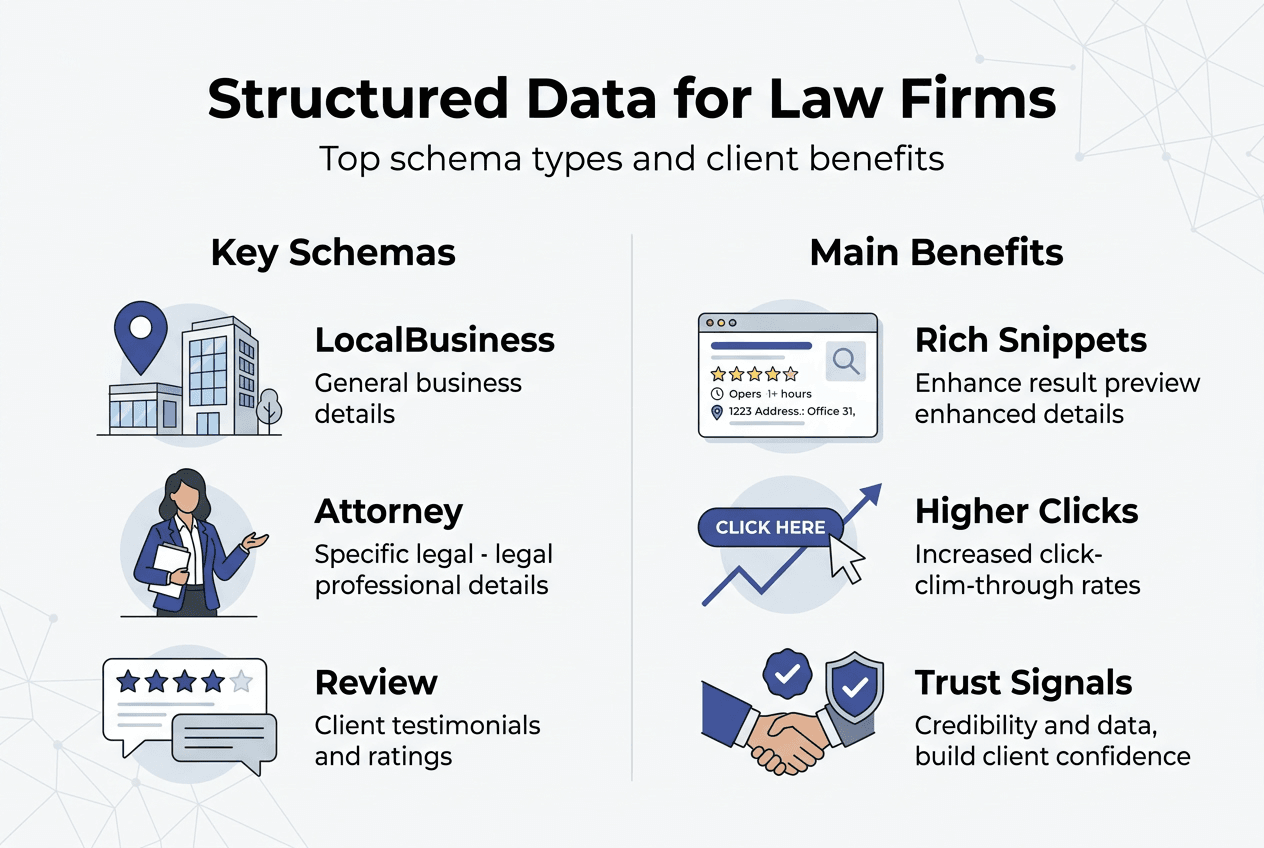
Rich snippets transform ordinary search results into eye-catching entries with additional information. A law firm with Review schema might display a 4.9-star rating with 127 reviews directly under the page title. FAQ schema can trigger an expandable question section right in search results, allowing users to get answers without clicking. These enhanced displays occupy more screen space and draw attention away from competitors with plain listings.
Featured snippets represent the ultimate search visibility. When you answer a common legal question with well-structured content and FAQ schema, Google may display your answer in the coveted position zero above all other organic results. Structured data can improve click-through rates by making your firm’s search presence more authoritative and helpful.
The SEO benefits extend beyond visual enhancements:
- Search engines index your content more accurately when schema clarifies what each page element represents, leading to better matching with relevant queries.
- Your pages become eligible for specialized search features like local packs, knowledge panels, and carousel results that weren’t accessible before.
- Click-through rates increase measurably when searchers see ratings, answers, or detailed service information before clicking, as they recognize your listing as more relevant.
- Voice search devices rely heavily on structured data to formulate spoken answers, positioning your firm to capture the growing voice search market.
- Rankings often improve indirectly as higher engagement signals tell search engines your content satisfies user intent better than competitors.
Client acquisition improves through multiple mechanisms. Potential clients searching for legal help are often anxious and uncertain. When they see your firm with five-star reviews, clear practice area descriptions, and immediate answers to their questions, you’ve already begun building trust. That trust translates to higher conversion rates when they reach your website.
Implementing comprehensive structured data across our practice area pages resulted in a 34% increase in qualified contact form submissions within 90 days, as our enhanced search listings attracted more motivated potential clients who already understood our expertise.
The competitive advantage matters enormously in legal marketing. Most law firms still haven’t implemented structured data properly, if at all. Early adopters gain disproportionate visibility while the opportunity remains open. As more firms recognize the value and implement schemas, the baseline shifts, but being ahead of that curve delivers significant returns.
Local search performance sees particularly strong improvements. When your LocalBusiness schema includes accurate NAP information, service areas, and hours, you become more likely to appear in map packs and local results. Combined with strong legal SEO strategies for law firms, structured data amplifies your visibility for high-intent local searches like “divorce lawyer near me” or “criminal defense attorney in [city].”
The impact compounds over time. Search engines continuously refine how they use structured data, creating new opportunities for marked-up content. Firms that boost Google rankings through structured data position themselves to benefit automatically as search features evolve.
Implementing structured data in your law firm website: best practices
Successful structured data implementation follows a systematic approach that ensures accuracy and maximizes SEO value. Start by auditing your current website to identify which pages need which schema types. Service pages require LegalService markup, attorney bios need Attorney schema, and your contact page benefits from LocalBusiness details.
Generate the actual structured data code using reliable tools. Google’s Structured Data Markup Helper walks you through tagging page elements and generates the code automatically. Schema.org provides official documentation and examples for each schema type. Many legal website platforms and WordPress plugins offer built-in structured data features that simplify implementation.
Add the generated code to your pages using JSON-LD format, which Google recommends. This format keeps structured data separate from your visible HTML, making it easier to manage and update. Place the JSON-LD script in your page’s head section or immediately after the opening body tag.
Validation is critical. Use Google’s Rich Results Test and Schema Markup Validator to check your implementation before publishing. These tools identify errors, missing required properties, and opportunities to enhance your markup. Fix any errors immediately, as incorrect structured data can hurt more than help.
Common errors to avoid:
- Using outdated schema types instead of current legal-specific schemas
- Marking up content that doesn’t actually appear on the page
- Inconsistent NAP information across LocalBusiness schemas
- Missing required properties that prevent rich results eligibility
- Duplicating schema markup across template and page-level code
- Failing to update schemas when business information changes
| Tool | Primary Feature | Recommended Use |
|---|---|---|
| Google Structured Data Markup Helper | Visual tagging interface | Initial schema creation for new pages |
| Schema.org Documentation | Official schema specifications | Reference for advanced implementations |
| Google Rich Results Test | Validation and preview | Testing before publishing changes |
| Schema Markup Validator | Comprehensive error checking | Auditing existing implementations |
| Google Search Console | Performance monitoring | Tracking rich result impressions and clicks |
Monitor performance through Google Search Console’s enhancements reports. These show which pages have valid structured data, which rich results you’re earning, and any errors that need fixing. Track how rich results impact your click-through rates by comparing performance before and after implementation.
Pro Tip: Set a quarterly reminder to review and update your structured data. Attorney credentials change, new reviews accumulate, service offerings expand, and search engines release new schema types. Regular maintenance ensures your markup stays current and continues delivering maximum SEO value.
Technical SEO for lawyers encompasses many elements beyond structured data, but proper schema implementation creates a strong foundation. Combine it with optimized site architecture, fast page speeds, and optimized URL structures for comprehensive technical excellence.
Start small if the full implementation feels overwhelming. Add LocalBusiness schema to your homepage and contact page first. Then tackle your highest-traffic practice area pages with LegalService and FAQ schemas. Build momentum with quick wins before expanding to your entire site.
Enhance your law firm’s online presence with expert SEO services
Implementing structured data represents just one component of a comprehensive legal SEO strategy. LawSEO.com specializes exclusively in helping law firms dominate search results and attract more qualified clients through proven optimization techniques. Our team understands the unique challenges legal practices face online and develops customized strategies that deliver measurable results. We handle everything from legal SEO strategies for law firms to technical implementations that most firms lack the resources to execute internally. Explore how legal SEO explained for law firms can transform your online visibility and client acquisition. Visit LawSEO.com to discover how our expertise can help your practice achieve online dominance.
Frequently asked questions
What exactly is structured data for law firms?
Structured data is standardized code added to your website that helps search engines understand your legal services, attorney credentials, office locations, and other important information. It translates your content into a format search platforms can easily process and use to create enhanced search results.
How does structured data improve my law firm’s search rankings?
Structured data doesn’t directly boost rankings like backlinks do, but it improves how search engines index and display your content. Better indexing leads to more accurate matching with relevant searches, while enhanced listings increase click-through rates, which signals quality to search algorithms and can improve rankings over time.
Which structured data schemas matter most for law firms?
LocalBusiness, LegalService, Attorney, Review, FAQ, and Breadcrumb schemas deliver the most value. LocalBusiness establishes your physical presence, LegalService connects your offerings to searches, Attorney highlights lawyer credentials, Review displays ratings, FAQ enables featured snippets, and Breadcrumb clarifies site structure.
Can I implement structured data myself or do I need a developer?
Many law firms can implement basic structured data using tools like Google’s Structured Data Markup Helper or WordPress plugins designed for legal websites. However, comprehensive implementation across a large site with multiple practice areas and attorneys often benefits from professional expertise to ensure accuracy and maximize results.
How long does it take to see results from structured data implementation?
Search engines typically process and begin using structured data within a few weeks of implementation. You may see rich results appear in search listings within 2 to 4 weeks. The full SEO impact, including improved rankings and increased traffic, usually becomes measurable within 60 to 90 days as search engines fully index and utilize your markup.
Does structured data help with voice search for legal services?
Yes, voice assistants rely heavily on structured data to understand and recommend businesses. When someone asks their device for a local attorney, properly marked-up law firm websites have a significant advantage in being selected as the spoken answer or top recommendation.