


TL;DR:
- Backlinks influence search rankings based on quality, relevance, and natural acquisition patterns rather than sheer volume. High-authority, contextually relevant backlinks from diverse sources enhance both traditional SEO and AI-driven search visibility. Building a sustainable backlink profile requires creating valuable content, targeted outreach, and ongoing measurement to maintain credibility and avoid penalties.
Backlinks have shaped search engine rankings since Google’s earliest days, yet the role of backlinks in SEO is still widely misunderstood. Many practitioners chase volume, assuming that more links always produce better results. That assumption gets websites penalized. What actually moves rankings is the quality, relevance, and natural acquisition pattern of the links pointing to your site. This guide breaks down how backlinks function, why their value has grown more nuanced heading into 2026, and what a sound backlink strategy looks like for professionals who need real, sustainable results.
Key takeaways
| Point | Details |
|---|---|
| Quality outranks quantity | A single authoritative, contextual backlink delivers more ranking power than dozens of low-quality links. |
| Backlinks remain a top-3 signal | Pages ranking first have significantly more high-quality backlinks than pages ranked below them. |
| AI search rewards authority too | Backlinks build editorial credibility that AI-powered search systems use when selecting cited sources. |
| Profile diversity is mandatory | Referring domain diversity and a natural mix of link types protect against spam flags and penalties. |
| Measurement drives improvement | Tracking referring domains, authority scores, and anchor text distribution is what separates effective strategies from guesswork. |
The role of backlinks in SEO: what they are and why they matter
A backlink is a hyperlink on one website that points to a page on another website. Search engines treat these links as votes of confidence. When a credible source links to your content, it signals that your page is authoritative and worth surfacing in search results. That fundamental mechanic has not changed since PageRank was patented, but the sophistication with which Google interprets those votes has grown considerably.
There are two primary link types every practitioner must understand:
- Dofollow links pass link equity, commonly called “link juice,” from the referring page to the destination. These directly influence how Google evaluates the authority of the linked page.
- Nofollow links carry a rel=“nofollow” attribute that historically told crawlers not to pass equity. Google now treats nofollow as a hint rather than a directive, meaning some equity can still transfer.
- Sponsored and UGC links use rel=“sponsored” and rel=“ugc” attributes to identify paid placements and user-generated content. These signal context to Google rather than manipulate authority.
Anchor text, the clickable words within a hyperlink, also shapes how Google interprets a link’s meaning. An anchor reading “personal injury attorney in Dallas” tells the algorithm something specific about the destination page’s topic. Generic anchors like “click here” carry far less signal value. Contextual placement within body content passes more authority than links buried in footers or sidebars, where they appear decorative rather than editorially chosen.
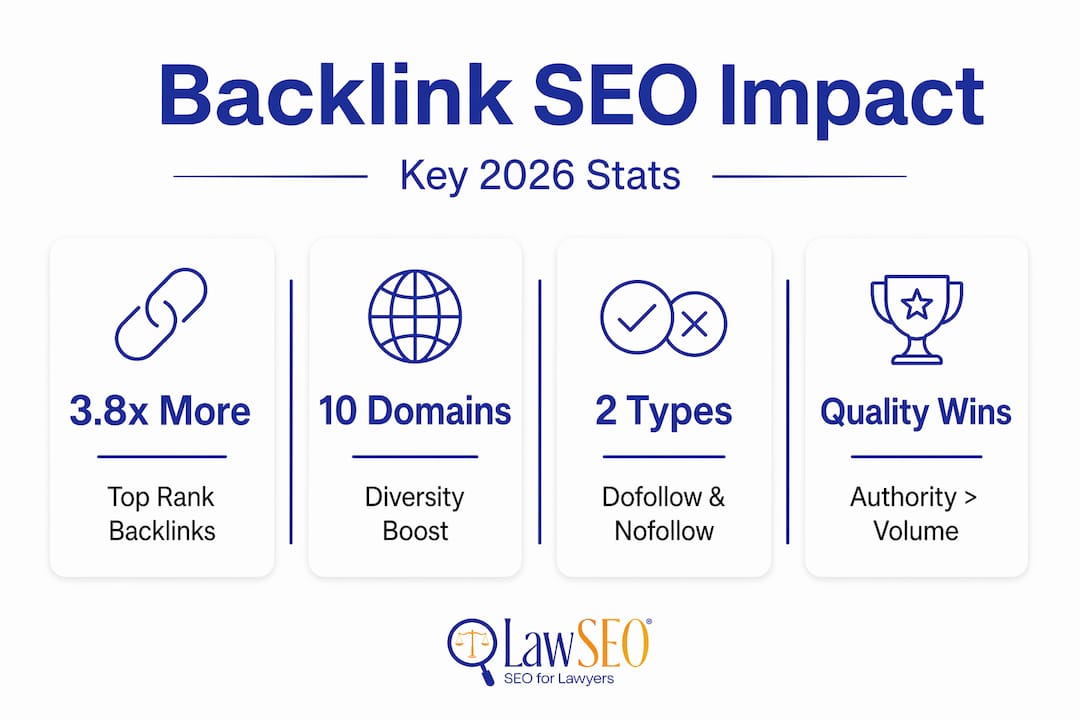
Referring domain diversity compounds all of this. Google weights domain diversity heavily, meaning ten links from ten different authoritative sites outperform fifty links from one site. The breadth of your link profile communicates how widely recognized your content is across the web.
Why backlink quality matters more than volume
The shift from quantity to quality is not a new concept, but in 2026 it carries more practical urgency than ever. Google’s algorithms have become adept at recognizing unnatural link patterns, and low-quality link schemes frequently cause ranking penalties that can take months to recover from.
What defines a high-quality backlink? Several factors work together:
- Domain authority and trustworthiness of the referring site. A link from a major legal publication carries exponentially more weight than a link from a generic blog directory.
- Topical relevance. A law firm earning a backlink from a state bar association or a legal news outlet receives a contextually relevant signal. The same firm receiving a link from a pet supplies retailer sends a confusing signal to the algorithm.
- Editorial intent. Links that appear because a site genuinely found your content worth citing have higher value than links you placed manually in forums, comment sections, or paid link networks.
- Link placement. Body content links in substantive paragraphs signal genuine editorial choice.
The contrast between low-quality and high-quality backlinks becomes stark in practice. Consider a law firm that purchases 200 links from a private blog network versus one that earns 15 links from regional legal directories, bar association websites, and news outlets covering a notable case. The 15 earned links will consistently outperform the 200 purchased ones on every ranking and traffic metric that matters. A single high-authority contextual link can generate qualified referral traffic and leads for years, making it a long-term revenue asset rather than a one-time ranking nudge.
Pro Tip: Before building any new links, audit where your competitors’ strongest backlinks come from using a tool like Ahrefs or Semrush. Replicating their best editorial placements is more efficient than starting from zero and avoids the guesswork that often leads to low-quality link acquisition.
Rapid link acquisition also raises spam flags. Link velocity, how quickly a site accumulates new backlinks, is a signal the algorithm scrutinizes. A site that gains 500 links in a week after years of minimal link growth looks suspicious. Steady, organic growth over time is what a natural profile looks like.
How backlinks affect ranking and AI search visibility
The empirical evidence on the impact of backlinks on SEO is direct. Pages ranking first average 3.8 times more backlinks than pages ranked in positions two through ten. Backlinks remain one of the top three Google ranking factors heading into 2026. That data point is not a reason to chase volume. It reflects that authoritative content, which naturally earns more links over time, dominates the top position.
Google’s algorithm uses backlinks as a proxy for trust and authority. A page that has earned editorial endorsements from reputable sources is, by that logic, more credible than one that has not. This is especially consequential in competitive verticals like legal services, where every firm in a market is fighting for the same high-intent search queries.
The story gets more interesting when you factor in AI-powered search. Tools like Google’s AI Overviews and other generative AI platforms are increasingly selecting sources to cite based on perceived editorial credibility. Backlinks build that editorial credibility in ways that AI systems recognize when choosing which sources to surface. A law firm that has earned consistent backlinks from respected legal publications, news outlets, and professional associations is far more likely to appear as a cited source in an AI-generated answer than one relying on thin, self-published content.
Building backlinks for AI visibility requires the same foundation as traditional SEO but with a heavier emphasis on topical authority. A backlink from a source that covers your specific practice area intensively does more for AI citation than a backlink from a broadly authoritative but off-topic domain. Topical authority built through backlinks improves rankings for entire keyword clusters while increasing the probability of AI-driven search citations.
Strategies for building a strong backlink profile
A sound backlink strategy for SEO is built on earned links first and manual outreach second. Here is a practical framework:
- Create reference-worthy content. Original research, detailed guides, and case studies attract editorial links naturally. If your content is the most thorough treatment of a topic in your niche, other writers will cite it.
- Strategic outreach. Identify publishers, journalists, and bloggers who cover your subject area. Pitch your content as a resource when it fills a genuine gap in their existing coverage.
- Digital PR. Position firm attorneys as expert sources for media outlets. A quote in a local news story often produces a high-authority editorial link with zero additional effort.
- Legal directory submissions. Structured citation links from reputable legal directories like Avvo, Justia, and FindLaw build domain authority and topical relevance simultaneously.
- Guest contributions. Publishing substantive articles in respected legal or business publications earns contextual editorial links and builds brand recognition with potential clients.
- Broken link building. Find pages in your niche that link to dead resources, then offer your content as a replacement. Publishers appreciate the help, and you earn a genuine editorial link.
| Approach | Best for | Risk level |
|---|---|---|
| Editorial content marketing | Long-term authority building | Low |
| Outreach and guest contribution | Targeted link acquisition | Low to medium |
| Legal directory listings | Local SEO and topical relevance | Very low |
| Private blog networks | Fast link accumulation | Very high |
| Paid link schemes | Shortcut ranking attempts | Very high |
Balanced profiles with dofollow and nofollow links help avoid manual spam reviews and maintain profile health. Not every link you earn will be dofollow, and that is not a problem. A profile composed entirely of dofollow links from commercial outreach looks as unnatural as a profile full of nofollow links.
Pro Tip: Set a monthly goal to earn links from three to five new referring domains rather than a raw link count. This naturally constrains link velocity and forces you to prioritize quality over volume.
Measuring backlink impact and auditing your profile
Knowing your backlink profile’s composition is as important as building it. Without measurement, you cannot tell which efforts are working or identify toxic links that may be quietly suppressing your rankings.
The metrics that matter most are:
- Referring domains. The count of unique domains linking to your site. Growth here is a stronger positive signal than raw backlink count.
- Domain Rating or Domain Authority. Tool-specific scores (Ahrefs uses DR, Moz uses DA) that estimate the overall authority of linking domains. Higher is better, but relevance still matters more than raw score.
- Anchor text distribution. Over-optimization with exact-match anchors looks manipulative. You want a natural spread of branded, topical, partial-match, and generic anchors.
- Link velocity. The rate at which new links appear. Sudden spikes warrant investigation.
- Toxic link percentage. Links from spammy, irrelevant, or penalized domains that could trigger algorithmic or manual penalties.
| Tool | Primary strength | Best use case |
|---|---|---|
| Google Search Console | First-party link data | Baseline auditing and monitoring |
| Ahrefs | Largest backlink index | Competitor analysis and prospecting |
| Semrush | Integrated SEO suite | Full-campaign reporting |
| Moz Link Explorer | Domain Authority metric | Authority benchmarking |
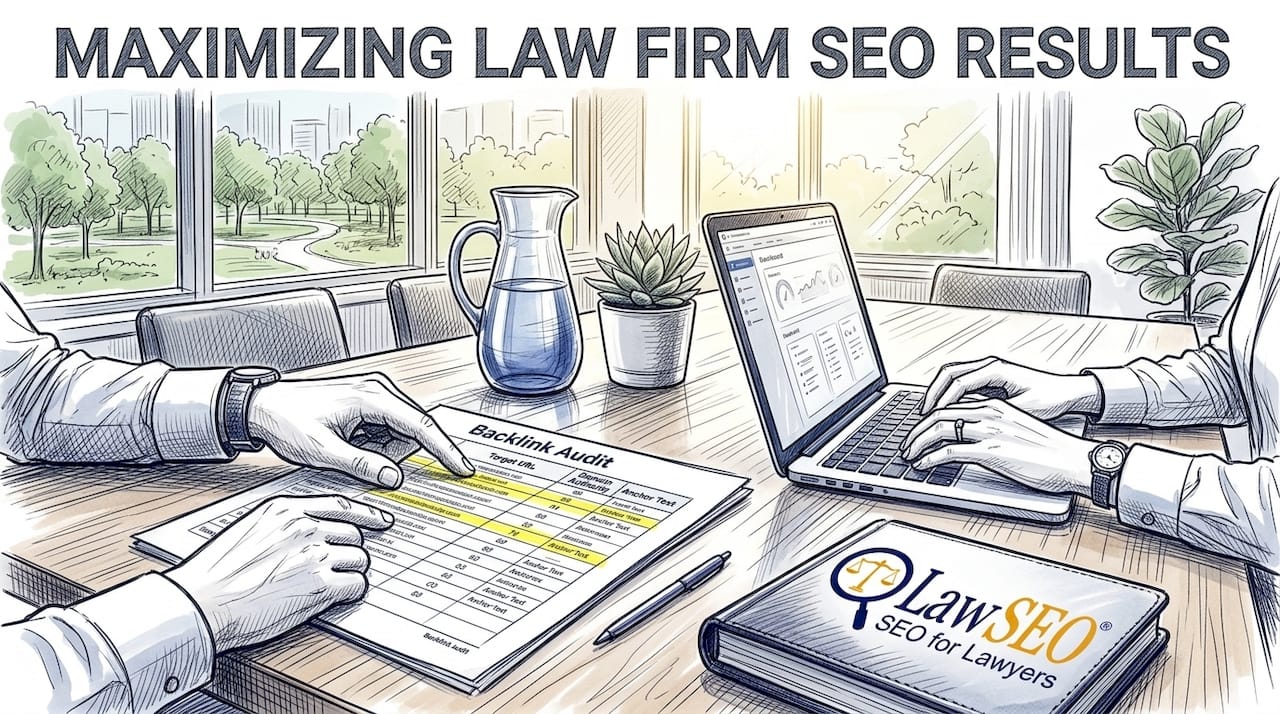
Conduct a thorough backlink audit at least twice a year. Export your full link profile, filter for low-authority and irrelevant domains, and use Google’s Disavow Tool for any links that represent clear spam or prior penalties. Avoid disavowing aggressively. Removing legitimate links by mistake does more damage than leaving a few marginal links in place.
Interpret organic traffic alongside backlink data. A sustained increase in referring domains should correlate with ranking improvements over a three-to-six month window. If it does not, the issue may be content quality, technical SEO, or a mismatch between the links you are earning and the queries you are targeting.
My perspective on backlinks after nearly three decades in SEO
I have watched backlink strategy cycle through hype, abuse, correction, and maturity more times than I can count. The practitioners who treated link building as a shortcut eventually paid for it. The ones who treated it as a long-term investment in editorial credibility kept compounding their gains.
What I have learned over 29 years working with legal and professional service clients is that the conversation almost always starts in the wrong place. People ask how many links they need. That is the wrong question. The right question is which sources in your market your target clients and Google both trust, and how you earn a genuine presence on those sources.
I have also watched AI search change the calculus in ways most people are underestimating. When a generative AI platform cites a source, it is not just driving traffic. It is conferring credibility in front of a potential client at the exact moment of high intent. Law firms that have built real topical authority through years of earned editorial backlinks are winning those citations disproportionately. Firms chasing volume with low-quality links are invisible to AI systems entirely.
The uncomfortable reality is that backlink building done properly looks a lot like brand building. It requires producing content worth citing, cultivating relationships with publishers, and accepting that the results compound slowly before they accelerate. There is no shortcut worth the risk in 2026. I have seen it derail firms that were otherwise doing everything else right, and I have seen patient, quality-focused link building improve Google rankings for law firms in ways that sustained for years without any additional maintenance.
— Todd
How Lawseo helps law firms build authoritative backlink profiles
Backlinks do not operate in isolation. They work alongside technical SEO, content quality, local optimization, and AI search readiness to determine how visible a law firm is to potential clients. Lawseo is built specifically for law firms, and link building is a core part of every strategy the firm executes. Todd R. Stager personally reviews every campaign with nearly three decades of legal SEO experience behind each recommendation. If you want to understand how a disciplined legal SEO strategy can put your firm in front of more qualified clients, Lawseo has the track record and the specialized focus to get it done. Explore what comprehensive law firm SEO looks like when it is built around real authority.
FAQ
What are backlinks and why do they matter for SEO?
Backlinks are links from external websites pointing to your site. Search engines treat them as votes of editorial confidence, and pages with more high-quality backlinks consistently rank higher in search results.
How do backlinks affect ranking in Google?
Pages in the first position average 3.8 times more backlinks than pages ranked below them. Backlinks signal authority and trustworthiness, two of the most heavily weighted factors in Google’s ranking algorithm.
What makes a backlink high quality vs. low quality?
A high-quality backlink comes from a trusted, topically relevant domain and appears in the body of substantive content. Low-quality backlinks originate from irrelevant sites, link networks, or automated placements and often trigger penalties.
Do nofollow links have any SEO value?
Nofollow links contribute to a natural link profile and Google now treats the attribute as a hint rather than a hard directive. A healthy backlink profile includes both dofollow and nofollow links, and an all-dofollow profile can itself look suspicious.
How do backlinks influence AI-powered search results?
AI search platforms select cited sources based on editorial credibility and topical authority. A strong backlink profile from respected industry sources increases the probability that generative AI tools will cite your content as a trusted reference.