

Law firm marketing / practical guide

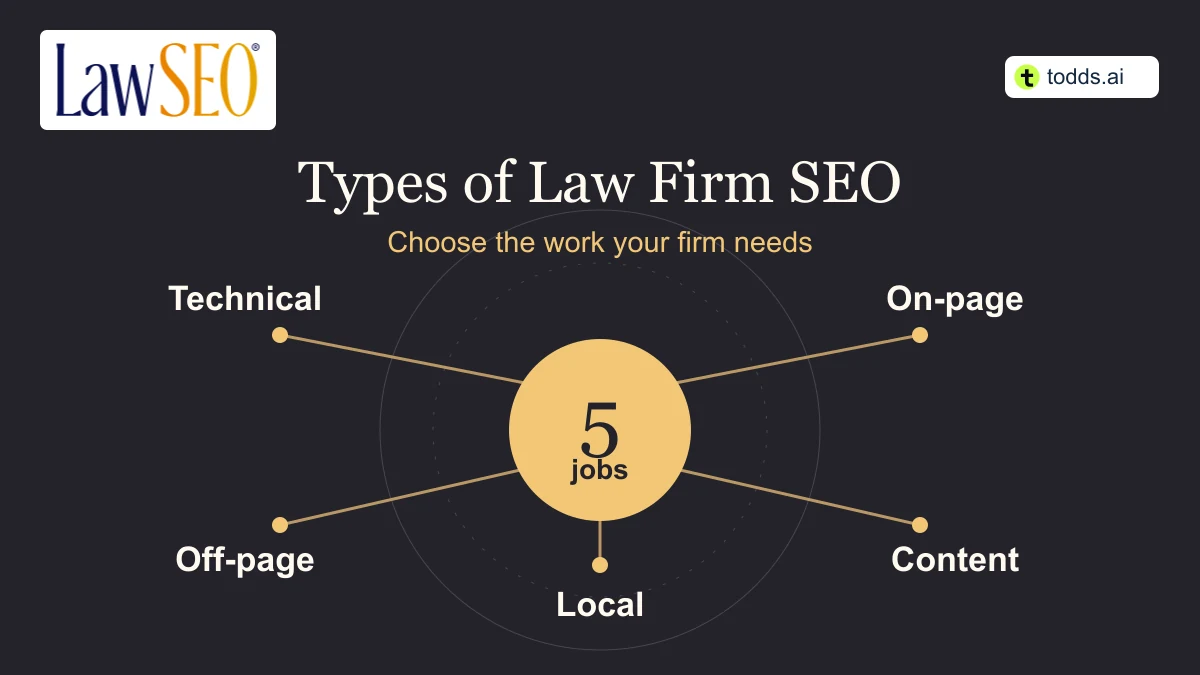
The main types of law firm SEO are technical SEO, on-page optimization, content, local SEO and off-page authority building. They overlap, but solve different problems: helping search engines access a page, explaining its purpose, answering a prospective client’s question, representing a real location and earning credible references. Choose the work by the problem you can verify.
A firm whose consultation form fails needs a different next step from a firm whose practice page is missing from search. A long list of deliverables can hide that distinction. Use the five categories below to assign a specific task, identify the person responsible and agree on evidence that the work is complete.
This is a practical grouping for managing work, not an official Google classification. Google’s SEO Starter Guide describes a connected set of practices for people and search engines. Buying five separately named services does not establish that any of those practices have been implemented.
Choose the work before choosing the package
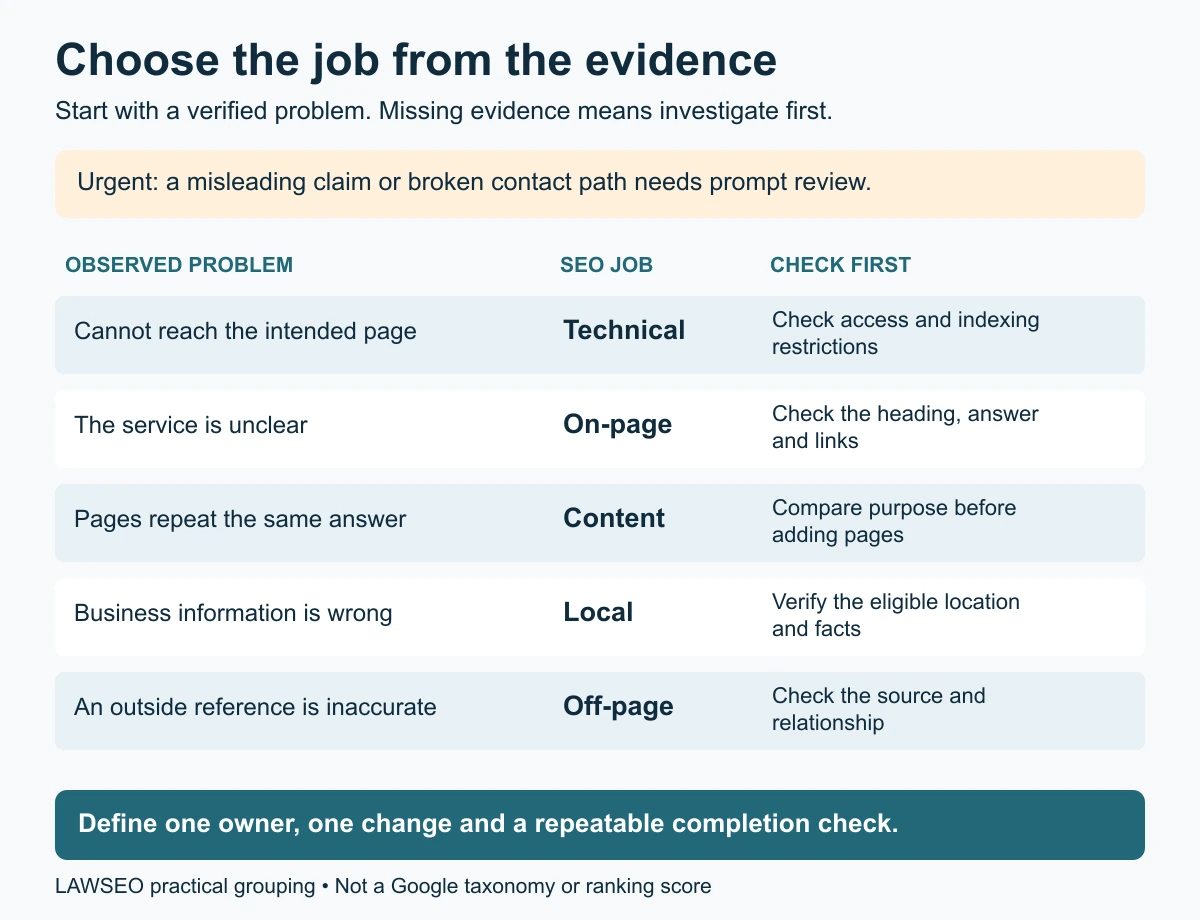
Start with one important practice page and the route a prospective client would take to contact the firm. Check the evidence in the middle column before assigning the work in the last. A symptom can have more than one cause; this table is a starting point for investigation. If the evidence is unavailable, assign a check first and mark the cause unknown. An unchecked item is not a confirmed defect.
| Observed problem | Check first | Likely work and proposed owner |
|---|---|---|
| A page cannot be found in Google | The exact URL’s indexing status, accessibility, canonical and exclusions | Technical investigation — SEO lead and developer |
| A visitor cannot tell which matters the firm handles | Visible heading, service explanation, location and contact route | On-page revision — editor and responsible attorney |
| Several articles answer the same question | Each page’s purpose, search queries and unique reader value | Content differentiation or consolidation proposal — content lead |
| A listing shows an incorrect address or hours | The actual eligible business location and owner-controlled profile | Local information correction — authorized profile manager |
| A relevant professional reference is inaccurate | The referring page, relationship and factual details | Off-page correction — marketing lead with appropriate approval |
A broken contact form sits beside this SEO work as a website and intake problem. Repairing it can be urgent even when rankings are unchanged. Our website design guide considers the visitor’s path through the site.
Why do some guides list seven types instead of five?
The categories depend on how the work is grouped. This guide includes reviews within local SEO and discusses AI visibility across the five jobs. Neither number is an official Google taxonomy.
1. Technical SEO: make the intended page accessible
Technical SEO concerns how a site can be reached and interpreted. For an important URL, ask the developer to show the HTTP response, crawl restrictions, indexing directives and chosen canonical. Also check whether the main content and contact controls work on a phone.
Google’s technical requirements include access for Googlebot, a successful HTTP response and indexable content. Meeting those conditions makes a page eligible; it does not guarantee that Google will include it. A successful browser visit alone does not prove that Googlebot receives the same response.
For a technical task, a useful completion record identifies the URL, the defect, the change and a repeatable check after release. “The audit score increased” is less informative than “the unintended noindex directive was removed and the live inspection no longer reports that restriction.” Keep intentional exclusions. Private client areas need appropriate access controls; a noindex directive is not a security control.
See the technical SEO guide for the broader scope. Do not turn every warning into a redesign project without verifying its effect.
2. On-page SEO: make one page’s purpose clear
On-page work improves the page a reader actually encounters: its title, main heading, explanation, navigation, images and links. A practice page should make it easy to understand what the firm handles, where it works and how to take the next step. It should not imply an office, credential or result that the firm cannot substantiate.
Before adding another city or service phrase, ask whether it improves the answer. Descriptive links help a reader reach related material; repeated phrases that make a paragraph awkward do not make it more useful. Google’s starter guidance favors useful, organized content and meaningful links over mechanical repetition.
Assign the editor a specific before-and-after task, such as clarifying which employment matters a page addresses. Have the responsible attorney verify practice facts. Compare the saved and rendered versions, including mobile, so a correct editor preview is not mistaken for a correct public page. The on-page SEO guide expands this page-level review.
3. Content SEO: answer a distinct reader question
Content work decides what deserves a page and what belongs within an existing one. A prospective client comparing services has a different task from someone researching a legal definition. The article, practice page or short answer should fit that task.
Before commissioning a new article, identify the closest existing page. Write one sentence explaining what the proposed page helps the reader do that the existing page does not. If that distinction is weak, improve the existing answer first. Our search intent guide provides a useful starting point.
A substantive refresh might correct an outdated rule, add a sourced explanation, replace an unhelpful example or supply a usable checklist. Merely changing a date or exchanging synonyms does not establish that the reader receives a better answer. Google describes scaled content abuse in terms of producing content primarily to manipulate rankings rather than help users. An existing URL does not exempt a weak revision from that concern.
Keep a claim-to-source record, an actual legal reviewer where legal interpretation requires one, and a clear publication history. The content marketing guide explores how a useful reader task becomes a content decision.
4. Local SEO: represent the actual firm and location
Local SEO covers the information people encounter when looking for a nearby firm, including the website, Business Profile and relevant business references. Begin with accurate contact details, practice information, hours and a location that qualifies under the platform’s rules.
Google says local results depend mainly on relevance, distance and prominence. Completing a profile does not eliminate distance or buy a better position. Compare observations for the same query and location rather than presenting one person’s search as the result every prospective client sees.
Reviews belong in this work, but collection must be genuine. Google’s review policies prohibit incentives, pressure about ratings and selectively asking for positive reviews. Use a neutral request for an honest account of a genuine experience; do not choose recipients because you expect praise. Have the firm review its request and response process for professional obligations and confidentiality; never publish private matter details merely to answer criticism.
The Business Profile guide addresses eligibility and account control. A local task is complete when the intended information is saved and verified, not simply when a request has been submitted to a platform.
5. Off-page SEO: earn and verify credible references
Off-page work considers how other sites identify and refer to the firm. Examples include a factual professional directory entry, an association reference or an editorial link to a resource worth citing. The useful question is why the reference exists and what a visitor can learn from it.
Check the referring page, its relevance and the nature of any commercial arrangement. Google’s link spam policy addresses links created primarily to manipulate rankings. Legitimate advertising and sponsorship links are allowed when qualified as Google describes, using rel="sponsored" or rel="nofollow". A purchased quantity of ranking links or an invented authority target is not a substitute for an accountable editorial plan.
For a real directory correction, retain the before-and-after business details and the live source URL. For proposed outreach, approve the recipient, claim and message before anyone sends it. Keep links earned, links proposed and links removed as separate outcomes. A reference does not prove that it caused a later traffic change.
Prioritize a verified problem, then reassess
Illustrative scenario, not a client result: a mobile inquiry form fails, two articles repeat one another and a directory lists an old address. With room for one website change this week, first ask the developer and intake owner to investigate the failed contact route. Test without confidential case information and verify receipt at the intended destination, not just a success message.
Prepare the content decision separately and route the address correction to the authorized profile manager. If the form works but messages enter an unmonitored inbox, the remedy and owner change. This prioritization follows the observed user problem; it does not predict a ranking gain.
A documented check of this page’s earlier advice
We tested the task brief against the version of this LawSEO article saved on October 31, 2026. Its review section advised firms to encourage satisfied clients to leave positive reviews. That is a content problem with a local-marketing consequence: Google’s current Maps policy prohibits selectively soliciting positive reviews.
| Task brief field | What the evidence supports |
|---|---|
| Problem | The earlier guidance selected happy clients and a favorable rating. |
| Evidence | Saved article text, compared with Google’s Fake Engagement and Rating Manipulation rules on November 1, 2026. |
| Proposed owner | Content editor for the article; authorized profile manager for any review-request process. |
| Change | Replace the selective advice with a neutral request for a genuine experience, without incentives or pressure about the rating. |
| Verification | Check every review-request recommendation in the revised article. Separately inspect any real request template before calling an operating process corrected. |
The finding did not require creating a new location page or buying more reviews. It required correcting advice. We did not inspect a law firm’s messages or measure a ranking effect, so this example establishes neither a real-world solicitation violation nor a performance gain. The Google Maps policy is the primary source for that decision.
Where do AI search, reputation and measurement fit?
AI visibility is an outcome to investigate across these disciplines, not evidence that the site needs a separate technical trick. Google states that its AI Overviews and AI Mode do not require special schema or additional technical requirements beyond its stated Search requirements. To appear as a supporting link in those features, a page must be indexed and eligible to show a snippet. Useful content, accessibility and accurate business information remain relevant; meeting the requirements does not guarantee selection. These Google-specific statements do not establish how every other AI service operates.
Keep an AI citation observation separate from an organic position, a Maps result and a client inquiry. Record the query, date and conditions when examining a result. Our AI Overviews guide explains why a screenshot needs that context.
Measurement also spans the five types. Google Search Console’s Performance report provides clicks, impressions, click-through rate and average position, with filters such as page, query, country and device. Those metrics are not signed clients. Pair appropriately scoped search reporting with verified inquiry and intake records, using the firm’s privacy controls.
A five-line task brief you can use
Download the two-page task brief and worked example (PDF)
The first page is blank for your own task; the second shows the documented review-policy check above. Use public page details and omit client or case information.
- Problem: Name one page, listing or user action and the observed issue.
- Evidence: Save the source, date, conditions and limits of the observation.
- Owner: Propose the person who can fix it and the reviewer needed.
- Change: Describe the smallest useful revision, including anything it depends on.
- Verification: Define the repeatable check, completion evidence and next review date.
Agree on the owner and due date rather than assuming a role in a report has accepted the assignment. Mark unresolved evidence as unknown. The brief is a management aid, not a proprietary Google score.
Questions firms ask about SEO types
Do we need all five types at once?
Review all five, then prioritize verified problems. The work can proceed at different speeds. A small firm may need a focused page correction and reliable intake measurement before a large publishing program.
Can more blog posts compensate for a technical problem?
Not necessarily. Investigate whether the affected page is accessible and eligible for indexing before treating content volume as the remedy. An indexed page with a weak answer presents a different problem.
Does requesting indexing finish a refresh?
No. Google’s recrawl guidance explains that a request does not guarantee inclusion or immediate processing. Keep live verification, request acceptance and subsequent indexing observations separate.
Which category owns attorney advertising compliance?
It crosses the work. Give the responsible attorney the claims, locations, credentials, testimonials and contact language that need review under the rules applicable to the firm. An SEO checklist is not that legal review.
Created with  todds.ai