


TL;DR:
- On-page SEO involves optimizing every controllable element of a web page, such as content, HTML tags, and internal links, to improve search engine understanding and ranking. For legal websites, establishing authority through author credentials and proper content structure is crucial, especially with AI-driven search increasingly prioritizing structured data and direct answers. Consistent, strategic on-page SEO practices, including schema markup and avoiding common mistakes like keyword stuffing, significantly enhance visibility and client acquisition in a competitive digital landscape.
If you’ve been told that on-page SEO is just about sprinkling keywords into your web pages, you’ve been misled. What is on-page SEO really? It’s the practice of optimizing every element you control on a given page, from content quality and heading structure to HTML tags, image attributes, and internal links, to help search engines understand and rank your content. For attorneys and legal marketing professionals, getting this right is not optional. With US digital ad spend hitting $294 billion in early 2026, organic search visibility has never been more valuable or more competitive.
Key Takeaways
| Point | Details |
|---|---|
| On-page SEO covers page-level elements | Content, title tags, headings, images, and internal links all fall within your direct control. |
| E-E-A-T matters most for legal sites | Author credentials and verifiable expertise now directly influence how Google ranks legal content. |
| AI search changes your structure | Hierarchical headings and concise answers improve your chances of appearing in AI-generated results. |
| Keyword stuffing still kills rankings | Natural language and semantic relevance outperform forced keyword repetition every time. |
| A checklist approach prevents errors | Auditing each page element systematically is more reliable than applying fixes reactively. |
What on-page SEO means for legal websites
On-page SEO covers all elements you control directly on a web page: the content itself, HTML tags, heading structure, internal links, and image attributes. This is distinct from off-page SEO, which involves external signals like backlinks, and technical SEO, which deals with site infrastructure. For a law firm, on-page SEO is what determines whether your personal injury practice area page ranks when someone searches “car accident lawyer in Chicago,” or whether it disappears below your competitors.
Content quality and legal E-E-A-T
Google’s framework for evaluating content quality is called E-E-A-T, which stands for Experience, Expertise, Authoritativeness, and Trustworthiness. E-E-A-T is a critical ranking factor for legal content because law falls under Google’s “Your Money or Your Life” category, meaning pages that could affect someone’s legal rights receive extra scrutiny. A practice area page written by an anonymous author with no credentials will consistently underperform against one with a named attorney bio, bar membership, and verifiable case experience.
Search intent drives modern on-page SEO more than keyword density. When someone types “what to do after a slip and fall accident,” they want immediate guidance, not a page that restates the phrase ten times. Your content must match the user’s stage in the decision process, whether they’re researching, evaluating, or ready to hire.
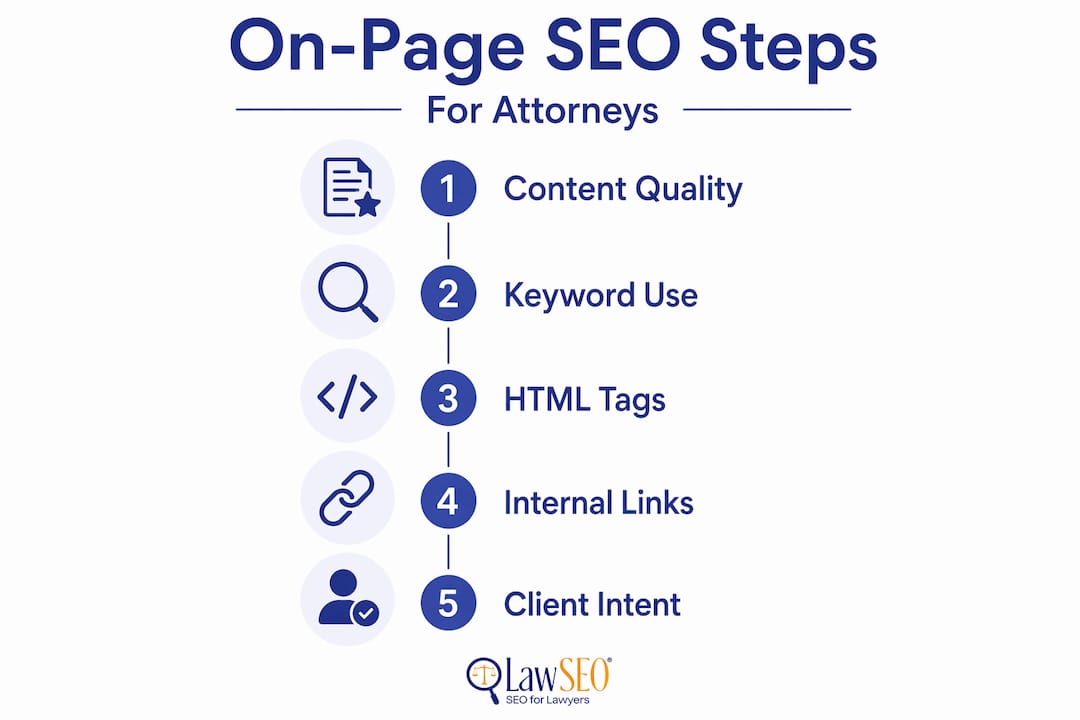
Core HTML elements to optimize
The following elements represent the non-negotiable foundation of any on-page SEO checklist for a legal website:
- Title tags: Keep title tags under 60 characters to prevent Google from truncating or rewriting them in search results. Your primary keyword and city should appear here naturally.
- Meta descriptions: Stay under 155 characters. While meta descriptions do not directly affect rankings, they influence click-through rates significantly, which does affect rankings indirectly.
- Header tags (H1 through H3): Use one H1 per page matching your primary keyword intent. H2s and H3s organize subtopics and make content readable for both users and crawlers.
- Image alt text: Descriptive alt text serves two purposes: it helps search engines understand your images and it supports accessibility compliance, which matters for legal websites.
- Internal links: Linking your practice area pages to related blog posts or resource pages builds topical authority and helps search engines understand your site’s structure.
Pro Tip: Create a dedicated bio page for each attorney on your site. Link to it from every article and practice area page that attorney wrote or reviewed. This single step reinforces E-E-A-T signals across your entire domain.
On-page SEO and AI-driven search results
The search results page in 2026 looks nothing like it did five years ago. Google’s AI Overviews now appear at the top of results for a wide range of queries. AI Overviews appear for roughly 30% of queries, which means a significant portion of your potential clients may never scroll past the AI-generated answer to reach your organic listing. The only way to compete is to become the source that AI pulls from.
Hierarchical headings improve AI crawlability and help AI systems extract structured answers from your pages. Here is how to structure your legal content for maximum visibility in both traditional and AI-driven search:
- Lead with a direct answer. Place the most concise, accurate answer to the searcher’s question within the first two sentences of each section. AI systems are built to extract this kind of clear, front-loaded information.
- Use a logical H1 to H3 hierarchy. Your H2 headings should represent major subtopics. H3s break those down further. A page titled “Premises Liability in Texas” should have H2s like “What qualifies as negligence” and “Steps to file a claim,” not vague headings like “More information.”
- Eliminate keyword stuffing completely. Natural language and semantic relevance now outperform forced keyword repetition. Write for the person asking the question, and the rankings follow.
- Add FAQ schema markup. Structuring your FAQ sections with proper schema tells search engines exactly where your Q&A content lives. For legal queries, this can generate rich results and improve your visibility in AI Overviews.
- Optimize for voice and agentic search. Clients increasingly ask legal questions to AI assistants and voice search tools. Content written in conversational, direct language performs better in these contexts than formal legal prose.
Pro Tip: When writing FAQ sections for legal pages, phrase questions exactly as a potential client would ask them, not as a lawyer would write them. “Can I sue my landlord for mold?” outperforms “Liability of lessor for habitability defects” every time in search.
For a deeper look at how AI-driven search affects content structure for law firms, the Lawseo AI optimization guide for 2026 provides a thorough breakdown of what has changed and what to do about it.
Common on-page SEO mistakes on legal sites
Even well-maintained legal websites make on-page SEO errors that quietly suppress their rankings. Recognizing these patterns is the first step toward correcting them.
- Keyword stuffing and repetitive anchor text. Forced keyword placement and repeated anchor text lead to penalties and ranking drops. If every internal link to your personal injury page uses the exact phrase “personal injury lawyer,” Google interprets this as manipulation. Vary your anchor text naturally.
- Mismatched title tags and H1 headings. Your title tag and your H1 should align thematically but not be word-for-word identical. A mismatch often causes Google to rewrite your title in search results, removing your carefully chosen keywords.
- Ignoring author credentials. The February 2026 Google core update increased the importance of verified author expertise for legal content. Pages without author attribution or bio links are increasingly disadvantaged against competitor pages that clearly establish who wrote the content and why that person is qualified.
- Neglecting mobile responsiveness and page speed. Google indexes the mobile version of your site first. A page that renders poorly on a smartphone or loads slowly will rank below a faster, mobile-friendly competitor page, regardless of content quality.
- Keyword cannibalization. When two pages on your site target the same keyword, they compete against each other in search results. For law firms with multiple city pages or practice area subpages, this is a frequent and damaging problem.
A practical on-page SEO checklist for attorneys
Applying best practices for on-page SEO consistently requires a structured process. The checklist below covers the core tasks attorneys and legal marketers should run through when optimizing or auditing any practice area page or blog post.
- Conduct keyword research aligned with legal search intent. Identify how your potential clients actually phrase their legal questions at each stage of the decision process. Tools like Google Search Console reveal which queries already bring people to your site.
- Craft a title tag under 60 characters that includes your primary keyword, practice area, and geographic market where relevant. Example: “Houston DWI Lawyer | Free Consultation.”
- Write a meta description under 155 characters that summarizes the page’s value and includes a clear reason to click. Do not waste this space on generic legal disclaimers.
- Implement a clear heading hierarchy from H1 down through H3, with natural keyword integration in at least two heading levels.
- Optimize all images with descriptive file names (not “IMG_4521.jpg”) and alt text that describes the image in plain language relevant to the page topic.
- Add internal links from new pages to established ones and from high-authority pages back to newer content that needs a ranking boost.
- Include schema markup for your law firm, individual attorneys, FAQs, and practice areas. This helps both traditional search engines and AI systems understand your content.
- Audit regularly. Use an SEO audit tool at least quarterly to catch duplicate content, broken links, and pages where performance has declined.
The table below compares two approaches to optimizing a practice area page, showing what separates a well-optimized page from a poorly optimized one.
| Page Element | Poorly Optimized | Well Optimized |
|---|---|---|
| Title tag | “Personal Injury Attorney Services” (32 characters, vague) | "Dallas Personal Injury Attorney |
| H1 heading | Same as title tag, word for word | Thematically aligned but not identical to title |
| Content focus | Keyword repeated throughout, no structure | Answers specific client questions with clear H2/H3 sections |
| Author attribution | None | Named attorney with bio link and bar credentials listed |
| Schema markup | None | LegalService, Attorney, and FAQ schema implemented |
| Internal links | Zero | Links to related practice pages and blog resources |
This kind of page-by-page comparison is exactly what a professional SEO audit for attorneys surfaces. Without it, you’re guessing about what is suppressing your rankings.
My perspective on on-page SEO for law firms in 2026
I’ve spent nearly three decades doing SEO, and I want to be direct about something: most law firm websites still treat on-page SEO like it’s 2015. They load up practice area pages with keyword repetitions, skip author credentials entirely, and then wonder why a smaller firm with a better-structured site is outranking them.
The single most underutilized on-page SEO technique I see in the legal sector is proper E-E-A-T implementation. Author E-E-A-T now heavily influences legal webpage rankings, and I’ve watched firms climb significantly in search results after doing nothing more than adding verified attorney bios with credentials and linking those bios to the pages each attorney contributed to. That’s not a technical overhaul. It’s a content structure decision that costs almost nothing.
The other thing I’d push back on is the idea that technical SEO has somehow replaced on-page fundamentals. Technical SEO matters. But if your content doesn’t answer what the searcher is actually asking, no amount of schema or Core Web Vitals optimization will compensate for that gap. Get the on-page fundamentals right first. Then layer the technical improvements on top of a solid content foundation.
— TODD
How Lawseo helps attorneys get on-page SEO right
Understanding the principles of on-page SEO is one thing. Executing them consistently across dozens of practice area pages, city landing pages, and blog posts is another challenge entirely. Lawseo works exclusively with law firms and attorneys, which means every recommendation is grounded in legal industry context, not generic SEO advice borrowed from e-commerce or SaaS playbooks.
The team at Lawseo handles everything from initial legal SEO strategy to full on-page audits, content optimization, and schema implementation tailored to your specific practice areas and markets. If you want to see exactly where your current website stands, an attorney SEO audit is the fastest way to identify what’s holding your rankings back and what to prioritize first. Higher rankings, more targeted traffic, and more qualified client inquiries are all achievable outcomes when on-page SEO is done properly and maintained consistently.
FAQ
What is on-page SEO in simple terms?
On-page SEO is the practice of optimizing the content and HTML elements of a single web page so search engines can understand it and rank it appropriately. It includes title tags, headings, content quality, internal links, and image attributes.
How does on-page SEO differ from off-page SEO?
On-page SEO involves elements you control directly on your website, such as content and tags. Off-page SEO refers to external factors like backlinks and online mentions that signal authority to search engines.
Why does E-E-A-T matter for law firm websites?
Google categorizes legal content as high-stakes information, meaning it applies stricter quality standards. Pages with verified author credentials and clear expertise signals consistently rank higher than anonymous content.
How often should attorneys update their on-page SEO?
A quarterly audit is a reasonable baseline, but pages tied to time-sensitive legal topics or recent case law changes should be reviewed more frequently. Content freshness is a recognized ranking signal for legal pages.
What is the most common on-page SEO mistake on legal websites?
Keyword stuffing and missing author attribution are the two most damaging and most common errors on legal websites. Both can be corrected quickly and often produce measurable ranking improvements within weeks of being fixed.