


TL;DR:
- Legal SEO copywriting for law firms requires credible, comprehensive content that satisfies Google’s high standards for high-stakes legal topics. Thin, keyword-stuffed pages and anonymous authorship undermine rankings and trust, emphasizing the importance of specialized, attorney-reviewed content. Focusing on quality, authority, and strategic internal linking enhances visibility and client conversion potential.
Keyword stuffing was never a strategy. It was a shortcut, and Google closed that door years ago. Yet many law firm websites still rely on thin, repetitive content that fails to rank, fails to convert, and actively erodes client trust. SEO copywriting for law firms is something more disciplined: the craft of writing content that satisfies both search engine algorithms and the human beings searching for legal help. Get it right, and your firm becomes the answer people find. Get it wrong, and your competitors do.
Key Takeaways
| Point | Details |
|---|---|
| SEO copywriting defined | It combines persuasive writing with search optimization to turn web traffic into clients for your law firm. |
| High standards for law | Legal content must be comprehensive, clear, and credibly authored to rank highly and inspire trust. |
| Pitfalls to avoid | Thin, keyword-stuffed, or anonymous pages harm visibility—focus on depth and real expertise. |
| Practical elements | Author bios, clear explanations, and internal links are crucial for legal SEO success. |
| Quality over quantity | Producing fewer, in-depth pages supports both rankings and your law firm’s reputation. |
What is SEO copywriting?
SEO copywriting sits at the intersection of persuasive writing and search engine optimization. The goal is to create content that earns high rankings in search results while also engaging readers well enough to convert them into clients. For law firms, this is not optional polish. It is a foundational marketing function.
Google classifies legal content under a category called YMYL, which stands for “Your Money or Your Life.” This designation applies to any topic that could significantly affect a reader’s financial situation, health, safety, or legal standing. Because the stakes are so high, Google’s quality raters evaluate legal pages with extra scrutiny. Legal queries are high-stakes and demand comprehensive, credibly authored content. A generic blog post from an unnamed writer simply will not perform in this environment.
The most common pitfalls law firms fall into include thin content (pages with too few words or too little useful information), keyword stuffing (forcing target terms into unnatural sentence constructions), and anonymous authorship (content with no identified attorney or credentialed writer). Each of these signals to Google that the page may not be trustworthy enough to surface for a user with a real legal problem.
Understanding content for law firm SEO starts with recognizing that the writer matters as much as the words. SEO copywriting for legal websites requires a specific skill set:
- Legal literacy: The writer must understand practice area terminology and common legal concepts well enough to write accurately without misleading readers.
- SEO expertise: Keyword research, on-page optimization, internal linking, and metadata are all in scope.
- Plain language skills: Legal concepts must be translated for the average person without being oversimplified or inaccurate.
- Audience empathy: Readers searching for a personal injury attorney or a divorce lawyer are often under stress. The tone and structure of the copy must reflect that.
- Compliance awareness: Bar association rules around attorney advertising vary by state. Good legal SEO copywriters know where the lines are.
Here is how SEO copywriting for law firms compares to traditional copywriting:
| Factor | Traditional copywriting | SEO copywriting for law firms |
|---|---|---|
| Primary focus | Brand voice and persuasion | Search visibility plus persuasion |
| Audience | Broad consumer base | People searching for specific legal help |
| Key metric | Engagement and conversions | Organic rankings, traffic, and conversions |
| Authorship requirement | Optional | Critical for YMYL compliance |
| Content length | Often short and punchy | Usually long-form and comprehensive |
| Keyword strategy | Minimal | Intentional and research-driven |
The distinction matters because a law firm that treats its website copy like a billboard is leaving significant organic traffic and client acquisition potential on the table.
Why great SEO copywriting matters for law firms
Understanding what SEO copywriting is, let’s examine why it is so pivotal for attracting clients and maintaining trust in the legal field.
Google does not treat a personal injury law page the same way it treats a restaurant review. The algorithm applies stricter quality signals to legal content because bad information in this category can cause real harm to real people. Anonymous or poorly researched content on a law firm site will struggle regardless of how many backlinks point to it.
“Publishing thin or not credibly authored content undermines rankings for high-stakes legal queries.”
The consequences of poor SEO copywriting compound quickly. Here is how the damage unfolds:
- Lower search visibility. Pages without clear authority signals get pushed down in rankings, often below competitors who have invested in quality content.
- Lost credibility with prospective clients. Readers who encounter vague, poorly written content associate that quality with the firm itself.
- Reduced conversions. Even when users do land on a weak page, they are unlikely to complete a contact form or call if the content did not answer their question or build trust.
- Potential non-compliance issues. Content that makes unsubstantiated claims or omits required disclaimers can create bar association problems in addition to SEO penalties.
Understanding why SEO matters for lawyers also requires looking at the full client journey. Research shows that how intake impacts Google ranking is more connected to content quality than most firms realize. Google increasingly uses behavioral signals, such as whether users stay on your page or immediately return to search results, to assess content value.

Consider a real-world scenario: a personal injury firm publishes a series of short, generic blog posts with titles like “Car Accident FAQ” and “What to Do After an Accident.” The posts are 300 words each, written by an unnamed staff member, with no attorney review noted. Traffic to those posts stays flat for months. A competing firm publishes one 1,500-word guide, authored by a named partner, covering the same topic with specific state law references, a FAQ section, internal links to relevant practice pages, and a clear call to action. That second page earns rankings for multiple keyword variations and generates consistent inbound calls.
Pro Tip: Add attorney bios that link directly to your practice area pages. This single step strengthens the author credibility signal Google uses to evaluate YMYL content, and it gives readers a direct path to retain your firm.
Core elements of effective legal SEO copywriting
Having seen the stakes, here is how you can architect legal content that ranks and converts.
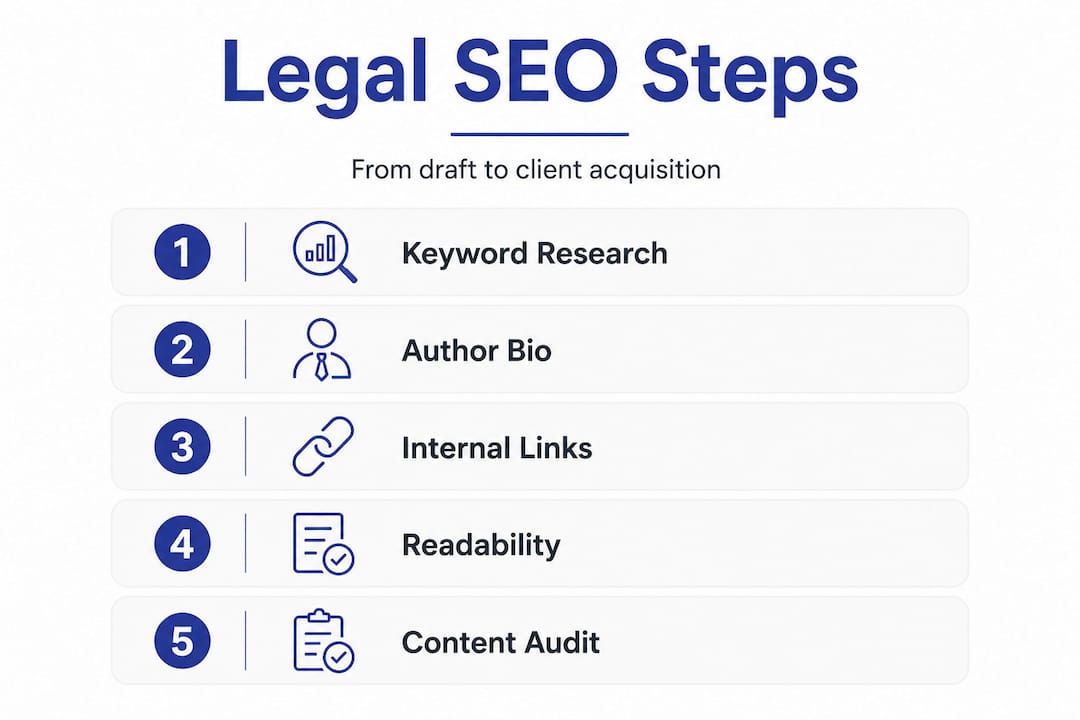
Effective legal SEO copywriting is not about writing more. It is about writing the right things in the right way. Comprehensive topic coverage and precise legal terminology explained for lay readers are required for high rankings. That requires a structured approach to every piece of content you publish.
Here is how to explain complex legal terms without misleading or overwhelming your audience:
- Define the term first, then contextualize it. Example: “Negligence, which means a failure to act with reasonable care, is the central element in most personal injury claims.”
- Use analogies sparingly but effectively. Comparing a breach of contract to a broken promise works well for non-legal readers.
- Avoid Latin phrases without immediate explanation. “Res ipsa loquitur” means nothing to most prospective clients. Say “the negligence is obvious from the facts” and follow it with the Latin only if your audience needs it.
- State what the term means for the reader’s situation. Do not just define; tell them why it matters to their case.
- Link to a glossary or explanatory page. This keeps the main page clean while providing depth for readers who want more.
Explore on-page SEO tips for lawyers to see how keyword placement, title tags, and header structures interact with copy quality. You should also review legal content ideas if you need fresh angles for practice area pages.
| Element | Good legal SEO copywriting | Poor legal SEO copywriting |
|---|---|---|
| Author bio | Named attorney with credentials and photo | No authorship listed |
| Structure | Clear H2/H3 headers, logical flow | Wall of text with no visual breaks |
| Internal links | Links to related practice areas and blog content | Isolated page with no contextual links |
| Topic coverage | Covers all user questions thoroughly | Answers only the surface question |
| Legal terminology | Defined and contextualized | Used without explanation |
| Call to action | Specific, practice-relevant, visible | Generic or absent |
Pro Tip: Internal linking is one of the most underused SEO levers for law firms. Linking from a blog post about slip and fall accidents to your premises liability practice page tells Google both pages are topically related, and it guides readers directly toward hiring you.
Common mistakes and how to avoid them
Mastering the basics means also knowing what to leave out or fix. Here are the most common missteps in legal SEO copywriting.
Thin, keyword-stuffed pages particularly undermine legal SEO, but they are far from the only problem. Here are the mistakes that most consistently damage law firm content performance:
- Publishing thin content. Pages under 600 words rarely provide enough context to satisfy a searcher or signal expertise to Google. Comprehensive legal content typically runs 1,000 to 2,000 words for competitive practice area pages.
- Over-optimizing for keywords. Inserting your target phrase 20 times in a 500-word post does not increase relevance. It reads awkwardly and Google’s natural language processing detects the manipulation.
- Ignoring reader comprehension. Content written at a law review level will drive prospective clients away. Most legal searchers are not attorneys. Write for the person who just got injured or just received divorce papers.
- Missing or inadequate author bios. Google evaluates expertise, authoritativeness, and trustworthiness, collectively referred to as E-E-A-T, and anonymous content signals low trust.
- No calls to action. Even perfectly written content fails if there is no clear instruction to the reader about what to do next.
- Outdated information. Laws change. A page that accurately described the statute of limitations three years ago may now be actively misleading clients.
Reviewing legal SEO best practices can give you a structured framework for auditing your existing content against these standards.
Pro Tip: Use a free readability tool such as Hemingway Editor or Readable to score your legal content. Aim for a reading level between grades 8 and 10. If sentences are flagged as very hard to read, break them apart or substitute plain language equivalents.
Here is a brief rewrite scenario. A family law firm published this sentence: “The dissolution of marriage proceedings involves equitable distribution of marital assets pursuant to applicable jurisdictional statutes.” The rewritten version: “In a divorce, the court divides marital property fairly according to your state’s laws.” Same legal accuracy, far better readability, and far more useful to someone searching for guidance at 10 p.m. after a difficult conversation with their spouse.
What successful legal SEO copywriting looks like in practice
With pitfalls identified, here is what good looks like: practical examples you can use as models.
Attorney bios linked to practice areas reinforce credibility and support better rankings. That single structural choice, placing an identified attorney’s bio at the bottom of each practice page, has measurable impact on both user trust and search performance.
Consider a mid-sized immigration law firm. They redesigned their H1B visa practice page with the following elements:
- A named partner’s bio with credentials, a professional photo, and a link to her full attorney profile
- A 1,400-word page covering the H1B process step by step, written in plain English
- A FAQ section addressing the 10 most common questions the firm receives
- Internal links to related pages covering green card applications and employer sponsorship
- A clear call to action: “Schedule a free consultation with [attorney name] today.”
- A reference to relevant USCIS rules with an explanation of what they mean for the applicant
That page now ranks in the top three positions for multiple H1B-related queries in their metro area and drives a measurable share of their monthly intakes. The transformation was not about more pages. It was about one well-constructed page.
The components of best-in-class legal SEO content consistently include:
- Credible, named authorship with credentials visible above or below the content
- Clean visual structure with headers, bullet points, and white space that aids skimmability
- Internal links connecting the page to related practice areas, attorney profiles, and relevant blog content
- Plain language explanations of all legal terms used
- A FAQ section targeting common search queries and voice search patterns
- Location-specific language for local SEO where appropriate
- A strong, specific call to action that reflects the reader’s likely situation
For legal marketing lead generation strategies that go beyond content alone, the structural decisions you make on every page are the foundation everything else is built on. Content strategy and conversion strategy are not separate disciplines in legal SEO. They operate together. See how content’s role in law firm SEO extends across every marketing channel your firm uses.
What most legal SEO advice gets wrong (and how to do better)
The prevailing advice in legal content marketing often reduces to a single directive: publish more. More blog posts, more practice area pages, more news updates. Volume becomes the proxy for performance. This is a serious misreading of how Google actually evaluates legal content.
Comprehensive, expert-written content always outperforms low-value, generic copy, regardless of how many pages a firm produces. We have seen law firms with 400-page websites routinely outranked by competitors with fewer than 50 pages, simply because those 50 pages were authoritative, well-structured, and credibly attributed.
The deeper issue is that thin content creates a credibility deficit that is hard to reverse. Google’s quality evaluators look at a site holistically. If 300 of your 400 pages are underdeveloped, they pull down the perceived quality of the entire domain, even your strongest pages.
The more strategically sound approach is to invest deeply in fewer, more authoritative pages. That might mean spending three days developing a flagship personal injury guide instead of publishing five lightweight posts. It means commissioning attorney-reviewed content rather than relying on generalist writers who lack legal literacy. It means treating each practice area page as the most important page on your site for that topic.
Law firms that have adopted this philosophy tend to see more durable rankings. The reason is straightforward: a single, well-researched, attorney-authored page is far more difficult for a competitor to replicate than 20 thin posts. It becomes a genuine asset.
Pro Tip: Audit your existing content for low-quality pages before publishing new ones. Consolidating or upgrading five weak pages into two strong ones often yields better ranking improvements than adding more weak pages to the mix.
Explore advanced SEO strategy for lawyers to understand how content quality interacts with technical SEO, backlink authority, and local search performance at the campaign level.
Next steps: Supercharge your firm’s SEO copywriting
Armed with knowledge and best practices, here is how you can take action for your law firm.
If you are serious about growing your practice through search, the next step is a structured content audit paired with a clear strategy. At LawSEO.com, we work exclusively with law firms to build content strategies grounded in the specific demands of legal search. That means attorney-reviewed content plans, credible authorship frameworks, and advanced law firm SEO strategies designed to generate consistent, qualified leads. Whether you need a full content overhaul, targeted practice area pages, or an ongoing SEO program, a professional audit of your current site is the right place to start. Your content should be your hardest-working asset. We can help make it exactly that.
Frequently asked questions
What makes SEO copywriting different for law firms?
SEO copywriting for law firms must be more comprehensive, credible, and compliant due to Google’s higher standards for legal content. Legal queries are high-stakes and demand content that demonstrates clear expertise and trustworthy authorship.
How often should law firms update their SEO copywriting?
Auditing and updating legal content quarterly helps maintain rankings and address search trends or changes in the law. Even evergreen practice area pages should be reviewed at least twice a year for accuracy and SEO performance.
Are attorney bios really necessary for SEO?
Attorney bios enhance content credibility, signaling expertise and trust to Google and to potential clients. Attorney bios linked to practice areas reinforce credibility and are a recognized factor in Google’s E-E-A-T evaluation for YMYL content.
What should law firms avoid in their website copy?
Avoid thin, keyword-stuffed, or generic pages because these harm rankings and erode client trust. Publishing or optimizing thin content is one of the most consistently damaging practices in legal SEO.