


Sign an exclusivity agreement with an SEO or marketing agency — but only with three non-negotiable contract safeguards in place first.
Before you countersign anything, confirm these items are in writing:
- Scope is precise. The agreement names specific counties or metros, specific practice areas, and every service covered (SEO, PPC, content, Google Business Profile).
- You own all assets. Domain, CMS admin credentials, Google Business Profile, Search Console, GA4, and all content transfer to your firm at termination, no conditions attached.
- Exit rights are milestone-based. You can terminate without penalty if defined performance benchmarks are not met by month three or four of the engagement.
Pro Tip: Negotiate exclusivity during the proposal stage, not after you’ve already signed a master services agreement. Your leverage drops sharply once the agency has your retainer.
Key Takeaways
Exclusivity agreements deliver real competitive advantages for law firms, but only when the contract includes precise scope language, guaranteed asset ownership, and milestone-based exit rights.
| Point | Details |
|---|---|
| Sign with safeguards | Require scope precision, asset ownership, and milestone exit rights before countersigning any exclusivity agreement. |
| Exclusive leads convert better | Exclusive lead delivery eliminates prospect fatigue from shared-lead models and supports faster, higher-quality intake conversations. |
| Asset ownership is non-negotiable | Insist that domain, GBP, Search Console, GA4, and all content transfer to your firm unconditionally at termination. |
| Review at 3 or 4 months and 6 months | Measure ranking movement at 3 or 4 months and cost-per-acquired-client at 6 months to determine whether exclusivity is paying off. |
| Lawseo builds in these protections | Lawseo’s exclusive SEO programs include founder-reviewed strategy, full asset return at termination, and monthly KPI reporting for U.S. law firms. |
Why exclusivity matters in marketing for law firms
In the legal marketing context, an exclusivity agreement is a contractual promise from your agency that it will not simultaneously represent a competing firm in your defined market. That promise is the core of why exclusivity matters in marketing: your agency’s resources, strategy, and competitive intelligence work only for you, not against you.
The scope of that promise varies widely. Common dimensions include:
- Geography: A defined radius, county, metro area, or state.
- Practice area: Personal injury, family law, criminal defense, or any other subject-matter carve-out.
- Service type: SEO, pay-per-click, lead generation, content production, or link building — each can be exclusive or non-exclusive independently.
- Channel ownership: Who controls the Google Business Profile, backlink profile, and content calendar.
Common exclusivity models range from full-market exclusivity (the agency drops all competing firms in your state) to regional exclusivity (one firm per metro), subject-matter exclusivity (one personal injury firm per county), and time-limited exclusivity (exclusive for 12 months, then renegotiated).
How exclusivity benefits your firm strategically and operationally
The clearest benefit is lead quality. Exclusive lead programs deliver each prospect to one firm only, which shifts intake conversations away from “who answers first” toward higher-quality consultations and better case acceptance rates. Shared-lead models, by contrast, routinely distribute the same prospect to five or more attorneys simultaneously, creating price competition and prospect fatigue that erode conversion.
Speed compounds that advantage. Exclusive real-time delivery helps your intake team hit that critical response window before a prospect moves on.
Additional operational benefits include:
- Predictable monthly volume for staffing and intake planning.
- Dedicated agency resources rather than shared account teams split across competing clients.
- Conflict-free strategy: The agency’s keyword research, content, and link-building work for your rankings, not a competitor’s.
- Precise targeting by jurisdiction and case type, so your budget reaches only the counties and matter types you actually want. Explore law firm marketing strategies that pair well with an exclusive arrangement.
Pro Tip: Ask the agency to show you a current client roster for your metro and practice area before signing. If they hedge, that hesitation is your answer.
Risks, trade-offs, and legal considerations before you sign
Exclusivity costs more. Agencies charge a premium because they forgo other local clients, and that premium can be substantial in competitive markets. The financial risk is real if performance lags.
Key risks to evaluate:
- Lock-in with no results: If the agency underdelivers but holds exclusivity, you are blocked from competitors while your rankings stagnate.
- Asset ownership gaps: SEO contracts sometimes include language where the agency retains control of the website, content, or GBP. Losing access to your own digital assets at termination is a serious operational risk.
- Ethics and bar compliance: Outsourcing marketing to a third party does not transfer your professional responsibility obligations. Confirm the agency understands attorney advertising rules in your state and discloses any subcontractors handling your content.
- Confidentiality: The agency will have access to client intake data, matter types, and revenue figures. Require a confidentiality clause that survives termination.
A study of SEO contracts for law firms found that clear scopes, performance metrics, monthly reporting, and confidentiality clauses reduce disputes significantly, and that experts broadly favor short initial terms to build trust before committing to longer engagements.
Contract clauses to require, negotiate, or refuse
A well-drafted exclusivity agreement protects your firm on every dimension the agency touches. Require these clauses:
- Scope definition: Named counties or metros, named practice areas, and an explicit list of covered services. Ambiguity favors the agency.
- Deliverables and KPIs: Monthly outputs (content pieces, links, GBP updates), lead definitions, measurable SLAs, and a reporting cadence of at least monthly.
- Ownership and access: Domain, CMS admin, all content, GBP, Search Console, and GA4 transfer to your firm at termination, unconditionally.
- Term and exit rights: A 6–12 month initial term is standard in legal SEO, but negotiate milestone-based exit rights after month three or four so you are not trapped if results stall.
- Performance remedies: Define a cure period (30–60 days), remediation steps, and termination rights for non-performance.
- Confidentiality and subcontractor disclosure: Require written notice before any subcontractor accesses your data or produces content under your brand.
- Fee structure: Specify the exclusivity premium, minimum monthly spend, and financial consequences if the agency violates exclusivity by onboarding a competing firm.
Numbered negotiation steps to follow:
- Request a redlined draft, not just a summary of terms.
- Propose narrow geographic carve-outs if full-market exclusivity is priced beyond your budget. Agencies and clients can negotiate minimum spend offsets or limited duration as compromise options.
- Insert a milestone-based exit clause with specific ranking or lead-volume benchmarks.
- Add a data-return clause requiring all logins and analytics access within five business days of termination.
- Require monthly written performance reports tied to the KPIs in the contract.
How exclusivity changes pricing, resource allocation, and ROI
Exclusivity commands a premium because the agency sacrifices revenue from other local firms. That premium typically reflects the opportunity cost of refusing competing clients in your market.
What you get in return:
- A dedicated account team rather than a shared pool.
- Prioritized campaign execution when algorithm updates or competitor moves require fast response.
- Conflict-free keyword and content strategy.
ROI benchmarks to set before signing:
| Milestone | What to measure |
|---|---|
| 3 or 4 months | Baseline ranking movement on target keywords; GBP impression growth |
| 6 months | Qualified lead volume vs. pre-contract baseline; cost per acquired client |
| 12 months | Total retainer spend vs. new client revenue attributable to the channel |
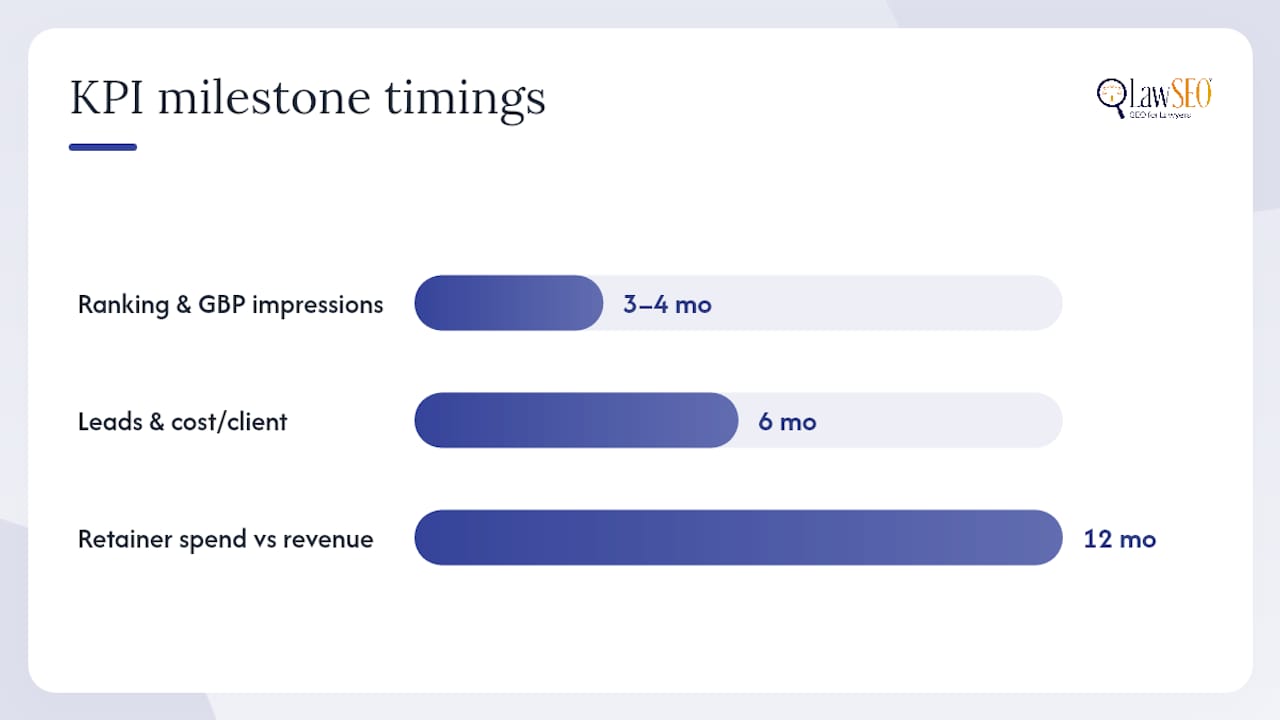
A higher per-lead cost under an exclusive model is often offset by a lower cost-per-acquired-client, because exclusive leads convert at materially higher rates than shared leads. The payback window depends on your average case value, but most firms in competitive practice areas see meaningful ROI signals by month six if the agency is performing.
When to accept exclusivity, when to negotiate, and when to walk away
Use this framework before signing:
Sign if:
- The agency has a documented track record in your practice area and metro.
- Asset ownership is guaranteed in writing.
- Milestone-based exit rights are in the contract.
- The exclusivity scope matches your actual competitive footprint.
Negotiate limits if:
- The required spend is high but deliverables are vague.
- The agency cannot show legal-sector case studies for your market.
- Ownership of GBP or content is unclear or conditional.
Walk away if:
- The agency retains your domain, GBP, or content at termination.
- There is no cure period or exit right for non-performance.
- The agency cannot confirm it will disclose subcontractors.
- Confidentiality protections are absent or weak.
Recommended decision flow: Quick vet (client roster, case studies, references) → contract red-flag review (ownership, exit, scope) → short trial period with milestone exit → final approval.
How Lawseo and Todd R. Stager approach exclusivity for U.S. law firms
Todd R. Stager, founder of Lawseo with over 29 years of SEO experience, personally reviews strategy for every client campaign. That founder-reviewed model is not a marketing claim; it is the operational standard that governs how Lawseo structures exclusivity.
Lawseo’s standard exclusivity model includes:
- Geographic and practice-area exclusivity defined at the county and metro level.
- Full asset ownership returned to the client at termination: CMS, GBP, Search Console, GA4, and all content.
- Monthly performance reporting tied to agreed KPIs, including ranking movement, lead volume, and cost per acquired client.
- AI optimization as a core deliverable, positioning client content for generative search platforms alongside traditional Google rankings.
Lawseo’s local SEO case studies document ranking and lead-volume outcomes for law firms in competitive markets. For firms that want to verify performance before committing to a full exclusivity term, Lawseo offers a pre-contract SEO audit that maps your current competitive position and identifies the specific gaps the exclusive engagement would address.
How exclusivity in marketing evolved historically
Exclusivity as a formal marketing concept predates digital advertising by decades. Broadcast media — radio and television — routinely sold category exclusivity to advertisers, guaranteeing that a car dealer’s spot would not run back-to-back with a direct competitor’s. Print publications offered similar arrangements to major advertisers in the same product category.
The practice migrated into agency-client relationships as retainer-based advertising agencies grew through the mid-twentieth century. Large holding companies developed conflict-of-interest policies that prevented sister agencies from representing competing brands. By the time digital marketing matured in the early 2000s, exclusivity had become a standard negotiating point in agency master services agreements, particularly for high-value, geographically bounded clients like law firms, medical practices, and financial advisors.
How exclusivity shapes client perception and decision-making
Exclusivity signals commitment. When a firm knows its agency cannot simultaneously advise a competitor, the relationship carries a different weight: the agency’s success is tied directly to the firm’s success, not distributed across a portfolio of competing clients.
For prospective clients of the law firm, the downstream effect is subtler but real. A firm that receives exclusive leads and exclusive marketing attention tends to respond faster, present more consistently, and convert at higher rates. That consistency shapes the client’s first impression of the firm’s professionalism before a single consultation occurs.
The psychological mechanism at work is straightforward: scarcity of access increases perceived value. An agency that works with every personal injury firm in a metro is, by definition, a commodity vendor. One that works with only yours is a strategic partner. That distinction affects how the agency allocates its best talent, its most current research, and its fastest response time.
Exclusivity in practice: what it looks like across industries
Law firms are not the only category where exclusivity agreements have produced measurable outcomes. Financial advisory practices use geographic exclusivity with digital marketing agencies to protect their referral networks. Medical specialty groups negotiate practice-area exclusivity with healthcare SEO providers to avoid competing for the same orthopedic or cardiology keywords within a hospital market.
In each case, the pattern is consistent: the exclusive client receives prioritized resources, conflict-free strategy, and a vendor whose incentives align with the client’s growth rather than with a broader book of competing business. For law firms, the stakes are particularly high because legal marketing is zero-sum at the local level. A personal injury firm ranking first for “car accident attorney Chicago” directly displaces every other firm below it. An agency that serves multiple firms in that market cannot optimize aggressively for all of them simultaneously.
Exclusive vs. non-exclusive agency arrangements: a direct comparison
Non-exclusive arrangements cost less upfront and offer flexibility. You can work with multiple agencies simultaneously, test different approaches, and switch vendors without a penalty period. The trade-off is that your agency has no contractual reason to prioritize your campaigns over a competing firm’s, and your competitive intelligence is shared across its client base.
Exclusive arrangements cost more and require stronger contract discipline. In exchange, you get dedicated resources, conflict-free strategy, and an agency whose revenue depends on your results. For firms in competitive practice areas and metros, that alignment is often worth the premium. For solo practitioners in low-competition markets, a non-exclusive arrangement with a strong content strategy may deliver comparable results at lower cost. Review types of legal marketing to assess which channels warrant exclusivity and which do not.
The decision is not binary. You can negotiate exclusivity for SEO and PPC while leaving content production or social media on a non-exclusive basis, reducing cost while protecting the highest-value channels.
How to manage and renegotiate exclusivity agreements over time
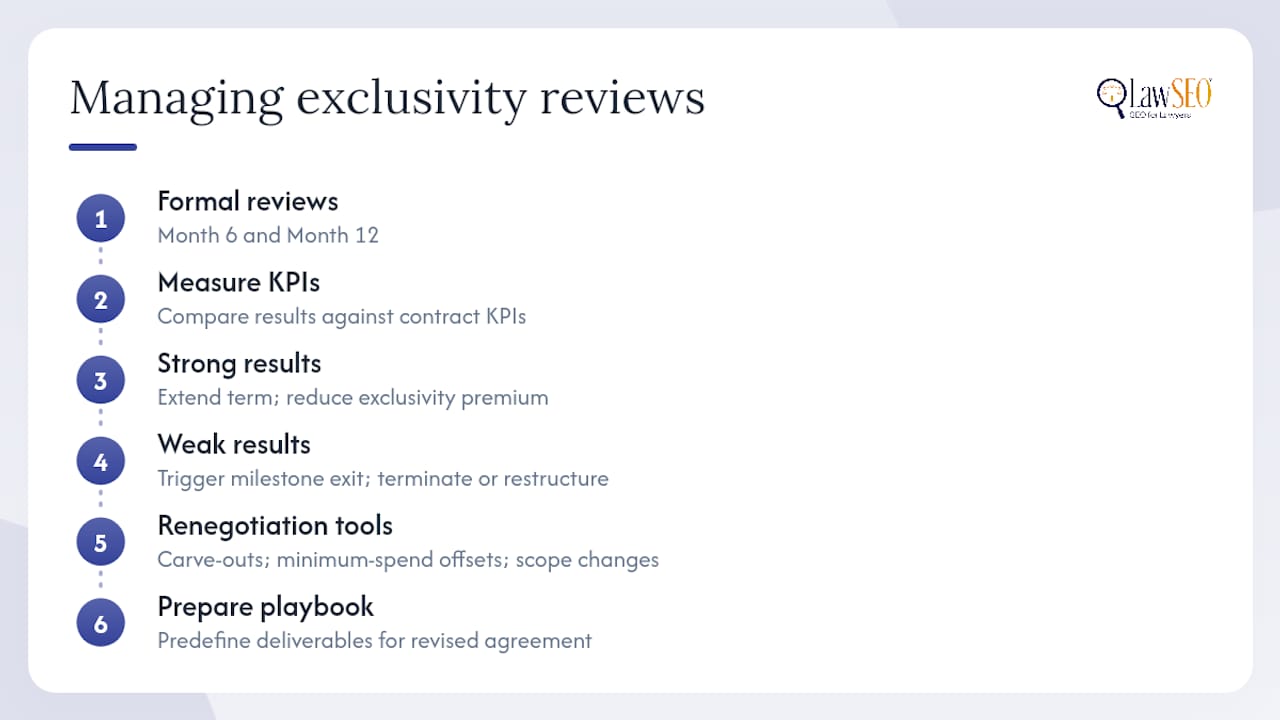
Exclusivity agreements should be treated as living documents, not set-and-forget contracts. Build in a formal review at month six and again at month twelve. At each review, measure actual performance against the KPIs in the contract and assess whether the exclusivity scope still matches your competitive footprint.
Renegotiation leverage increases when you have performance data. If the agency has delivered strong results, you can negotiate an extended term in exchange for a reduced exclusivity premium. If results have been weak, the milestone-based exit clause you negotiated at signing gives you the right to terminate or restructure without penalty.
Narrow carve-outs and minimum spend offsets are the most common renegotiation tools. A firm that initially signed full-market exclusivity may renegotiate to county-level exclusivity at a lower monthly spend if its practice has narrowed geographically. Conversely, a growing firm may expand the exclusivity scope to cover additional practice areas as its caseload diversifies.
For content strategy during renegotiation, a legal content marketing playbook can help you define the deliverables you want written into the revised agreement before you sit down with the agency.
The exclusivity decision comes down to contract discipline
Partners and managing attorneys who sign exclusivity agreements without milestone-based exit rights and explicit asset ownership clauses take on avoidable risk. The benefits of exclusivity are real, but they depend entirely on the agency performing. A well-drafted contract protects you if it does not.
Pro Tip: Require a minimum spend threshold that reflects the agency’s actual opportunity cost of refusing other local clients. If the agency will not name that number, it has not thought seriously about what exclusivity is worth to either party.
Lawseo’s exclusive SEO programs for U.S. law firms
Lawseo builds every client engagement around the protections this article describes: geographic and practice-area exclusivity, full asset ownership at termination, founder-reviewed strategy from Todd R. Stager, and monthly reporting tied to measurable KPIs. The firm works exclusively in the legal sector, which means its competitive intelligence, content standards, and link-building relationships are built specifically for attorney marketing, not adapted from a general-purpose agency model.
Firms that want to verify their current position before committing to an exclusive retainer can start with a pre-contract SEO audit for attorneys that maps ranking gaps, GBP performance, and competitor positioning in your specific metro and practice area. From there, Lawseo’s team structures an exclusivity proposal with the contract terms, KPIs, and exit rights that protect your firm from day one. Visit Lawseo to request your audit and review the firm’s proven legal SEO strategies.
Sources
- Lead Exclusivity in Marketing for Attorneys | Full Guide
- Hiring an Attorney SEO Agency: 9 Questions Before You Sign
- Let’s Be “Exclusive” – How to Manage Client Exclusivity Demands of Your Agency – Legal + Creative
This article is general information, not a substitute for advice from a qualified lawyer. Consult a qualified legal professional about your own circumstances before acting on anything here.