


TL;DR:
- In 2025, law firms must prioritize SEO to remain visible amid AI-driven search experiences that favor high-quality, useful content. Relying solely on paid advertising is unsustainable, as organic and local search visibility offer long-term, compounding advantages that attract qualified clients. Effective SEO now requires ongoing technical optimization, authoritative content, and strong local reputation management to outperform competitors in a layered digital landscape.
Many law firms still rely on paid advertising and word-of-mouth referrals as their primary client acquisition strategies. That approach is becoming increasingly expensive and unreliable. People-first, unique content now determines which law firms rank in both Google’s classic search results and its newer AI-driven experiences, which means that firms without a strong SEO foundation are losing ground to competitors every single month. This article breaks down exactly why SEO is the smartest long-term investment a law firm can make, and how to execute it effectively in 2025 and beyond.
Key Takeaways
| Point | Details |
|---|---|
| SEO is an owned asset | Investing in SEO delivers long-term client visibility and builds law firm value beyond paid ads. |
| 2025 search is AI-driven | Law firm clients increasingly discover services through AI Overviews and unique content, not old ‘blue links’ alone. |
| ROI compounds over time | SEO returns grow month-over-month while ad returns drop off when spending stops. |
| Success needs full-funnel tracking | Modern SEO measurement requires tracking inquiries, client actions, and quality—not just website visits. |
How client discovery has changed in 2025
With the new reality of Google’s search and AI experiences, it’s essential to first understand exactly how prospective clients are connecting with law firms today.
The ten blue links that once defined Google search are no longer the whole picture. Today, a potential client searching for “divorce attorney near me” or “what happens after a car accident” may encounter an AI Overview summary at the top of the page, local map packs, featured snippets, and only then a traditional organic listing. This layered search environment changes how law firms capture attention and earn clicks.
Google’s algorithm in 2025 places heavy weight on non-commodity, useful content that genuinely addresses what a user needs. Thin, keyword-stuffed pages no longer rank well in classic search, and they are almost never featured in AI Overviews. Law firms that built their SEO strategy around volume of pages rather than quality of information are experiencing significant visibility losses this year.
Key shifts every law firm marketing director should understand:
- AI Overviews now appear for many legal queries, summarizing answers directly on the results page and reducing the number of clicks that reach individual law firm websites.
- Zero-click searches are increasing. Clients may get the answer they need from Google without ever visiting your site, which makes it critical to be the source Google’s AI cites.
- Paid search costs for legal keywords remain among the highest of any industry, with personal injury and criminal defense terms regularly exceeding $50 to $150 per click in major markets.
- Organic discovery patterns are changing as AI-driven search for law firms introduces new touchpoints where brand authority matters as much as keyword targeting.
| Discovery channel | Trend in 2025 | Impact on law firms |
|---|---|---|
| Organic search (classic) | Stable but more competitive | Requires E-E-A-T and depth |
| AI Overviews | Growing rapidly | Demands authoritative, citable content |
| Paid search (PPC) | Rising cost per click | Diminishing ROI for smaller firms |
| Local map pack | High intent, consistent | Requires strong GBP and reviews |
| Referral and direct | Declining share | Not scalable alone |
The firms winning client inquiries right now are those that show up across multiple channels simultaneously. That kind of multi-surface visibility is almost impossible to achieve through paid ads alone, especially at a sustainable budget. Understanding the full landscape of SEO trends for lawyers is what separates firms that grow from those that stagnate.
For a deeper look at how AI tools for law firms are reshaping research and discovery, the intersection of legal technology and client behavior offers important context for any marketing strategy.
The business case: SEO as a law firm asset versus ad spend
Now that you see the evolving patterns of client search, it’s time to weigh what SEO actually yields for a law practice compared to just buying clicks.

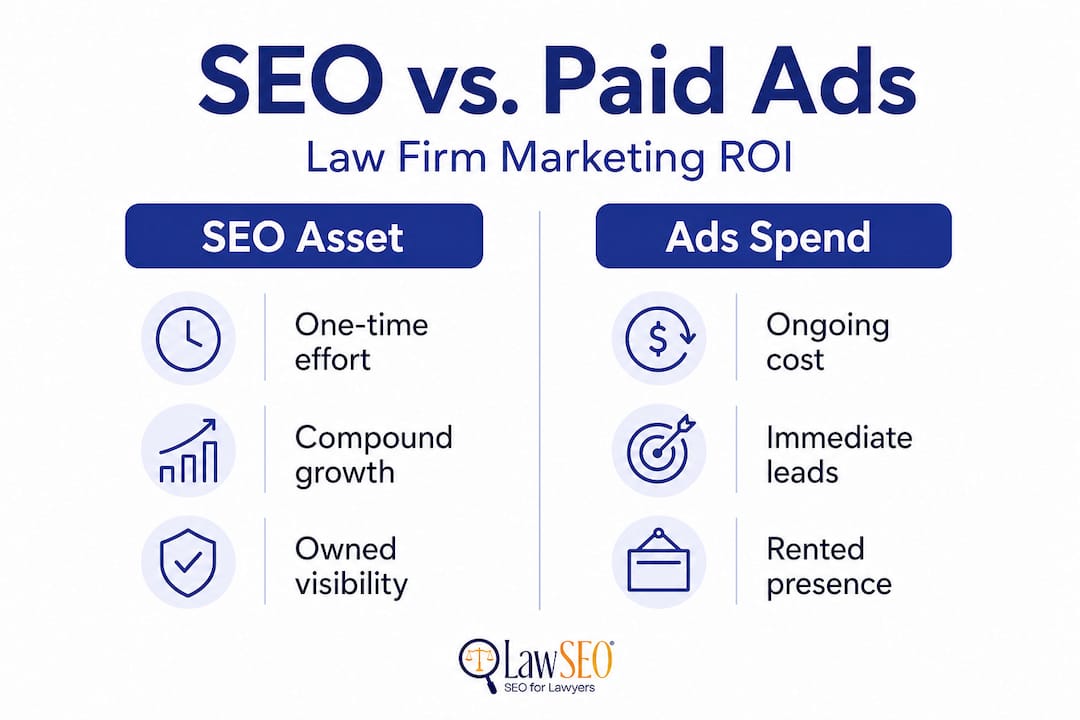
Think of paid advertising as renting office space and think of SEO as owning the building. The moment you stop paying rent, you’re out. The moment you stop running ads, your phone stops ringing from that channel. SEO builds owned visibility rather than rented traffic, which makes it a fundamentally different kind of investment with compounding returns over time.
Here is a direct comparison to help clarify the financial logic:
| Factor | Organic SEO | Paid ads (PPC) |
|---|---|---|
| Monthly cost structure | Fixed investment, growing returns | Ongoing spend, flat or declining returns |
| Click cost | None per click once ranked | $50–$150+ per click for legal keywords |
| Longevity | Rankings persist after investment | Traffic stops when budget stops |
| Compounding effect | Yes, increases over 12–36 months | No, resets every billing cycle |
| Trust signals | High (organic results trusted more) | Lower (users recognize and skip ads) |
| AI search visibility | Yes, organic content is AI-cited | Minimal presence in AI summaries |
The compounding nature of SEO is its most underappreciated quality. A well-optimized blog post answering a common client question, such as “how long does a personal injury case take,” can attract qualified traffic for years with minimal additional investment. A paid ad targeting the same keyword disappears the moment the budget is paused.
Organic search conversion rates consistently outperform paid in legal services over time because clients who find you through an organic result already trust that Google has validated your expertise. They arrive with higher intent and lower skepticism.
Four financial realities of law firm SEO investment:
- Break-even typically occurs between months 6 and 12. SEO takes time to build momentum, but once it does, cost per acquired client drops dramatically compared to PPC.
- Top three organic positions capture the majority of clicks. Ranking first for a high-intent local legal keyword can deliver dozens of qualified inquiries monthly at no additional ad spend.
- Client lifetime value amplifies ROI. A single retained client in a family law or estate planning practice can represent thousands of dollars in revenue, making even a modest improvement in search visibility highly profitable.
- Tracking true outcomes matters. Measuring traffic and rankings without connecting those signals to actual calls, form submissions, and retained cases gives an incomplete and often misleading picture of SEO value.
“For law-firm decision-makers, SEO is an efficiency and compounding play: it builds an owned visibility asset rather than paying to rent traffic every month.” — Pinion Newswire
Pro Tip: Before investing in any SEO program, establish your baseline cost per lead from paid ads. This gives you a concrete benchmark to measure SEO’s ROI against as the campaign matures, typically showing a favorable crossover by month 9 or 10.
Understanding AI and SEO strategies for law firms in 2025 helps leadership teams make the business case internally for shifting marketing budget allocation toward owned visibility.
Essentials of law firm SEO strategy in 2025
Armed with the financial logic for treating SEO as a long-term asset, you need to understand exactly which strategic SEO elements will drive client results for law firms.
A strong law firm SEO strategy in 2025 operates across three integrated pillars: technical site performance, content depth and credibility, and local visibility. Google’s guidance treats all three as interconnected, which means neglecting one weakens the others.
Technical SEO fundamentals for law firms:
- Page speed and Core Web Vitals: Slow-loading pages rank lower and drive higher bounce rates. Google’s ranking signals include Largest Contentful Paint and Cumulative Layout Shift, both of which directly affect user experience.
- Mobile optimization: The majority of local legal searches happen on mobile devices. A site that performs poorly on smartphones loses both rankings and conversions.
- Schema markup: Structured data (attorney schema, FAQ schema, local business schema) helps Google and AI systems understand your firm’s services, location, and credentials.
- HTTPS and site security: Unsecured sites carry trust penalties. Website security is a baseline requirement for both ranking and client trust.
- Crawlability and indexation: If Google can’t efficiently crawl your site, your content won’t rank, regardless of its quality.
For a complete breakdown of foundational requirements, technical SEO essentials for attorneys covers each element with practical guidance.
Content strategy rooted in real client questions:
Content is where law firms can build the strongest competitive advantage. Google’s E-E-A-T framework (Experience, Expertise, Authoritativeness, and Trustworthiness) rewards content written by or attributed to credentialed attorneys who demonstrate real-world legal knowledge. Generic content from content mills does not perform at this level.
The most effective law firm content strategy includes:
- Practice area pages that address the specific legal process, timeline, costs, and outcomes a client can expect, written in plain language.
- FAQ and educational blog content that answers the questions clients actually type into Google before they decide to hire an attorney.
- Case study and outcome content (within ethical guidelines) that demonstrates actual experience and builds trust.
- Location-specific pages for each city or region the firm serves, optimized with local intent signals.
Pro Tip: Use Google’s “People Also Ask” boxes for legal queries in your practice area as a direct content brief. Each question represents a real client need, and answering it thoroughly positions your firm as the authoritative source.
Local SEO for high-intent inquiries:
Local search drives the most immediate client inquiries for most law firms. A well-maintained Google Business Profile with consistent NAP (Name, Address, Phone) citations across legal directories, regular review responses, and updated service descriptions signals authority to both Google’s local algorithm and prospective clients browsing local results.
Combining these three pillars—technical quality, content depth, and local presence—creates a reinforcing system where each element supports the others and compounds visibility over time.
Measurement that matters: SEO KPIs for legal practices in the AI era
Implementing the right SEO strategies is powerful, but knowing whether those investments pay off depends on tracking what truly matters in 2025’s search ecosystem.
Traditional SEO reporting focused almost exclusively on keyword rankings and organic traffic volume. In an era of zero-click search risks, that approach gives a distorted view of actual performance. A law firm can lose 20% of organic traffic due to AI Overviews while simultaneously generating 30% more client calls, because the traffic that still arrives carries higher intent.
The metrics that actually indicate SEO health for law firms:
- Phone calls from organic search: Track calls attributed to organic visits using call tracking software. This is the most direct indicator of lead generation from SEO.
- Form submissions and consultations booked: Connect contact form completions to their originating traffic source to understand which content is converting.
- Qualified lead rate: Not all inquiries are good fits. Measure the percentage of SEO-sourced leads that result in consultations and retained clients.
- AI-assisted conversions: Some clients encounter your firm through an AI Overview, then search your name directly. Branded search volume growth is one signal of AI-driven discovery.
- Google Business Profile interactions: Calls, direction requests, and website visits from your GBP listing indicate strong local SEO performance independent of traditional traffic metrics.
“AI Overviews can reduce direct clicks, so leaders should measure beyond rankings—track calls/inquiries, assisted conversions, and traffic quality from AI-sourced discovery paths.” — Digital Bloom
Pro Tip: Set up a dedicated phone tracking number for your Google Business Profile and another for your organic website traffic. Comparing these two numbers monthly gives you a real-time read on how both your local and broader SEO are generating client interest.
Revisiting AI-driven search metrics as a measurement framework helps law firm marketing directors present meaningful data to firm leadership, rather than explaining away traffic fluctuations that don’t reflect actual business impact.
Why the old SEO playbook isn’t enough—and how law firms can win
Conventional SEO advice for law firms focused almost entirely on two things: target the right keywords and build enough backlinks. That model still matters, but it is no longer sufficient on its own. The firms that are dominating search visibility in 2025 have moved beyond those fundamentals to treat SEO as an ongoing practice of earning trust, both from Google’s systems and from the clients those systems serve.
The uncomfortable truth is that many law firms have been sold “SEO services” that consist of a few keyword-stuffed pages, a basic backlink package, and monthly reporting that shows rankings without any connection to revenue. That checkbox approach was marginal five years ago. Today it actively wastes budget.
Google’s AI-focused guidance treats page experience and content usability as part of content quality itself. Technical SEO and user experience are not separate concerns that can be handled by different vendors with no coordination. They are part of the same signal that Google evaluates when deciding whether your firm’s content deserves prominence.
The law firms winning right now share three characteristics. They invest in content that genuinely answers client questions with attorney-level depth. They maintain technically sound websites that load fast and work perfectly on mobile. And they actively manage their local reputation through reviews, citations, and a well-maintained Google Business Profile. None of these are one-time tasks. All of them require ongoing attention as SEO trend insights and algorithm priorities evolve.
Law firm leadership needs to shift from asking “how much traffic is our website getting?” to “how many qualified clients found us through search this month?” That shift in measurement focus is what separates firms that treat SEO as a growth asset from those that treat it as a line item cost with unclear returns.
Ready to grow your law firm’s visibility? Next steps
If your law firm is ready to make the shift and capitalize on the new reality of AI and SEO, here’s how to get started.
The strategies covered in this article are not theoretical. They represent the actual approach that separates law firms with growing client pipelines from those struggling to justify their marketing spend. LawSEO.com helps law firms implement every element of this framework, from legal SEO strategies for 2025 to technical site optimization, content production, and local reputation management. Our work is founder-led and legal-sector exclusive, meaning every strategy is built around the specific competitive and ethical considerations your firm faces. If you’re ready to move beyond rented ad traffic and build lasting search visibility, explore our SEO services for law firms or visit LawSEO.com to start a conversation about your firm’s growth objectives.
Frequently asked questions
How quickly can a law firm see ROI from SEO in 2025?
Most law firms start seeing measurable SEO impact in 4 to 8 months, with compound ROI growing significantly over longer time horizons compared to paid advertising.
Are paid ads still needed if a law firm invests heavily in SEO?
Paid ads and SEO can work together strategically, but strong organic rankings reduce dependence on expensive clicks and deliver more sustainable, compounding client growth over time.
How is measuring SEO success different in the new AI search era?
Law firms should prioritize tracking calls, consultations, and qualified leads rather than traffic alone, because AI Overviews and zero-click results now intercept many sessions before a user ever clicks through.
What are the most critical elements of law firm SEO in 2025?
Technical site quality, in-depth client-focused content, and local reputation through reviews and citations are the three core pillars that Google evaluates for both classic and AI-driven search visibility.
Can AI tools or chatbots replace investing in SEO for law firms?
AI tools can support certain research and content tasks, but they cannot substitute for SEO that makes your firm discoverable at scale, since unique, people-first content remains the determining factor in how Google surfaces and cites law firm information.