

TL;DR:
- Outdated legal content harms search rankings, client trust, and firm reputation.
- Substantive updates involve legal changes, new cases, or practical client questions, not just superficial tweaks.
- Regular, attorney-led content review and structured data use give firms a competitive advantage.
Legal content is not a one-and-done investment. Many law firms publish a practice area page, a blog post, or an FAQ resource and then treat it as finished work. That assumption is expensive. Search engines reward content that reflects current law, and clients who encounter outdated guidance lose trust quickly. Firms that build a disciplined content update process see measurable gains in rankings, lead volume, and client confidence. This guide explains exactly what is at stake, how to identify what needs updating, and how to do it in a way that search engines and prospective clients actually notice.
Key Takeaways
| Point | Details |
|---|---|
| Freshness matters | Regular updates to legal content are essential for staying visible in search and building client trust. |
| Update with substance | Real legal content updates address both new law developments and user questions, not just cosmetic changes. |
| Prioritize by risk | Focus on pages tied to fast-changing law or high website traffic for the greatest impact. |
| Attorney oversight required | AI can help, but every content change must be reviewed and approved by an attorney for compliance. |
The hidden risks of outdated legal content
Most law firm marketers understand that search visibility matters. Fewer recognize how quickly that visibility can erode when legal content falls behind the law. Google’s ranking systems are increasingly capable of detecting when a page describes a statute, regulation, or legal standard that has been amended or repealed. When that happens, the page’s authority and relevance scores decline, sometimes dramatically.
Consider employment law. Minimum wage rates, non-compete enforceability rules, and classification standards for independent contractors change at both the federal and state levels, often several times a year. A page that accurately described the law in 2023 may now contain guidance that a court or regulatory agency has directly contradicted. That page still ranks until Google or a competing site catches up. But when it loses ground, it typically drops several positions at once rather than sliding gradually.
The SEO authority risks extend beyond rankings. Prospective clients who find outdated information on your site and act on it face real consequences. A person who reads that their state allows certain estate planning instruments without a specific witness requirement, only to discover later that the requirement was added by legislation, may pursue a malpractice claim. Even when liability does not materialize, the reputational damage to the firm is real.
There are also trust signals that search engines and AI platforms evaluate when deciding whether to cite or surface a legal resource. Key signals include:
- Publication and revision dates that are recent and accurate
- Citation of current statutes and case law rather than superseded versions
- Content depth that addresses how the law applies to real client situations
- Internal link structures that connect related legal topics coherently
As noted in legal SEO strategies, firms that maintain content authority across their site consistently outperform those that publish heavily and then ignore maintenance.
Evergreen content needs quarterly reviews for law changes. Avoid thin refreshes or date-only changes, and distinguish fast-moving versus stable law tiers to prioritize your update effort effectively.
Neglecting this discipline is not a passive choice. It is an active decision to cede ground to competing firms that are investing in content accuracy and freshness. The longer outdated content stays live, the harder the recovery.
What counts as a real legal content update?
Understanding that content needs updating is one thing. Knowing what actually constitutes a meaningful update is another. This distinction matters enormously because many firms invest time in superficial refreshes that do nothing for search performance or client trust.
Google’s quality raters and its underlying algorithms evaluate whether an update adds substantive value. Changing a “2023” to “2026” in a heading, or rewriting the introduction without touching the substantive legal content, does not move the needle. Thin refreshes or date-only changes are among the most common update mistakes law firms make, and they waste significant time while creating a false sense of progress.
A real legal content update must accomplish at least one of the following:
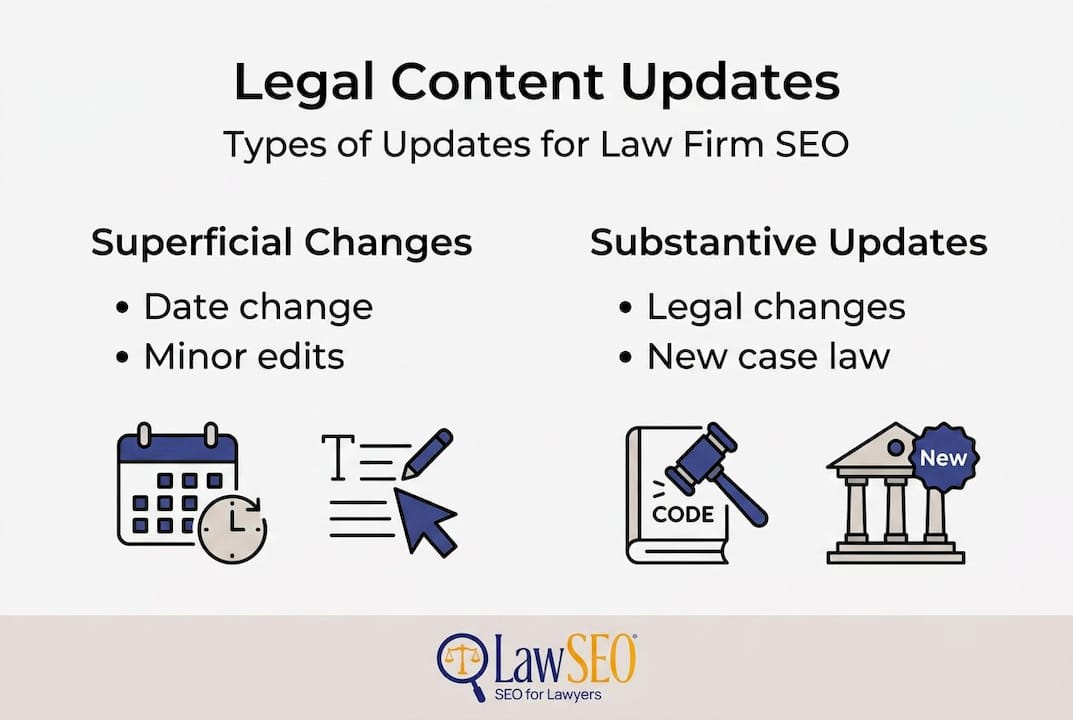
| Superficial update (low value) | Substantive update (high value) |
|---|---|
| Change the published date only | Reflect a new statute or amended regulation |
| Rewrite the intro without touching body content | Add a new FAQ based on actual client questions |
| Add a stock photo | Incorporate a recent appellate court decision |
| Insert a keyword phrase without context | Update penalty amounts, filing deadlines, or thresholds |
| Shorten the page without adding new information | Add a new section addressing a law change’s practical impact |
Substantive updates address legal changes, incorporate new precedents, answer emerging client questions, or add detail that makes the page more useful than any competing resource. This is the bar that separates firms whose content performs from those whose content sits idle.
Exploring new content ideas that align with real client questions is one of the most productive ways to identify where your current pages fall short. When clients ask questions your existing pages do not answer, that is a gap worth closing with a substantive addition, not a cosmetic tweak.
Organizing updates within a coherent content structure also strengthens topical authority. When related pages link to one another and each page serves a specific, well-defined purpose, search engines recognize the site as a comprehensive resource on a given area of law. That recognition translates into rankings, featured snippet appearances, and citation by AI tools.
Pro Tip: Create a simple update log inside your content management system or a shared spreadsheet. Document the date of each update, the specific change made, and the reason for the change. This creates accountability, helps with attorney review workflows, and signals to search engines that your content is actively maintained.
How to prioritize which legal content needs updating
A disciplined update schedule depends on categorizing your content by how quickly the underlying law changes. Not every practice area page carries the same risk of becoming outdated. Treating all content equally wastes resources and leaves your highest-risk pages under-maintained.

Categorize content by law change speed, because AI tools and search engines demonstrably prioritize more recently updated pages in fast-moving legal areas. The following framework gives most law firms a practical starting point:
| Content tier | Example practice areas | Recommended review frequency |
|---|---|---|
| Fast-changing | Employment law, immigration, tax, regulatory compliance | Quarterly |
| Moderate | Estate planning, family law, personal injury | Semiannual |
| Stable | Constitutional overviews, foundational contract principles | Annual |
Once you have categorized your content by tier, apply a second filter based on business impact. Not every fast-changing page generates the same number of leads. Rank your pages by organic traffic volume and by the rate at which they convert visitors into contacts. Pages with high traffic and strong lead conversion deserve the most immediate attention.
Use the following process to build your review schedule:
-
Export your analytics data. Pull organic traffic, session duration, and conversion data for every page on your site. Most firms use Google Analytics 4 or a similar platform. Sort by organic sessions descending.
-
Assign each page a tier. Use the three-tier framework above. When in doubt, err toward the faster review cycle.
-
Flag any page that references specific statutes, regulations, or dollar thresholds. These are your highest-risk pages because any legislative or regulatory change makes the information factually wrong.
-
Set calendar reminders for each tier. Fast-changing pages go on the quarterly review calendar. Moderate pages get a semiannual reminder. Stable pages get an annual check.
-
Assign ownership. Every page should have a named attorney or practice group responsible for substantive review, and a named marketer responsible for publishing the update.
Implementing structured data for law firms, such as FAQ schema and LegalService markup, also makes it easier for search engines to surface updated content accurately. When structured data is kept current alongside the page content, the combination sends a strong freshness and authority signal to both traditional search and AI-driven platforms.
The firms that execute this process consistently are not doing anything heroic. They are applying a systematic approach to a problem most of their competitors ignore. That consistency compounds over time into a significant competitive advantage.
Maintaining compliance and authority in an AI-driven landscape
The rise of generative AI tools has introduced new considerations for law firm content teams. AI-generated drafts can accelerate production, but they also introduce risks that are particularly acute in a regulated profession like law.
AI language models occasionally generate plausible-sounding but factually wrong legal information. This phenomenon, known as hallucination, can result in published content that cites nonexistent cases, misstates statutory language, or describes legal standards that do not exist in a given jurisdiction. Publishing that content without attorney review creates both a credibility problem and potential liability exposure. As one widely cited analysis notes, AI-only content carries unacceptable hallucination and liability risks for law firms and should always require qualified attorney review before publication.
Beyond the content itself, several technical and operational practices determine whether your updated content actually performs:
- Structured data maintenance. Adding or refining schema markup alongside content updates helps AI platforms and search engines accurately categorize your firm’s services, locations, attorney credentials, and practice areas. This is one of the most underutilized tools in legal SEO.
- State bar and local listing synchronization. Your website content should consistently reflect the same information as your Google Business Profile, state bar directory listing, and any other authoritative local data sources. Inconsistencies confuse search engines and reduce trust signals.
- Ethical compliance review. Attorney advertising rules vary by state and change over time. Content that is accurate from a legal standpoint may still violate bar rules regarding testimonials, outcome predictions, or specialization claims. Every content update should pass through a compliance checkpoint, not just a factual accuracy review.
- Citation accuracy. When you reference specific cases or statutes, verify that the citation is still good law. A case that has been overturned or distinguished significantly should not be presented as controlling authority.
Pro Tip: Build a two-step review process for every legal content update. Step one is the attorney review for legal accuracy and bar compliance. Step two is the SEO review for structured data, internal linking, and keyword alignment. Running these as sequential checkpoints prevents errors from slipping through and ensures both the legal and marketing goals of the update are met.
Following structured data best practices is especially important as more prospective clients find attorneys through AI-generated responses rather than traditional search results. When an AI assistant answers a question about finding a criminal defense attorney in a specific city, it draws on structured, authoritative data sources. Firms whose structured data is accurate and current are far more likely to be included in those responses.
Why most legal content updates still miss the mark
After working with law firms across nearly every practice area and market size, one pattern emerges consistently. Most firms that commit to updating their content do so reactively and cosmetically. They notice a drop in rankings, assign someone to “refresh” a page, and that person rewrites a few paragraphs without any input from the attorneys who understand what has actually changed in the law. The result is content that looks new but carries no additional value for the reader or the search engine.
The firms that actually benefit from content updates do something different. They treat the attorney as the primary source for the update, not the marketer. When a significant employment law change occurs in their state, the attorney who handles those cases writes a summary of what changed, what it means for clients, and what clients should do now. The marketer then shapes that summary into page-ready content. This process takes more coordination, but the output is substantively richer, more authoritative, and far more likely to earn rankings and citations from AI tools.
There is also a counterintuitive truth about FAQs. Many firms populate their FAQ sections with questions they think clients ask, rather than questions clients actually ask. The most effective legal FAQs come directly from intake conversations, client emails, and the questions attorneys field in consultations. These questions reflect real search intent, and content that answers them precisely tends to outperform content built around keyword research alone.
The lesson is not that keyword research does not matter. It does. The lesson is that attorney-led content reviews and client-driven FAQs create a depth of relevance that purely marketing-driven updates rarely achieve. As AI-only content continues to flood search results, the differentiator for law firms will be content that is unmistakably informed by real legal expertise and genuine client experience.
Firms willing to invest in standout legal content that reflects actual attorney knowledge will hold a durable advantage over competitors who treat content as a commodity production task.
Ready to turn legal content into new clients?
LawSEO.com works exclusively with law firms to build and maintain content that performs in both traditional search and AI-driven platforms. If your firm’s content has not been reviewed and updated within the past quarter, you are likely losing ground to competitors who are doing this work consistently. Our team applies proven legal SEO strategies alongside attorney-reviewed content production, structured data implementation, and compliance-focused publishing workflows. Whether you are looking to improve a single high-traffic practice area page or build a firm-wide content maintenance program, SEO for law firms starts with a clear strategy. Visit LawSEO.com to explore how we can help your firm achieve the online visibility it deserves.
Frequently asked questions
How often should law firms update website content?
Most law firm sites benefit from quarterly reviews of high-impact pages, with fast-changing legal areas such as employment or immigration law potentially requiring more frequent attention.
What are the risks of superficial content updates?
Thin refreshes or date-only changes do not improve SEO performance or compliance standing and may cause search engines to treat the page as low-effort, which can actually suppress rankings over time.
Can law firms rely on AI-generated legal content?
No. AI-only content carries real hallucination and liability risks in legal publishing, which means qualified attorney review is mandatory before any AI-assisted draft is published on a firm’s website.
How can structured data improve legal content performance?
Structured data, such as FAQ schema and LegalService markup, helps search engines and AI platforms accurately categorize your firm’s services and credentials, increasing the likelihood that your content is surfaced in both traditional results and AI-generated answers.