


Every law firm website faces the challenge of engaging potential clients while meeting strict professional standards. Legal marketing directors know that building trust online is more than just attractive design. Defining user experience in legal SEO requires understanding how visitors perceive, interact with, and respond to your digital presence. This article explores practical strategies for balancing compliance, accessibility, and usability so your firm stands out in the crowded American legal market.
Table of Contents
- Defining User Experience In Legal SEO
- Unique Challenges For Law Firm Websites
- Ethical And Regulatory Factors For Attorneys
- Integrating UX With Technical SEO Tactics
- Common Pitfalls And How To Avoid Them
Key Takeaways
| Point | Details |
|---|---|
| User Experience is Crucial | Law firms must prioritize user experience by designing websites that facilitate easy navigation and emotional engagement to meet potential clients’ needs. |
| Compliance and Ethics Matter | Attorneys must navigate complex ethical standards while ensuring client confidentiality, maintaining professional integrity, and avoiding conflicts of interest. |
| Integrate UX with Technical SEO | A successful law firm website requires a combination of user-friendly design and technical optimization to enhance both user experience and search engine visibility. |
| Avoid Common Design Pitfalls | Law firms should regularly audit their websites for issues such as mobile responsiveness, cluttered navigation, and accessibility to improve overall user engagement. |
Defining User Experience in Legal SEO
User experience (UX) represents the comprehensive interaction between potential legal clients and a law firm’s digital presence. In the context of legal SEO, UX transcends mere website design, encompassing a holistic approach to meeting user needs and expectations through digital platforms.
At its core, UX in legal digital marketing is about understanding user perceptions and interactions with legal service websites. This dynamic concept involves multiple critical components:
- Emotional Engagement: How visitors feel when navigating legal websites
- Usability: Ease of finding relevant information and services
- Information Accessibility: Clarity and straightforward presentation of legal insights
- Navigation Efficiency: Intuitive site structure that guides users seamlessly
The legal industry demands a specialized approach to UX design. Unlike generic websites, law firm digital platforms must balance professional credibility with user-friendly interfaces. UX design processes focus on creating meaningful digital interactions that help potential clients quickly understand complex legal services and feel confident in their choice of representation.
Effective legal UX considers the entire user journey – from initial search to consultation scheduling. This means designing websites that answer key client questions, provide clear pathways to assistance, and reduce potential friction points in the decision-making process.
Here’s a comparison of UX priorities for law firm websites versus general business websites:
| Aspect | Law Firm Websites | General Business Websites |
|---|---|---|
| Trust Requirement | Extremely high, must convey legal expertise | Moderate, focus on brand reputation |
| Compliance Needs | Strict, regulated by bar associations | Typically less regulated |
| User Goals | Understanding services, privacy, guidance | Product info, pricing, purchasing |
| Info Sensitivity | High—client confidentiality critical | Usually low, with few legal risks |
Pro tip: Conduct regular user testing and analyze website heat maps to understand how potential clients interact with your legal website and identify areas for improvement.
Unique Challenges for Law Firm Websites
Law firm websites operate in a uniquely complex digital landscape that demands extraordinary considerations beyond traditional online marketing strategies. Strict ethical rules and client confidentiality requirements create significant barriers to standard web design and content development approaches.
The core challenges for law firm digital platforms include:
- Regulatory Compliance: Adhering to professional conduct rules and bar association guidelines
- Confidentiality Protection: Ensuring sensitive client information remains secure
- Professional Credibility: Presenting expertise without appearing overly aggressive or sales-oriented
- Diverse Client Communication: Addressing multiple potential client demographics effectively
Smaller law firms face additional hurdles, often struggling with limited technological resources and budget constraints. These firms must strategically allocate limited marketing investments to create professional, engaging online experiences that compete with larger, more technologically advanced practices.
Large law firms integrating technological capabilities must simultaneously communicate advanced technological competence while maintaining the traditional perception of legal professionalism. This delicate balance requires sophisticated website design that demonstrates technological understanding without compromising the gravitas associated with legal services.

Client expectations continue evolving, demanding websites that provide transparency, efficiency, and clear communication pathways. Modern legal websites must function as comprehensive information resources, initial consultation platforms, and trust-building mechanisms – all while navigating complex ethical and professional standards.
Pro tip: Conduct a comprehensive audit of your law firm’s website, examining both technical performance and compliance with professional ethical guidelines to identify potential improvement areas.
Ethical and Regulatory Factors for Attorneys
Attorneys operate within an intricate framework of professional responsibilities that extend far beyond traditional legal practice. Legal ethics govern professional conduct and establish critical boundaries for client interactions, particularly in digital communication platforms.
The core ethical considerations for attorneys include:
- Client Confidentiality: Protecting sensitive information at all times
- Conflict of Interest: Identifying and avoiding potential professional conflicts
- Transparent Communication: Providing accurate and honest representation
- Professional Integrity: Maintaining high standards of personal and professional behavior
Professional conduct rules from the ABA Model Rules create comprehensive guidelines that attorneys must navigate carefully. These regulations become increasingly complex when integrating digital marketing strategies, requiring lawyers to balance promotional efforts with strict ethical standards.
Technology has introduced new challenges in maintaining professional boundaries. Online platforms demand attorneys carefully manage digital communications, ensuring that website content, social media interactions, and digital marketing materials remain compliant with professional conduct requirements. This means crafting online presence that demonstrates expertise while avoiding potentially misleading or unethical representations.
Jurisdictional variations further complicate ethical compliance, with different state bar associations implementing nuanced interpretations of professional conduct rules. Attorneys must remain vigilant, continuously updating their understanding of evolving ethical guidelines in an increasingly digital legal landscape.
Pro tip: Develop a comprehensive compliance checklist that reviews all digital marketing materials against current professional conduct guidelines to minimize ethical risks.
Integrating UX With Technical SEO Tactics
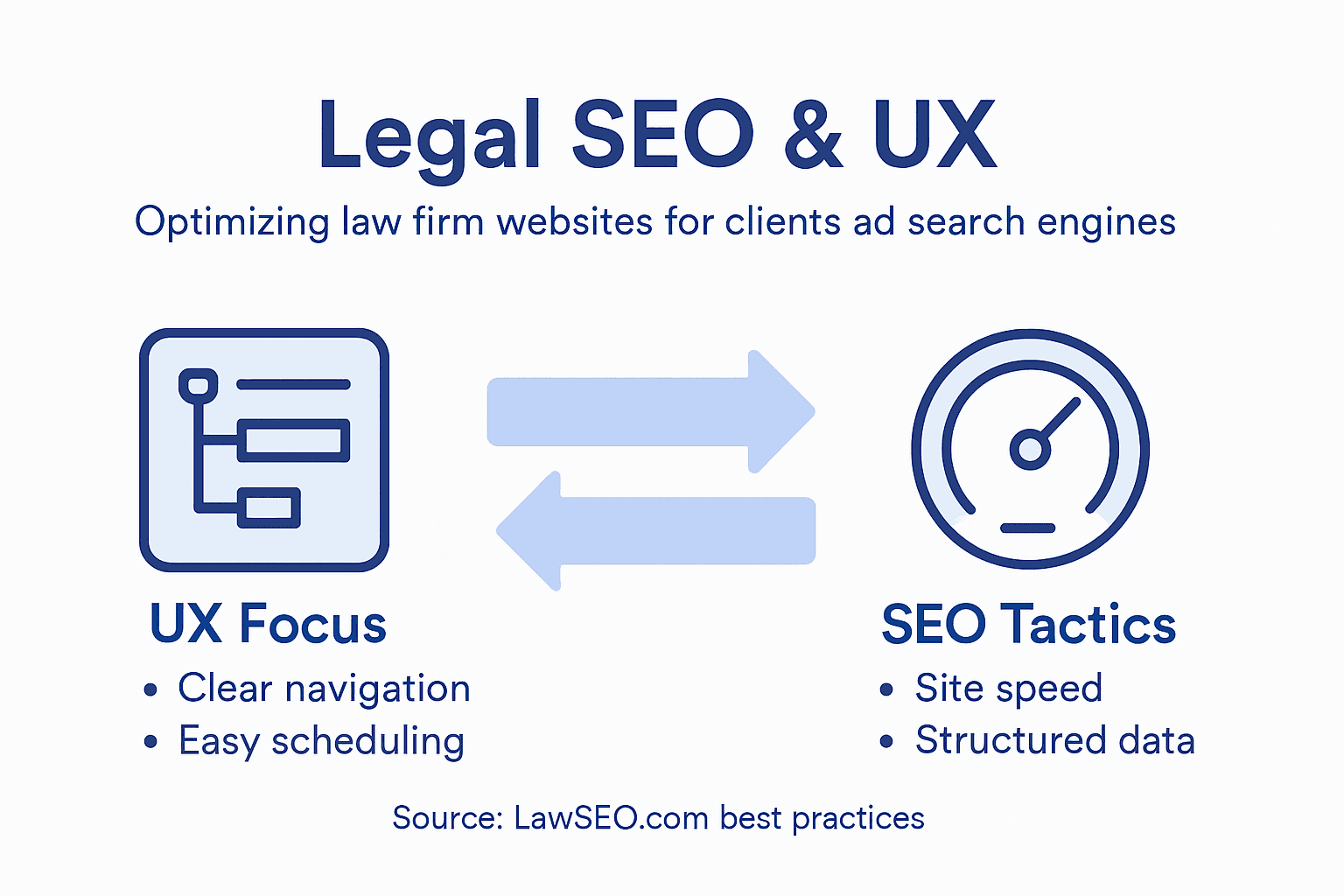
UX strategy and technical SEO optimization represent a critical intersection for law firms seeking digital marketing success. By aligning website infrastructure with user expectations, attorneys can create powerful online platforms that simultaneously attract search engines and potential clients.
Key integration strategies include:
- Site Speed Optimization: Reducing page load times
- Mobile Responsiveness: Ensuring seamless cross-device experiences
- Intuitive Navigation: Creating clear, logical site structures
- Content Accessibility: Making information easy to find and understand
- Schema Markup: Implementing structured data for enhanced search visibility
Technical SEO elements like structured data enhance website discoverability while improving user interaction. This means developing websites that are not just search-engine friendly, but genuinely helpful to potential clients seeking legal guidance.
Successful integration requires a holistic approach that considers both technical performance and human experience. Law firms must balance sophisticated backend optimization with frontend design that feels intuitive, professional, and trustworthy. This involves carefully crafting website architecture that guides users naturally through information discovery and potential service engagement.
For reference, here are the typical impacts of technical SEO enhancements for legal websites:
| Enhancement | User Experience Benefit | Search Engine Impact |
|---|---|---|
| Site Speed | Reduces user frustration | Improves ranking and visibility |
| Mobile Responsiveness | Enables cross-device access | Boosts mobile search placement |
| Schema Markup | Clarifies service details | Ensures rich listings in results |
| Content Accessibility | Reaches broader audience | Signals quality and relevance |
Search engines increasingly prioritize websites that demonstrate superior user experience. Metrics like time on page, bounce rate, and interaction depth now directly influence search rankings, making the marriage of UX and technical SEO more important than ever for legal digital marketing strategies.
Pro tip: Conduct quarterly user experience audits using both technical analytics and direct client feedback to continuously refine your law firm’s online presence.
Common Pitfalls and How to Avoid Them
Law firm websites frequently encounter critical design challenges that can significantly impede user experience and search engine performance. Understanding these potential obstacles is crucial for creating an effective digital presence that attracts and retains potential clients.
Common website design pitfalls include:
- Mobile Unresponsiveness: Failing to optimize for smartphone and tablet users
- Cluttered Navigation: Creating complex, confusing site structures
- Inadequate Contact Information: Hiding or obscuring communication channels
- Poor Content Hierarchy: Presenting information without clear organization
- Slow Page Loading: Compromising user experience through technical inefficiencies
ADA website accessibility standards present another critical consideration for law firms. Non-compliance can expose practices to legal risks and alienate potential clients with disabilities. This means implementing robust accessibility features that go beyond basic design considerations.
Technical limitations often stem from outdated design approaches or insufficient understanding of modern digital user expectations. Law firms must recognize that their website serves as a primary point of client interaction, requiring the same level of professional care and attention applied to traditional marketing channels.
Successful law firm websites balance sophisticated design with functional simplicity, creating intuitive pathways that guide potential clients toward meaningful engagement. This requires ongoing assessment, user testing, and a commitment to continuous improvement.
Pro tip: Conduct semi-annual comprehensive website audits that evaluate both technical performance and user accessibility to proactively identify and address potential design limitations.
Elevate Your Law Firm’s Online Presence with Expert Legal SEO and UX Integration
The article highlights the critical challenge law firms face in balancing ethical compliance, user experience, and SEO effectiveness. If you struggle with creating a website that builds trust, ensures client confidentiality, and drives new leads through superior user journeys, you are not alone. Key goals like site speed optimization, mobile responsiveness, and clear navigation are essential but often difficult to implement alongside strict regulatory demands. Understanding these demands is one thing. Delivering a seamless, compliant digital experience that converts visitors into clients is another.
At LawSEO.com, we specialize exclusively in the legal sector, guiding law firms through these unique digital marketing challenges. With founder-led strategies and over 29 years of SEO expertise, we combine cutting-edge UX tactics with AI-optimized content to help your firm achieve online dominance while respecting professional ethics. Don’t let your website’s technical pitfalls or compliance risks hold you back from attracting high-value clients.
Are you ready to transform your law firm’s digital presence with tailored SEO solutions built specifically for attorneys? Start by exploring our comprehensive approach at LawSEO.com and discover how to outshine competitors without sacrificing professional integrity. Take the first step today toward an optimized law practice website that not only ranks high but wins client trust with every click.
Frequently Asked Questions
What is user experience (UX) in legal SEO?
User experience (UX) in legal SEO refers to the overall interaction that potential legal clients have with a law firm’s digital presence. It encompasses emotional engagement, usability, information accessibility, and navigation efficiency to meet user needs effectively.
How can law firms improve user experience on their websites?
Law firms can enhance user experience by optimizing site speed, ensuring mobile responsiveness, simplifying navigation, providing accessible content, and implementing schema markup to enhance search visibility and ease of information retrieval.
What are some common challenges law firms face in digital marketing?
Law firms often encounter challenges such as regulatory compliance, maintaining client confidentiality, ensuring professional credibility, and effectively communicating with a diverse client demographic within their digital platforms.
Why is integrating UX with technical SEO important for law firms?
Integrating UX with technical SEO is crucial for law firms because search engines now prioritize websites that provide superior user experiences. This integration can improve client engagement, increase search rankings, and ultimately drive more potential clients to the legal practice.