

Clients are no longer simply typing legal questions into a search bar. With the rise of conversational AI tools and smart assistants, how people discover and interact with law firms is changing fast. For attorneys and legal marketers across the United States, understanding voice search optimization in legal marketing is crucial for staying visible and credible. This article highlights practical strategies, key challenges, and the latest insights on adapting content for natural, voice-driven queries.
Table of Contents
- Voice Search Optimization In Legal Marketing
- How Voice Search Alters Client Behavior
- Key Elements Of Effective Voice Seo
- Adapting Content For Conversational Queries
- Risks, Ethics, And Competitive Challenges
Key Takeaways
| Point | Details |
|---|---|
| Voice Search Transformation | Voice search is changing client interactions, requiring firms to adapt by creating more conversational content. |
| Conversational Content Creation | Develop content that directly answers common legal questions using natural, long-tail keywords to improve voice search visibility. |
| Local SEO Optimization | Focus on optimizing for local searches to cater to clients looking for immediate, location-based legal assistance. |
| Ethical Considerations | Address data privacy and misinformation risks by implementing transparent practices and compliance policies in voice marketing. |
Voice Search Optimization in Legal Marketing
Voice search is rapidly transforming how potential legal clients discover and engage with law firms. As conversational AI technologies become increasingly sophisticated, attorneys must adapt their digital marketing strategies to capture voice-based search queries effectively.
Understanding the nuanced landscape of voice search requires recognizing its unique characteristics. Unlike traditional text-based searches, voice queries tend to be more conversational and longer, often phrased as complete questions. NLP technologies are revolutionizing legal marketing by enabling more intelligent, context-aware search result matching.
Key strategies for voice search optimization in legal marketing include:
- Develop content that answers specific legal questions naturally
- Use conversational, long-tail keywords that mirror spoken language
- Create FAQ sections that directly address common client inquiries
- Optimize local SEO for location-based voice searches
- Ensure website content is structured with clear, concise language
The technical foundations of voice search optimization involve structured data markup, schema implementation, and understanding natural language processing algorithms. AI tools are transforming legal communication by enabling more personalized, contextually relevant search interactions.
Pro tip: Record yourself asking potential client questions and use those exact phrasings when developing voice search content to ensure maximum conversational alignment.
How Voice Search Alters Client Behavior
Voice search is fundamentally reshaping how potential legal clients seek and interact with legal services. Modern clients now expect immediate, conversational, and personalized information retrieval that traditional text-based search methods cannot match.

Voice technology impacts consumer behaviors dramatically, creating new patterns of legal service discovery and engagement. Potential clients are increasingly comfortable using voice-activated devices to ask complex legal questions, expecting nuanced and instantaneous responses that feel more like a conversation than a traditional search.
Key behavioral shifts in client interactions include:
- Preference for natural, conversational query language
- Expectation of immediate, precise answers
- Increased trust in personalized voice interactions
- Reduced patience for complex navigation processes
- Higher likelihood of taking immediate action based on voice search results
Moreover, voice search introduces significant psychological dynamics. Consumer alert research highlights how clients are more prone to swift decision-making when information is delivered through familiar or authoritative voices. This means law firms must carefully craft their voice search content to sound both professional and approachable.
Here’s a comparison of voice and text-based search behaviors for legal clients:
| Aspect | Voice Search | Text-Based Search |
|---|---|---|
| Query Style | Conversational, extended questions | Short, keyword-based phrases |
| Expected Response | Immediate, personalized reply | List of website links |
| Trust Factor | High with authoritative voices | Based on written reputation |
| Action Likelihood | More likely to act quickly | Often involves more research |
Pro tip: Practice recording your voice responses to common legal questions to understand how potential clients might perceive your firm’s communication style through voice search platforms.
Key Elements of Effective Voice SEO
Voice search optimization represents a critical evolution in legal marketing strategies, requiring attorneys to fundamentally rethink how potential clients discover and interact with legal services online. The core of effective voice SEO lies in understanding and anticipating how people naturally communicate their legal queries.
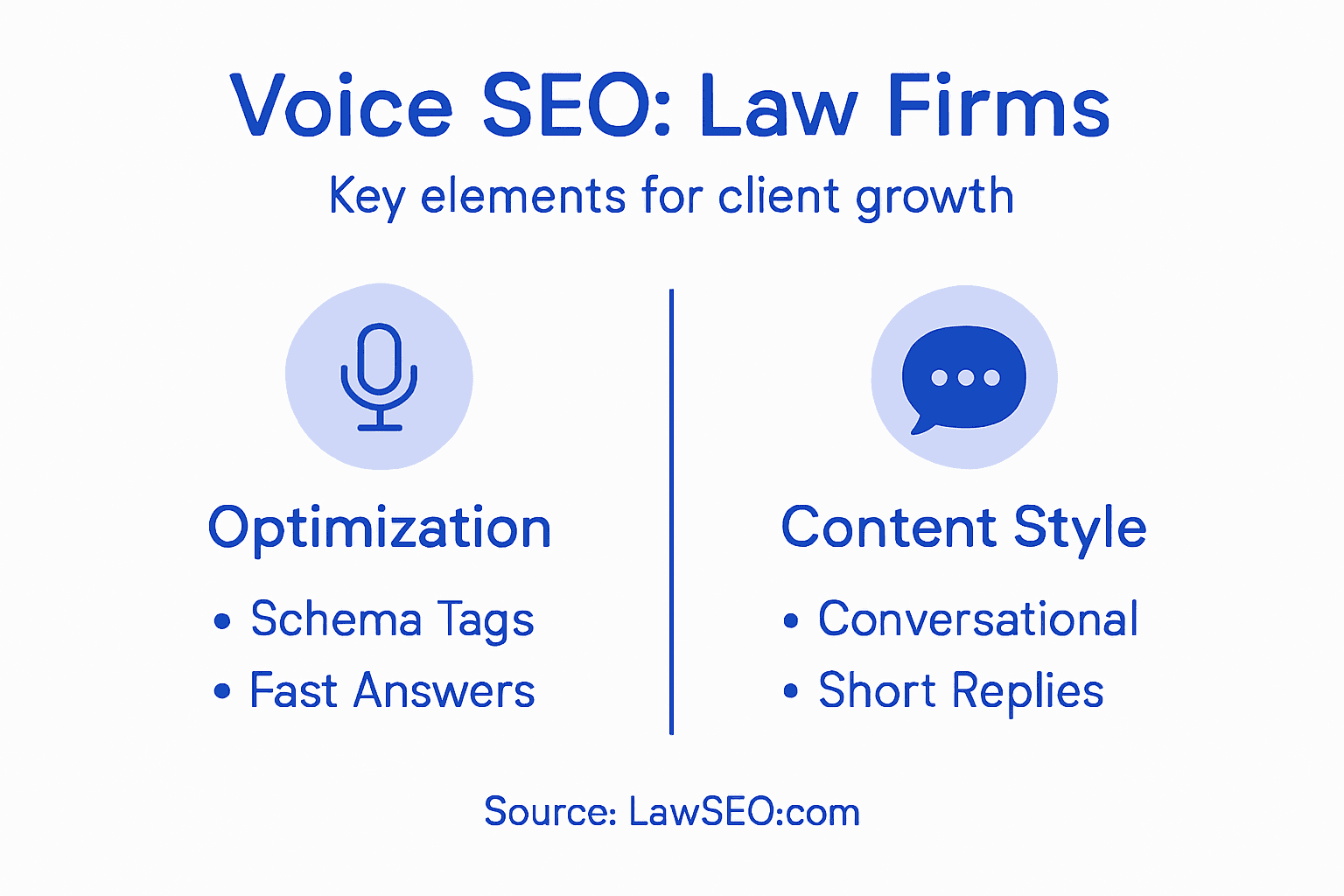
Natural language processing techniques have transformed the way legal content must be structured to be voice-search friendly. Law firms need to develop content that mirrors conversational speech patterns, anticipating the questions potential clients might ask about legal services, case types, and specific legal challenges.
Key elements of successful voice SEO for law firms include:
- Creating content that directly answers specific legal questions
- Using conversational, long-tail keywords that reflect natural speech
- Implementing structured data markup for enhanced search visibility
- Developing local SEO strategies that capture location-based voice searches
- Optimizing for featured snippets and position zero in search results
Compliance and authenticity are paramount in voice search optimization. Online advertising guidelines emphasize the importance of creating truthful, evidence-based content that builds trust with potential clients. This means crafting voice search content that is not only discoverable but also genuinely helpful and professionally credible.
Pro tip: Record yourself asking legal questions out loud and use those exact phrasings as a benchmark for developing voice-optimized content that sounds natural and conversational.
Adapting Content for Conversational Queries
Voice search demands a radical transformation in how law firms structure and present legal information. Unlike traditional text-based searches, conversational queries require content that mimics natural human dialogue, anticipating the exact questions potential clients might ask about legal challenges.
Natural language processing techniques have revolutionized content adaptation for voice search, enabling law firms to create more responsive and intuitive information resources. The goal is to craft content that sounds like a direct, personalized conversation with a knowledgeable attorney, addressing complex legal questions in an accessible and straightforward manner.
Effective strategies for conversational content adaptation include:
- Structuring content to directly answer specific legal questions
- Using question-and-answer formats that mirror real client conversations
- Incorporating natural language phrases and colloquial legal terminology
- Breaking down complex legal concepts into digestible, conversational explanations
- Anticipating follow-up questions and providing comprehensive context
AI legal advice research emphasizes the critical balance between maintaining professional credibility and creating approachable, conversational content. Law firms must develop a voice that is simultaneously authoritative and accessible, ensuring that voice search results provide genuine value and build client trust.
Pro tip: Record actual client consultations and analyze the natural language patterns to inform your voice search content strategy, capturing the authentic way people discuss legal challenges.
Risks, Ethics, and Competitive Challenges
Voice search technologies present a complex landscape of opportunities and potential pitfalls for law firms seeking to innovate their digital marketing strategies. The rapid advancement of artificial intelligence introduces unprecedented ethical considerations that extend far beyond traditional marketing approaches.
Natural language processing risks encompass multiple critical dimensions that law firms must carefully navigate. These include potential algorithmic biases, privacy concerns, and the challenge of maintaining professional integrity while leveraging cutting-edge technologies.
Key ethical and competitive challenges include:
- Ensuring accurate representation of legal expertise
- Protecting client data privacy in voice interactions
- Mitigating risks of AI-generated misinformation
- Maintaining transparency in AI-driven marketing tools
- Developing robust consent and verification mechanisms
- Balancing technological innovation with professional standards
AI voice technology challenges demand unprecedented levels of vigilance from legal marketing professionals. The potential for voice cloning and synthetic media introduces complex risks of consumer deception, requiring law firms to implement stringent verification and authentication protocols.
Below is a summary of ethical and competitive challenges introduced by voice-driven legal marketing:
| Challenge Area | Potential Risk | Mitigation Strategy |
|---|---|---|
| Data Privacy | Unintended sharing of client info | Robust encryption protocol |
| Misleading Information | AI-generated legal inaccuracies | Human content review process |
| Voice Cloning | Risk of deceptive impersonation | Secure authentication systems |
| Professional Integrity | Difficulty maintaining standards | Clear ethics and compliance policy |
Pro tip: Develop a comprehensive AI ethics policy that explicitly addresses voice search technologies, creating clear guidelines for technological implementation and client interaction.
Transform Your Law Firm’s Client Acquisition with Voice Search Optimization
The article highlights a key challenge face by many law firms today: adapting to the rise of voice search and conversational AI. Potential clients now use natural, question-based spoken queries expecting immediate, precise, and trustworthy answers. To capture this shifting demand, law firms must optimize for voice SEO by creating content that mirrors how people speak and search locally. The risks of misinformation and client trust also require ethically sound, authoritative strategies to stay competitive in this emerging landscape.
At LawSEO.com, we understand these specific pain points and have tailored solutions made just for attorneys and legal professionals. With over 29 years of experience, our founder-led team specializes exclusively in legal SEO and digital marketing. We combine deep industry knowledge with cutting-edge AI optimization techniques to help your firm achieve top visibility on voice search platforms and generative AI tools. Our comprehensive services include:
- Developing natural, conversational content that answers client questions authentically
- Building local SEO presence to capture location-based voice queries
- Implementing ethical strategies to maintain professional integrity and trust
- Offering exclusive partnerships to protect your market from local competitors
Ready to turn voice search traffic into new legal clients? Visit LawSEO.com to discover how our AI optimization services can revolutionize your law firm’s online presence. Don’t wait—start capturing the rapidly growing audience using voice platforms today and gain the competitive edge with proven legal marketing expertise.
Frequently Asked Questions
How can law firms optimize their content for voice search?
Law firms can optimize their content for voice search by creating content that directly answers specific legal questions, using conversational and long-tail keywords, implementing structured data markup, and developing local SEO strategies for location-based searches.
What are the key differences between voice search and traditional text search?
Voice search queries are generally more conversational and longer, often phrased as complete questions, whereas text-based searches are typically short, keyword-based phrases. Voice search expects immediate, personalized responses, while text search often provides a list of web links.
How does voice search impact client behavior when seeking legal services?
Voice search significantly influences client behavior by creating a preference for natural, conversational queries, immediate answers, and increased trust in personalized voice interactions. Clients are likely to act quickly based on voice search results compared to traditional searches.
What ethical challenges do law firms face when using voice search technology?
Law firms face several ethical challenges, including ensuring accurate representation of legal expertise, protecting client data privacy during voice interactions, and preventing the dissemination of AI-generated misinformation. Developing robust consent and verification mechanisms is essential to address these challenges.