

Featured snippets appear in 12.3% of Google queries, yet most law firms miss this golden opportunity to dominate search results. These prime organic placements sit above traditional listings, dramatically increasing visibility and client inquiries. This guide shows you how to capture featured snippets using AI-powered strategies that comply with legal marketing ethics and deliver measurable lead growth.
Table of Contents
- Understanding Featured Snippets: What They Are And Why They Matter
- The Role Of Ai And Nlp In Featured Snippet Selection
- Types Of Featured Snippets Relevant For Law Firms
- Ethical And Legal Constraints In Snippet Optimization
- Optimizing Law Firm Content For Snippet Success
- Technical Seo Tactics: Schema And Microdata
- Measuring And Tracking Featured Snippet Impact
- Leveraging Ai And Generative Search For Law Firms
- Boost Your Law Firm’s Visibility With Expert Seo Strategies
- How Do Featured Snippets Improve Client Acquisition For Law Firms?
- Can Law Firms Optimize For Featured Snippets Without Violating Ethical Rules?
- What Types Of Law Firm Content Are Best Suited For Featured Snippets?
- How Can Law Firms Track The Success Of Their Snippet Optimization Efforts?
Key takeaways
| Point | Details |
|---|---|
| Featured snippets boost law firm click-through rates by appearing prominently in 12.3% of queries | They position your firm as the authoritative answer above all competitors |
| AI and natural language processing prioritize content that matches user intent over keyword density | Google’s BERT model analyzes context and semantic meaning to select snippets |
| Legal ethics rules require non-misleading content, shaping every snippet optimization decision | Compliance protects firm reputation while building long-term client trust |
| Structured data like LegalService schema increases snippet eligibility by approximately 40% | Technical markup helps Google’s AI accurately interpret your legal content |
| Snippet acquisition can increase law firm leads by up to 45% when properly tracked and optimized | Measuring CTR and lead volume proves ROI and guides continuous improvement |
Understanding featured snippets: what they are and why they matter
Featured snippets are highlighted answers Google displays at the top of search results, often called “position zero.” They pull content directly from web pages to answer user queries without requiring a click. For law firms, this prime placement offers unprecedented visibility in an increasingly competitive digital landscape.
The data speaks volumes. Featured snippets appear in 12.3% of Google queries, offering prime organic placement that traditional listings can’t match. When your firm captures a snippet, you gain immediate credibility as Google’s chosen authority on that legal question. This translates to higher click-through rates, more qualified leads, and stronger brand recognition among potential clients actively seeking legal help.
Law firms benefit from snippets in four critical ways:
- Visibility dominance: Your content appears above all paid and organic results
- Instant credibility: Google endorsement positions you as the trusted expert
- Higher CTR: Snippets can double or triple click-through rates compared to standard listings
- Voice search advantage: Smart assistants read snippet content aloud for voice queries
Pro Tip: Focus your content on answering specific client questions with crystal-clear language. Google’s algorithm favors direct, concise answers that immediately address user intent without fluff or legal jargon.
Targeting snippets requires understanding how to boost Google rankings for law firms through strategic content optimization. The 2024 SEO statistics report confirms that snippet opportunities continue growing, making this a critical focus area for 2026 legal marketing strategies.
The role of AI and NLP in featured snippet selection
Google’s search algorithm has evolved far beyond simple keyword matching. Since 2019, Google has used AI models such as BERT to understand intent beyond keywords, fundamentally changing how snippets get selected. Natural language processing allows Google to grasp context, semantic relationships, and the nuanced meaning behind complex legal queries.
This AI evolution matters enormously for law firms. When someone searches “can I sue for emotional distress,” Google’s NLP understands they want actionable legal guidance, not just a definition. The algorithm evaluates which content best satisfies that specific intent, considering factors like comprehensiveness, clarity, and contextual relevance.
Three key ways AI affects snippet selection for law firms:
- Intent understanding: BERT analyzes the full query context to match content addressing the precise legal question
- Semantic matching: The algorithm identifies content using related concepts and synonyms, not just exact keyword phrases
- Answer precision: AI prioritizes content providing direct, specific answers over vague or generalized information
“AI has revolutionized search by making relevance about understanding what users truly need, not just matching words on a page. For law firms, this means your expertise must shine through clear, human-focused content.”
Aligning your content with AI-driven snippet criteria requires a strategic approach. Start by researching actual client questions using tools like Answer the Public or reviewing your firm’s intake forms. Structure content to mirror how people naturally ask questions. Write in conversational language that explains legal concepts without oversimplifying or losing accuracy. Finally, ensure each answer directly addresses the core question within the first 50-60 words, then provides supporting detail.
The 2026 advanced SEO strategy for lawyers emphasizes this AI-first approach. Understanding the Google AI BERT model helps you create content that resonates with both search algorithms and human readers seeking legal guidance.

Types of featured snippets relevant for law firms
Featured snippets come in three primary formats, each requiring different content structures. Understanding these formats helps you optimize strategically for the snippet types most common in legal searches.
Paragraph snippets display 40-60 words of text answering a specific question. They dominate legal queries because complex legal concepts often need brief explanations. About 70% of legal featured snippets are paragraphs, with list and table snippets less frequent but still key. These work best for “what is,” “how to,” and “can I” questions.
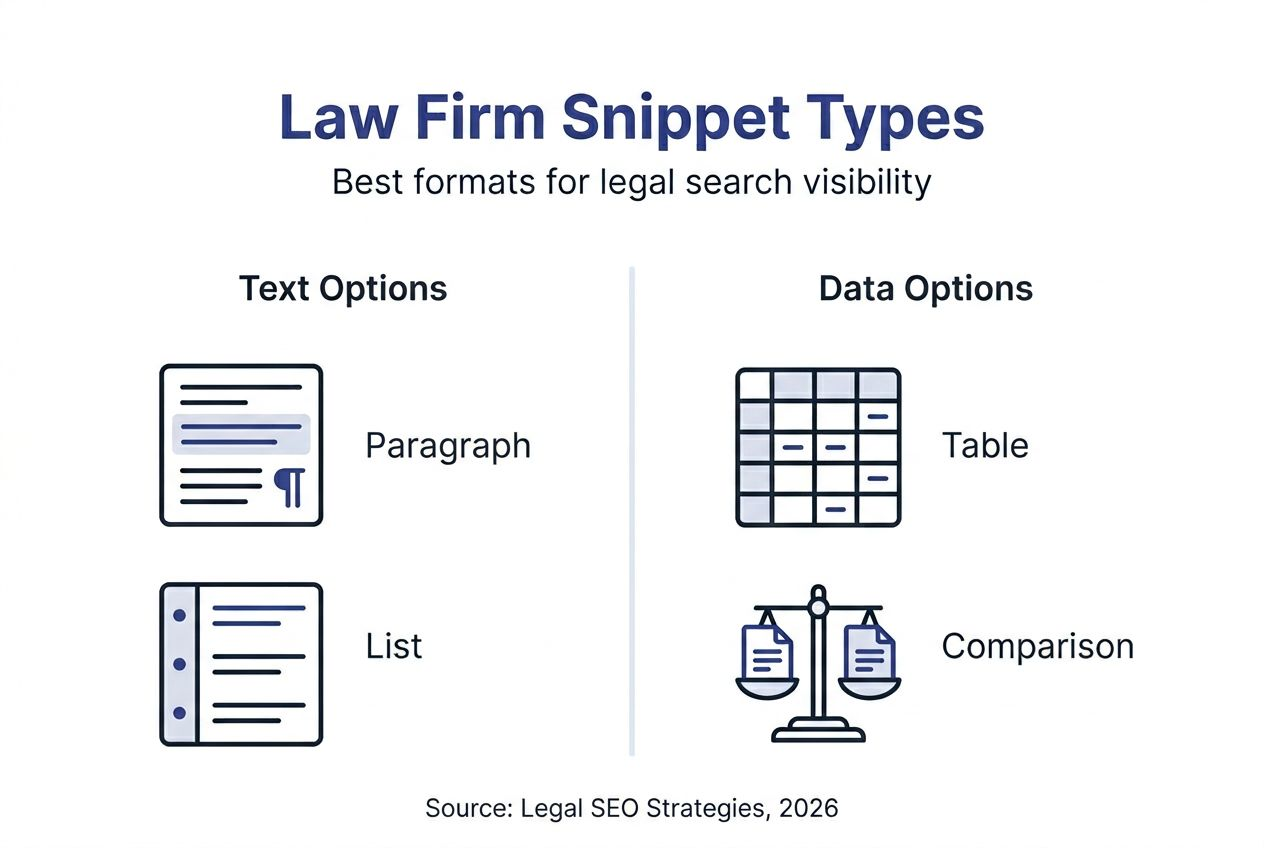
List snippets present information as bulleted or numbered sequences. They excel for process-oriented queries like “steps to file a lawsuit” or “documents needed for divorce.” Google pulls these directly from well-structured HTML lists on your pages.
Table snippets organize comparative data in rows and columns. They answer queries requiring side-by-side comparisons, like “bankruptcy chapter 7 vs 13 differences” or “state filing fee comparison.”
| Snippet Type | Characteristics | Optimization Tactic |
|---|---|---|
| Paragraph | 40-60 word text blocks answering direct questions | Write concise definitions immediately after H2/H3 question headings |
| List | Bulleted or numbered sequences of steps or items | Use proper HTML list markup with clear, actionable list items |
| Table | Comparative data in structured rows and columns | Create clean comparison tables with descriptive headers |
Structuring content for snippet capture requires deliberate formatting:
- Place your target question as an H2 or H3 heading in exact question format
- Answer immediately below the heading in 40-60 words for paragraph snippets
- Use HTML list tags for any sequential or categorical information
- Create comparison tables when discussing multiple options or alternatives
- Maintain consistent formatting throughout your legal content
The legal SEO strategies for law firms guide provides deeper tactical advice on formatting content for maximum snippet potential. Review the 2024 SEO statistics report to understand current snippet distribution patterns across legal practice areas.
Ethical and legal constraints in snippet optimization
Legal marketing operates under strict regulatory oversight that directly impacts snippet optimization. The ABA Model Rules govern lawyer advertising and require non-misleading language in marketing, creating unique constraints for law firm SEO.
Snippet content must avoid several risky practices. Never guarantee outcomes or results, as this violates advertising rules in most jurisdictions. Don’t use superlatives like “best” or “top” without verifiable basis. Avoid creating unjustified expectations about case values or success rates. Every claim in snippet-targeted content must be accurate, verifiable, and appropriately contextualized.
Key compliance tips for snippet-targeted content:
- Verify all statistics and legal information before publication
- Include appropriate disclaimers when discussing case outcomes or legal processes
- Avoid comparisons with other firms unless substantiated
- Never promise specific results or guarantee case outcomes
- Review state-specific advertising rules, as requirements vary significantly
- Maintain truthful, non-deceptive language throughout all content
Pro Tip: Before publishing any snippet-optimized content, have your legal ethics advisor or compliance officer review it for potential violations. This extra step protects your firm’s license and reputation while ensuring your SEO efforts remain sustainable.
Ethical SEO builds long-term client trust and Google credibility simultaneously. When you consistently provide accurate, helpful information without misleading claims, you establish authority that both search engines and potential clients recognize. This approach may seem slower than aggressive marketing tactics, but it creates sustainable competitive advantages that withstand regulatory scrutiny and algorithm updates.
The ethical SEO for attorneys resource provides comprehensive guidance on navigating these requirements. Understanding the ABA advertising rules ensures your snippet strategy aligns with professional responsibility standards.
Optimizing law firm content for snippet success
Capturing featured snippets requires methodical content optimization that balances SEO best practices with legal marketing constraints. Follow this five-step process to maximize your snippet acquisition rate.
-
Incorporate clear question-and-answer content aligned with client search intent. Research actual questions your target clients ask using Google’s “People Also Ask” boxes, legal forums, and your intake data. Structure content with questions as H2 or H3 headings, followed immediately by direct answers. Using clear Q&A formats can increase snippet chances by 30-50%, making this the single most effective tactic.
-
Use bullet lists and numbered lists appropriately for list snippets. When explaining multi-step processes or listing items, use proper HTML markup. Start with a clear introductory sentence, then present 3-7 list items. Keep each item concise, typically 5-15 words. This structure signals to Google that your content suits list snippet format.
-
Avoid keyword stuffing and focus on natural language. Write as if explaining concepts to an intelligent client unfamiliar with legal terminology. Define technical terms on first use. Let keywords appear naturally rather than forcing repetition. Google’s NLP can identify topically relevant content without exact keyword matching.
-
Include legal FAQ pages with structured data. Create comprehensive FAQ sections addressing common questions in your practice areas. Implement FAQ schema markup to help Google understand the Q&A structure. Optimizing legal FAQs can triple snippet likelihood compared to standard content pages.
-
Write concise, authoritative paragraph content for paragraph snippets. The ideal paragraph snippet answer is 40-60 words immediately following a question heading. Provide the core answer first, then add supporting detail in subsequent paragraphs. This structure allows Google to extract the perfect snippet length while giving readers deeper information.
Pro Tip: Continually update FAQ content based on SEO analytics and new client questions. Review your snippet performance quarterly, refreshing underperforming pages with better-structured answers and more current information.
Implementing these tactics requires understanding meta descriptions for law firm SEO and broader on-page SEO for lawyers principles. The featured snippets SEO guide offers additional technical details on optimization techniques. Apply these 7 proven legal SEO strategies for comprehensive snippet and ranking improvements.
Technical SEO tactics: schema and microdata
Structured data markup provides the technical foundation that helps Google’s AI accurately interpret and feature your law firm content. Schema markup is code added to your website that explicitly defines what each content element represents, eliminating ambiguity for search engines.
For law firms, several schema types prove especially valuable. LegalService schema identifies your practice areas and services. Attorney schema provides details about individual lawyers, their credentials, and specializations. LocalBusiness schema helps with local search visibility and maps integration. These structured data types work together to create a comprehensive, machine-readable profile of your firm.
Legal-specific schema markup boosts snippet eligibility by about 40% because it removes interpretation guesswork. When Google’s algorithm can confidently identify your content as authoritative legal information from verified attorneys, it’s more likely to feature that content prominently.
Best implementation practices for law firms:
- Use JSON-LD format for schema markup, as Google recommends this over microdata or RDFa
- Implement FAQ schema on all Q&A pages to explicitly mark questions and answers
- Add Attorney schema to lawyer bio pages with complete credential information
- Include LegalService schema on practice area pages listing specific services
- Validate all markup using Google’s Rich Results Test tool before publishing
- Update schema regularly as your firm’s information changes
| Schema Type | Primary Benefit | Implementation Tool |
|---|---|---|
| LegalService | Defines practice areas and legal services offered | Schema.org generator or SEO plugins |
| Attorney | Establishes lawyer credentials and expertise | Google’s Structured Data Markup Helper |
| LocalBusiness | Improves local search and map visibility | Yoast SEO or Rank Math plugins |
| FAQ | Explicitly marks Q&A content for snippet eligibility | Manual JSON-LD or FAQ schema plugins |
The technical SEO for lawyers guide provides step-by-step implementation instructions for each schema type. Review structured data for legal services best practices to ensure your markup meets current standards and maximizes snippet potential.
Measuring and tracking featured snippet impact
Tracking snippet performance transforms optimization from guesswork into data-driven strategy. You need baseline metrics before implementing changes, then consistent monitoring to measure impact and ROI.
Key metrics for snippet tracking include snippet acquisition frequency (how many queries trigger your snippets), click-through rate from snippet positions, and lead volume from snippet-optimized pages. Featured snippet acquisition can increase law firm leads by up to 45%, but you must track conversions to confirm this impact for your specific practice.
Essential SEO tools for snippet tracking and analytics:
- SEMrush: Tracks snippet ownership and shows competitor snippet captures
- Ahrefs: Monitors featured snippet keywords and historical snippet data
- Google Search Console: Reveals which queries generate impressions and clicks from snippet positions
- Google Analytics 4: Tracks user behavior and conversion paths from snippet traffic
- Position tracking tools: Monitor when you gain or lose snippet positions for target keywords
Benchmarks for snippet-driven success vary by practice area and market competitiveness. In competitive markets like personal injury or family law, capturing even 5-10 snippets can significantly increase qualified leads. Less competitive practice areas might see measurable impact from 3-5 well-chosen snippets. The key is focusing on high-intent queries where snippet visibility directly influences hiring decisions.
Pro Tip: Establish baseline metrics before implementing snippet optimization, including current organic traffic, lead volume, and keyword rankings. Track these same metrics monthly after optimization to prove ROI and identify which snippet types drive the most valuable traffic for your firm.
Continuous data-driven content adjustment is essential. Review your snippet performance monthly, identifying pages that lost snippets to competitors and refreshing them with updated information and better structure. Analyze which content formats generate the most engagement and leads, then replicate those patterns across other practice area pages.
The legal SEO strategies for law firms framework includes detailed tracking methodologies. Reference the Moz SEO statistics 2024 report for industry benchmarks and performance comparisons.
Leveraging AI and generative search for law firms
AI-powered conversational search represents the next frontier in client acquisition, and featured snippets provide the foundation for success in this emerging channel. ChatGPT, Google’s AI Overviews, and other generative search tools increasingly answer legal questions by synthesizing information from authoritative sources.
More than 50% of conversational search results are influenced by featured snippet content, making snippet optimization a direct investment in AI visibility. When your content captures traditional featured snippets, it’s more likely to be cited and referenced by AI chatbots answering related legal questions.
Strategies to optimize content for voice and conversational AI:
- Write in natural, conversational language matching how people speak questions aloud
- Structure content to answer follow-up questions AI tools commonly generate
- Include context and background information AI models use to synthesize comprehensive answers
- Implement schema markup that helps AI understand your content’s authority and relevance
- Create topic clusters linking related content so AI can understand your expertise depth
The growing importance of aligning SEO efforts with AI evolution cannot be overstated. Traditional search still drives most law firm leads in 2026, but AI-powered search grows monthly. Firms that optimize now for both snippet capture and AI visibility will dominate client acquisition as search behavior continues shifting toward conversational interfaces.
“AI is fundamentally changing how people find legal help. The firms that win will be those providing clear, authoritative answers that both traditional search engines and AI tools recognize as trustworthy and comprehensive.”
Integrating snippet capture with AI-focused content marketing requires a holistic approach. Every piece of content should serve multiple purposes: ranking for traditional keywords, capturing featured snippets, providing value for human readers, and offering reliable information AI tools can reference. This convergence of goals actually simplifies content strategy by focusing exclusively on comprehensive, authoritative answers to real client questions.
Explore how AI chatbots for law firms complement snippet optimization by providing 24/7 client interaction. Review the complete 2026 AI search optimization for law firms guide for advanced strategies. The AI search trends 2025 analysis provides data on adoption rates and user behavior patterns.
Boost your law firm’s visibility with expert SEO strategies
Capturing featured snippets and optimizing for AI search requires specialized expertise in both legal marketing ethics and cutting-edge SEO tactics. LawSEO.com has spent nearly three decades mastering the unique challenges law firms face in digital marketing, helping practices across the country dominate search results while maintaining full compliance with advertising rules.
Our legal SEO proven strategies have helped hundreds of firms outrank competitors and dramatically increase qualified leads. We combine technical SEO excellence with deep understanding of legal marketing constraints, ensuring every optimization protects your firm’s reputation while maximizing visibility. Whether you need comprehensive AI search optimization for law firms or want to ensure your marketing follows ethical SEO for attorneys guidelines, our team delivers results you can measure in new client inquiries and case signings.
How do featured snippets improve client acquisition for law firms?
Featured snippets increase visibility and click-through rate by providing authoritative answers atop search results, attracting high-intent prospects actively seeking legal help. They build trust by presenting your firm as Google’s chosen expert, positioning you above all competitors. Snippet placement can double or triple CTR compared to standard organic listings, translating directly to more qualified leads and client inquiries.
Can law firms optimize for featured snippets without violating ethical rules?
Yes, by avoiding misleading claims and working within advertising standards, snippet content can be both ethical and effective. The key is focusing on accurate, helpful information rather than promotional language or outcome guarantees. Consulting with legal ethics advisors ensures compliance throughout optimization, protecting your license while building sustainable competitive advantages.
What types of law firm content are best suited for featured snippets?
Paragraph-format answers to common legal questions perform best as they match Google’s preferred snippet type, representing roughly 70% of legal snippets. FAQ pages, numbered process lists, and comparison tables also capture snippets effectively when structured properly with clear headings and concise answers. Content addressing specific “how to,” “what is,” and “can I” questions tends to generate the most snippet opportunities.
How can law firms track the success of their snippet optimization efforts?
Use specialized SEO tools like SEMrush, Ahrefs, and Google Search Console to track snippet appearances and measure traffic changes from featured positions. Analyze lead volume increases and engagement metrics on snippet-optimized pages to quantify ROI. Establish baseline metrics before optimization, then monitor monthly to prove which snippet types and topics drive the most valuable traffic and conversions for your practice.