


Geofencing ads let a law firm show digital ads to people whose mobile devices are inside a defined physical area, such as a courthouse district, a hospital campus perimeter or a neighborhood. Used well, they put your firm’s name in front of a local audience at a relevant moment. Used carelessly, they can create bar advertising problems and privacy exposure. This guide explains how geofencing works for attorneys, how to build a campaign, which rules to check first, and how to tell whether it is producing clients.
TL;DR
- Geofencing ads target mobile users by physical location, then deliver display, video or social ads to their devices. They are a supplement to search, not a replacement for it.
- The strongest legal use cases are area-based: local brand awareness, event audiences and practice areas tied to a place, such as a courthouse or a business district.
- Never target accident scenes, hospital rooms or health facilities. Bar rules on solicitation and several state privacy laws restrict location-based targeting near health care sites.
- Budget is driven by impression volume, audience size, ad format and campaign length. Measure signed cases and qualified calls, not impressions.
- Build geofencing on top of a solid local SEO and Google Business Profile foundation so the people who see your ad can verify you when they search.
What geofencing ads are and how they work for law firms
A geofence is a virtual boundary drawn around a real place. When a mobile device with location services enabled enters, or has recently been inside, that boundary, an advertising platform can add the device’s anonymous advertising ID to an audience. Your ads are then served to that audience in apps, on websites and in social feeds.
Two variations matter for attorneys:
- Geofencing proper targets people while they are inside the boundary, or shortly after.
- Geo-conquesting or event targeting adds devices seen at a specific place to an audience that you can reach later, for days or weeks, wherever they go.
The second approach is usually more practical for a law firm. A person rarely decides to hire a lawyer while standing in a parking lot. A reminder that reaches them later, at home, when they are weighing the decision, is more likely to be useful. Our broader explanation of geo-targeting for law firms covers how location signals feed your whole local marketing mix.
Geofencing is a paid media tactic. It does not influence organic rankings directly. What it can do is raise familiarity with your firm name, so that when the same person searches for an attorney, your listing is one they recognize.
Where geofencing fits in the legal sales cycle
Legal services are not impulse purchases. Most people take days or weeks to move from a problem to a consultation, and many contact more than one firm. Geofencing is best at the top and middle of that cycle: awareness and recall. It is weaker at capturing a person who has already decided to hire and is typing a query into Google. Search ads and local SEO handle that moment.
Think about it as three layers:
- Intent capture: Google search, local pack and Business Profile. These reach someone actively looking.
- Area reinforcement: geofenced display, video and social ads. These keep your firm visible to people in places that correlate with your practice.
- Retargeting: follow-up ads to people who visited your website. Read our guide to ethics-first remarketing for law firms before turning this on.
A firm that buys only layer two, with a weak website and an unclaimed or poorly optimized Business Profile, will pay to generate attention it cannot convert.
Which practice areas and locations make sense
Geofencing suits practice areas where the audience gathers in identifiable places or the market is tightly local. Examples of sensible, lower-risk targets include:
- Criminal defense and DUI: the area around a county courthouse, or a city’s nightlife district, with ad copy that is informational rather than a direct approach to someone in trouble.
- Immigration: community events, cultural centers and neighborhoods where your language capabilities are relevant.
- Business and employment law: commercial districts, business parks and industry conferences.
- Estate planning and elder law: senior living community areas and local seminar venues, positioned as educational outreach.
- Personal injury: neighborhoods, workplaces and large employers in your service area. Personal injury is the practice area where restraint matters most, as covered below.
Some locations should be off your list entirely. Accident scenes, emergency rooms, hospital buildings, doctors’ offices, rehabilitation clinics and funeral homes combine bar solicitation risk with privacy restrictions. A fence that looks clever on a map can be a liability in an ethics complaint.
Check the rules before you draw a fence
State bar advertising and solicitation rules
Attorney advertising rules are set state by state, and many states build on the ABA Model Rules. The central concern for geofencing is the line between advertising and solicitation. Rules on direct contact typically prohibit in-person, live telephone or real-time electronic contact aimed at someone who needs legal services, when a significant motive is the lawyer’s financial gain. The ABA’s Model Rule 7.3 text states that principle, and your state’s current version of the rule governs your firm.
The Florida Bar offers a concrete illustration. Its 2025 Advertising Handbook says a lawyer may not contact a prospective client in person, including by telephone or other direct real-time electronic contact, when a significant motive is pecuniary gain. It also says accident scenes, hospital rooms and doctors’ offices are not business or professional meeting locations. A geofence placed around one of those sites, serving ads about injury representation, invites the argument that you targeted a person at the worst possible moment.
A practical way to stay on the right side of the line:
- Treat geofenced ads as advertising to an audience, not as a message to an identified individual.
- Keep copy informational and truthful, with no promises about outcomes and no comparisons you cannot substantiate.
- Include the disclaimers, firm name and office location your state requires.
- Keep records. Our overview of U.S. attorney advertising rules and record retention explains why you should archive every ad version and its dates. Some states require retention for years.
- Check state-specific guidance. We have written compliance guides for New York and California attorney advertising, and your bar’s ethics opinions may address digital targeting directly.
If your state has an advisory opinion process, ask before launching anything near a gray area.
Health-location privacy laws
A second set of rules applies regardless of your bar. Several states now restrict geofencing around health care facilities, and these laws can apply to any business that does it, not only health providers.
- Washington: the My Health My Data Act prohibits geofencing around facilities that provide in-person health care services when it is used to identify or track consumers seeking care, collect consumer health data or send health-related ads, according to Goodwin’s analysis of the law.
- New York and Connecticut: New York bars a geofence of 1,850 feet or less around a health care facility, other than the advertiser’s own, to deliver digital ads, build a consumer profile or infer health status. Connecticut, effective October 1, 2023, prohibits geofencing within 1,750 feet of a mental health or reproductive or sexual health facility for tracking, data collection or notifications about health data, as Rivkin Radler summarizes.
- California: AB 45, effective January 1, 2026, bans geofencing within 1,850 feet of family planning centers to target individuals with advertisements related to health care services, with civil penalties of $25,000 per infraction, per Censinet’s regulatory overview.
These laws are written around health care, and a law firm’s ad is not obviously a health ad. But personal injury, medical malpractice and disability firms operate close to that territory, and an ad that implies knowledge of a person’s medical situation is exactly what these laws aim at. The safe approach is to keep every fence well clear of clinics, hospitals and similar facilities, and to have counsel review any campaign that comes near one. This area is changing, so confirm the current statute in each state where you advertise.
How to set up a geofencing campaign
- Define one goal. Brand awareness among a defined audience, consultation requests from a specific neighborhood, or event follow-up. A single measurable goal keeps the campaign testable.
- Choose the geography. Start from your practice area and service territory. Draw fences around places that indicate who someone is or what they do, such as a business district, a courthouse area for a defense practice, or a community event, rather than the places where they are most vulnerable.
- Pick the audience logic. Decide whether you want people currently in the fence, people who visited in the last several weeks, or both. For legal services, the visited-recently audience generally gives you more time to reach them with a considered message.
- Select formats and platforms. Mobile display banners, short video, streaming audio, and social placements on the major networks are all typical. Our guide to Facebook ads for lawyers explains why tracking has to be in place before you spend.
- Write compliant creative. Lead with a service or an educational resource. Include your firm name, location and required disclosures. Avoid language that suggests you know the viewer’s circumstances, for example a headline implying they were just in an accident.
- Send traffic to a purpose-built page. A page matching the ad, with a clear call button, a short form and a plain statement of what happens after contact, converts better than a generic home page.
- Set frequency caps and a schedule. Overexposure wastes budget and irritates the audience. Run ads when your intake team can answer.
- Launch small, then compare. Run two or three fence sizes or creatives against one another for a few weeks before scaling.
Choosing fence size
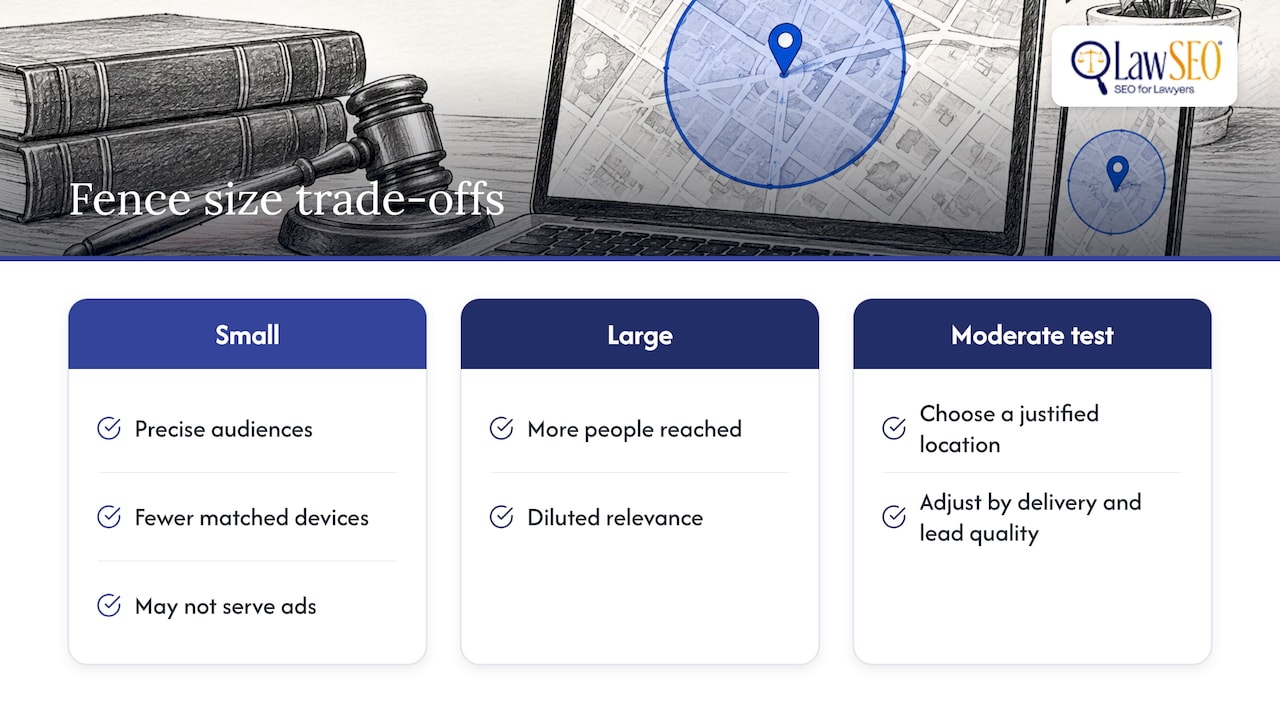
Small fences produce precise audiences but small ones, and location accuracy on phones has limits. A very small fence around one building can leave you with too few matched devices to serve ads at all. Larger fences capture more people but dilute relevance. The workable answer is a test: begin with a moderate fence around a place you can justify on audience grounds, then adjust according to delivery and lead quality.
What geofencing costs and what drives the budget
Geofencing is usually bought on a cost per thousand impressions (CPM) basis, and a managed campaign adds the vendor’s service fee or markup. Pricing varies widely by provider and market, so we will not quote a figure you should expect. The main drivers, which providers commonly cite, are:
- Campaign objective and the competitiveness of your market
- Audience size and how many fences you run
- Targeting strategy, including how narrow the audience is
- Ad format, since video typically costs more per thousand impressions than display
- Impression volume and campaign length
Two budget principles apply to a law firm. First, impressions are cheap compared with clicks on high-intent search terms, but they convert far less often. Second, awareness advertising needs time. A two-week test rarely tells you much about a decision that people take over a month. Plan for a test window long enough to see calls and form submissions follow, and put the money you cannot spare for it into search and local SEO first.
Our article on TV ads for lawyers includes a similar cost-and-rules framework for streaming and connected TV, which is often paired with geofenced audiences.
Measuring whether geofencing works
Impressions and click-through rates are the easiest numbers to get and the least useful. Build measurement around what a managing partner cares about: matters signed.
- Dedicated tracking: use a unique phone number and a campaign-specific landing page for geofenced traffic, with UTM parameters on every link.
- Call tracking and intake notes: have intake staff ask every caller how they found you, and record the answer in your case management system.
- Lead quality, not volume: track what share of geofence leads are in your practice area, in your territory and willing to schedule a consultation.
- Assisted conversions: many people who saw a geofenced ad will convert later through a branded search or the Business Profile. Watch branded search volume and direction requests in the geographic areas you target.
- Cost per signed case: divide total spend, including management fees, by retained clients attributed to the campaign. Compare it to your cost per signed case from search and referrals.
Run the same measurement discipline on every channel so comparisons are fair. Our guide to online lead generation for attorneys lays out the conversion basics that make any paid channel measurable.
Our perspective
Geofencing is a legitimate tool, but it works only as one part of a system. In our work with law firms, we see attorneys buy location-based ads before their foundations are in place, and the ads then send people to a thin website and an incomplete Google Business Profile. That is paying twice for the same attention.
We approach paid media the way we approach everything else for law firms: as a specialist in the legal sector, led by Todd Stager, who has more than 29 years in SEO and personally handles or reviews strategy for every client campaign. Compliance is built into the plan from the start, because a clever ad that creates a bar complaint is worse than no ad.
Our view is that the first dollars belong in local SEO, Business Profile optimization and content that answers client questions. Paid channels such as PPC, social ads and streaming TV then reinforce that visibility, and a geofenced audience becomes a way to keep a firm familiar to people nearby. We also optimize for the new front door, AI search tools, which increasingly name firms in answers. Ads that raise familiarity and a web presence that machines can understand support one another.
Where we offer exclusivity, we do not work with a client’s local competitors, so the strategy we build is yours alone in your market.
TODD
Build the foundation, then add geofencing
Before you spend on location-based ads, make sure the pages and listings people will land on are ready. Our local SEO checklist for law firms is a good place to start, and a technical SEO audit for attorneys will show you what is holding your site back.
If you want a single team to handle search, paid advertising and web design with legal compliance in mind, see our law firm marketing services. That includes local SEO, Google Business Profile work, PPC and social ads, streaming TV and AI search optimization, managed under one strategy and reported against signed cases.
Common mistakes to avoid
- Fencing sensitive places. Hospitals, clinics, accident scenes and similar sites mix bar risk with privacy law risk.
- Using creative that implies knowledge of a person’s situation. Keep ads generic and informational.
- Skipping record keeping. Save every version of an ad and when it ran.
- Ignoring state differences. A campaign compliant in one state may not be in another. Review each state where the ads will be served.
- Judging results by impressions. Tie spend to qualified calls and retained matters.
- Sending traffic to the home page. Use a dedicated page that matches the ad.
- Letting a vendor run it unsupervised. You remain responsible for advertising done in your name, so review all creative and targeting before launch.
FAQ
Are geofencing ads legal for lawyers?
Geofencing itself is a lawful advertising method, but how you use it is regulated. Your state bar’s advertising and solicitation rules apply, and several states restrict geofencing near health care facilities. Review your state’s current rules and consult ethics counsel for any campaign that touches a gray area.
Can a personal injury firm geofence a hospital or accident scene?
We advise against it. Bar guidance such as the Florida Bar’s handbook treats accident scenes, hospital rooms and doctors’ offices as inappropriate places for approaching prospective clients, and health privacy laws in states like Washington, New York and Connecticut restrict geofences near health care facilities. Target neighborhoods, employers and community settings instead.
How much should a law firm spend on geofencing?
There is no standard figure, because cost depends on audience size, ad format, impression volume and duration. Start with a modest test budget that runs long enough to generate leads, and fund search and local SEO first. Judge the result by cost per signed case.
How do I know geofencing is generating clients?
Use a dedicated phone number, a campaign landing page and intake questions that record how each caller found you. Then compare the cost per signed case with your other channels, and watch branded search and direction requests in the targeted areas.
Sources
- ABA Model Rule 7.3, Direct Contact With Prospective Clients
- The Florida Bar Advertising Handbook, 2025 Edition
- Goodwin: Washington’s My Health My Data Act Comes Into Force
- Rivkin Radler: New York and Connecticut Prohibit Geofencing near Health Care Facilities
- Censinet: Emerging Privacy Regulations in Digital Health
