


TL;DR:
- Organic traffic builds long-term authority and trust without ongoing per-click costs.
- Paid traffic provides immediate visibility but is costly and stop-dependent.
- Successful law marketing blends both channels based on goals, budget, and practice area.
Most law firm partners assume that spending more on Google Ads automatically means more clients. That assumption is costing firms thousands of dollars every month. The reality is that organic and paid traffic serve very different roles in your client acquisition pipeline, and treating them as interchangeable is one of the most common and expensive mistakes in legal marketing. Understanding how each channel works, what it costs over time, and when to use each one is the foundation of a sustainable growth strategy. This article gives you a clear, evidence-based framework for making that decision.
Key Takeaways
| Point | Details |
|---|---|
| Know your traffic sources | Organic and paid traffic each bring unique strengths to a law firm’s client acquisition strategy. |
| Balance short and long-term ROI | Paid ads drive quick results, but organic SEO builds lasting authority and lead flow. |
| Customize your approach | Strategic resource allocation depends on your firm’s goals, competition, and market region. |
| Track, adapt, and invest wisely | Continuous review and optimization of both channels ensures stronger growth and better returns. |
Understanding organic vs paid traffic for law firms
Let’s start by clarifying the concepts at the heart of this decision.
Organic traffic refers to visitors who find your firm through unpaid search results. This includes traditional Google rankings driven by SEO, local search results like Google Business Profile listings, and legal directory placements on platforms like Avvo or Justia. Paid traffic refers to visitors who arrive through advertisements you pay for, including Google Ads (pay-per-click or PPC), display ads, and social media advertising on platforms like Facebook or LinkedIn.
The distinction matters because user behavior differs significantly between these two groups. People clicking organic results tend to be in a research or evaluation phase, often reading multiple sources before contacting a firm. People clicking paid ads are frequently in a more immediate decision mode, especially when searching high-intent queries like “divorce attorney near me” or “DUI lawyer free consultation.”
Here is a side-by-side comparison to frame the decision:
| Factor | Organic traffic | Paid traffic |
|---|---|---|
| Source | SEO, local search, directories | PPC, Google Ads, social ads |
| Speed to results | Slow (months) | Fast (days) |
| Cost structure | Upfront investment, lower ongoing | Ongoing spend per click |
| ROI timeline | Long-term compounding | Short-term, budget-dependent |
| User trust | High | Moderate |
Proper structuring of law firm websites is foundational to organic performance, influencing how search engines crawl and rank your pages.
Core advantages of organic traffic:
- Builds lasting authority and brand trust
- No cost per click once rankings are established
- Compounds over time as content ages and earns links
- Positions your firm as a credible resource
Core advantages of paid traffic:
- Immediate visibility for competitive keywords
- Precise targeting by location, device, and intent
- Scalable based on budget and campaign goals
- Measurable return on ad spend in real time
Both channels have real drawbacks too. Organic requires sustained effort and patience. Paid traffic stops the moment you stop funding it. Neither is a silver bullet, and comparing both channels carefully is the only way to allocate your marketing budget wisely.
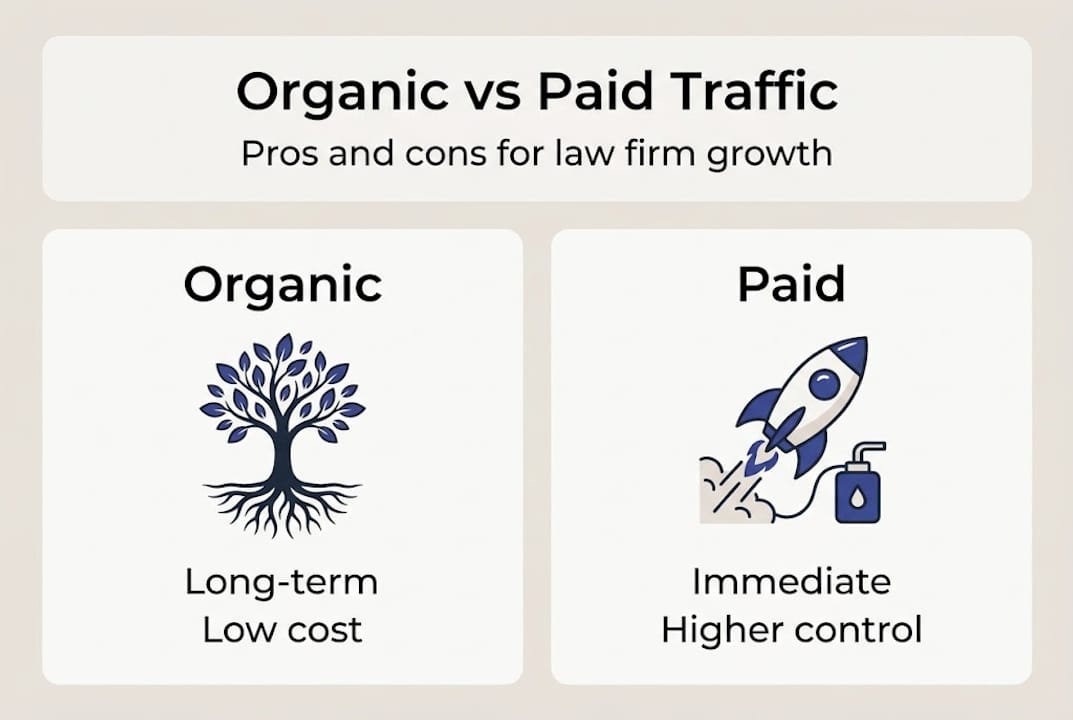
The pros and cons of organic traffic for law firms
Once you understand the basics, it’s essential to weigh the unique strengths and challenges of organic traffic for law firms.
Organic search is the backbone of long-term client acquisition for most successful law practices. Organic search still drives the majority of web traffic across industries, and legal services are no exception. The trust factor is significant. Prospective clients who find your firm through a top Google ranking often perceive that placement as an implicit endorsement of your credibility.
That said, organic traffic is not a quick fix. Rankings start slow but compound over time, meaning the investment you make today in content and technical SEO pays dividends months and years from now. Most new campaigns require 4 to 12 months before meaningful traffic gains appear.
Key benefits of organic traffic for law firms:
- Authority building: Consistent rankings signal expertise to both search engines and prospective clients
- Cost efficiency: Once established, organic traffic does not require per-click spending
- Sustainable lead flow: A well-ranked page continues attracting leads without additional ad spend
- AI search visibility: Optimized content is increasingly surfaced by AI-driven tools and chatbots that prospective clients use to find attorneys
Key drawbacks:
- Slow initial ramp-up period with limited early visibility
- Requires ongoing investment in content, on-page SEO, and link building
- Rankings can shift with Google algorithm updates
- Competitive practice areas like personal injury or criminal defense require substantial effort to rank
“The firms that invest in organic search early are the ones that dominate their markets in three to five years. The ones that skip it are always playing catch-up.”
Pro Tip: To accelerate early SEO wins, prioritize your Google Business Profile and local citation consistency before tackling competitive national keywords. Local optimization can produce visible results in 60 to 90 days, giving your firm traction while longer-term Google ranking improvements take hold.
The benefits and risks of paid traffic for legal practices
After examining organic approaches, let’s turn to how paid channels can accelerate or drain your client acquisition efforts.
Paid advertising delivers something organic simply cannot: speed. A well-configured Google Ads campaign can put your firm in front of high-intent searchers within 24 to 48 hours of launch. For firms entering a new market, launching a new practice area, or recovering from a slow quarter, that immediacy has real value.
However, legal keywords are among the most expensive in all of Google Ads. Legal PPC benchmarks show that cost-per-click (CPC) for legal terms regularly exceeds $50, with some personal injury and mass tort keywords surpassing $200 per click. Paid ads deliver rapid visibility but can become costly and unsustainable without careful management.
Here is a snapshot of typical legal keyword costs and performance:
| Practice area | Avg. CPC | Avg. conversion rate |
|---|---|---|
| Personal injury | $50-$200 | 3-5% |
| Criminal defense | $30-$100 | 4-6% |
| Family law | $20-$60 | 5-8% |
| Immigration | $15-$45 | 4-7% |
| Estate planning | $10-$30 | 6-9% |
Steps to assess your paid campaign ROI:
- Calculate your average case value for the targeted practice area
- Determine your current cost per lead from paid campaigns
- Measure your lead-to-client conversion rate
- Divide your total ad spend by the number of new clients acquired
- Compare that cost per client against your average case revenue
If the math does not work at current CPCs, the campaign needs restructuring before you scale it.
Risks of paid traffic for law firms:
- Budget dependency: traffic stops immediately when spending stops
- Click fraud and irrelevant clicks can inflate costs
- High competition in major metro markets drives CPCs higher each year
- Without a strong landing page, even well-targeted ads convert poorly
Pro Tip: Target lower-competition, high-intent practice area keywords in specific geographic submarkets. Instead of bidding on “personal injury lawyer,” test “truck accident attorney city name]” to reduce CPC while maintaining lead quality. Reviewing the full [SEO vs PPC cost analysis for your specific practice area helps calibrate realistic expectations.
How to choose the right mix: Strategy for law firm growth
With pros and cons in mind, here’s how law firm leaders can map out their optimal organic and paid traffic investment.
Law firms succeed by blending organic and paid efforts based on specific goals and budgets, not by defaulting to one channel. The right allocation depends on your firm’s size, growth stage, practice areas, and competitive market.
Steps to audit your current web marketing results:
- Pull 12 months of data from Google Analytics and Google Search Console
- Identify which pages and keywords drive the most qualified leads
- Review your Google Ads account for cost per conversion by campaign
- Calculate the percentage of new clients attributed to organic vs paid sources
- Identify gaps: practice areas with no organic presence or underperforming ad groups
Once you have a clear picture, use this framework to guide resource allocation:
When to invest more in organic:
- Your firm has a 12-plus month growth horizon and can absorb a slower ramp-up
- You practice in a niche area with lower keyword competition
- You want to reduce long-term marketing costs and build brand authority
- Your current paid CPCs are delivering a negative or marginal ROI
When to scale paid traffic:
- You need clients immediately and have budget available
- You are entering a new market or launching a new practice area
- Seasonal demand spikes justify short-term ad investment
- You have tested and optimized landing pages ready to convert traffic
Firm size also shapes strategy. Solo practitioners and small firms often benefit from a local SEO-first approach, using paid ads selectively for high-value case types. Mid-size firms with dedicated marketing budgets can run both channels simultaneously, using paid ads to fill short-term pipeline while organic compounds. Larger firms should treat both as permanent, parallel investments.
Ongoing optimization checklist:
- Review keyword rankings monthly and refresh underperforming content
- Audit paid campaigns weekly for wasted spend and negative keyword gaps
- Test new landing pages quarterly to improve paid conversion rates
- Update your website structure for legal SEO as you add new practice area pages
- Track new client source attribution consistently to keep data clean
Why most law firms get stuck: Beyond the organic vs paid debate
Having covered tactical details, it’s time for a frank perspective on what actually works in legal marketing.
After nearly three decades working in SEO, the pattern is clear: the firms that struggle most are not the ones with small budgets. They are the ones that treat organic and paid as competing priorities rather than complementary systems. They run Google Ads until costs spike, then pull the budget and wait for SEO to kick in. When SEO takes time, they restart paid ads. The cycle drains resources and builds nothing lasting.
The firms that win consistently use data to shift budget seasonally. They lean on paid ads during high-demand periods, like post-holiday divorce filings or summer personal injury season, while organic content keeps generating leads year-round. They never go dark on either channel entirely.
The contrarian truth is this: chasing quick wins with paid traffic without an organic foundation is not just expensive, it is fragile. One algorithm change or a competitor outbidding you can erase your visibility overnight. SEO’s importance for law firms is not just about rankings. It is about building an asset that works for you even when you are not actively spending. Build for both the short and long pipeline. Do not pick either/or.
Unlock more legal clients with tailored SEO and PPC solutions
For law firms ready to put these principles into practice, expert help is available.
At LawSEO.com, we work exclusively with attorneys and law firms to build client acquisition systems that perform across both organic and paid channels. Whether you need to establish a stronger foundation through legal SEO essentials, want to review detailed cost comparisons for your specific practice area, or are ready to explore law firm marketing strategies tailored to your growth goals, our team has the tools and experience to help. Contact us today for a customized marketing plan built specifically for your firm’s market, practice areas, and budget.
Frequently asked questions
Is organic or paid traffic more cost-effective for law firms?
Organic traffic is typically more cost-effective over the long term because rankings continue generating leads without ongoing per-click costs, while paid traffic delivers faster results but requires continuous budget to maintain visibility.
How long does it take to see results from SEO for law firms?
Most law firms begin seeing significant organic gains after 4 to 12 months of consistent SEO effort, though local optimization can produce early wins within 60 to 90 days.
What’s a good budget for paid ads in the legal industry?
Highly competitive practice areas like personal injury or criminal defense may require several thousand dollars monthly to generate meaningful results, while niche or lower-competition areas can perform with more modest budgets.
Can law firms rely only on paid ads or only on SEO?
Relying solely on either channel is risky because combining both strategies creates a more resilient pipeline, with paid ads filling short-term gaps and organic traffic building long-term authority and lead flow.