


TV ads for lawyers still work when the practice area suits the medium, the creative gives a viewer one clear reason to call, and someone can trace calls and signed cases back to the spot. Most firms that lose money on television lose it on the last two points, not on the choice of channel. This guide explains why attorney commercials exist, how broadcast and streaming differ, what a good spot contains, which rules apply, and how to judge whether the money is paying off.
TL;DR
- Lawyer TV advertising is legal everywhere in the U.S. since 1977, but each state still regulates content, so check your state’s rules before a script is written.
- Streaming and connected TV now sit beside broadcast, letting smaller firms target by geography and audience instead of buying a whole market.
- A spot that wins cases has one practice area, one promise you can honestly keep, one phone number and a clear next step.
- Call logs alone cannot prove television works. Plan attribution before the first airing, not after the first invoice.
- Pair television with search visibility, because viewers who see a spot often search your firm’s name before they call.
Why lawyers advertise on television at all
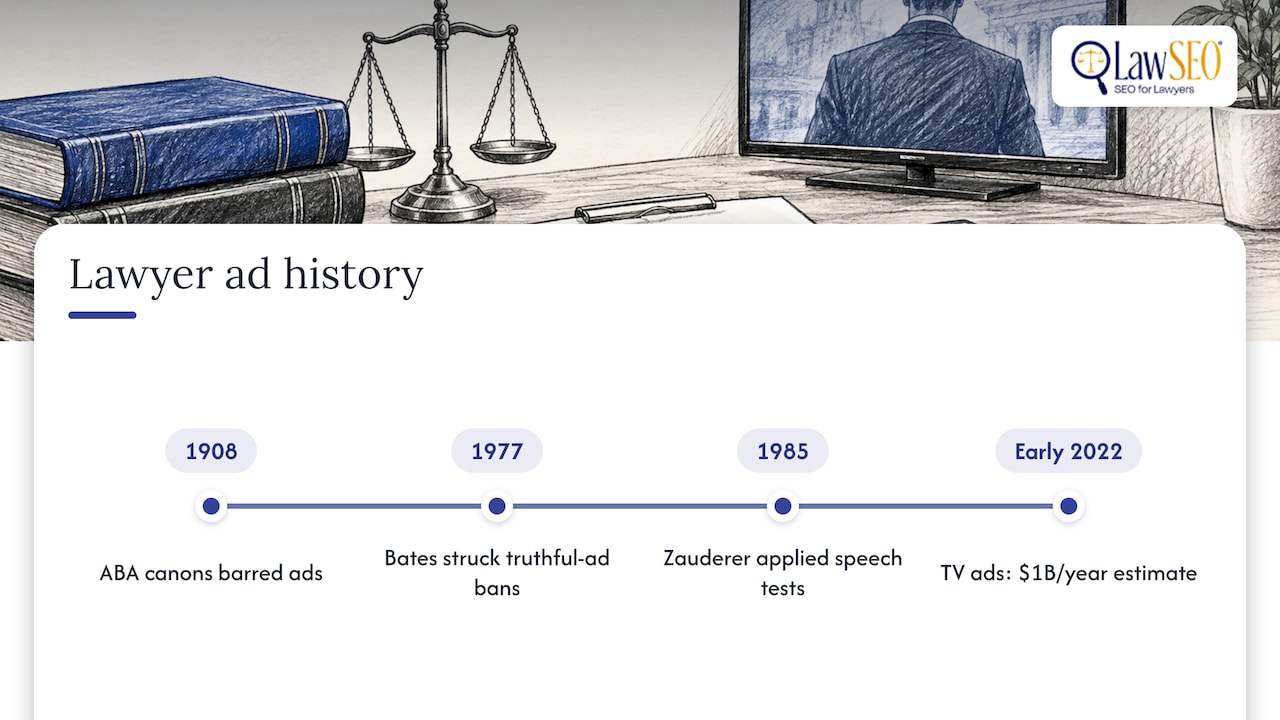
For most of the twentieth century, a lawyer who advertised risked discipline. According to CBS News, American Bar Association canons generally barred lawyer advertising from 1908 until 1977, when the U.S. Supreme Court decided Bates v. State Bar of Arizona and held that state bans on truthful attorney advertising were unconstitutional. The American Bar Association’s own history of the doctrine traces how later cases, including Zauderer v. Office of Disciplinary Counsel in 1985, applied commercial speech tests to lawyer advertising and set the limits states work within today.
Once the ban fell, television filled up quickly. CBS News reports that lawyer television advertising was estimated to be a billion-dollar-a-year industry as of early 2022. That figure is an estimate and it is several years old, so treat it as a sense of scale rather than a current budget number.
The reason the spots keep running is practical. The same CBS report quotes attorney Trish Rich making the point that most Americans hire a lawyer only once or twice in their lives and have no personal connection to one. When an injury, an arrest or a divorce arrives, the firm they have seen on television is often the first name they have.
The Federal Trade Commission has long taken the view that advertising helps consumers. In a staff comment to the ABA, FTC staff said evidence suggests that routine legal services cost less where advertising is permitted. That is an argument about competition, not a promise that any individual campaign will pay back.
Which practice areas use TV, and which should not
Personal injury firms dominate lawyer television. Criminal defense, family law, bankruptcy, immigration and workers’ compensation firms also buy time, but personal injury remains the most visible category. The pattern follows economics. Television is a mass-reach medium: you pay to be seen by many people who do not need you today so that you are remembered by the few who do.
That suits practice areas with three traits:
- High case value. A single signed case must be able to cover a meaningful share of the media budget.
- Unplanned demand. The client did not shop for a lawyer last month. They need one after an event.
- Broad addressable market. A large share of the viewing audience could plausibly become a client.
A niche practice, such as a firm handling a narrow category of commercial disputes, rarely meets these tests. For those firms, search visibility, directory profiles and referral relationships usually deliver more qualified inquiries per dollar than a television flight.
Broadcast, cable and streaming: choosing where to air
Traditional broadcast and cable still carry heavy lawyer spend. CBS News also notes a shift among high-performing firms toward internet-first, over-the-top ads with low-budget, viral or humorous creative aimed at younger viewers who do not watch linear television. The Texas Law Hawk’s jet skis and motorcycles are the example the report gives.
The practical differences look like this.
| Factor | Broadcast and cable | Streaming and connected TV |
|---|---|---|
| Buying unit | Time slots in a designated market area | Impressions targeted by location and audience |
| Minimum commitment | Often higher, with production plus media | Can start smaller and scale |
| Audience | Older and local-news viewers skew heavily | Cord-cutters and younger households |
| Targeting | By daypart and program | By geography, device and audience segment |
| Measurement | Call tracking and surveys, indirect | Digital signals such as site visits, still imperfect |
| Creative length | Usually 15 or 30 seconds | Often 15 or 30 seconds, unskippable in many placements |
Neither column is better in every market. A firm in a mid-sized city with a loyal local news audience may still get its best reach from broadcast. A firm trying to reach under-40 households in a metro area may find broadcast wasteful. The right answer comes from your intake data: who calls, how old they are, and what they say when asked how they heard about you.
We treat television, including streaming and connected TV campaigns, as one channel in a larger acquisition plan. If you want the longer treatment with examples of spots that led to signed cases, our guide to TV advertising for law firms goes further.
What a lawyer commercial needs to do in 30 seconds
The spots that rank on “best lawyer commercial” lists are often memorable because they are strange: parodies, mascots, motorcycles, shouted slogans. CBS Detroit’s write-up of an outrageous lawyer commercial asks the right question in its opening line: how does a lawyer stand out in a sea of local commercials? Standing out is only half the work. The other half is giving the viewer a reason to act.
A useful structure for a 30-second spot:
- Seconds 0 to 5: the situation. Name who the ad is for. “Hurt in a truck accident?” does more than a logo animation.
- Seconds 5 to 15: the proof. One verifiable fact about the firm, such as years practicing, trial experience or a no-fee-unless-you-win arrangement if that is truly how you work.
- Seconds 15 to 25: the promise. What the viewer gets when they call. A free case review is common. Keep it accurate.
- Seconds 25 to 30: the number and the name. Say the phone number twice, show it on screen, and repeat the firm name.
Pick a hook, then stay on it
The “hammer” nickname is a good case study. CBS notes that Jim Adler, the Texas Hammer, and Darryl Isaacs, who calls himself The Hammer, each built a market identity on the same word, and that this led to branding fights in their markets. The lesson for a smaller firm is that a distinctive identity is an asset, but it has to be yours and it has to stay consistent for years. A new gimmick each quarter resets the recognition you paid for.
Send viewers somewhere that finishes the job
Many people who see a spot will not dial from the couch. They will pick up a phone, search the firm’s name and look at the reviews, the website and the Google Business Profile. If those assets are thin, the television money leaks. Before you book airtime, confirm that a branded search returns a clean profile, current reviews and a site that loads fast on mobile. That is the work our local SEO and search optimization services are built around.
The rules: what you can say and what you cannot
The baseline is generous. ABA Model Rule 7.2(a) states that a lawyer may communicate information regarding the lawyer’s services through any media. But the Model Rules are a template. Each state adopts its own version, and the differences matter in a script.
Typical areas where state rules bite, and where you should confirm your own state’s text:
- Required disclaimers and the name of the responsible attorney
- Restrictions on testimonials and client endorsements
- Rules about dramatizations, actors and results claims
- Limits on describing yourself as a specialist or expert
- Record-keeping requirements for the ad and its airing history
We have written state-specific guides for two of the largest markets: New York attorney advertising rules and California attorney advertising rules. For the record-keeping side, including how retention applies as AI tools enter the workflow, see our overview of U.S. attorney advertising rules.
Federal scrutiny of lawsuit-solicitation ads
State bars are not the only regulator. The FTC has said lawyers may advertise, but their ads must not be deceptive under the FTC Act. Its warning letters about prescription drug lawsuit TV ads concern ads that could lead viewers to stop prescribed medication, falsely suggest FDA involvement or misstate the risk of rare side effects. If your firm recruits plaintiffs in mass torts or drug cases, a script that frightens viewers about a medication needs careful legal review before it airs. Cases involving health risks are where a loose line of copy can cause real harm to a viewer.
The FTC has also cautioned that overly broad limits on lawyer advertising, such as bans meant only to protect a “dignified” image, can deprive consumers of truthful information. So the standard you are held to is truthfulness, not taste. Your goal is an ad that is both effective and defensible if a bar counsel or a regulator reads it closely.
If you are unsure whether a claim in your script is permissible, ask your state bar’s ethics hotline or your firm’s ethics counsel before the shoot, not after the media buy.
How to tell whether television is working
This is where most campaigns go wrong. A call tracking number tells you how many people dialed. It does not tell you how many saw the ad, searched your name and then clicked a different number, or how many signed. Television’s effect often shows up as a rise in branded search, direct visits and calls to your regular office line, none of which a TV-only tracking number captures.
A workable measurement plan has five parts:
- Baseline first. Record branded search volume, direct traffic, call volume and signed cases for at least eight weeks before the first airing.
- Unique tracking numbers by flight. Use a different number for each station, daypart or streaming campaign so you can compare placements.
- Intake discipline. Train staff to ask every caller how they heard about you and record the answer in your case management system, not on a sticky note.
- Signed-case matching. Tie the first-contact source to the retained matter, not only the lead. Leads are cheap; signed cases are the number that matters.
- Lift analysis. Compare branded search and total inquiries in the markets and weeks when ads ran against the baseline and against markets where they did not.
We go deeper on why raw call logs mislead in law firm TV attribution. A simple rule of thumb: if your reporting cannot connect a spot to a retained case, you are measuring activity, not return.
A worked example of cost per signed case
The numbers below are illustrative, not benchmarks or client results. Suppose a firm spends a combined amount on production and airtime during a flight, receives a number of qualified calls, and signs a share of them. Divide total spend by signed cases. Then compare that figure with the average fee on a signed case. If the cost per signed case is a small fraction of the average fee, the channel may be worth scaling. If it approaches or exceeds the fee, the problem could be the creative, the market, the intake process or all three. Measure each before you cut the budget or double it.
Perspective: television works when search is ready for it
We have spent years watching what happens after a firm’s commercial airs. A viewer who sees a spot at 7 p.m. rarely calls during the commercial. More often they pick up a phone and type the firm’s name, or a description such as the practice area plus the city, into Google or ask an AI assistant who to call. What they find in the next ninety seconds decides whether the spot paid off.
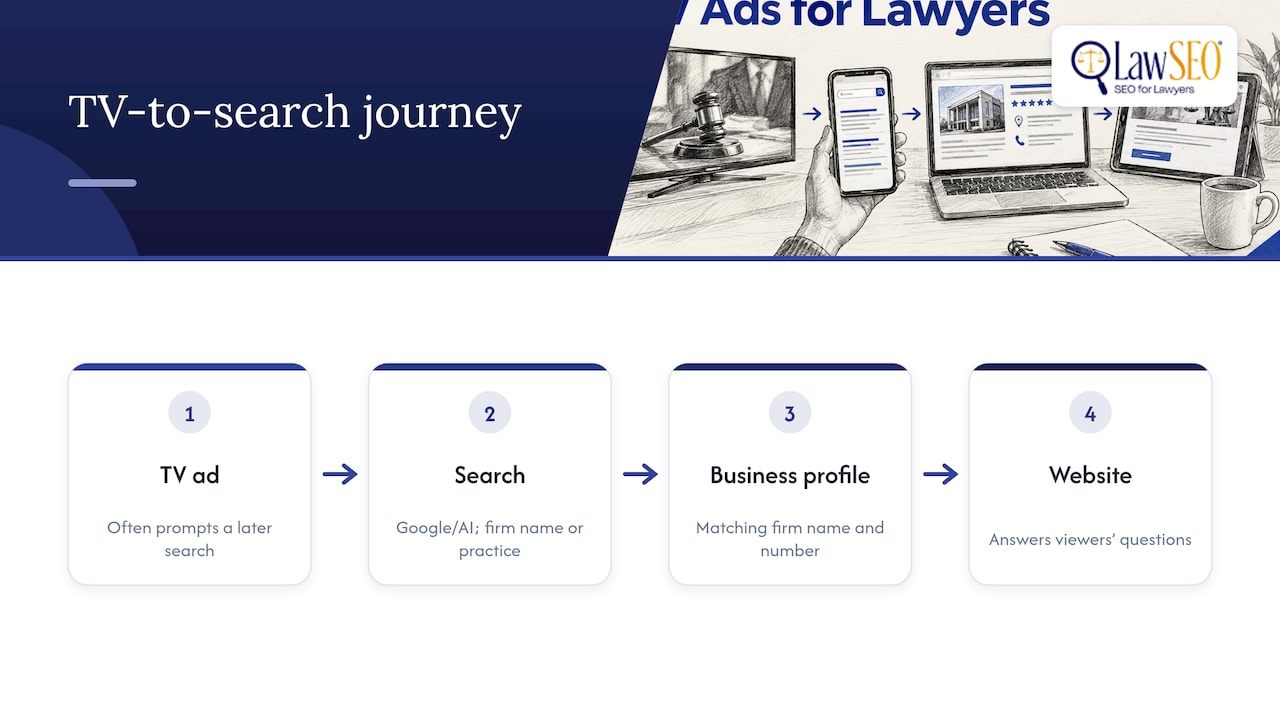
That is why we at LawSEO treat television as part of a system. Our firm works exclusively with attorneys and law firms, and Todd R. Stager, who has more than 29 years in SEO, personally handles or reviews strategy for every client campaign. When a client runs TV or streaming ads through us, the work around it is what we focus on: a Google Business Profile that matches the firm’s name and number, a site that answers the questions a viewer has, and visibility in the AI tools that are becoming another front door for clients.
We also offer exclusivity agreements, meaning we do not work with a client’s local competitors. For a firm investing in television, that matters. You should not be paying to build awareness that a rival’s search campaign, run by the same agency, is positioned to capture.
Our advice to a partner weighing a first television budget is plain. Do the search and reputation groundwork first. Write one honest promise. Measure from week one. And have your ethics counsel read the script.
— TODD
Where LawSEO fits
If you are planning a television or streaming flight, or you already have spots running and cannot say what they return, we can help build the foundation around them: local SEO, Google Business Profile optimization, AI search optimization, paid advertising and streaming/CTV campaigns, reporting that connects activity to cases. You can see the full list on our services page. For a firm that wants a review of how visible it is today before spending on media, our SEO audit for attorneys is the practical first step.
FAQ
Was it ever illegal for lawyers to advertise on TV?
For decades, lawyer advertising was effectively prohibited. CBS News reports that ABA canons generally barred it from 1908 until the Supreme Court’s 1977 decision in Bates v. State Bar of Arizona struck down state bans on truthful attorney advertising. Today it is legal, but states still regulate the content.
Why are there so many lawyer commercials on TV?
Most people hire a lawyer rarely and do not know one personally, so the firm they have seen repeatedly has an advantage when a need arises. Television gives high-value practice areas, especially personal injury, broad reach in a local market. The industry was estimated at roughly a billion dollars a year in early 2022.
Can lawyers say anything they want in a TV ad?
No. State bar rules govern content, and the FTC polices deception. The ABA’s Model Rule 7.2 allows advertising through any media, but claims must be truthful and not misleading, and your state’s version of the rule controls. Ads about drug lawsuits receive particular FTC attention.
Is streaming TV better than broadcast for a law firm?
Not automatically. Streaming offers tighter geographic and audience targeting and smaller starting commitments, while broadcast can still deliver strong local reach with older audiences. Look at who actually calls your firm, then test each channel against signed cases.
Sources
- How lawyers’ TV ads became a billion-dollar industry, CBS News
- The Most Outrageous Lawyer Commercial Ever Made, CBS Detroit
- Warning Letters regarding Prescription Drug Lawsuit TV Ads, Federal Trade Commission
- FTC staff comment to the American Bar Association on attorney advertising
- Lawyer Advertising and Solicitation, American Bar Association
- Rule 7.2: Communications Concerning a Lawyer’s Services, American Bar Association
