

Criminal defense lawyer SEO is different from most legal SEO because the searcher is usually under pressure, often searching on a phone, and almost never in a calm, comparison-shopping mindset. If your firm still treats criminal defense lawyer SEO like a generic practice-area campaign, you will miss the queries that matter most.
A prospective client may search after an arrest, after a call from a detective, after a DUI stop, after learning about a warrant, or after a family member gets booked into jail. They may see your Google Business Profile, your website, a directory profile, an AI answer, and then a second round of research before they ever call. That is why modern criminal defense SEO has to combine classic search visibility with AI search optimization, better information architecture, and faster conversion paths.
The firms that win criminal defense search are not just the firms that rank. They are the firms that look immediately relevant, immediately credible, and immediately reachable.
Why Criminal Defense Lawyer SEO Is Different
Most legal SEO pages speak in broad terms. Criminal defense cannot afford that. This practice area is driven by urgency, discretion, geography, and trust.
Urgency changes search behavior
Criminal defense prospects are often searching under stress. They are not leisurely reading a law firm blog on a desktop with ten tabs open. They want answers now, clear next steps now, and a lawyer they can contact now. That is why search intent matters so much in this practice area. The site has to serve the panic search, the research search, and the hire-now search without confusing the reader.
Discretion changes what earns trust
Criminal defense clients are often more private than plaintiffs in other practice areas. Some do not want to fill out long forms. Some are wary of public reviews. Some do not want to explain their situation in detail until they trust the lawyer. That means your website needs stronger user experience, clearer reassurance, and lower-friction conversion than an ordinary service page.
Local jurisdiction changes what should rank
“Criminal defense lawyer” is too broad on its own. Real prospects search by city, county, court, charge type, and case stage. A firm that understands local judges, prosecutors, diversion programs, bond issues, and courthouse procedures can create the kind of content that feels genuinely useful. That is why a better website optimization strategy for criminal defense is not just broader. It is more specific.
SEO, AEO, AIO, and GEO for Criminal Defense Lawyers
For criminal defense firms, modern search visibility is not one tactic. It is a layered system.
SEO makes you discoverable
Traditional SEO still matters. Your pages need to be crawlable, internally linked, fast, locally relevant, and aligned to how real people search for criminal defense help. If the site architecture is weak, none of the advanced tactics matter.
AEO makes you answer-first
Answer Engine Optimization matters because many criminal defense searches begin with immediate questions: Do I need a lawyer before questioning? What happens at arraignment? Can a first-time DUI be reduced? Can I clear a warrant? The firms that organize content around clear questions and direct answers are more likely to earn visibility in featured answers, voice results, and short-form summaries. That is why featured snippet strategy is especially valuable in criminal defense.
AIO makes you visible in AI-assisted search
As explained in Google’s AI features documentation, AI search experiences still rely on the same basic signals of quality, clarity, crawlability, and usefulness. For criminal defense firms, AIO is not a trick. It is what happens when your pages are well-structured enough to be understood, extracted, and surfaced in AI-driven search. That is where Google AI Overview SEO, AI search visibility, and AI optimization for law firms all become relevant.
GEO makes your firm citeable
Generative Engine Optimization is what helps your criminal defense content become the kind of source AI systems summarize, quote, or cite. Generic pages rarely travel well in generative search. Specific pages do. A page on “what to do after a DUI arrest in [city]” or “how probation violations are handled in [county]” is far more citeable than a vague page that tries to rank for every charge in every market.
The best criminal defense SEO strategy is simple to explain even if it is hard to execute: build pages that are discoverable, answerable, citeable, and easy to contact from any device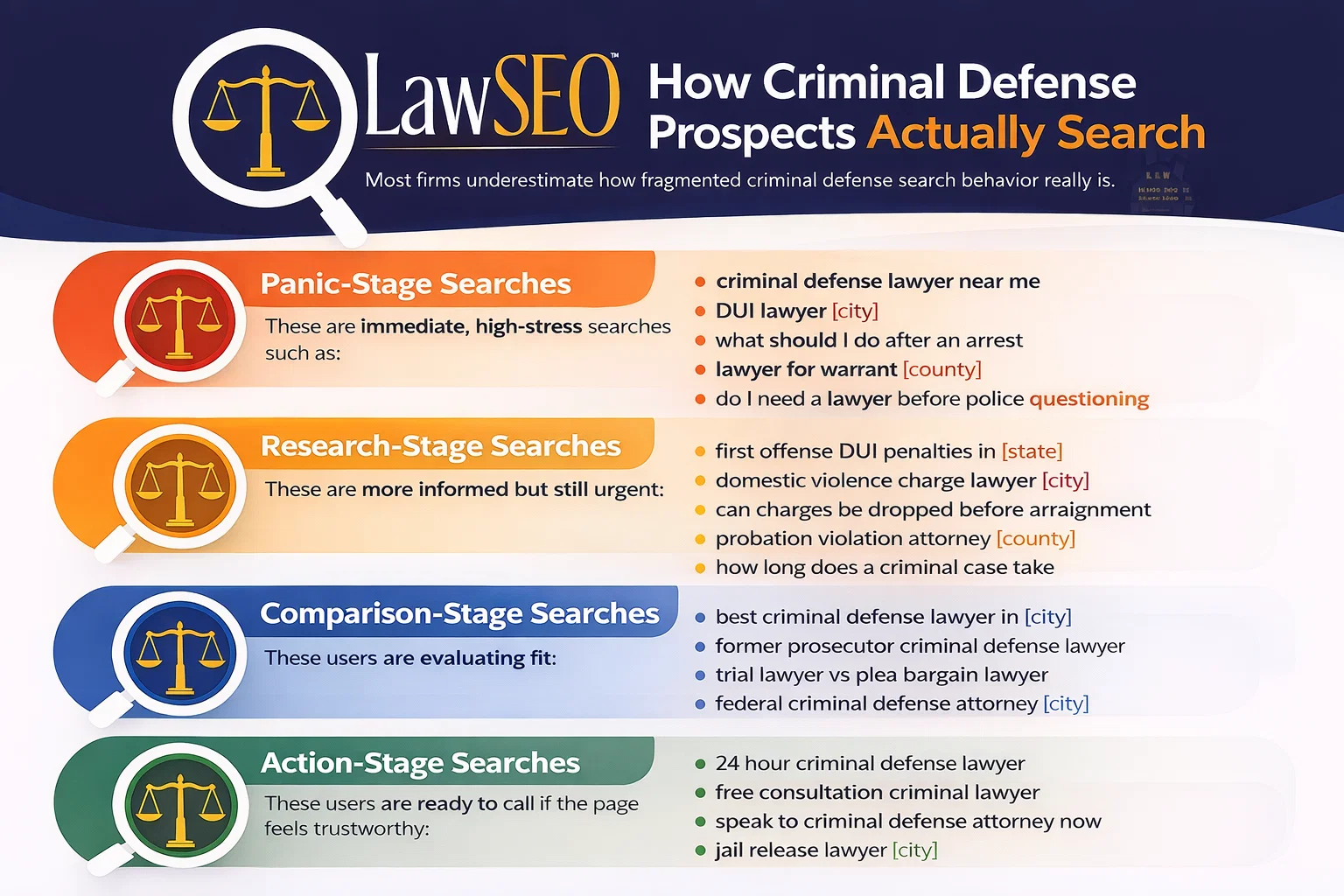
How Criminal Defense Prospects Actually Search
Most firms underestimate how fragmented criminal defense search behavior really is. People do not just search “criminal defense lawyer near me.” They search based on what just happened, what they fear is coming next, and how much they understand their situation.
Panic-stage searches
These are immediate, high-stress searches such as:
- criminal defense lawyer near me
- DUI lawyer [city]
- what should I do after an arrest
- lawyer for warrant [county]
- do I need a lawyer before police questioning
Research-stage searches
These are more informed but still urgent:
- first offense DUI penalties in [state]
- domestic violence charge lawyer [city]
- can charges be dropped before arraignment
- probation violation attorney [county]
- how long does a criminal case take
Comparison-stage searches
These users are evaluating fit:
- best criminal defense lawyer in [city]
- former prosecutor criminal defense lawyer
- trial lawyer vs plea bargain lawyer
- federal criminal defense attorney [city]
Action-stage searches
These users are ready to call if the page feels trustworthy:
- 24 hour criminal defense lawyer
- free consultation criminal lawyer
- speak to criminal defense attorney now
- jail release lawyer [city]
The better your site maps pages to those search states, the more likely you are to win the consultation. This is why criminal defense SEO is really about intent sequencing, not just keyword targeting.
Keyword Strategy for Criminal Defense Law Firms
A strong criminal defense campaign starts with keyword architecture, not keyword stuffing. You do not need one bloated page to rank for every charge. You need a deliberate set of pages that each match a clear type of search.
Core money pages
- criminal defense lawyer [city]
- criminal defense attorney [city]
- criminal lawyer [county]
- federal criminal defense lawyer [city]
- white collar crime lawyer [city]
Charge-specific pages
- DUI lawyer [city]
- drug crimes lawyer [city]
- domestic violence lawyer [city]
- assault lawyer [city]
- theft crimes lawyer [city]
- gun charges lawyer [city]
- juvenile defense lawyer [city]
Case-stage and process pages
- arraignment lawyer [city]
- bail hearing lawyer [city]
- probation violation lawyer [county]
- warrant lawyer [city]
- expungement lawyer [state]
Question-driven pages
- should I talk to police without a lawyer
- can a DUI be reduced
- what happens at arraignment
- how long does a felony case take
- can I clear a bench warrant
The firms that dominate criminal defense search usually go deeper on query mapping than their competitors. That means using long-tail keywords, reading the actual language prospects use, and building a smarter competitive analysis around charge type, geography, and intent.
Site Architecture That Builds Criminal Defense Authority
Criminal defense firms should think in clusters, not isolated pages. A strong structure usually starts with a core criminal defense page, then branches into charge pages, process pages, local pages, and educational pages.
Your core service hub
Your main criminal defense page should establish what the firm handles, where the firm practices, what types of cases it takes, and why a prospect should trust the firm enough to call. That page can rank for broad terms, but it should also act as the authority hub for the entire cluster.
Your charge clusters
Each major charge type deserves its own page. DUI, domestic violence, drug crimes, theft, assault, federal cases, and expungement should not be buried as subsections on one page. A better site structure gives each service area room to rank, convert, and support the broader criminal defense hub.
Your process and question pages
Criminal defense clients often search before they are ready to hire. Pages about arrests, questioning, arraignment, plea negotiations, diversion, probation violations, and record sealing build relevance around the exact moments that lead to consultations. Those pages are also ideal for on-page SEO and answer-first formatting.
Your local intent pages
Some firms make the mistake of cloning city pages. Better firms create genuinely useful pages tied to the counties, courthouses, and jurisdictions they actually serve. If you want more consultations from local search, your criminal defense site should also borrow from what works in high-converting landing pages, smart attorney website navigation, and click-worthy meta descriptions.
 Local SEO for Criminal Defense Lawyers
Criminal defense is intensely local. People usually want a lawyer who knows the courts, knows the prosecutors, knows the procedure, and can get involved immediately. That makes local search one of the highest-value channels for criminal defense firms.
Google’s own local ranking guidance still centers on relevance, distance, and prominence. Criminal defense firms that ignore those basics often wonder why they are invisible in maps and local results.
Relevance
Your site and profile need to make it obvious that you handle criminal defense matters in the places you actually serve. That is why local SEO for lawyers matters so much here.
Distance
You do not rank everywhere from one office. Criminal defense firms that try to manufacture reach with thin city pages usually create clutter, not authority.
Prominence
Prominence comes from reviews, citations, links, local references, media mentions, directory strength, and branded demand. For criminal defense firms, prominence is also shaped by how credible the attorney looks when a prospect lands on the site.
Your local SEO stack should include a fully built and verified profile, which is why pages like How to Claim Google Business Profile for Law Firms Easily, How to Improve Google Business Profile Rankings | Local SEO Guide 2025, and How to Rank in Google Maps for Law Firms Effectively are directly relevant to growth.
Directories matter too, especially in legal search where prospects compare firms across multiple websites before calling. Criminal defense firms should not ignore directory optimization. And if you want proof that better local visibility can translate into real growth, study this Local SEO Case Study.
Content Strategy That Wins Clicks and Consultations
Criminal defense content has to do more than rank. It has to calm, guide, and persuade people who may feel embarrassed, scared, or confused. That means the best criminal defense content is not just optimized. It is useful under pressure.
Answer the urgent question first
Do not make people scroll through a generic sales pitch before they know whether the page is relevant. If the page is about DUI defense, answer the first question quickly. If the page is about warrants, explain the immediate next step clearly. That is the practical side of content’s role in SEO.
Write pages around real criminal defense concerns
Strong content for this practice area often covers:
- what to do immediately after arrest
- whether to speak with police
- what happens at first appearance or arraignment
- possible penalties and defenses
- what a lawyer can do early in the case
- how local procedure affects strategy
This is also where legal content marketing stops being theory and becomes a case-intake tool. A strong criminal defense blog should support service pages, not wander off into disconnected traffic topics. That is why blog SEO basics matter.
Build for extraction, not just ranking
AI systems and featured results prefer pages that are easy to interpret. That means concise definitions, useful subheads, short paragraphs, direct answers, and scannable lists. Criminal defense firms should also think about voice search optimization, because many urgent searches happen conversationally and on mobile.
Add stronger trust assets than your competitors
Reviews are helpful, but criminal defense firms often need more than reviews to win trust. Add attorney bios, trial background, former prosecutor experience where relevant, court familiarity, bar memberships, media appearances, FAQ sections, and plain-English process explanations. Short video can help here too, which is why a law firm video marketing strategy can support both SEO and conversion.
Technical SEO, Structured Data, and Authority Still Matter
There is a lot of noise around AI search right now, but criminal defense firms still need a strong technical foundation. Slow pages, broken internal links, weak mobile layouts, and unclear hierarchy will quietly kill performance.
A serious campaign should include technical SEO for lawyers, strong structured data, and ongoing improvements to mobile-first indexing readiness, mobile SEO, website speed, and website accessibility.
Authority comes from relevance and trust
Criminal defense link building should focus on quality, not gimmicks. The best links usually come from local media, bar associations, criminal justice commentary, community organizations, podcasts, citations, and legitimate legal publications. A more durable approach looks like a real lawyer link building workflow, not random outreach to junk sites.
Ethics matter more in criminal defense
This practice area cannot afford reckless claims. Do not promise outcomes. Do not imply every case gets dismissed. Do not publish pages that sound like legal fan fiction. Strong criminal defense SEO should align with ethical SEO for attorneys, especially when the client is dealing with a life-altering legal problem.
Avoid shortcuts that create long-term risk
This is also where Google’s spam policies matter. Thin doorway pages, manipulative link schemes, and auto-generated junk may create the illusion of progress, but they are not a durable criminal defense SEO strategy.
Conversion Optimization for High-Urgency Criminal Defense Leads
Criminal defense SEO does not end when the user lands on the page. In many markets, the firm that responds first wins. That means the website has to behave like an intake asset, not just an information asset.
Make contact impossible to miss
The phone number should be obvious. The call to action should be clear. The page should not force a stressed prospect to hunt for the next step. This is where conversion rate optimization matters more than vanity traffic.
Design for mobile urgency
Many criminal defense leads come from mobile. Someone may be searching from outside a jail, from a car, from a police station parking lot, or late at night at home. The site needs fast load times, tap-friendly design, and minimal friction. A stronger law firm website feature set should support fast contact and clarity, not clutter.
Capture after-hours leads
Criminal defense demand does not follow business hours. Firms that use smart intake tools often protect more opportunities after hours. That is one reason AI chatbots for law firms can be useful, provided they are configured to support intake and escalation, not pretend to give legal advice.
Reduce hesitation on the page
Prospects want to know who they are contacting, what happens next, and whether the firm handles cases like theirs. Better criminal defense pages reduce fear with clear process explanations, strong positioning, and practical reassurance. This is where better design, message framing, and website optimization directly improve signed-case volume.
How to Measure Criminal Defense SEO the Right Way
The wrong way to evaluate criminal defense SEO is to obsess over raw traffic. The right way is to measure whether the site is attracting the right case types, from the right locations, with the right urgency.
Track visibility by page group
Measure how your broad criminal defense page performs, but also track charge pages, process pages, FAQ pages, and local pages separately.
Track leads by intent quality
A consultation from a high-value felony case and a call from someone outside your jurisdiction are not the same thing. Criminal defense firms should look deeper than total lead count.
Track signed cases, not just rankings
The best campaign reporting connects traffic and rankings to consultations, signed matters, and case mix. That is why analytics for law firm websites should be tied to a broader visibility checklist and business outcomes, not just screenshot reports.
 Common Criminal Defense SEO Mistakes
The firms that struggle with criminal defense SEO usually make one of the following mistakes:
- They try to rank one generic criminal defense page for every charge.
- They publish city pages with no real local value.
- They ignore charge-specific and process-specific search intent.
- They bury the phone number and slow down intake.
- They use AI to publish generic pages with no attorney perspective.
- They neglect technical SEO and mobile performance.
- They buy low-quality links or overuse weak directories.
If you want a shortcut for what not to do, start with 7 Critical SEO Mistakes Law Firms Must Avoid Today. Criminal defense is too competitive and too sensitive for lazy SEO.
Work With a Criminal Defense Lawyer SEO Agency That Understands Modern Search
The best criminal defense SEO agency does not just sell rankings. It builds a system that helps your firm get found in organic search, maps, AI search, and answer engines while also improving how the website converts under pressure.
That means combining modern legal SEO strategy, stronger local visibility, better site architecture, answer-first content, ethical authority building, and faster intake paths. It also means understanding the psychology of criminal defense clients, not just the mechanics of search engines.
If your current provider is still doing generic practice-area SEO, it is probably time to talk to a law firm SEO agency that understands where search is going. You can review why firms choose LawSEO, learn more about the team behind LawSEO, visit LawSEO, or contact LawSEO to discuss a strategy built for criminal defense growth.
Frequently Asked Questions
Is criminal defense lawyer SEO different from other legal SEO campaigns?
Yes. Criminal defense search is more urgent, more private, and more local than many other practice areas. The best campaigns are built around charge type, case stage, geography, and trust under pressure.
Do criminal defense firms need separate pages for each charge type?
Usually, yes. DUI, domestic violence, drug crimes, assault, theft, federal charges, probation violations, and expungement searches all carry different intent. Separate pages usually create more relevance and better conversion than one broad page.
Does AI search matter for criminal defense firms yet?
Yes. Criminal defense prospects increasingly encounter AI-generated summaries, answer boxes, and conversational search experiences before they choose a lawyer. That is why AEO, AIO, and GEO should now be part of the strategy, not an afterthought.
How important is local SEO for criminal defense lawyers?
It is critical. Criminal defense is tied to courts, counties, prosecutors, and local procedure. Strong local pages, a well-optimized Google Business Profile, accurate directory presence, and local authority signals can materially improve lead flow.
How long does criminal defense SEO take?
In competitive markets, you may see early movement in a few months, but durable results take longer. The firms that win usually commit to stronger content, better local signals, better architecture, better technical performance, and ongoing measurement.