
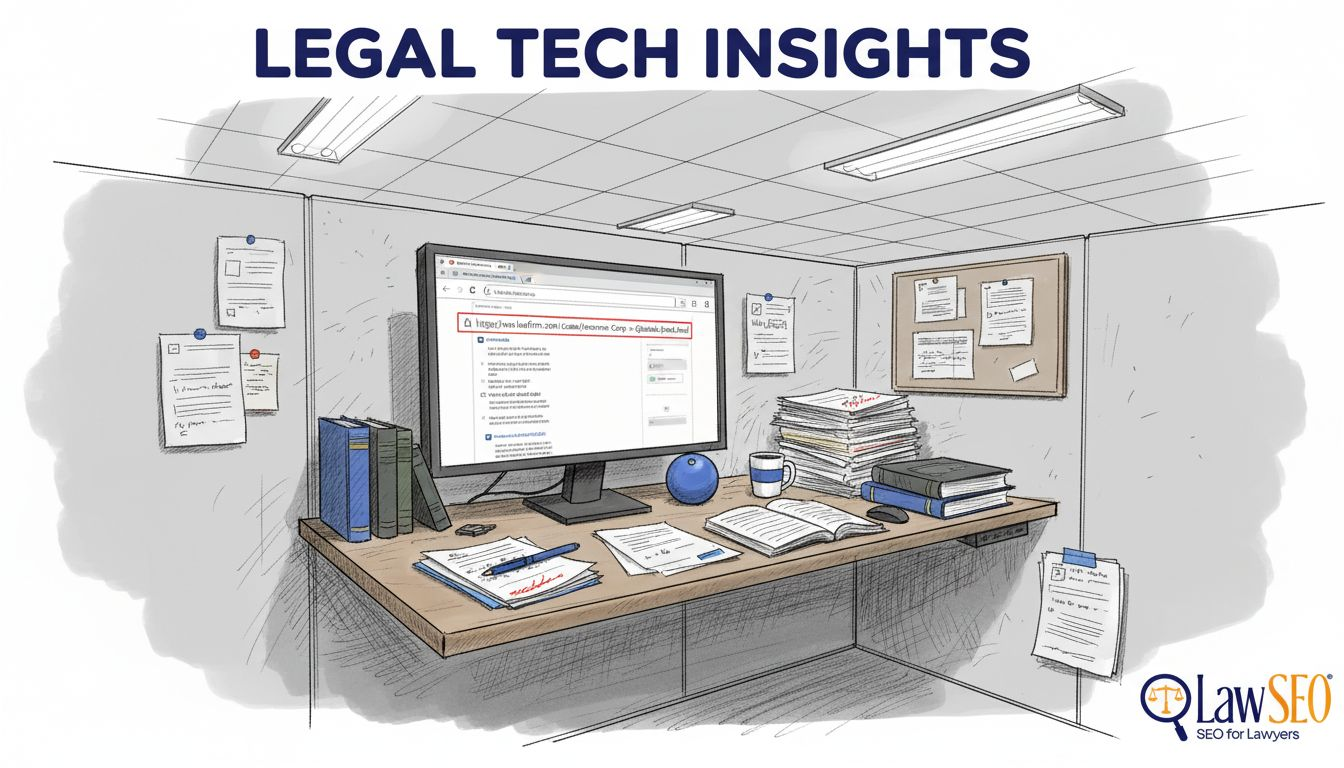
Many law firm marketers believe longer, complex URLs improve search rankings. The opposite is true. Cluttered URL paths confuse search engines, reduce user trust, and hurt both traditional SEO and AI discoverability in 2026. This guide reveals how clean, strategic URL structures drive measurable client acquisition and enhance your firm’s online visibility across all search platforms.
Table of Contents
- Foundations Of URL Structure For Law Firms
- Key Best Practices In URL Formatting
- Technical SEO And Schema Integration
- Common Misconceptions About URL Structure
- Local SEO And URL Structuring For Law Firms
- User Experience And URL Design
- Integrating URL Structure With SEO Strategy
- Learn Legal SEO Strategies To Maximize Client Leads
- FAQ
Key takeaways
| Point | Details |
|——-|———||
| Clean, descriptive URLs | Aligning URLs with practice areas and locations boosts SEO and AI discoverability for law firms. |
| Flat URL hierarchies | Shallow structures improve crawling efficiency and user trust more effectively than deep nested paths. |
| 301 redirects preserve equity | Implementing permanent redirects maintains SEO authority when changing URL structures. |
| Local SEO advantages | Tailored URL paths reflecting geographic focus significantly enhance local search rankings. |
| User experience impact | Clear URLs increase visitor confidence and conversion rates by building immediate trust. |
Foundations of URL structure for law firms
Law firms operate in a sensitive space where trust matters from the first click. Your website belongs to the Your Money Your Life category, demanding exceptional clarity and credibility in every element, including URL structure. Research shows up to 75% overlap between AI citations and traditional SEO rankings in fields like legal services, making clean URLs critical for both search paradigms.
Clean, hierarchical URLs enhance comprehension for AI systems parsing your content and human visitors evaluating your firm’s professionalism. When a potential client sees a URL like example.com/personal-injury/car-accidents/atlanta versus example.com/page?id=4729&cat=personal, they immediately understand your specialization and location. Search engines process this clarity too, strengthening your topical relevance.
Your URL structure should reflect site architecture logically:
- Practice areas appear as primary folders in the path
- Geographic locations integrate naturally when relevant for local firms
- Specific case types or services nest under broader practice areas
- Each level adds meaningful context without excessive depth
URL structure forms one layer of a comprehensive SEO framework intersecting with content quality, backlink profiles, and technical optimization factors. You cannot rely on URLs alone, but poor structure undermines every other effort you make. Think of URLs as the foundation: invisible when done right, but catastrophic when flawed.
Key best practices in URL formatting
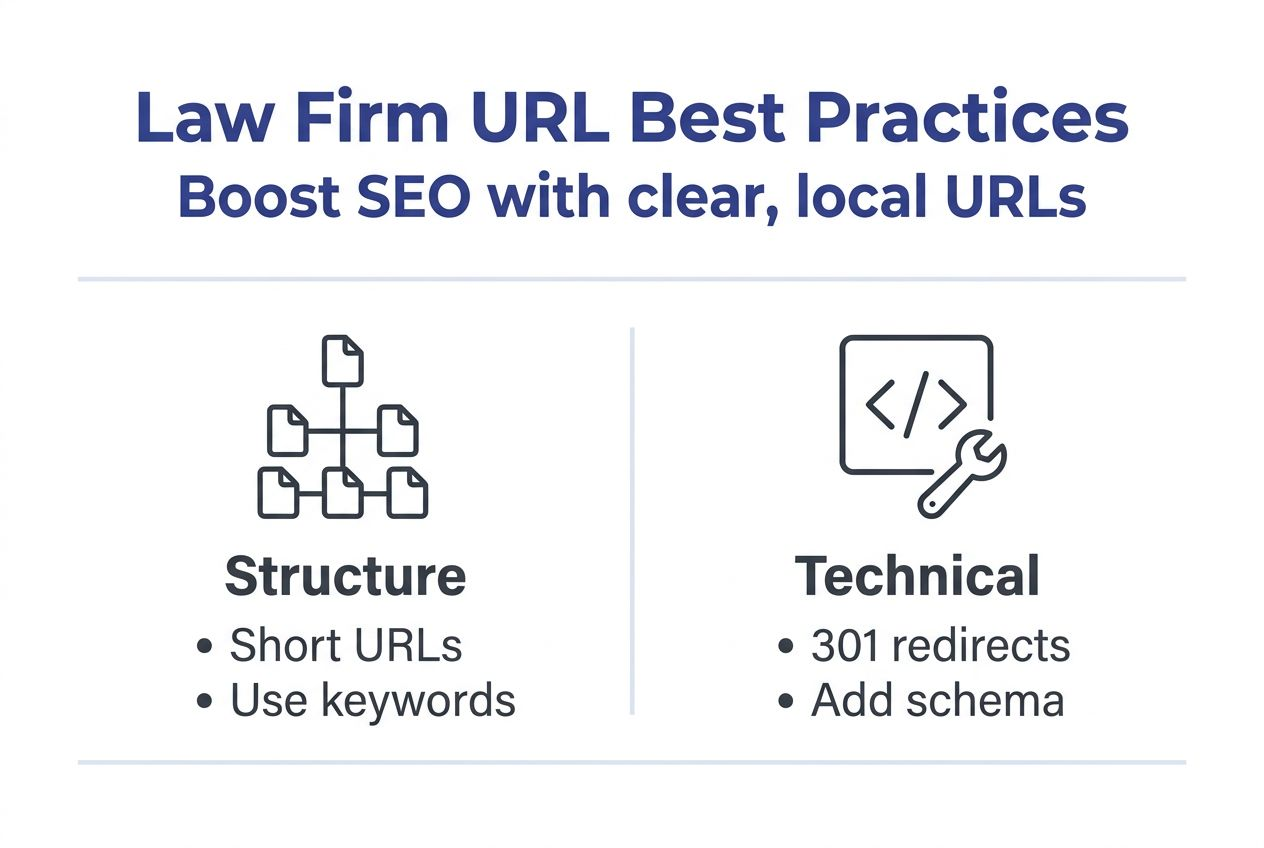
Incorporate primary practice area and geographic keywords naturally into your URLs without forcing repetition. A URL like /divorce-attorney-boston/ immediately signals relevance to both search algorithms and visitors seeking divorce representation in Boston. This strategic placement strengthens your page’s authority for those specific search terms.
Maintain shallow URL depth, ideally reaching any page within three to four clicks from your homepage. Deep hierarchies like /services/legal/family/divorce/contested/high-net-worth/ dilute link equity and confuse crawlers about your site’s true priorities. Flatten your structure by eliminating unnecessary categories.
Avoid keyword stuffing or excessively long paths that trigger spam signals. URLs exceeding 100 characters often indicate over optimization or poor planning. Keep paths descriptive yet concise, focusing on user value rather than search engine manipulation.
Use hyphens to separate words in your URLs:
- Hyphens make URLs readable: /car-accident-lawyer/ versus /caraccidentlawyer/
- Avoid underscores, which search engines sometimes ignore as word separators
- Never use spaces, which convert to ugly encoded characters like %20
- Skip special characters entirely unless they are part of necessary parameters
Ensure URLs are readable, predictable, and descriptive for humans first. If your team cannot guess a page’s content from its URL alone, visitors and AI systems will struggle too. Consistency across your site builds pattern recognition, helping users navigate confidently.
Pro Tip: Audit your URLs quarterly for complexity creep. Marketing campaigns and content additions gradually introduce unnecessary parameters and deep paths. Prune these regularly to maintain a clean, flat structure that preserves crawl efficiency and user experience.
Technical SEO and schema integration
Add appropriate schema markup on pages to improve how AI and search engines interpret your content. Implementing LegalService and Attorney schema types provides structured data that explicitly defines your practice areas, locations, and credentials. This markup works synergistically with clear URLs to maximize discoverability.
Use permanent 301 redirects immediately when changing URLs to preserve SEO authority and ranking positions. Every established URL accumulates link equity over time through backlinks and search history. A 301 redirect transfers this value to your new URL, preventing catastrophic ranking drops. Temporary 302 redirects do not pass authority and should never be used for permanent URL changes.
Ensure your site runs on HTTPS and delivers fast mobile experiences. These technical factors complement URL structure by meeting baseline search engine requirements. Google treats security and mobile optimization as ranking signals, making them non-negotiable for competitive law firm SEO in 2026.
Monitor crawl errors and broken links vigilantly after URL changes:
- Use Google Search Console to identify 404 errors appearing after redirects
- Check that old URLs properly redirect to appropriate new destinations
- Verify internal links update to point directly to new URLs rather than relying on redirects
- Test critical conversion paths to ensure no steps break during URL migrations
Coordinating URL updates with schema implementation and redirect deployment creates seamless transitions that maintain your search visibility. Plan these changes during low-traffic periods and monitor analytics closely for two weeks afterward to catch issues quickly.
Common misconceptions about URL structure
Long, complex URLs do not improve SEO despite outdated advice suggesting keyword-rich paths boost rankings. Modern search algorithms penalize over-optimization and prioritize user experience. Cluttered URLs dilute link equity across too many path segments and confuse both search crawlers and visitors about page importance.
Failing to implement 301 redirects when changing URLs causes significant ranking drops and authority loss. Some marketers mistakenly believe search engines will eventually discover new URLs and restore rankings naturally. This never happens. Without proper redirects, you abandon all the trust and link value your old URLs accumulated, forcing you to rebuild from zero.
URL structure is a foundational SEO element alongside content quality and backlink profiles, not an optional cosmetic detail. Many law firms invest heavily in content creation while ignoring URL architecture, undermining their own efforts. Your content’s quality cannot overcome a confusing, poorly structured URL system that prevents proper indexing and user navigation.
Ignoring URL simplicity undermines both AI discoverability and human visitor trust:
- AI systems struggle to parse complex parameter-heavy URLs accurately
- Visitors perceive messy URLs as unprofessional or potentially insecure
- Sharing and linking becomes difficult when URLs are unreadable
- Analytics tracking grows complicated with dynamic parameters
Proper URL structure supports sustainable SEO growth and consistent client acquisition by building a foundation that scales with your content. Investing time upfront to plan logical, clean URL hierarchies prevents costly migrations later and ensures every new page you publish benefits from strong structural signals.
Local SEO and URL structuring for law firms
One city, one firm exclusivity models with URL structures reflecting city and practice area dramatically improve local search rankings. URLs like /locations/miami/personal-injury/slip-and-fall/ immediately signal geographic and topical relevance to search algorithms evaluating local intent queries.
Customized local URLs function as competitive advantages against generic national firms using parameter-based location targeting. When someone searches “divorce lawyer Chicago,” your dedicated /divorce-lawyer-chicago/ URL outperforms a competitor’s /lawyers/?location=chicago&practice=divorce by demonstrating permanent geographic commitment rather than dynamic filtering.
| URL Approach | Local SEO Effectiveness | User Trust | Maintenance Complexity |
|---|---|---|---|
| Dedicated local paths (/city/practice/) | Excellent, strong relevance signals | High, clear commitment | Low, static structure |
| Parameter-based (?location=city) | Poor, dynamic and temporary | Low, appears automated | High, database dependent |
| Deep nested paths (/locations/state/city/practice/sub/) | Moderate, diluted authority | Medium, overly complex | High, difficult to scale |
Local URL optimization supports measurable lead growth by capturing searchers at the moment they express geographic intent. Your URL structure should mirror how potential clients think about legal services:
- Primary geographic identifier appears early in the path
- Practice area follows location to maintain keyword proximity
- Specific service pages nest under practice areas when needed
- Avoid excessive depth even for granular location targeting
Compare how local SEO tools track your URL structure’s performance across different geographic markets. Tools reveal which location-specific URLs drive qualified leads versus those generating traffic without conversions, helping you refine your approach.
User experience and URL design
Visitors decide within eight seconds if your site is trustworthy, with URL clarity playing a significant role in that snap judgment. A clean URL matching the page title and navigation breadcrumbs reinforces professionalism and reduces cognitive friction. Mismatched or cryptic URLs trigger doubt about your firm’s legitimacy.
Clear URLs aligned with on-page content enable faster user understanding and reduce bounce rates. When someone clicks a search result for “estate planning attorney Denver” and lands on /estate-planning/denver/, they immediately confirm they reached the right destination. This alignment eliminates the confusion that drives visitors back to search results.
URLs reflecting the user’s search intent and geographic context increase perceived relevance. Your URL communicates specialization before visitors even finish loading your page, setting positive expectations that your content must then fulfill.
Best UX practices for law firm URLs include:
- Keep total URL length under 75 characters when possible for easy reading and sharing
- Ensure URLs predict page content accurately so visitors know what to expect
- Maintain consistency between URL structure and visible navigation menus
- Use the same terminology in URLs that appears in your page titles and headings
- Avoid dates or version numbers unless content is explicitly time-bound
Pro Tip: Align your URL structure with visible navigation menus and page titles to reinforce trust signals throughout the user journey. When every element of your site speaks the same language, visitors feel confident they are dealing with an organized, professional operation that values their time.
Integrating URL structure with SEO strategy
Integrate keyword research to guide URL naming aligned with practice areas and actual client search behavior. Your URLs should reflect the terms potential clients use, not legal jargon only attorneys understand. Research reveals the difference between “DUI lawyer” and “drunk driving attorney” in search volume, informing which terminology your URLs should prioritize.
Coordinate URL structure with content hierarchy and internal linking to strengthen topical authority. When related practice area pages link to each other using consistent URL patterns, search engines recognize your depth of coverage. This interconnected structure signals expertise more effectively than isolated pages scattered across unrelated URL paths.
Use technical SEO tools to monitor crawl budget, redirect chains, and indexing tied to URL health. Search engines allocate limited resources to crawling your site. Complex URL structures with multiple redirect hops waste this budget, preventing your newest content from being discovered quickly.
Link URL design with ethical SEO practices to build long-term trust and sustainable client acquisition. Clean URLs that accurately represent page content demonstrate transparency, avoiding the manipulative tactics that risk penalties. This approach aligns with legal marketing ethics and search engine guidelines simultaneously.
Practical steps to align URL structure with overall SEO strategy for law firms:
- Audit existing URLs to identify overly complex paths, broken links, and inconsistent naming conventions across your site.
- Map practice areas and locations to a logical hierarchy on paper before implementing any URL changes in your CMS.
- Implement 301 redirects from old URLs to new ones in batches, monitoring traffic and rankings after each batch completes.
- Update internal links sitewide to point directly to new URLs rather than relying on redirect chains that slow page loads.
- Add schema markup to pages with newly optimized URLs to maximize their visibility in both traditional and AI-powered search.
- Monitor performance weekly for six months, tracking how URL changes affect organic traffic, rankings, and conversion rates.
Encourage ongoing analysis of URL performance using search console data and analytics. URLs that generate clicks in search results but high bounce rates on your site indicate a mismatch between URL promises and content delivery. Refine these to improve both user satisfaction and search engine trust.
Learn legal SEO strategies to maximize client leads
Explore advanced legal SEO strategies that complement optimized URL structures to generate more qualified client leads for your practice. Our expertise extends beyond URLs to encompass content optimization, link building, and AI search preparation that work together systematically.
Leverage ethical SEO practices tailored for attorneys to build lasting online trust while maintaining bar association compliance. We understand the unique constraints legal marketing faces and design strategies that strengthen your visibility without crossing ethical boundaries.
Avail professional SEO audits that identify URL and technical SEO opportunities specifically for your law firm’s website. Our comprehensive analysis reveals hidden issues preventing your current structure from achieving its full ranking potential and provides actionable remediation steps.
FAQ
What is the best URL structure for a law firm website?
The best URLs are concise, descriptive, and reflect your main practice areas and locations while maintaining shallow site depth for optimal SEO and user clarity. Keep paths under four levels deep, use hyphens to separate words, and avoid complex parameters. URLs should be readable and predictable, allowing visitors to understand page content before clicking.
How do 301 redirects affect SEO when changing URLs?
301 redirects pass SEO value from old URLs to new ones, preventing the ranking drops and traffic loss that occur with broken links. Implementing permanent redirects immediately when changing URLs preserves the authority your pages accumulated through backlinks and search history. Failing to redirect properly forces you to rebuild rankings from scratch, often taking months to recover lost visibility.
Can URL structure impact local SEO for law firms?
Including city names and practice areas in URLs dramatically improves relevance for local searches by sending strong geographic signals to search engines. Tailored local URLs like /divorce-attorney-boston/ give you competitive advantages over firms using generic parameter-based location targeting. This dedicated approach demonstrates permanent market commitment rather than temporary filtering.
Why is URL simplicity important for AI-powered search?
Simple URLs are easier for AI systems to parse and understand, increasing your chances of accurate citations in AI-generated responses. Complex parameter-heavy URLs may reduce AI comprehension because the systems struggle to extract clear meaning from convoluted paths. Clean URLs help AI confidently recommend your firm when answering user queries about legal services.